Blog

When Seoul Met Mumbai: The Complete Cultural Revolution Story That Rewrote Marketing’s Future

From the monsoon-soaked streets of Mumbai to the cultural laboratories of YouTube’s comments section, one Tuesday morning revelation changed everything I thought I knew about marketing. When Crocs paired Bollywood’s Siddhant Chaturvedi with Korean actress Chae Soobin in their monsoon campaign, they didn’t just create an advertisement—they wrote the future playbook for cross-cultural commerce. This isn’t the story of another trending campaign; it’s the complete cultural cartography of how Korean food culture, K-drama aesthetics, and Indian Gen Z sophistication converged to create the most sophisticated audience response to cross-cultural marketing I’ve witnessed in my career. Through 445 YouTube comments, ₹500 crore in Korean content spending, and a 3,150% explosion in Korean food imports, the data reveals what happens when brands stop appropriating trending culture and start celebrating authentic cultural synthesis. For digital marketers willing to embrace this complexity, the opportunities are limitless—and the responsibility is enormous.

When Seoul Met Mumbai: The Complete Cultural Revolution Story That Rewrote Marketing’s Future Read More »

Abstract illustration of data streams converging into a single, unified direction, symbolising efficient data processing and optimisation.

The Curious Case of MUVERA: How Google’s Algorithmic Wizardry is Quietly Revolutionising Search

Tucked away in Google’s research labs, MUVERA is quietly rewriting the rules of search. By transforming multi-vector retrieval into a single-vector problem, it promises both speed and nuance—ushering in a new era where meaning, not just keywords, determines what rises to the top. Yet beneath the technical marvel lies a set of trade-offs and challenges that will reshape SEO, digital marketing, and the very architecture of information on the web.

The Curious Case of MUVERA: How Google’s Algorithmic Wizardry is Quietly Revolutionising Search Read More »

Bolt AI development interface showing a dark-themed code editor with the prompt 'What do you want to build?' and a modal dialog for choosing a Figma frame to convert into a web application

Your Digital Jeeves Has Arrived: How AI is Revolutionising Product Development and Making Everyone Rather More Capable

The product development landscape of 2025 bears a striking resemblance to the relationship between Bertie Wooster and his incomparable valet, Jeeves. Rather like how Jeeves anticipates needs before they’re articulated, AI is transforming product development with diplomatic precision—62% of UX designers already use AI to supercharge their workflows whilst 87% of developers now use AI-assisted tools in their daily work. These professionals aren’t being replaced; they’re being elevated. Replit Agent transforms weeks of coding into minutes, generating full-stack applications from single conversational prompts, whilst platforms like Uizard turn sketches into responsive designs within seconds. It’s the perfect embodiment of the Jeevesian ideal: supremely capable assistance that never makes one feel diminished, democratising software creation for everyone from Sarah in accounting to seasoned engineers.

Your Digital Jeeves Has Arrived: How AI is Revolutionising Product Development and Making Everyone Rather More Capable Read More »

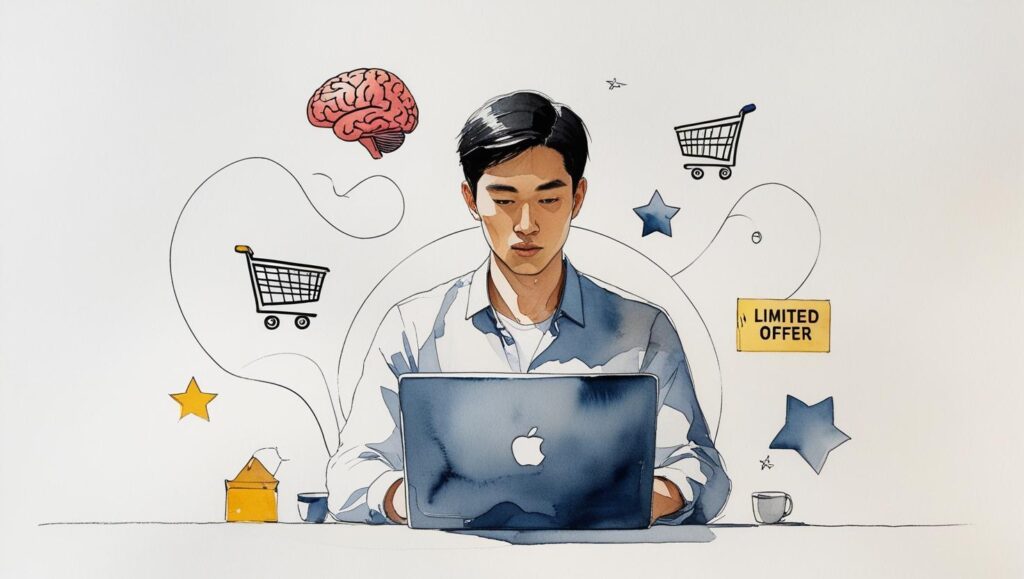
Watercolour illustration of a person at a laptop, surrounded by icons including a brain, shopping carts, stars, and a "limited offer" sign, evoking themes of digital marketing and consumer psychology.

The mind games behind your shopping cart

It begins, as so many things do, with a confession. To admit that marketing is about influencing human behaviour—Holly Pound’s phrase, not mine—is, in certain circles, rather like declaring a secret fondness for cheesy rom-coms and obscure jazz. Yet this is the world we inhabit: a society in which the art of persuasion has become less the province of snake-oil salesmen and more the daily occupation of well-heeled professionals with PowerPoint decks, fMRI scans, and a penchant for the Oxford comma. The modern marketer, a curious hybrid of amateur neuroscientist and corporate dramaturge, now perambulates the corridors of commerce with the quiet confidence of someone who knows which neural buttons to press.

The mind games behind your shopping cart Read More »

Cannes Lions International Festival of Creativity logo with iconic lion emblem overlooking the Mediterranean coastline from Cannes, featuring two blue director's chairs on a terrace with mountains in the background

The Côte d’Azur’s Annual Parade of Creative Peacocks: Cannes Lions 2025 Decoded

The Côte d’Azur’s annual parade of creative peacocks concluded last week with the 72nd Cannes Lions International Festival of Creativity, where 26,900 submissions from 96 countries vied for recognition in advertising’s most prestigious competition. Amidst the predictable pageantry and ritual networking, some genuinely transformative work emerged—most notably AXA’s “Three Words” campaign, which won the coveted Titanium Grand Prix by simply adding “and domestic violence” to French home insurance contracts, providing victims with emergency support services.

WPP claimed Creative Company of the Year for the second consecutive year with an impressive haul of 168 Lions, whilst DDB Worldwide reclaimed Network of the Year honours. The festival showcased artificial intelligence as both creative collaborator and industry disruptor, with campaigns increasingly focusing on authentic purpose over polished artifice. India delivered its strongest performance in years with 32 Lions total, led by FCB India’s “Lucky Yatra” campaign for Indian Railways.

Perhaps most tellingly, the rebranding of “Social & Influencer Lions” to “Social & Creator Lions” reflected the industry’s belated recognition that creators might actually be strategic partners rather than mere content amplifiers—progress, of sorts, in an industry perpetually caught between commercial imperatives and social responsibility.

The Côte d’Azur’s Annual Parade of Creative Peacocks: Cannes Lions 2025 Decoded Read More »

Playful hand-drawn doodles of quirky animals, monsters, and a smiling child, all with exaggerated expressions and whimsical poses on a white background.

The Unbearable Lightness of Being Funny: How Humour Conquered Cannes and Our Collective Ennui

In a world that often takes itself far too seriously, a touch of whimsy can be revolutionary. Whether it’s a grinning monster or a dancing dog, these playful characters remind us that laughter and imagination are not just child’s play—they’re essential ingredients for creativity, connection, and even the most sophisticated storytelling.

The Unbearable Lightness of Being Funny: How Humour Conquered Cannes and Our Collective Ennui Read More »

Illustration of a woman with long dark hair wearing a red jacket and holding a camera, standing in front of a glowing crescent moon and a starry olive-green sky.

The Art of Claiming Space: A Negotiation Playbook for Women in Creative Industries

Somewhere between my third cup of chai and my sixth “Sorry to interrupt, but—” of the day, it hit me: the creative industry’s unwritten rules were never written with women like me in mind. We’re told to lean in, but no one mentions that the table is already crowded—or that the chairs for women are suspiciously wobbly. As a mid-career woman in India’s creative world, I’ve spent years perfecting the art of collaboration, only to discover that the very skills that make me indispensable in a brainstorm can turn into liabilities when it’s time to negotiate my own worth. The real art, I’m learning, isn’t just in ideation or execution—it’s in claiming space, unapologetically, at a table that was never built for us in the first place.

The Art of Claiming Space: A Negotiation Playbook for Women in Creative Industries Read More »

Young woman holding a reusable water bottle and smartphone, representing Gen Z consumer awareness.

Can We Really Change the World—by Shopping? (Yes, Seriously.)

We’ve long known that money talks—but lately, it’s been screaming through tote bags, biodegradable shampoo, and ethically sourced coffee beans. In a world where climate anxiety and corporate distrust are trending harder than avocado toast, our shopping carts have become unlikely vessels of political will. From Gen Z Instagram overhauls to EV showrooms with no salespeople in sight, consumer demand is rewriting the rules of capitalism—one “sustainably made” label at a time. But can your oat-milk latte and Pin-interest worthy compost bin really change the world? Or is conscious consumerism just capitalism in a recycled wrapper?

Can We Really Change the World—by Shopping? (Yes, Seriously.) Read More »

Scroll to Top