
On 8 January 2026, Google released an eight-minute film about Recursion Pharmaceuticals, a Utah-based company using artificial intelligence to discover new medicines. The piece—part of Google’s Webby Award-winning Where the Internet Lives series—follows co-founder Chris Gibson on his journey from aspiring surgeon to biotech entrepreneur. It opens with stark statistics about cancer mortality, features a researcher sharing his teenage cancer diagnosis, and culminates in the promise that AI will help us “not have to say goodbye to those loved ones early.”
It’s moving. It’s beautifully shot. It’s also promotional content masquerading as documentary journalism.
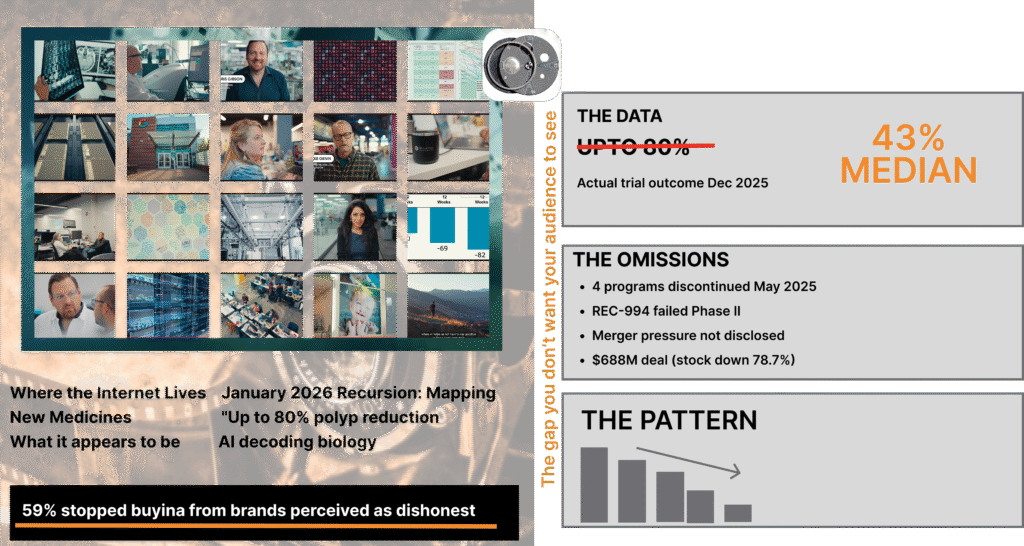
The film omits that Recursion discontinued four pipeline programmes just eight months earlier, including one whose “promising trends” collapsed in long-term trials. Cherry-picking the most dramatic data point—”up to 80%” polyp reduction—obscures the actual median result of 43%. Neither does the documentary mention that both Google and Recursion benefit materially from this narrative: Google showcases its cloud infrastructure whilst Recursion positions itself amidst merger pressures and declining valuations.
This matters because 2026 is the year marketers can no longer afford the gap between what they call “storytelling” and what their audiences recognise as propaganda.
The Trust Deficit Your Brand Is Already Living In
The numbers are brutal. 59% of consumers have stopped buying from brands they perceived as dishonest or misleading in advertising. That’s not a niche of sceptics—it’s the majority.
Advertising credibility has collapsed to the point where paid promotion now functions as a red flag rather than a trust signal. Consumers understand that advertising intensity sometimes correlates inversely with product quality, because inferior offerings require more promotion to compete.
Why 2026 is different
Transparency and authenticity are non-negotiable for brands hoping to survive, let alone thrive. Gen Z—now wielding significant purchasing power—expects radical transparency, responsible data use, and seamless digital experiences. They can spot a manufactured viral moment from a mile away. Influencers reading scripts? Spotted. Marketing claims that don’t survive scrutiny? Called out immediately.
“2026 is the year marketers can no longer afford the gap between what they call ‘storytelling’ and what their audiences recognise as propaganda.”
Trust is the new currency in data-driven marketing, which means every piece of content you produce either deposits into or withdraws from your credibility account. Branded documentaries, positioned as educational storytelling, make particularly large withdrawals when audiences discover what’s been left out.
What the Documentary Format Lets You Get Away With (Until It Doesn’t)
Here’s what makes branded documentaries so seductive for marketers: they bypass the constraints that govern traditional advertising. Pharmaceutical companies face rigorous FDA regulations requiring that promotional materials be “truthful and non-misleading,” include adequate risk information, and undergo cross-functional review.
The regulatory grey zone
A corporate documentary featuring a pharma company—positioned as education about technology rather than promotion of a specific drug—operates outside these constraints. Built-in authority comes with the format. Long-form video signals depth and seriousness. The documentary aesthetic—intimate interviews, ambient sound, sweeping visuals—triggers associations with journalistic integrity.
Viewers bring expectations shaped by legitimate documentaries that investigate, challenge, and contextualise. When a branded film adopts these conventions without adopting journalistic standards, it exploits that trust.
How the hype cascades
Research shows how this exploitation multiplies. When press releases contain exaggeration, 72% of resulting news stories will be hyped as well. A separate analysis found that 40% of press releases contain more direct advice than the original studies they reference, frequently omitting study limitations, funding sources, and conflicts of interest.
Branded documentaries amplify this dynamic: they function as extended press releases with cinematic production values and emotional manipulation that text cannot achieve.
“Branded documentaries function as extended press releases with cinematic production values and emotional manipulation that text cannot achieve.”
A pattern emerges across corporate AI marketing. When OpenAI launched its healthcare campaign, it faced a similar paradox: how do you market transformative technology whilst acknowledging genuine safety concerns? Too often, the solution is selective storytelling that emphasises promise whilst downplaying risk.
The hero’s journey as corporate weapon
The Recursion film demonstrates these mechanics precisely. Communication scholars identify the “hero’s journey” framework—a narrative structure deliberately used in corporate change management to reduce resistance and generate buy-in. Gibson’s transformation from frustrated researcher to entrepreneurial saviour follows Joseph Campbell’s archetypal pattern: call to adventure, trials and transformation, return with knowledge that can save others.
Primal storytelling makes this structure work, but applying it to corporate promotion without disclosure transforms narrative power into manipulation.
What the film shows versus what it hides
Consider what the film foregrounds. Recursion’s high-throughput phenomics lab conducts “millions of experiments every week.” Partnership with Nvidia built BioHive-2, reportedly the fastest supercomputer owned by a pharmaceutical company. AI emerges as the solution to the 90% drug failure rate plaguing the industry.
What doesn’t get mentioned: AI-discovered drugs show identical Phase II success rates to traditionally discovered drugs (around 40%), despite superior Phase I results. 80% of AI projects fail—twice the rate of other IT projects.
The $688 million merger with Exscientia occurred because Exscientia’s stock had fallen 78.7% from its 2021 high, driven by financial pressure rather than strategic vision. Within months of the merger closing, Recursion halted development on four programmes, including REC-994 for cerebral cavernous malformation, whose long-term extension data showed outcomes “similar to what we might expect without any treatment.”
These aren’t minor details. They’re the difference between a breakthrough narrative and an incremental-progress-with-significant-setbacks reality.
When Storytelling Becomes StoryLying: The B2B Trap
B2B marketers face particular temptation here because the data on storytelling effectiveness is compelling. Research shows that 50% of B2B consumers are more inclined to engage with content marketing through storytelling, and it increases purchases by 71%. Nearly 70% of B2B buyers will pay premium prices if they connect emotionally with the business.
When authentic storytelling works
Investment flows into branded documentaries, customer journey films, and founder story content based on these numbers. Google’s own campaigns—like the DigiKavach initiative—demonstrate how cultural intelligence and authentic storytelling can work when executed with integrity.
Adobe’s “Click Baby Click” campaign used humour and anxiety to showcase its Marketing Cloud, increasing platform usage by 25%. IBM’s “A Boy and His Atom”—a short film composed using carbon monoxide atoms viewed through a microscope—made national headlines whilst demonstrating scientific capability. Success arrived because these campaigns showcased genuine capability through creative formats without concealing limitations or manipulating emotions through omission.
The difference between effectiveness and ethics
Effectiveness and ethics aren’t the same thing. Whether branded documentaries work—they often do, at least initially—isn’t the question. What matters is whether they build trust or borrow it.
“The question isn’t whether branded documentaries work. It’s whether they build trust or borrow it.”
Consequences of getting this wrong have become severe. When SoulCycle’s founder held a fundraiser for a controversial political figure, the backlash revealed expectations customers held: “We joined this gym because it shared our values. We believed we were supporting a company that was inclusive, accepting, and celebrating of our diversity.”
Fury wasn’t merely about politics—it was about perceived betrayal. Storytelling had positioned the brand as values-aligned; when actions contradicted that story, trust evaporated.
When backlash destroys brands overnight
Jaguar’s 2024 rebrand prompted such swift and personal attacks on its US CMO—who wasn’t directly involved in creating the content—that she described it as “outrageous how cruel and personal people were.” H&M’s “monkey sweatshirt” controversy saw celebrities terminate contracts and the brand become shorthand for racial insensitivity.
Meta’s content moderation rollback in January 2025 saw hate speech targeting marginalised communities jump over 75%, triggering #DeleteMeta campaigns and connecting policy changes to real-world violence.
A consistent pattern emerges: values misalignment combined with perceived deception equals trust destruction. In 2026’s transparency-obsessed environment, omission is deception. Audiences no longer distinguish between lies of commission and lies of omission when the effect is the same: they made decisions based on incomplete information that benefited the brand at their expense.
The ROI Illusion: What You’re Actually Measuring
Branded documentary advocates point to metrics: engagement rates, social shares, sentiment analysis, brand affinity scores. These aren’t meaningless—ROI for branded films often manifests as increased brand affinity, stronger community engagement, and higher lifetime customer value rather than immediate conversions. Investment pays off over time through deeper relationships and premium pricing power.
The metrics that mislead
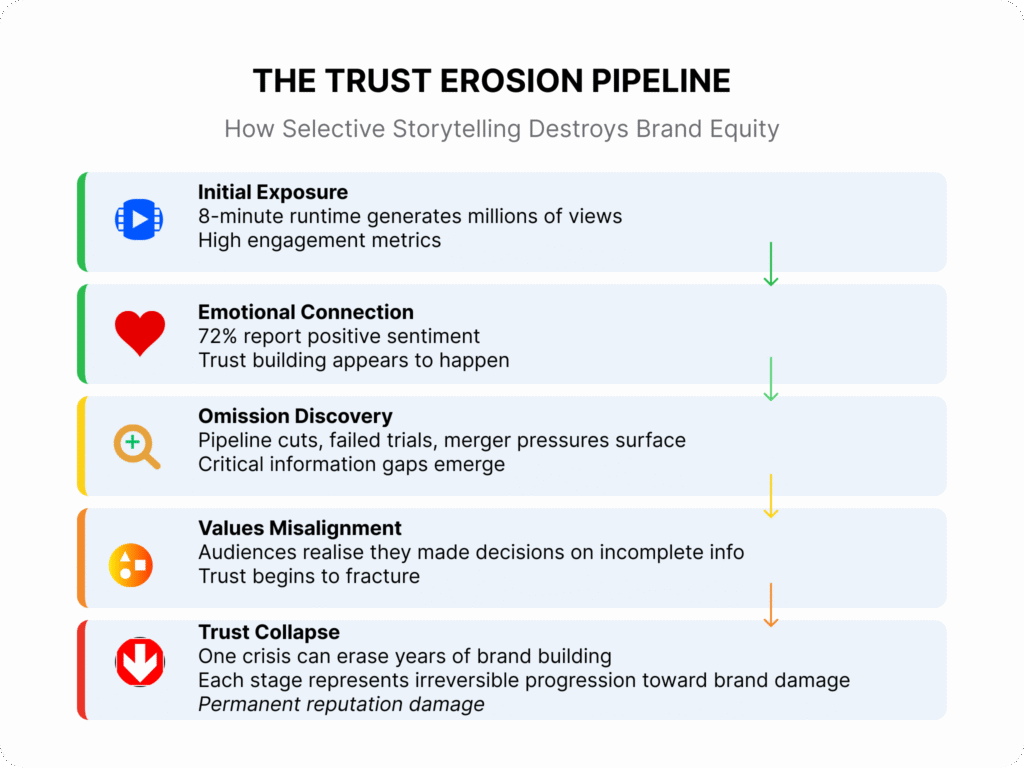
Attention and emotional response aren’t trust. Engineering engagement through manipulation is entirely possible. A documentary that conceals setbacks whilst amplifying successes will generate positive sentiment among viewers who don’t know what’s been hidden. What happens when they find out? That’s the question that matters.
Measuring documentary ROI compounds the problem. Video campaigns evoke emotions and build brand identity in ways that elude traditional ROI calculations. Attribution becomes complex—did the documentary drive the conversion, or was it one touchpoint in a multi-touch journey? How do you quantify brand equity erosion when omissions surface months later?
When one mistake erases years of work
What we do know: a single piece of bad content can destroy years of careful brand building. United Airlines’ “re-accommodating passengers” incident—and CEO Oscar Munoz’s initial victim-blaming response—became shorthand for corporate arrogance. Cold language and disconnect made the airline look cruel. Stock prices dropped. Public anger intensified. Eventual apology and policy changes couldn’t undo the damage.
“In 2026’s transparency-obsessed environment, omission is deception.”
The real ROI question for branded documentaries isn’t what they generate in year one. It’s whether they’re building assets or liabilities.
What Marketers Should Actually Do
The solution isn’t to abandon storytelling. Reconciling storytelling with integrity is what’s required.
Embrace radical transparency
If Google and Recursion both benefit from the documentary’s narrative—Google showcasing cloud infrastructure, Recursion positioning its platform—disclose it. When patient stories feature employees, state the relationship and any compensation. Highlighting a 43% median result? Don’t frame it as “up to 80%” to manufacture drama.
Present the achievement in context: a rare disease with no approved treatments now has a candidate showing meaningful benefit in early trials, with FDA meetings planned to define a registration pathway. That’s still compelling. It’s also honest.
Redefine what storytelling means
The most powerful brand stories aren’t those that ignore challenges—they’re those that grapple with them authentically. When Bobbie, a baby formula company, faced supply chain disruptions, they closed their store for seven months and protected inventory for existing subscribers. Parents themselves, the team made decisions that led to the “Bobbie Peace of Mind” promise—a competitive differentiator. Pretending scarcity wasn’t happening? They refused. Instead, they told the story of how they responded.
Amazon’s “Five Star Theater” campaign offers another model: the brand amplified genuine, unfiltered customer reviews—complete with absurdity and specificity—rather than manufacturing testimonials. A 6× brand lift resulted precisely because audiences recognised it as real.
Match format to message, not borrowed authority
Format matters as much as content. The way a story is told is as important as the story itself. Would your message land better as a short video? A longform report? An animated infographic?
Defaulting to documentary format because it carries borrowed authority is a mistake. Choose formats that match the message and the relationship you’re building.
Apply journalism’s standards or call it advertising
Documentary filmmaking has ethical codes: represent subjects truthfully, vet claims rigorously, present diverse viewpoints fairly, avoid manipulation. Making a branded documentary? Those standards apply. Meeting those standards would undermine your marketing objectives? Then you’re making an advertisement—call it that.
A simple test exists: Would you be comfortable if everything you omitted became public knowledge tomorrow? Answer no? Then you’re engaged in concealment, not storytelling.
Measure what actually matters
Track engagement, sentiment, and shares—but acknowledge their limitations. Views don’t equal trust. Positive comments from people who don’t know what you’ve omitted don’t validate your approach.
Monitor for early warning signs: questions about what’s not included, requests for comparative context, criticism about framing choices. These signals often precede broader backlash.
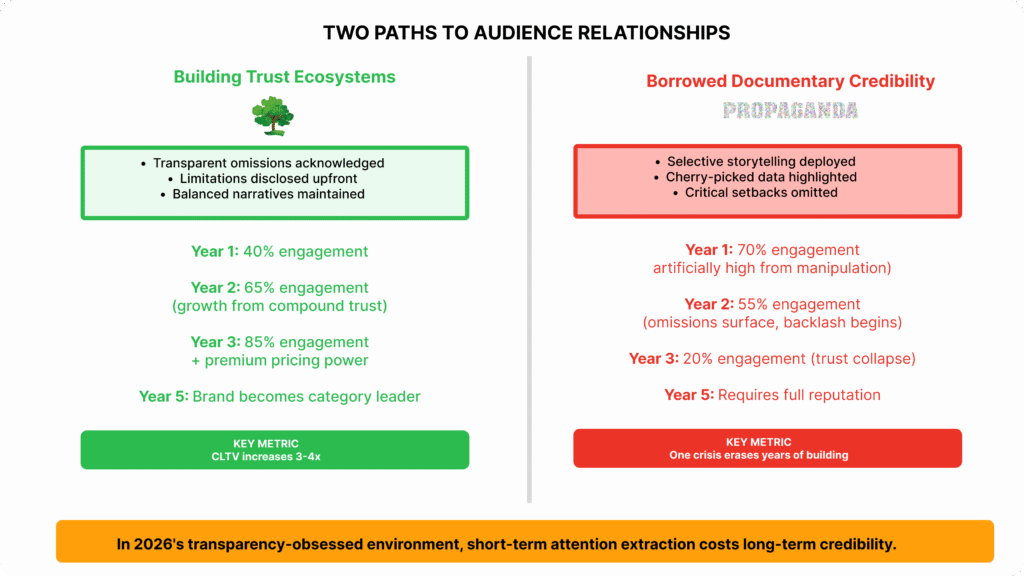
In 2026, content marketers must focus on building “trust ecosystems”—networks of authentic, interconnected assets that deepen credibility. Visibility alone won’t cut it. As AI transforms how content is made, discovered, and consumed, brands that earn trust and inspire belief will lead. Those relying on borrowed documentary credibility whilst concealing inconvenient truths will face a reckoning.
A Necessary Confession: Are We Guilty of the Same?
Before concluding, honesty demands acknowledgement: campaign analysis—including this piece—risks the same selective framing it critiques.
What this analysis might be hiding
I’ve emphasised Recursion’s omissions whilst potentially downplaying context that might complicate my argument. Early-stage biotech companies routinely discontinue programmes; that’s how drug development works. Pipeline cuts after mergers are standard industry practice, not necessarily evidence of concealment. Eight-minute runtime can’t include every nuance of a decade-long company history.
Perhaps framing the “up to 80%” claim as manipulation ignores that medical research conventionally reports ranges alongside medians. Maybe the film’s focus on promise rather than setbacks reflects genre conventions of inspirational documentary storytelling, not deliberate deception.
The research I didn’t do
Here’s what I haven’t done: interviewed Recursion’s communications team to understand their editorial choices. Consulted documentary ethics boards about industry standards for branded content. Examined comparable pharmaceutical documentaries to establish baseline disclosure norms. Spoken with patients in the FAP trial about whether they felt the film accurately represented their experiences.
“Critical analysis requires selecting evidence that supports a thesis. Distinguishing critique from hypocrisy lies in acknowledging what’s been left out and why.”
Critical analysis requires selecting evidence that supports a thesis. Distinguishing critique from hypocrisy lies in acknowledging what’s been left out and why.
My own commercial motivations
This piece argues that branded documentaries should disclose their commercial motivations and present balanced narratives. By that standard, I should disclose mine: I’m a content strategist who benefits professionally from arguing that content marketing needs higher ethical standards. Critique that elevates my positioning isn’t neutral analysis—it’s professional differentiation.
Does that invalidate the argument? No. But it does demand we apply the same scepticism to marketing criticism that we apply to marketing itself.
The Choice You’re Actually Making
There’s a prevailing myth that authenticity and effectiveness sit at opposite ends of a spectrum—that you must choose between transparency and results. The inverse is true. In an environment where 61% find influencer endorsements less trustworthy than five years ago, where consumers fact-check instantly and share negative experiences globally, long-term effectiveness requires authenticity.
What happens next with Recursion
The Recursion documentary is a perfect test case. We’ll discover whether the omissions surface. Whether journalists investigate the gap between the film’s breakthrough narrative and the mixed pipeline reality. Whether the “up to 80%” framing attracts scrutiny when audiences understand it represents an outlier rather than typical outcome. Whether Google faces questions about using educational content to promote cloud services without disclosure.
Should those revelations come, the trust damage will exceed any short-term engagement gains. If they don’t, the precedent is troubling: brands can exploit documentary conventions to conceal setbacks, cherry-pick data, and advance commercial agendas under the guise of education.
The real decision for marketers
Marketers don’t face a choice about whether to tell stories. Rather, the choice is whether to treat audiences like thinking humans capable of handling complexity or like emotional targets to be managed through strategic omission.
“The choice is whether to treat audiences like thinking humans capable of handling complexity or like emotional targets to be managed through strategic omission.”
One approach builds relationships that compound over decades. The other extracts short-term attention at the expense of long-term credibility.
Your documentary isn’t journalism. The question is whether you’ll stop pretending it is—and whether those of us critiquing your work will hold ourselves to the same standard.
Sources:
- Recursion Halts Four Pipeline Programmes — GEN News
- Recursion Reports Positive Phase 1b/2 Data for FAP Treatment — Investing.com
- Recursion-Exscientia Merger Details — Drug Discovery Trends
- The Trust Gap: Why Consumers Don’t Believe What Brands Say — MBLM
- Why Brand Trust Is the Most Valuable Currency in 2025 — Cooperative Computing
- 27 Marketing Trends and Predictions for 2026 — Quad
- 2026 Consumer Insights: Trends Marketers Should Know — Experian
- Association Between Exaggeration in Health-Related Science News — NCBI
- Why Hype in Press Releases Is Ineffective — Science Media Hub
- Quest for Success: The Hero’s Journey in Corporate Change — California Management Review
- AI-Discovered Drugs Success Rates — HT World
- The Gen AI Hype Cycle: A Reality Check in 2025 — Human Risks
- Recursion Streamlines Pipeline Following Merger — BioPharma Dive
- The Power of Storytelling in B2B Content Marketing — Adrian Alacy Consulting
- Business Storytelling: The Good, the Bad and the Downright Disastrous — Editor Group
- Marketing Leaders Share How Consumer Backlash Strengthened Brands — Marketing Dive
- PR Nightmares Revealed: 17 Unimaginable Crisis Moments — PRLab
- Branded Documentaries vs Traditional Advertising — Roosmith
- How to Calculate Video Marketing ROI — TEGNA
- A Story About Storytelling in B2B Marketing — Alex Segger
- 42 Experts Reveal Top Content Marketing Trends for 2026 — Content Marketing Institute
- OpenAI’s Healthcare Campaign: The Marketing-Safety Paradox — Suchetana Bauri
- Google DigiKavach Campaign Analysis — Suchetana Bauri
- Amazon Five Star Theater: Why Authenticity Wins — Suchetana Bauri