
The craft is impeccable. The budget unmistakable. The sentiment? Manufactured to the micron. Apple’s latest Chinese New Year film, Glad I Met You, landed on 30 January with all the hallmarks of prestige brand storytelling: acclaimed director Bai Xue at the helm, stop-motion puppets requiring over twenty hand-painted mouth expressions, 4K 120fps slow motion, and a narrative about a lonely woman and a lost dog finding family in each other. Industry publications dutifully called it “heartwarming”. Social media fawned over the craftsmanship. Meanwhile, Marketing Twitter—sorry, X—praised the “cultural sensitivity”.iclarified+2
But here’s what nobody’s saying: this eleven-minute branded film represents the precise pathology killing consumer trust in 2026. Marketers who don’t recognise it are building on sand.
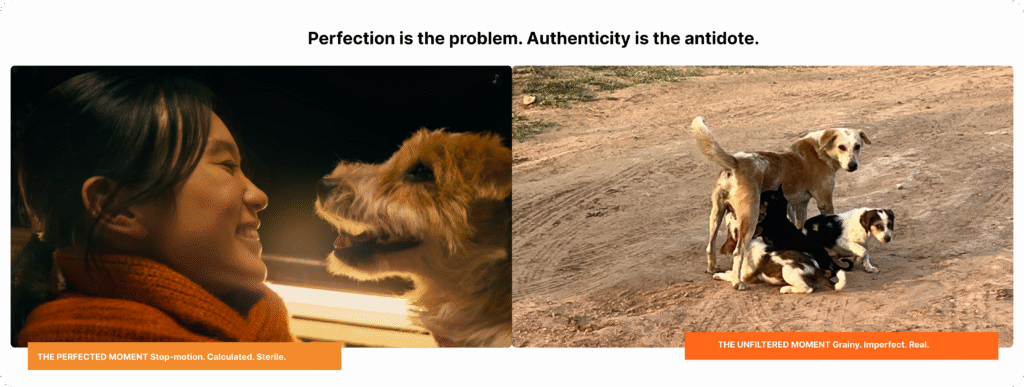
The Great Unshittification Has Begun
We’re in the middle of what trend forecasters call “the Great Exhaustion”—a moment when consumers have collectively hit the wall on polished, overproduced, emotionally manipulative content. Marketing fatigue isn’t abstract anymore. Consider the numbers: brand awareness in financial services has plummeted from 34% to 31% in eighteen months despite soaring ad spend. Social engagement is cratering. In fact, 76% of workers report event fatigue, whilst 47% attended events they felt weren’t worth their time. Online mentions of “slop”—low-effort, insincere content—grew by over 200% in 2025. Notably, “AI slop” became Merriam-Webster’s Word of the Year.thinklikeapublisher+5
“The 2026 marketing landscape isn’t about efficiency anymore. It’s about unshittification. Consumers are done with the fake, the formulaic, the algorithmically optimised.”
The 2026 marketing landscape isn’t about efficiency anymore. Instead, it’s about what one analyst brilliantly termed “unshittification”. Consumers are done with the fake, the formulaic, the algorithmically optimised. Authenticity isn’t a positioning statement—it’s the only currency that still trades.[thinklikeapublisher]
When Raw Beats Refined
Raw, spontaneous, phone-shot clips now outperform high-budget productions. Importantly, they signal something Apple’s film fundamentally cannot: genuine human effort unconstrained by commercial imperatives.digital-business-lab+1
And yet Apple gives us Glad I Met You: a technically flawless, strategically calculated, emotionally engineered piece of content that ticks every box except the one that matters. It’s honest about nothing—not its production budget, not its crew size, not its commercial intent—whilst wrapping itself in the rhetoric of democratised creativity and cultural belonging.
This isn’t Apple’s first dance with marketing sleight-of-hand this year. Earlier in September, the iPhone 17 Pro launch campaign deployed a similar “durability marketing” strategy—cinematic scenarios, vintage soundtrack, aspirational messaging. It prioritised aesthetic over honest capability claims. The pattern is clear: Apple has perfected the art of making advertising feel like art whilst remaining stubbornly, commercially, algorithmic.
The “Shot on iPhone” Lie We’ve All Agreed to Believe
Let’s address the elephant holding the gimbal. The “Shot on iPhone” campaign won a Cannes Lions Grand Prix, generated 6.5 billion impressions, and contributed to 231 million iPhone sales. It’s perhaps the most successful brand platform of the past decade. Nevertheless, it’s also, in any meaningful sense, a lie.macrumors+3
The Production Reality Nobody Mentions
Glad I Met You was indeed filmed on an iPhone 17 Pro. However, here’s what else it required:
- Director Bai Xue (whose debut The Crossing won Best Film at Pingyao)
- A professional cinematographer
- Dedicated animal coordinators
- Two production studios (Shooting Gallery for live-action, BUCK for stop-motion)
- Puppet fabrication by Mackinnon & Saunders (who worked on Tim Burton films)
- An editor, a composer, and extensive post-productionmusebyclios+1
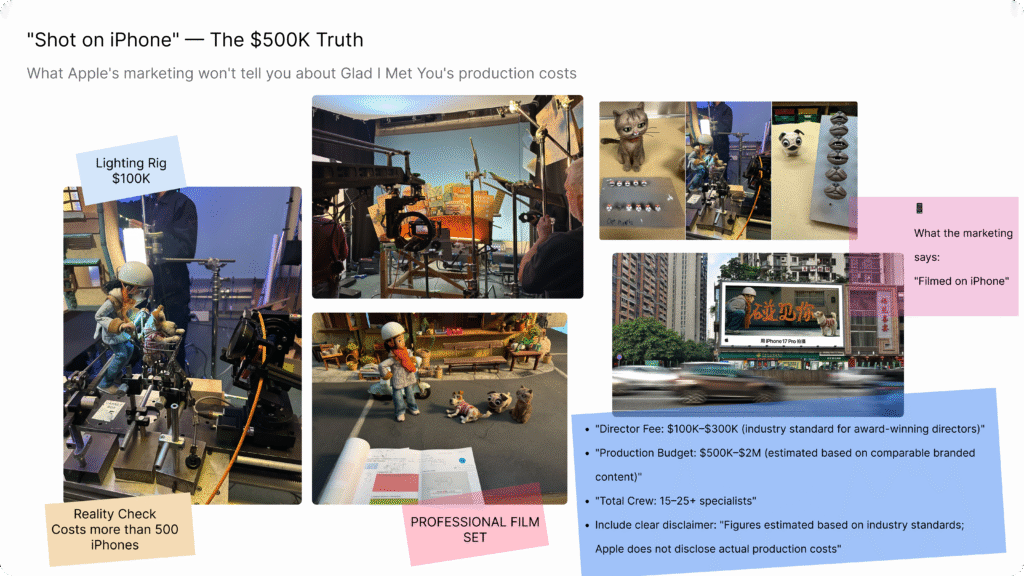
Beyond the phone itself, the behind-the-scenes footage reveals lighting rigs, motion-tracking equipment, and technical infrastructure no “everyday user” will ever possess.[youtube][iclarified]
“Yes, it was filmed on an iPhone, but you, as an average consumer, will never replicate what they accomplished.”
Critics have noted this contradiction for years. Specifically, Apple’s films utilise multi-million-dollar budgets and professional crews, which renders the “democratisation” claim hollow. As one observer put it: “Yes, it was filmed on an iPhone, but you, as an average consumer, will never replicate what they accomplished”.warc+1
Yet the campaign persists because it’s not about honesty—it’s about aspirational theatre. Ownership of the device appears to grant access to creative fluency. In reality, that fluency remains contingent upon resources far beyond the phone itself.linkedin+1
When CGI Lies and iPhone “Truth” Meet
The irony becomes sharper when you consider what Maybelline attempted last year with CGI dabbawalas carrying virtual lipsticks through Mumbai. That pixel-perfect lie sparked backlash precisely because audiences could spot the artifice.
Apple’s deception is more sophisticated. Certainly, the filming is real. But the premise—that you, too, could create this with your phone—remains fundamentally dishonest. Essentially, it’s the difference between an obvious deepfake and a carefully worded half-truth. Both manipulate. One just does it with better production values.
This matters more in 2026 than ever before. For instance, consumers can spot AI-generated content with 77% accuracy and trust it 68% less than human-created content. They’re attuned to manipulation, exhausted by inauthenticity, and unforgiving when brands pretend otherwise.[whitehat-seo.co]
The “Shot on iPhone” mythology worked brilliantly in 2015, when Instagram was ascendant and user-generated content felt revolutionary. By contrast, in 2026, it reads as exactly what it is: a product demonstration masquerading as cultural participation.[warc]
Slow Motion and the Engineering of Feeling
Bai Xue herself identified the film’s “most important shot” as Little White running towards Lin Wei in slow motion, claiming it “magnifies the emotional impact by extending the moment”. She’s not wrong. However, she’s also describing a manipulation technique backed by neuroscience research.thestable+1
The Neuroscience of Manufactured Emotion
Slow motion in advertising doesn’t capture emotion—it manufactures it. For example, studies show that slow-motion sequences increase perceived arousal and valence whilst triggering physiological responses: higher autonomic activation, larger pupil diameters, distorted time perception.journals.sagepub+1
“Slow motion exploits a cognitive vulnerability to engineer a response that feels spontaneous but is meticulously choreographed.”
Moreover, the technique works by simulating psychological processes associated with heightened emotional states, effectively short-circuiting rational evaluation in favour of affective immediacy. When paired with emotional musical underscoring—as Glad I Met You liberally does—the effect intensifies.pmc.ncbi.nlm.nih+2

Apple’s deployment of 4K 120fps “cinematic slow motion” throughout the film is anything but accidental. Consequently, quotidian gestures—a dog running, a woman smiling—get stretched, lingered over, sonically underscored until they accrue the weight of revelation. Research confirms that slow motion enhances brand liking and increases purchase intent, particularly amongst viewers engaging in low-deliberation processing.apple+2
In the precise sense, it is manipulative. Specifically, it exploits a cognitive vulnerability to engineer a response that feels spontaneous but is meticulously choreographed.
Where Ethics and Effectiveness Diverge
Here’s the ethical rub: emotional advertising can be twice as effective as rational advertising. In fact, 81% of subjects remember brands from emotional ads versus 69% from rational ones. Nevertheless, effectiveness does not equal ethics.[neurosciencemarketing]
As advertising scholars note, emotional manipulation becomes unethical when it exploits vulnerabilities, exaggerates risks, or capitalises on insecurities whilst perpetuating unrealistic standards. Essentially, it’s the difference between genuine connection and calculated exploitation.linkedin+3
Glad I Met You doesn’t cross into overt harm—nobody gets shamed or frightened. Rather, it operates in that grey zone where sentiment becomes product demonstration, where engineered emotion masquerades as authentic storytelling, where you’re invited to feel without ever being allowed to think.journals.sagepub+1
The Pet Economy and Strategic Sentiment
The choice of a lost dog as emotional fulcrum isn’t heartwarming. Rather, it’s calculated market positioning.
Pet ownership in China has surged dramatically. Currently, 73 million households own pets, urban ownership hit 60% (up from 48% in 2021), and the pet industry reached RMB 300 billion ($42 billion) in 2024, growing 7.5% annually.hrone+2
Significantly, nearly 90% of Chinese pet-owning households regard pets as important family members. This stems from urban loneliness and the emotional needs of young professionals—precisely Apple’s target demographic. Furthermore, pet-related content generates 2.5 times more engagement than non-pet content, with some brands seeing 295% surges in comments on pet-featuring posts.english.ckgsb+3
When Emotion Becomes Product Demo
Apple isn’t pioneering this territory. Indeed, brands from Subaru to Andrex have mined human-animal bonds for decades. What distinguishes Glad I Met You, however, is how it layers commercial imperatives atop emotional appeal whilst pretending the former doesn’t exist.[linkedin]
“Sentiment becomes instructional. Emotion becomes product demonstration. And nobody’s supposed to notice.”
On one hand, the film taps into China’s booming pet economy. On the other, it positions the iPhone as the tool through which such companionship gets documented and shared. Notably, the behind-the-scenes content—hosted by pet influencer Ke Ming using Dual Capture—makes this transactional dynamic explicit.[thestable.com][youtube]
You’re invited not simply to feel for Little White. Instead, you’re meant to imagine yourself capturing your own pet’s moments with identical fidelity.
Ultimately, sentiment becomes instructional. Emotion becomes product demonstration. And nobody’s supposed to notice.
Stop-Motion and the Authenticity Mirage
Stop-motion animation enjoys renewed currency in 2026 advertising. Specifically, it signifies authenticity in an era saturated with CGI and AI-generated “slop”. The technique’s “handmade quality” contrasts with computer-generated content, thereby creating “subconscious appreciation for craftsmanship that translates into positive brand associations”.educationalvoice+2
Viewers recognise the human effort involved. For instance, BUCK’s puppets required 12-24 frames per second, meaning a thirty-second sequence demands 360-720 individual photographs. Consequently, this recognition fosters trust, higher engagement, and superior brand recall.coldeaproductions+2
When Craft Becomes Strategy
Apple’s pivot towards practical effects (see also 2024’s puppet-driven Christmas campaign) is strategically astute. But here’s the problem: the “authenticity” is itself a construction—a carefully managed aesthetic designed to evoke artisanal labour whilst remaining entirely beholden to corporate imperatives. This is what branding scholars call the “Authenticity Mirage”—content that mimics the style of authenticity but lacks genuine substance.advids+2
We’ve seen this play out differently across campaigns. For example, when Asian Paints deployed stop-motion animation to tell stories about heritage and emotional connection, the technique felt organically tied to craft tradition. Similarly, when KitKat partnered with Spotify for a phygital “Break the Loop” experience, the tech-forward approach at least acknowledged its own commercial scaffolding.
By contrast, Apple wants you to believe the puppets are the authenticity—not merely a technique deployed to signal it.
The Collapse of Manufactured Authenticity
The puppets are exquisite. The animation painstaking. The craftsmanship undeniable. However, the narrative they serve is instrumental: a branding exercise designed to position Apple within China’s cultural calendar, align the company with themes of family and belonging, and ultimately move units. In essence, the craft is real, but the authenticity it purports to signify is not.longadvisory+3
“When craftsmanship becomes a premium production technique deployed to signal authenticity rather than embody it, the illusion collapses.”
Consumers are getting better at spotting the difference. For instance, research shows that 68% trust AI content less than human-created content—not because they oppose AI per se, but because they oppose being misled about how content was made.[whitehat-seo.co]
The same principle applies to stop-motion. Specifically, when craftsmanship becomes a premium production technique deployed to signal authenticity rather than embody it, the illusion collapses.[hands-on.damnart]
The Rise of Anti-Polish Content
By 2026, “anti-polish” content—raw, spontaneous, imperfect—outperforms high-budget productions. Importantly, it signals what audiences actually crave: content created without layers of strategic obfuscation. Apple’s film, for all its technical mastery, can’t escape its own artifice.mspcagency+1
Why Marketers Should Care (And What to Do Instead)
Here’s the uncomfortable truth: Glad I Met You will likely perform exceptionally well. Chinese New Year ad spend is projected to exceed $1 trillion globally, whilst pet-related content sees particularly high engagement. The film checks every strategic box, deploys proven emotional triggers, and will generate social impressions, drive conversation, and reinforce brand affinity.mediasmart+2
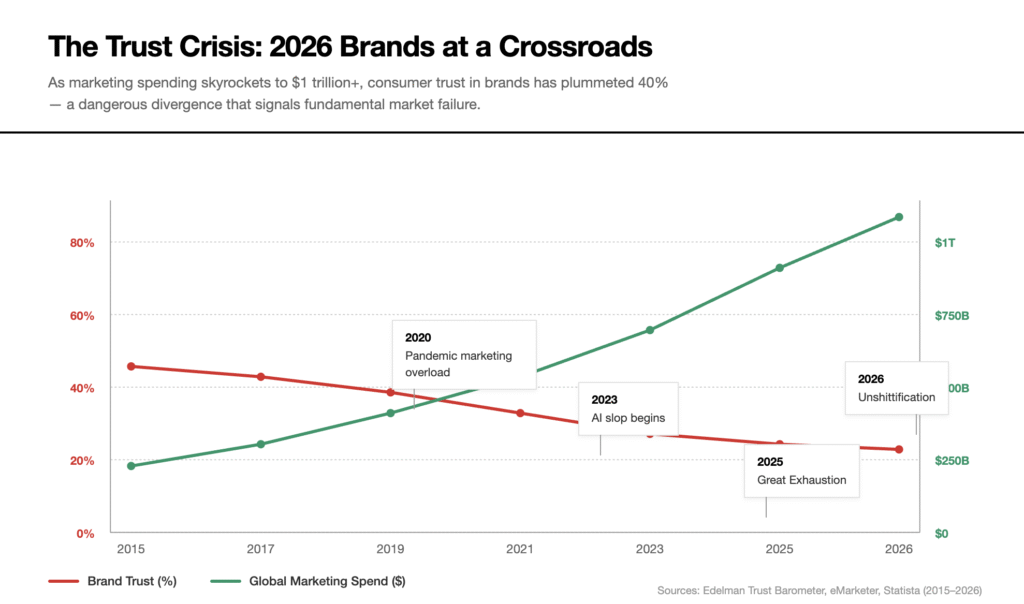
Nevertheless, short-term effectiveness is masking long-term erosion. Brand trust is in freefall: only 30% of consumers highly trust companies, and just 61% trust business leaders to tell the truth. When trust is the scarcest resource, its value increases exponentially.cmswire+2
Consequently, brands that can demonstrate genuine credibility—not engineered sentiment, not aspirational mythology, but actual transparency and consistency—are setting themselves apart.forbes+2
The Widening Gap Between Metrics and Meaning
The gap between what marketers think works and what actually builds lasting relationships has never been wider. On one hand, emotional advertising remains effective in driving immediate recall and purchase intent. On the other hand, when audiences perceive emotional appeals as manipulative—exploiting vulnerabilities, exaggerating needs, or capitalising on insecurities—they erode the very trust brands claim to seek.abacademies+3
“Brands that can demonstrate genuine credibility—not engineered sentiment, not aspirational mythology, but actual transparency and consistency—are setting themselves apart.”
Consider the contrasts emerging across 2025’s marketing landscape. For instance, Amazon’s Five Star Theater campaign succeeded precisely because it embraced the raw, unfiltered chaos of actual customer reviews—hairy men in mother’s slippers, boyfriend pillows compared to actual partners. The campaign generated a 6x brand lift not despite its authenticity, but because of it.
Similarly, Swiggy’s Wiggy 3.0 campaign worked because it centred delivery partners as genuine protagonists, not props in a corporate narrative about “finding family.”
Five Actions for the Unshittification Era
- First, be honest about production. If your “Shot on iPhone” campaign requires a seven-figure budget and a professional crew, say so. Consumers aren’t naïve—they know the difference between accessible creativity and aspirational theatre. Moreover, transparency about process builds credibility.martech+2
- Second, prioritise substance over sentiment. Emotional storytelling works when it emerges organically from genuine insight, not when you reverse-engineer it from neuropsychological research on slow-motion manipulation. Instead, create content that informs, educates, or genuinely entertains—not content optimised to trigger physiological responses.contentmarketinginstitute+4
- Third, embrace imperfection strategically. The rise of “anti-polish” content isn’t about abandoning quality. Rather, it’s about signalling human effort unconstrained by commercial calculation. Raw behind-the-scenes moments, unscripted founder stories, and mistakes acknowledged build trust in ways polished perfection cannot.linkedin+4
- Fourth, build trust ecosystems, not campaigns. In 2026, brands build trust through consistent, interconnected assets that deepen credibility over time—not through one-off brand films engineered to go viral. Educational content, transparent data practices, and genuine community engagement matter more than cinematic sentiment.cmswire+2
- Finally, test your content against the “slop” threshold. Ask: does this add genuine value, or does it exist solely to serve algorithmic or commercial imperatives? If you can’t articulate the specific insight or utility, you’re creating slop. Consumers are increasingly adept at ignoring it.humansecurity+4
The Verdict
Glad I Met You is a technically accomplished, strategically astute piece of branded content. Indeed, it reveals as much about contemporary marketing’s sophistication as it does about its ethical ambiguities. Apple has mastered the art of suturing product demonstration to emotional narrative, rendering the commercial imperative nearly invisible beneath layers of craft, sentiment, and cultural fluency.fastcompany+1
However, mastery of manipulation is still manipulation. In 2026, when consumers are exhausted, sceptical, and attuned to inauthenticity, brands that continue doubling down on polished sentiment over genuine transparency are building on a foundation that’s actively crumbling.amyodell.substack+4
When Perfection Becomes the Problem
The question isn’t whether Apple can make beautiful films on iPhones. They demonstrably can—provided you have the director, crew, studios, and budget that “democratised filmmaking” supposedly renders unnecessary.forbes+2
Rather, the question is whether marketers are willing to interrogate the mythologies embedded in such storytelling: the myth that technology democratises creativity, the myth that sentiment separates from strategy, the myth that craftsmanship equals authenticity.advids+2
“Perfection, in 2026, is precisely the problem. It signals calculation, not connection. Strategy, not sincerity.”
By the ninth year of Chinese New Year films, Apple has refined the formula to near-perfection—the same tonal beats, the same visual language, the same thematic payoff. But perfection, in 2026, is precisely the problem. Ultimately, it signals calculation, not connection. Strategy, not sincerity.marketing-interactive+1
Consumers—battered by a decade of overproduction, algorithmic optimisation, and AI-generated slop—are learning to turn away from what glitters most brightly in favour of what feels, however imperfectly, real.digital-business-lab+2
The Audience Has Already Left
The great unshittification has begun. Consequently, brands still optimising for sentiment manipulation and aspirational mythology will find themselves increasingly speaking to an audience that’s already left the room.amyodell.substack+2
Apple’s film is glad it met you. But the real question—the one marketers should be asking themselves in 2026—is whether their audiences will be glad they met them back.martech+1
Further Reading:
- Apple’s iPhone 17 Pro Marketing: A Critical Campaign Analysis
- The Pixel-Perfect Lie: Maybelline’s Mumbai Mirage
- Break the Loop, Mind the Bump: A Wry Audit of KitKat’s Latest Musical Break
- Amazon Five Star Theater: Why Authenticity Wins
- Brand Anthem in the Age of Algorithms: Swiggy Wiggy 3.0 Campaign
- The Alchemy of Animated Heritage: Asian Paints Campaign
Sources:
- Apple Releases ‘Glad I Met You’ Chinese New Year Film[iclarified]
- Shot on iPhone Campaign Success[entri]
- Apple’s ‘Shot on iPhone’ Campaign Wins Award[macrumors]
- The Curse of Perfection in Marketing[hands-on.damnart]
- Marketing Trends 2026: Unshittification[thinklikeapublisher]
- Consumers Suffering Marketing Fatigue[thefinancialbrand]
- AI Slop: Marketing Content Quality 2026[whitehat-seo.co]
- Branding Trends 2026: Authenticity Over Polish[digital-business-lab]
- Slow Motion Enhances Consumer Evaluations[journals.sagepub]
- Why Brand Trust Is Declining[martech]
- Stop Motion Advertising Effectiveness[educationalvoice.co]
- Pet Ownership Trends China[hrone]
- When Ads Play on Emotions: Manipulation or Strategy?[linkedin]
- Emotional Ads Work Best[neurosciencemarketing]
- iPhone 17 Pro Technical Specifications[apple]