

Let’s step into the octagon—not for a fight, but a lesson in the art (and artifice) of modern marketing. In November 2025, IBM unveiled its UFC “Insights Engine,” trumpeting—after 20 years of fight data and millions of data points—that artificial intelligence now powers the Ultimate Fighting Championship’s storytelling factory. The ad campaign is pure theatre: slick graphics, exultant broadcast teams, the word “AI” slathered over every sentence. But is this really artificial intelligence, or just a glorified search engine in gloves?
Is this really artificial intelligence, or just a glorified search engine in gloves?
If you sell, plan, or invest in marketing—all eyes are on you to decode this riddle. The pressure has never been higher: budgets grow sluggishly, CFOs ask for proof not promises, and regulators now care whether your AI actually does what it says on the tin. As hype and reality collide, the UFC-IBM affair isn’t just a sporting sideshow—it’s a playbook for what’s broken (and what might actually work) in brand innovation now.
The Hype Machine and Its Bit Players: IBM, UFC, and the Limits of “AI”
IBM’s pitch is simple and powerful. With watsonx, UFC broadcasters can ask “complex” questions of a vast historical database—Who wins with leg kicks? Who’s got the highest submission rate?—and get answers in seconds. The system, we’re told, churns out insights 40% faster, tripling the output of commentator-ready storylines.
But strip away the “AI” sticker and look under the hood: this is retrieval-augmented generation (RAG) paired with text-to-SQL, which translates natural language into database queries and then prettifies the output for broadcast.
The technology is efficient, yes—but it’s far from new, and hardly the kind of “cognitive” leap that IBM’s marketing promises. Put simply: this system organises statistics, not stories; it makes information accessible, it doesn’t understand what makes a fight memorable.
This pattern—rebranding incremental infrastructure improvements as revolutionary AI—has become familiar across industries. Brands package better interfaces, faster queries, and smoother workflows in glossy marketing language, creating the impression of innovation where optimisation might be more honest. IBM’s approach raises a persistent question: where does genuine innovation end and marketing theatre begin?
Jargon Busters: What Is Actually Happening?
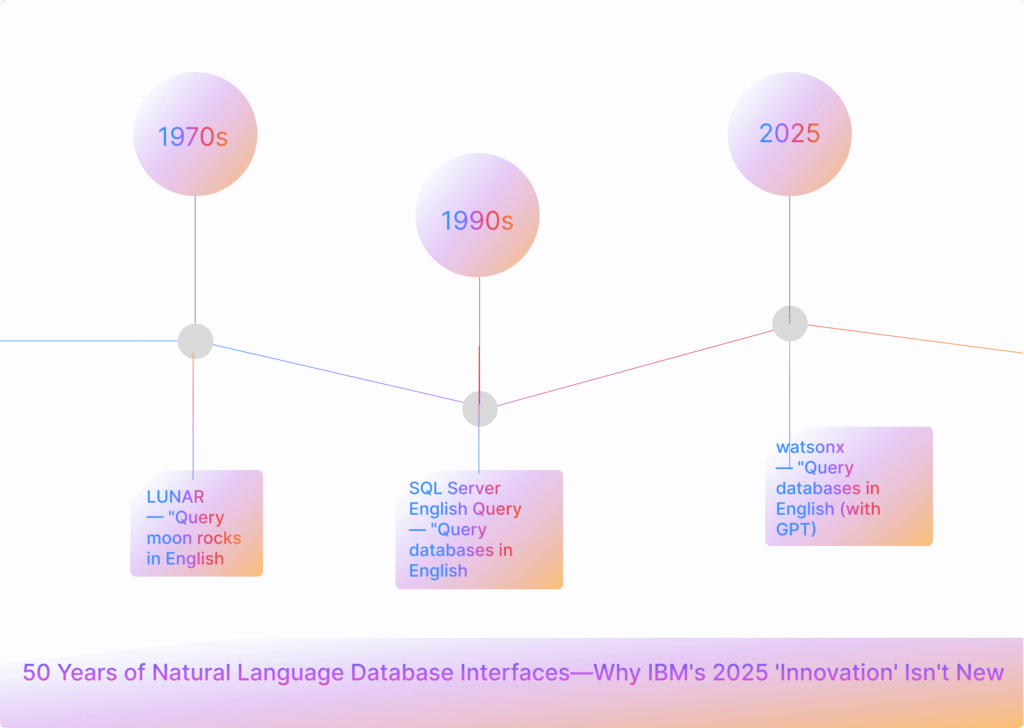
Marketers are inundated with jargon: natural language processing, query pipelines, generative AI. Yet, the UFC engine operates in familiar territory. For half a century, researchers have dreamt of “natural language interfaces to databases” (NLIDBs)—systems that take a human question and translate it to code a database understands.
In the 1970s, projects like LUNAR and LADDER let scientists query moon rock samples in plain English. By the mid-1990s, Microsoft’s SQL Server had “English Query”—enabling staff (no matter their technical prowess) to interrogate relational databases. These were slow, finicky, but the DNA was there: make stats accessible, eliminate jargon, democratise data. In 2025, with generative models atop old infrastructure, these systems are smoother and faster—yet, the underlying trick is unchanged.
The modern twist? Instead of arcane scripts, broadcasters type “Which fighters excel with leg kicks?” and get an answer, powered by watsonx, Llama, or Google’s Gemini. But whilst the engine “speaks English,” it’s constrained by what it knows. It borrows the drama of AI but rarely achieves true insight—at best, it delivers relevance-ranked stats in time for a bout’s big moment.
Why Now? Marketers Are Hungry for Answers, Audiences for Meaning
This moment matters because data-driven marketing is on the cusp of maturity—and crisis. The sector is worth $47 billion globally and climbing. Most marketers now use AI daily, nearly all expect to ramp up investment soon, and content powered by AI returns triple the ROI of unassisted campaigns—on average.
Yet, this army of tools—”agentic AI,” “GenAI,” “AI assistants”—has a dirty secret: 95% of enterprise pilots fail to deliver business impact, according to MIT’s latest survey. Most stalls aren’t due to bad tech, but messy integration, imprecise goals, and dreary data silos. Marketers, prodded by CFOs hungering for ROI, must prove real value—not photogenic demos or vanity metrics.
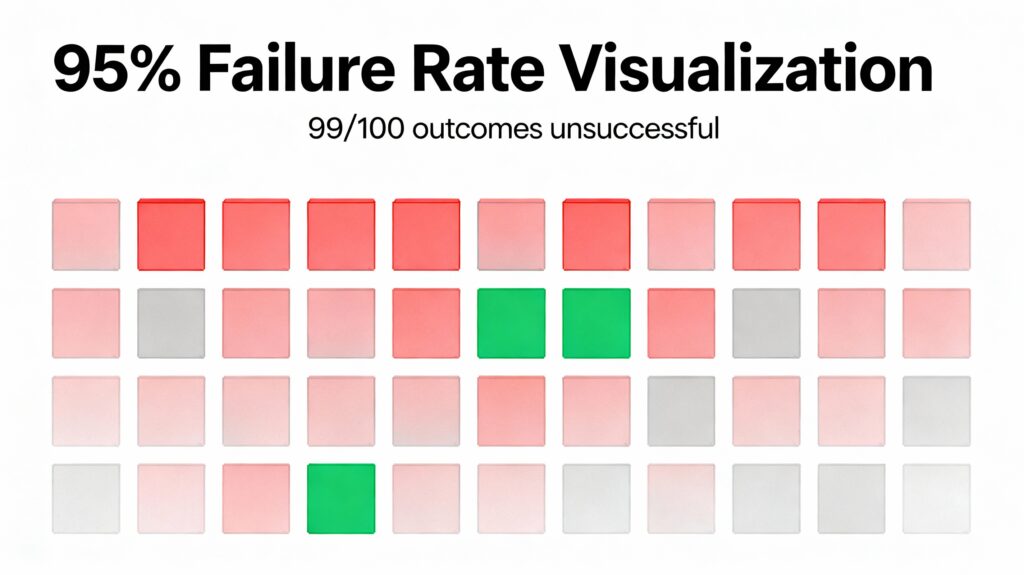
95% of enterprise pilots fail to deliver business impact, according to MIT’s latest survey.
The UFC/IBM case is symptomatic. Beyond the hype, marketers want tools that:
- Work at scale, not just in pilots
- Deliver measurable results (not more dashboards)
- Build narrative and meaning, not just automate outputs
- Guard trust and transparency at every turn
Above all, the moment is ripe for confronting the reckoning: Will AI help brands tell stories, or simply sequence stats? The answer is still up for grabs.
What Marketers Really Need to Know From UFC’s Database Drama
It’s tempting to mock the corporate pageantry of IBM’s “insights engine.” Still, dismissing it outright is a mistake—the system solves a genuine problem, making live event data accessible at speed. Yet, to act wisely and avoid falling for the AI-washing trap, marketers should demand answers to three essential questions:
1. Is the Tech Worth More Than Branding?
AI-washing is the regulatory word du jour: selling old tech with a new label, inflating tools to seem transformative, and coaxing executives to pay for what their teams already own. The Securities Exchange Commission (SEC) now prosecutes brands for exaggerated AI claims—first against investment firms, then tech start-ups, and recently a Nasdaq-listed company. The FTC chases “agentic AI” (think assistants that promise to replace humans but don’t), enforcing consumer protection law.
For marketers, the lesson is vital: Don’t buy branding. Instead, drill down:
- What precisely can this system do that wasn’t possible last year?
- Does the “AI” improve knowledge, relevance, or predictive power, or just distribution and speed?
- Is this a new model—or a friendlier interface for legacy data?
Transparency isn’t a box to tick, it’s a tool to wield.
Demand clear evidence of innovation. Ask for endpoint demos, not pilot purgatory. And if a vendor sells a database shortcut as a paradigm shift, walk away.
2. Does It Build Trust and Accountability—Or Just Noise?
Trust is now a measurable brand currency.
Edelman’s 2024 study finds 87% of shoppers pay more for relatable, honest brands. In India, 67% of citizens expect AI to disclose its role; 65% trust government to hold brands accountable for transparent usage. Over half of UK, Australian, and US consumers worry most about undisclosed AI-generated content; transparency is no longer optional.
As I explored in my analysis of Google India’s DigiKavach campaign, when brands combine culturally resonant storytelling with transparent communication about their tools and methods, they build lasting trust. Conversely, Has AI-Generated Content Stolen Creativity from Digital Marketing? examines how over-reliance on automated systems without human oversight erodes brand authenticity.
Marketers must surface not just how AI is used but why, bridging the chasm between audience expectations and content reality. Disclose methods, cite sources, and integrate human oversight at high-stakes junctures.
AI is compelling only when credibility is baked in—otherwise, it deepens the trust deficit, incites cynicism, and risks regulatory blowback.
The UFC engine, for all its flash, remains a cautionary tale: Useful tech wrapped in ambiguous branding risks damaging both trust and value.
3. Is Measurement the Key—Or Just Another Vanity Metric?
Boardrooms now reject flashy metrics in favour of clear marketing ROI. CFOs want answers: What did this spend return? How did it help us scale, retain, or drive profit? Gartner, BCG, and HBR all sing the same tune: Meaningful measurement is now non-negotiable. Marketers must report not just “engagement” or “reach,” but incremental revenue, customer lifetime value, and channel-attributed profit.
AI-powered data mining only matters if it aligns with business goals. Unified KPIs, dashboarding financial and marketing metrics in sync, make teams more accountable and efficient—often driving 22–31% gains in marketing ROI when collaboration is seamless.
The lesson: Use data to guide investment, not just justify spend.
Pilot projects and siloed dashboards are a waste—integrated, measurable campaigns are the path to impact.
Enterprise AI: Why 95% of Pilots Flounder Whilst Only 5% Scale
MIT’s research is blunt: 95% of generative AI pilots produce zero financial return. The problem isn’t tools—it’s context, integration, and alignment. Teams launch isolated experiments, fail to connect core data, and chase novelty—AI chatbots, automated summaries, synthetic content—that don’t embed with business workflows or KPIs.
AI pilots that “go solo” crash; those that partner with specialists succeed 67% of the time. The lesson, especially in regulation-heavy markets, is simple: Buy wisely. Don’t DIY if you lack expertise. Embed use cases in daily workstreams, slice away pilots not rooted in outcome, and enforce real measurement (not more PowerPoints).
Infrastructure and governance matter. Role-based permissions, audit trails, and performance reviews ensure that tech is genuinely integrated and scalable.
For marketers, the UFC engine may serve as a warning: A standalone showpiece with no operational linkage is theatre, not transformation.
Database Interfaces: The Unsung Heroes (and Villains) of the “AI Revolution”
The truth is that natural language interfaces to databases have evolved quietly, reliably, and—since at least the 1970s—without needing to call themselves “AI”. The best ones democratise access, break down technical barriers, and enable real innovation in work. They don’t tell stories or build strategy—they enable it.
What IBM sells to UFC is, in technical terms, an efficient NLIDB (Natural Language Interface to Databases). The engine translates English into code, surfaces statistics, and supports rapid query. The innovation is in usability, not cognition. The magic, such as it is, happens at the interface.
Yet, when tech providers rebrand database shortcuts as disruptive AI, markets get foggy. What matters isn’t the tool but what people do with it—whether it changes workflows, insight acquisition, or decision velocity.
When tech providers rebrand database shortcuts as disruptive AI, markets get foggy.
Brand Differentiation in an AI-Saturated Landscape
With AI now table stakes in nearly every vertical, marketers must fight the sideways pressure of commoditisation.
Tools alone aren’t enough. Differentiation comes from:
- Deep understanding of consumer sentiment, not just data mining
- Proactive use of AI to personalise experiences at scale—but with clarity and consent
- Consistent, human-guided brand messaging—not bland automated output
- Crafting bold, transparent narratives around AI’s real usage and impact
In my critique of Figma’s Schema campaign, I explored how even design-led companies struggle to balance entertainment and education in their AI messaging. Meanwhile, MG Motor’s “EV Sahi Hai” campaign demonstrates how authentic testimonials—rooted in real user experience rather than borrowed celebrity credibility—can build lasting trust.
Brands that combine smart technology with real stories—their struggles, wins, and transparent mistakes—succeed. Those hiding behind the “AI” badge risk sounding like every other automaton.
What to Do Next? Make AI Accountability a Brand Differentiator
Marketers should act urgently—because the audience is wise, the board impatient, and regulators emboldened:
- Audit your tech stack for real, not branded, AI functions. If your “AI” is a better search interface, own it. If your tool predicts new outcomes, measure and report on its accuracy and impact.
- Disclose AI use overtly. Don’t hide behind disclaimers. State how AI is used, why it matters, and how humans steer the ship. As Anthropic’s approach to Claude marketing demonstrates, honest communication about capabilities and limitations builds user confidence far more effectively than perfect demos that gloss over failure states. This stands in stark contrast to IBM’s glossy theatre around the UFC Insights Engine.
- Measure for profit, not optics. Use multi-touch attribution, incrementality testing, and business-wide dashboards. Share data across teams and hold each other accountable.
- Choose partners wisely. If expertise is lacking, buy specialised tools rather than build. Hold vendors to measurable, auditable standards and refuse vague claims.
- Avoid pilot purgatory. Embed AI into core systems, not just isolated experiments or shiny demos. If a pilot can’t drive meaningful business change, cut it.
- Protect trust like a moat. Make transparency, governance, and auditability central to your brand identity. Publish your challenges, not just your wins. Remember Swiggy’s Durga Puja dog campaign: noble intentions without contextual awareness can undermine brand credibility.
Conclusion: Leave the Hype at the Door—Build Smart, Honest, and Impactful Marketing
The UFC’s AI-powered Insights Engine is neither a villain nor a hero. It’s both a sign of marketing’s excesses and a lesson for those yearning for real innovation. Marketers must take heed: hype cycles fade, brand trust endures.
Hype cycles fade, brand trust endures.
Half a century on, database interfaces still propel strategy—but their best trick is making complexity accessible, not pretending to be sentient. The winners in this landscape will be those who distinguish real impact from flash, who measure what matters, and who craft stories that outlast the buzzwords.
In the end, AI is what you make of it. Use it to build trust, not just speed. Demand accountability, not just automation. The true narrative for 2025: Marketers who act boldly, measure fiercely, and champion transparency will write the playbook for the future. The rest? They’ll soon fade, their stories lost in a sea of undifferentiated noise.
Further Reading on SuchetanaB auri.com:
- September Smartphone Marketing 2025: Hype or Real Value? — A critical examination of AI washing in consumer tech
- Google India’s DigiKavach Campaign Analysis — When culturally resonant authenticity drives results
- Has AI-Generated Content Stolen Creativity from Digital Marketing? — Exploring the human-AI balance
- Figma Schema Campaign Analysis — The entertainment vs education dilemma in tech marketing
- MG Motor’s “EV Sahi Hai” Campaign — Authentic testimonials over borrowed credibility
- Anthropic’s Claude UX Writing Analysis — Honest communication about AI capabilities and limits
- https://www.foxbusiness.com/sports/ufc-ibm-reveal-ai-powered-in-fight-insights-technology-ahead-madison-square-garden-event
- https://newsroom.ibm.com/ufc-and-ibm-introduce-ai-driven-in-fight-insights
- https://stoneturn.com/insight/next-generation-compliance-preparing-for-continued-sec-ai-washing-enforcement/
- https://www.cricexec.com/ibm-launches-worlds-first-ai-driven-cricket-activation-eyes-ipl-franchise-integration/689562670/
- https://www.youtube.com/watch?v=zsXyeBZVKA0
- https://arxiv.org/html/2503.02435v1
- https://www.cambridge.org/core/journals/natural-language-engineering/article/natural-language-interfaces-to-databases-an-introduction/21C30448C70DD4988E6DA0D54205FB56
- https://learn.microsoft.com/en-us/azure/search/retrieval-augmented-generation-overview
- https://blogs.oracle.com/machinelearning/introducing-natural-language-to-sql-generation-on-autonomous-database
- https://learn.microsoft.com/en-us/microsoft-cloud/dev/tutorials/openai-acs-msgraph/03-openai-nl-sql
- https://blog.streamlit.io/snowchat-leveraging-openais-gpt-for-sql-queries/
- https://www.hfsresearch.com/research/ufc-ibm-data-deadlock/
- https://drops.dagstuhl.de/storage/00lipics/lipics-vol290-icdt2024/LIPIcs.ICDT.2024.1/LIPIcs.ICDT.2024.1.pdf
- https://aclanthology.org/L18-1469.pdf
- https://www.nowpublishers.com/article/DownloadSummary/DBS-078
- https://www.seo.com/ai/marketing-statistics/
- https://www.cubeo.ai/25-ai-marketing-statistics-every-cmo-should-know-in-2025/
- https://explodingtopics.com/blog/ai-statistics
- https://www.bcg.com/publications/2025/six-steps-to-more-effective-marketing-measurement
- https://www.artefact.com/blog/a-c-suite-guide-to-marketing-measurement-in-2025/
- https://2x.marketing/blog/cfo-playbook-marketing-roi/
- https://fortune.com/2025/08/18/mit-report-95-percent-generative-ai-pilots-at-companies-failing-cfo/
- https://business.google.com/uk/think/future-of-marketing/marketing-finance-collaboration-growth/
- https://www.salesforce.com/news/stories/why-ai-pilots-fail/
- https://brixongroup.com/en/cfo-guide-accounting-treatment-of-marketing-investments-strategies-for-financial-decision-makers/
- https://www.allganize.ai/en/blog/why-95-of-generative-ai-pilots-fail—and-how-your-company-can-succeed
- https://pwawco.com/how-cfos-evaluate-marketing-roi/
- https://www.commbox.io/why-95-of-ai-pilots-fail-enterprises-get-ai-right/
- https://hbr.org/2025/09/when-cmos-and-cfos-align-their-kpis-they-deliver-more-value
- https://www.forbes.com/sites/andreahill/2025/08/21/why-95-of-ai-pilots-fail-and-what-business-leaders-should-do-instead/
- https://aimagazine.com/news/mit-why-95-of-enterprise-ai-investments-fail-to-deliver
- https://www.healthcareitnews.com/news/mit-95-enterprise-ai-pilots-fail-deliver-measurable-roi
- https://www.fastcompany.com/91346610/how-ufc-is-employing-ai-to-elevate-the-fan-experience-and-give-its-own-workers-a-leg-up-on-the-competition
- https://www.ibm.com/new/product-blog/leading-sports-and-entertainment-companies-using-data-to-serve-up-trusted-ai-and-analytics-to-enhance-the-fan-experience
- https://www.alvarezandmarsal.com/thought-leadership/ai-litigation-enforcement-and-compliance-risk-q4-2025-regulatory-update
- https://dwfgroup.com/en/news-and-insights/insights/2025/4/ai-washing-understanding-the-risks
- https://www.dlapiper.com/en/insights/publications/2025/08/ftcs-latest-ai-washing-case
- https://www.beneschlaw.com/resources/one-year-in-ftcs-operation-ai-comply-continues-under-new-administration-signaling-enduring-enforcement-focus.html
- https://perkinscoie.com/insights/blog/ftc-files-new-ai-washing-case
- https://ctomagazine.com/what-is-ai-washing-why-it-is-a-problem/
- https://blog.rwth-aachen.de/itc/en/2025/08/01/ki-washing/
- https://signal-ai.com/wp-content/uploads/2025/03/AI-Washing-Report-2025.pdf
- https://www.ipsos.com/en-in/trust-and-transparency-emerge-key-cornerstones-ai-usage-among-indians-ipsos-ai-monitor-2025
- https://www.emarketer.com/content/ai-transparency–data-privacy-top-consumers–concerns-brands-on-social-media
- https://www.amraandelma.com/brand-trust-and-transparency-statistics/
- https://www.thegutenberg.com/blog/ai-trust-verified-brand-content/
- https://aigovernancegroup.com/blog/october-2025-brand-brief
- https://globalproductsexpo.com/brand-transparency/
- https://07hm.co.uk/how-brand-differentiation-can-succeed-in-a-saturated-ai-market/
- https://jdmeier.com/differentiate-with-ai/
- https://digitalmoose.ai/ai-content-brand-differentiation/
- https://www.bcg.com/publications/2025/ai-shifts-it-budgets-to-growth-investments
- https://www.forrester.com/blogs/the-5-top-initiatives-for-b2c-cmos-in-2025/
- https://www.walkme.com/blog/ai-adoption-statistics/
- https://www.verdantix.com/vantage/webinar/ai-in-the-enterprise–2026-priorities—investment-directions-revealed
- https://www.ey.com/en_in/newsroom/2025/11/india-s-ai-shift-from-pilots-to-performance-47-percent-of-enterprises-have-multiple-ai-use-cases-live-in-production-ey-cii-report
- https://www.mckinsey.com/capabilities/quantumblack/our-insights/the-state-of-ai
- https://mmaglobal.com/cmo-ai-transformation-summit2025
- https://www.marketingaiinstitute.com/2025-state-of-marketing-ai-report
- https://www.pwc.com/us/en/tech-effect/ai-analytics/ai-predictions.html
- https://www.surveymonkey.com/mp/ai-marketing-statistics/
- https://www.consultancy-me.com/news/12021/next-wave-of-global-ai-innovation-to-shift-investments-toward-the-global-south
- https://www.linkedin.com/pulse/what-accurate-marketing-measurement-really-looks-like-2025-r8g2f
- https://www.linkedin.com/pulse/unlocking-brand-product-differentiation-how-ai-stay-ahead-vasudevan–k9ihc
- https://inbeat.agency/blog/marketing-measurement-mistakes
- https://www.artefact.com/ressource-document/c-suite-guide-to-marketing-measurement-2025/
- https://www.measured.com/faq/ad-measurement-the-complete-2025-guide-to-accurate-actionable-marketing-analytics/
- https://www.kantar.com/inspiration/brands/the-pivotal-brand-opportunity-for-generative-ai
- https://funnel.io/blog/accountability-in-marketing
- https://www.sciencedirect.com/science/article/abs/pii/S0019850125001488
- https://www.oracle.com/in/cx/marketing/campaign-analytics/
- https://upgrowth.in/brand-strategy-ai-case-studies/
- https://www.sciencedirect.com/topics/computer-science/natural-language-interfaces
- https://cmosurvey.org/marketers-claim-a-broader-role-and-increased-influence-amid-pressures/