
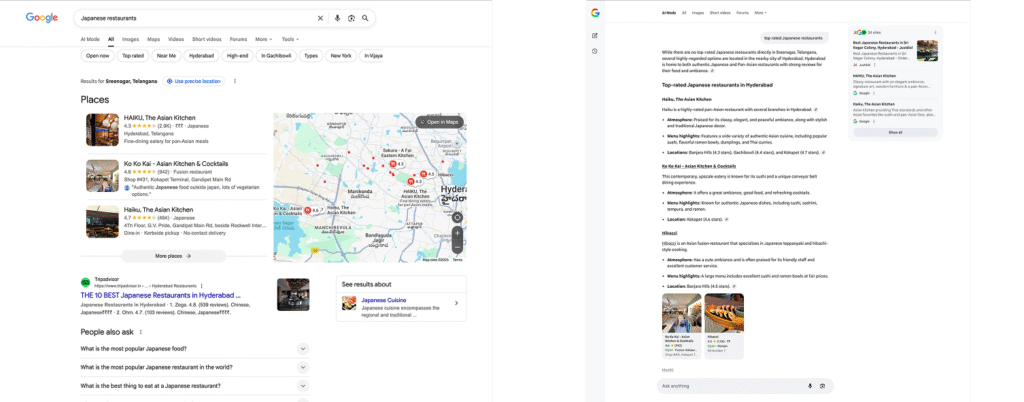
Ultimately, here’s the uncomfortable truth: the future of search won’t be won by the brand with the catchiest 15-second spot. Instead, it will go to the brand that adapts fastest to conversational, agentic, and visual search — where clicks vanish, tasks happen inside the results page, and brand visibility comes from answers, not links.
Here’s the uncomfortable truth: the future of search won’t be won by the brand with the catchiest 15-second spot. Instead, it will go to the brand that adapts fastest to conversational, agentic, and visual search
Meanwhile, Google’s new AI Mode videos — the breezy “Feeling stuck? Just Ask Google” and the slangy “Lost the plot? Just ask Google to get the tea” — feel fresh and relatable. They sell outcomes over features. However, if you’re a marketer thinking “nice ad,” you’ve missed the point. Specifically, AI Mode is reshaping discovery, decisions, and attribution, so you need a new marketing playbook.
What Google’s Ads Get Right

First, they speak human. “Get the tea” works because conversational search is now normal behaviour. In fact, people ask questions like people, not robots. Furthermore, data shows that zero-click and follow-up queries are on the rise. Therefore, Google’s tone matches real user habits without confusing tech talk.wsiworld+1
Similarly, this people-first move echoes Swiggy’s Wiggy 3.0 campaign: authentic connections over algorithms.
Smart Scenario Selection
For example, one spot shows a student stressing over finance homework. Likewise, the other captures a literature student struggling with Shakespeare’s twists. Consequently, these scenes prove AI Mode breaks down hard topics and handles follow-ups better than any feature list. Notably, most brands overthink this, but Google kept it simple.
Moreover, using “get the tea” for Shakespeare makes a 400-year-old play feel as juicy as modern gossip. Thus, Google bridges old and new without condescension.
Technical Restraint Builds Trust
Additionally, Google avoids jargon, model names, and benchmarks. Ultimately, it’s not oversimplifying; it’s opening the funnel. Meanwhile, the tech runs deep behind the scenes.quickframe+1
Where the Ads Fall Short
The real change: search is becoming a to-do list that gets done
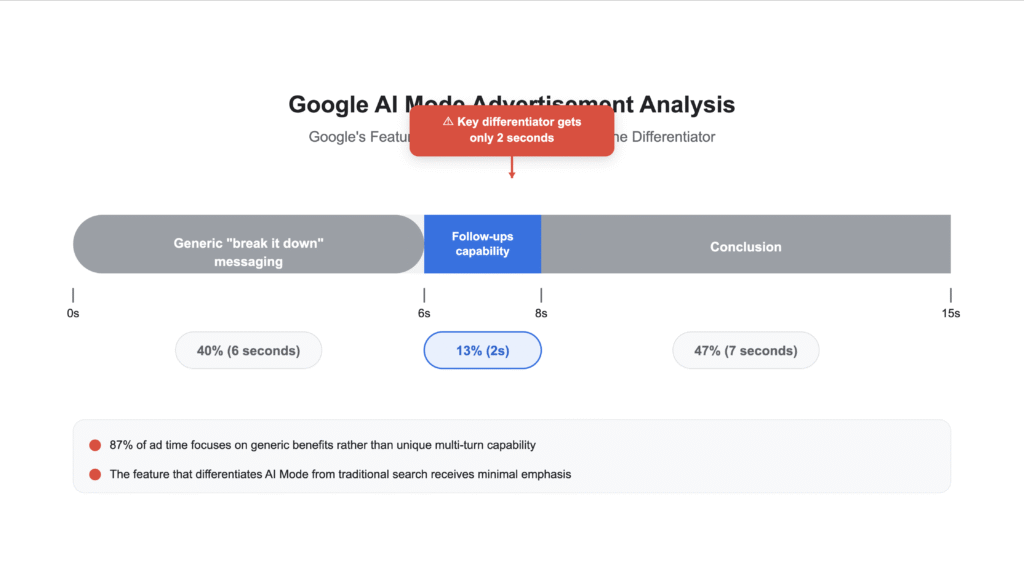
Most damning, Google buries its best feature. In particular, “and even ask follow-ups” appears for only two seconds in the Shakespeare spot. Clearly, multi-turn follow-ups chat sets AI Mode apart, yet Google treats it like a bonus. After all, competitors like ChatGPT already break things down — Google needed to lead with follow-ups.
Most damning, Google buries its best feature. Multi-turn chat sets AI Mode apart, yet Google treats it like a bonus
Duration Constraints
Moreover, a 15-second spot sparks curiosity but cannot change habits at scale. Indeed, conversational search is reshaping click-through rates and funnel paths. Consequently, marketers risk missing the full impact.bain+1
By contrast, KitKat’s musical break ads use short and long formats to build both rhythm and emotion.
Unclear Differentiation
Similarly, Google sells the vibe but not the advantage. For instance, why pick AI Mode over Perplexity, Copilot, or TikTok search? Because Copilot boasts 73% higher CTRs, marketers need clear reasons to invest, not just style.about.ads.microsoft
Meanwhile, focusing on students ignores bigger money in finance, healthcare, B2B research, travel, and shopping. Therefore, Google’s agentic booking features and visual shopping deserve equal airtime.verkeer+1
The Real Change: Search as a To-Do List
The most important updates to AI Mode aren’t in the ad. Two shifts matter more than any slogan.
First, agentic behaviour. Google now lets you book a table or complete actions inside search. Consequently, the entire funnel lives in one interface.thinkwithgoogle+1
Second, visual-first exploration. Inspiration grids and live product options draw on a 50 billion–item Shopping Graph. Thus, search feels part Pinterest, part Google.retailbrew
In summary, search becomes a conversation that ends with a task, not a click. As a result, websites relying on organic visits will suffer.wsiworld+1
What This Means for Performance & Content
Prepare for crocodile-mouth analytics. Impressions will climb while clicks fall, and brand mentions will rise in AI summaries.
If your reports still chase clicks, you will underinvest in what truly drives visibility.themartechsummit+1
Content Optimisation
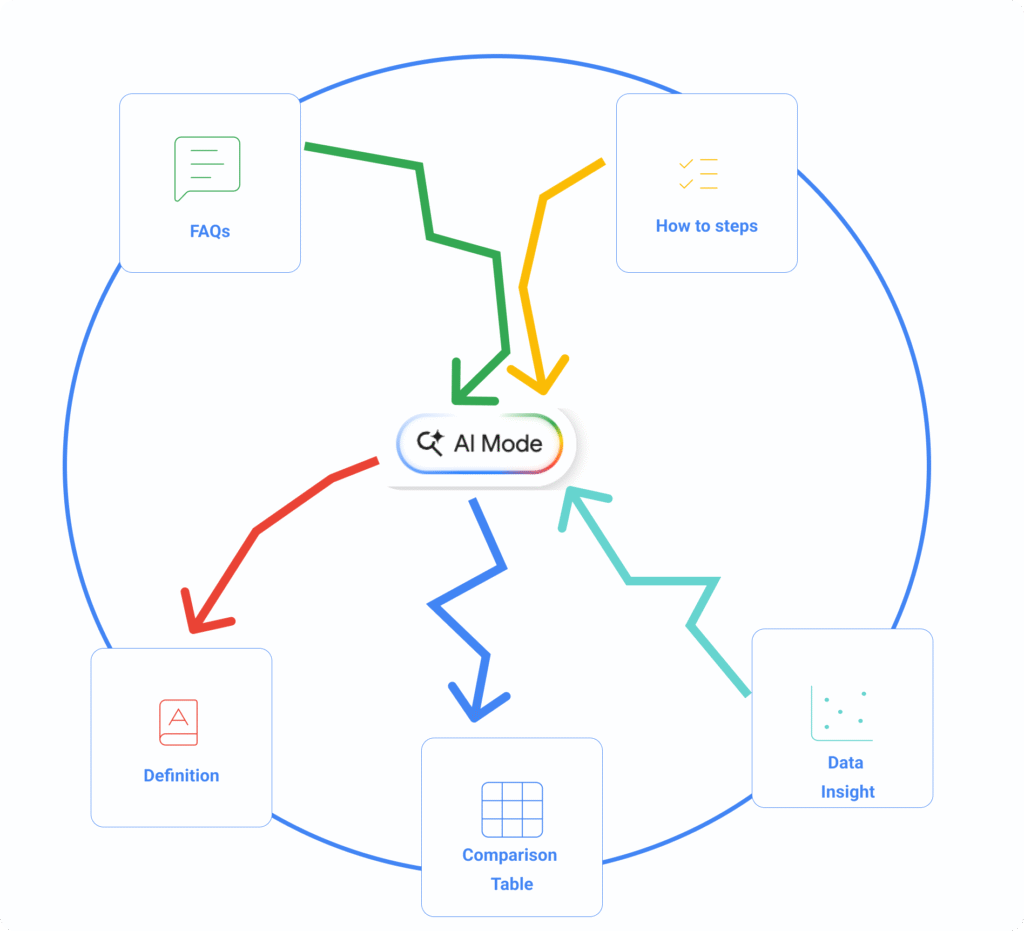
Furthermore, AI answers cite and synthesise. Your job is to make your content easiest to cite.
That means clear FAQs, how-tos, decision frameworks, and schema markup designed for excerpting.quantifimedia+2
As a result, treat entity authority and generative engine optimisation as core SEO, not side projects.searchengineland
Funnel Restructuring
Meanwhile, top-of-funnel needs shrink; mid- and bottom-funnel assets grow. Hence, modular product pages, comparisons, expert explainers, and localised details become AI building blocks, not just landing pages.theegg
In addition, ad budgets will shift toward AI search formats. Therefore, PPC and SEO teams must collaborate on a unified AI canvas.wordstream+2
A Five-Part Playbook
- Design for questions, not keywords.
For example, write for “I overpronate, run 20 km weekly, and hate bulky soles — what should I buy?” Then, optimise headings and copy for that language.brainwavesindia+2 - Build AI-citable pillars.
Create concise summaries, schemas, and first-party data. Furthermore, publish unique research with expert quotes.quantifimedia+2 - Treat visual as content, not decoration.
If inspiration grids surface, supply high-quality images, detailed alt text, and refreshed shopping feeds.retailbrew - Prepare for agentic flows.
Ensure structured actions, accurate inventory, and frictionless hand-offs. For B2B, add spec sheets and demo links.verkeer+1 - Rethink measurement.
Add brand-mention tracking in AI answers. Also, build a test budget for AI Mode ad formats to gauge organic impact.bain+2
Creative Guidance
Moreover, tier storytelling: bumpers for awareness, 30s demos for flows, 60–90s films for category depth. Additionally, lead with follow-ups in your scripts: “Who’s Iago? Why does he hate Othello? What’s his plan?” to showcase sequential queries.porchgroupmedia+2
Finally, pair ads with mirror-dialogue landing pages: “Help me choose…” flows, skimmable videos, and cite-ready content. Ultimately, optimise for questions, not clicks.
The Risks If You Don’t Adapt
Zero-click is not a phase. Bain finds 80% of consumers rely on zero-click in 40% of searches, putting 15–25% of organic traffic at risk.
As a result, if you plan on “getting clicks later,” you’re behind the curve.bain
Performance Expectations Will Reset
Meanwhile, Microsoft reports higher CTRs and shorter journeys in Copilot. Therefore, standard search ads will feel blunt. Your media plan must reflect this AI shift.about.ads.microsoft
AI Mode is expanding fast. Consequently, global rollout, new languages (Hindi included), and deeper features close the window for early advantage. Late adopters face entrenched authority inside AI answers.theegg
A Practical 90-Day Roadmap
Weeks 1–2: Audit
- Identify top 50 revenue-driving queries as questions.
- Score content for AI-excerpt readiness (summaries, schema, visuals).
- Benchmark AI answer presence and brand mentions.
Weeks 3–6: Fix Foundations
- Ship schemas and FAQs on priority pages.
- Publish two first-party data assets with expert input.
- Enrich product feeds, images, and variant coverage.
Weeks 7–10: Test & Learn
- Run two AI Mode ad tests: one conversion-focused, one exploration-focused.
- Produce three 30s demo cuts for different personas; track lifts in citations.
Weeks 11–13: Scale & Systematise
- Expand conversational content to 100 more queries.
- Launch “entity authority” PR and expert partnerships.
- Build quarterly “AI visibility” reports on non-click discovery.
Final Word
Ultimately, don’t fetishise the ad; fix the system. Instead, rebuild content, data, and measurement so brands can appear helpfully, repeatedly, and visibly inside AI conversations where decisions happen.
Optimise for questions. Structure for answers. Design for visuals. Prepare for actions. Measure beyond clicks.
Then, you won’t just survive AI Mode; you’ll compound advantage while others wait for links that are never clicked.
References:
- https://www.wsiworld.com/blog/the-rise-of-conversational-queries-and-their-impact-on-serps
- https://www.bain.com/insights/goodbye-clicks-hello-ai-zero-click-search-redefines-marketing/
- https://quickframe.com/blog/youtube-marketing-guide/
- https://www.outbrain.com/blog/video-storytelling/
- https://themartechsummit.com/martech-thoughts-hans-henning-raven
- https://about.ads.microsoft.com/en/blog/post/august-2025/73-higher-ctrs-why-advertisers-need-to-pay-attention-to-conversational-ai
- https://www.verkeer.co/insights/october-2025-digital-marketing-industry-updates/
- https://www.retailbrew.com/stories/2025/10/01/google-gives-visual-upgrade-to-shopping-searches-in-ai-mode
- https://www.thinkwithgoogle.com/marketing-strategies/automation/google-io-2025-ai-marketing/
- https://www.quantifimedia.com/what-are-the-october-2025-google-seo-updates
- https://www.theegg.com/seo/apac/google-ai-mode-is-here-what-it-means-for-your-business/
- https://searchengineland.com/how-ai-is-reshaping-seo-challenges-opportunities-and-brand-strategies-for-2025-456926
- https://www.wordstream.com/blog/google-ads-ai-mode
- https://www.emarketer.com/content/genai-search-advertising-trends-2025
- https://www.thinkwithgoogle.com/intl/en-apac/marketing-strategies/search/ai-for-search-advertising-campaign-strategy/
- https://brainwavesindia.com/ai-changing-search-behavior-in-2025/
- https://www.leansummits.com/from-keywords-to-questions-how-search-is-becoming-more-conversational-in-2025/
- https://porchgroupmedia.com/blog/youtube-advertising-best-practices/
- https://business.google.com/in/resources/articles/abcds-of-effective-video-ads/