
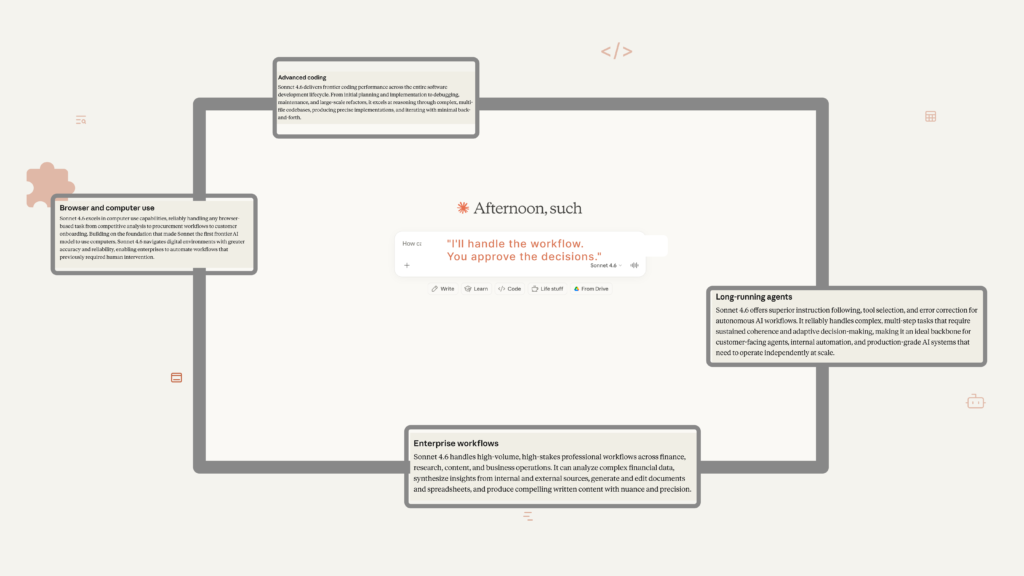
When Anthropic announced Claude Sonnet 4.6, it first looked like yet another model bump. Then I looked closer. What they were really launching was a future where my “default” AI reads my docs, writes my code and operates my computer, as coverage in outlets like CNBC made very clear.[cnbc]
This shift does not only matter to marketers or engineers. Instead, it lands in the middle of everyone’s workday, because almost every job now runs through software.
Sonnet 4.6 is now the standard model behind Claude for free and Pro users. According to Anthropic’s own Sonnet 4.6 launch blog and the detailed product page, it brings a long context window, lower prices than the top‑tier Opus model and one headline feature that keeps coming up in their messaging: better “computer use”, the ability to click, type and move through real apps and websites on my behalf.anthropic+2
What caught my eye was not only the model card. Rather, it was the launch choreography: a coordinated LinkedIn wave, Claude‑branded YouTube videos, and a confident “new default” storyline that shows up almost everywhere I look. Quietly, they are training me – and everyone else – to expect AI to act as a digital worker, not just a writing tool, which you can see both in Anthropic’s official narrative and in early hands‑on videos on the Claude YouTube channel.anthropic+1youtube+2
1. Why Sonnet 4.6 feels different to me
Within roughly two weeks, Anthropic rolled out Claude Opus 4.6 and then Claude Sonnet 4.6. I watched Opus get positioned as the deep‑thinking “frontier” brain. Soon after, Sonnet slid in as the model I actually hit by default in Claude.
From my vantage point, Sonnet 4.6 is where the real behavioural change happens. As outlets like Android Headlines and Anthropic’s own product page describe it, the model offers near‑Opus performance on many coding and automation tasks, but at mid‑tier prices and with better speed.
Key promises I keep seeing
On the feature list, I see:
- More accurate coding and refactoring, as highlighted in coverage from 9to5Mac.
- Stronger multi‑step reasoning over long contexts, reportedly up to around 1 million tokens in some beta configurations, according to the Claude release notes and the Sonnet 4.6 product details.
- Extended tool use and “computer use” for browser and desktop‑style tasks, a point that Anthropic and partners emphasise in the official Sonnet 4.6 blog and in Amazon’s Bedrock announcement.
These are not new concepts. However, the way Anthropic talks about them is new.
How the channels line up
In Anthropic’s own write‑up, they go deep on OSWorld, a benchmark where models control a virtual desktop with mouse and keyboard. Think Chrome, LibreOffice, VS Code – the everyday tools on my machine, all laid out in the Sonnet 4.6 launch blog.[anthropic]
In Anthropic’s framing – echoed in the LinkedIn ‘Today’s top news’ module and partner posts from AWS, Microsoft and others – this solves a specific pain I recognise: so many organisations still run on older or awkward software that either has no API or a brittle one.
On the Claude YouTube channel, the launch is even more explicit. The demos show Sonnet 4.6 navigating interfaces, updating documents and working with code, not just chatting, as in videos like “Introducing Claude Opus 4.6” and newer Sonnet‑focused walkthroughs. The whole thing feels less like a research milestone and more like a new colleague being introduced to the company.youtube+2
Because I have already written about Sonnet 4.5’s marketing, where Anthropic shifted from promise to proof, and about their more abstract “thinking partner” campaigns, I see Sonnet 4.6 as a steady escalation. They are no longer hinting at what Claude might do someday. Instead, they are showing me what it will do by default, today, which I explored in pieces like my Sonnet 4.5 launch critique and my analysis of Claude as a thinking‑partner brand.suchetanabauri+1
2. How “computer use” changes the way I think about AI
The phrase that has stuck with me from this launch is “computer use”. It is less glamorous than “general intelligence”, yet it is much closer to my actual work, as Anthropic’s own Sonnet 4.6 blog makes clear.[anthropic]
Sonnet 4.6 does not stop at text. It can open tabs, fill forms, click buttons and manipulate spreadsheets by driving a virtual computer. In Anthropic’s framing, this solves a specific pain I recognise: so many organisations still run on older or awkward software that either has no API or a brittle one, which is exactly the scenario highlighted both in the launch post and in Amazon’s Bedrock announcement about Sonnet 4.6 for legacy and enterprise systems.aboutamazon+1
From APIs to interfaces
I am used to thinking of automation as API integrations and zaps. Here, the “integration” is the UI I already stare at every day. OSWorld measures how well a model can complete tasks in that environment, using the same interface I do, as Anthropic explains in its Sonnet 4.6 launch blog.[anthropic]
Two parts of the story stand out for me:
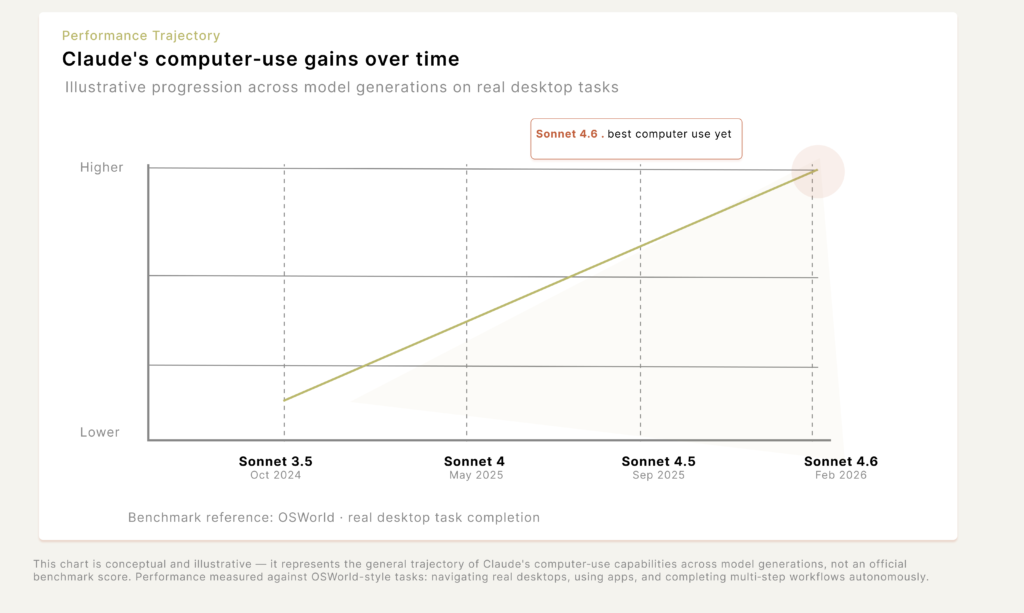
- Anthropic shows a curve, not just a single score. In the blog, they plot Sonnet’s OSWorld performance from Claude 3.5 through Sonnet 4, 4.5 and now 4.6. The line bends upwards. The implied question is not “Can this work?” but “When will you be comfortable letting it work?”, which is exactly how they frame the chart in the official post.[anthropic]
- They root the benchmark in familiar tools. Naming browsers and office apps makes it impossible for me to treat this as an abstract test. I can picture the model stepping through some of my own admin and reporting flows, just as the Anthropic write‑up encourages readers to do.[anthropic]
A different default question
For me, that changes the default question. It is no longer “Should we let AI near our tools at all?” Instead, it becomes “On which tasks, and under what supervision, do we allow AI to run the workflow?”
That sounds empowering, but it is also a little unnerving. If I hand a model CPU‑level access – even in a sandbox – I am no longer just asking it to suggest words. I am asking it to push buttons and commit changes. In a CRM, finance system, CMS or HR portal, that is the difference between a draft and a transaction.
3. Watching the launch roll through LinkedIn and YouTube
Because I live on LinkedIn more than any other social platform, that is where the Sonnet 4.6 story really came alive for me.
On launch day, LinkedIn’s “Today’s top news” banner clearly stated that Anthropic had released its second significant model in under two weeks and that Sonnet 4.6 was now the new default for Claude, with better multistep computer use, coding and design, as highlighted in the CNBC/LinkedIn post.[linkedin]
The LinkedIn chorus
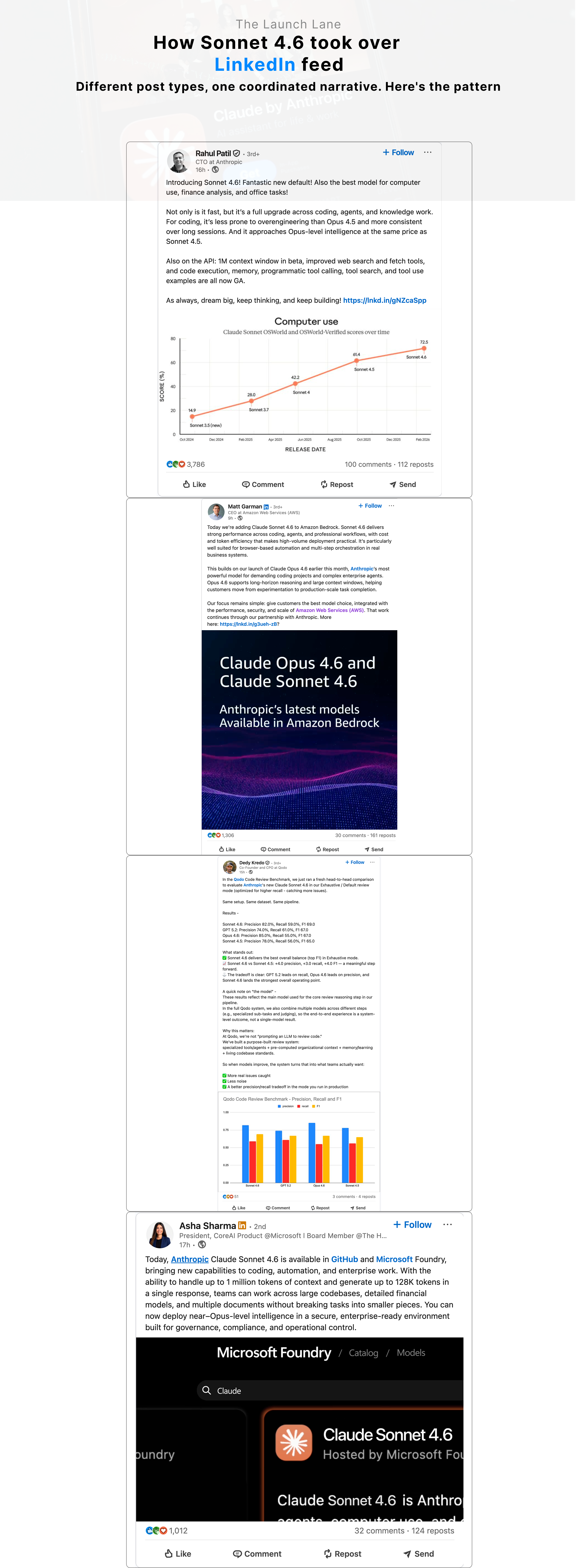
Under that banner, my feed filled up with posts. Anthropic leaders, AWS and Microsoft executives, dev‑tool founders and analytics companies all used similar lines:
- Sonnet 4.6 is the new default.linkedin+1
- It is the best model yet for computer use and agents.linkedin+2
- It is a direct upgrade to Sonnet 4.5 in most workflows, as several launch posts on LinkedIn framed it.linkedin+1
One chart in particular stuck with me. Qodo shared a code‑review benchmark comparing Sonnet 4.6, GPT‑class models and earlier Claude versions on precision, recall and F1 for catching issues in code. Those are metrics I have actually heard engineering leaders debate in meeting rooms. It made the launch feel less like a flex and more like a performance review, which outlets like Analytics India Magazine picked up in their LinkedIn coverage.[linkedin]
AWS leaders, meanwhile, used their posts to announce Sonnet 4.6 landing in Amazon Bedrock, stressing frontier‑level performance but at lower cost and with the same enterprise scaffolding they already sell. That matters if I am trying to imagine real deployments rather than one‑off hacks.aboutamazon+1
The YouTube angle
On YouTube, I saw the same narrative in a different costume. The Claude channel and early reviewers pushed out hands‑on videos – Sonnet 4.6 building features, browsing the web, updating documents, and slotting into developer or founder workflows – in uploads like this walkthrough from the Claude channel, a short “just released” overview and other early tests.youtube+4
The titles chase attention, yet as I watched, the underlying claims matched what Anthropic had written up: useful coding, credible automation, near‑Opus quality on many tasks without Opus‑level pricing, a framing echoed in pieces such as Android Headlines’ take on “flagship power at budget pricing” and several of those YouTube reviews.youtube+1[androidheadlines]
Because I have already picked apart Anthropic’s earlier campaign work – from Sonnet 4.5’s launch to the more impressionistic “Keep Thinking” film – I read this LinkedIn and YouTube wave as a deliberate evolution. They have tightened their story around agents and “default” in a way I had been expecting, but had not fully seen until now.suchetanabauri+1
4. How I think engineers should respond
I am not an engineer, but I work with enough of them – and use enough coding tools myself – to see what Sonnet 4.6 changes.
When Anthropic says Sonnet 4.6 is “near‑Opus‑level on the coding tasks we care about”, they are saying: for a large chunk of everyday engineering work, this cheaper, faster model is now good enough. Coverage such as 9to5Mac’s breakdown of Sonnet 4.6’s coding gains and Anthropic’s own Sonnet product page both reinforce that framing, and when you add availability through platforms like Amazon Bedrock and IDE integrations, it starts to look like a realistic co‑worker rather than a toy.9to5mac+3
I am not an engineer, but I work in the fringes of software engineering as a content, UX and UI professional, and my job means I sit next to engineers a lot. Many of my closest friends are engineers too, so I tend to look at launches like Sonnet 4.6 through their eyes as well as my own.
How I’d expect engineers around me to use Sonnet 4.6
Designing for agents, not just humans
The first shift I see for engineering teams is mindset. If I were in their seat, I would start assuming some “users” will be AI agents acting through APIs, tools or even the UI. That means planning for clear state transitions, predictable errors and strong audit logs, exactly the kind of guardrails Anthropic talks about around computer use in its Sonnet 4.6 blog and product page. Computer use only really makes sense when everyone can see what the agent did and when.anthropic+1
Using specs and tests as leverage
The second shift is where they put their effort. The more capable the model, the more valuable it is to be the person who can frame work clearly. As write‑ups like Android Headlines’ Sonnet 4.6 overview and Anthropic’s own docs point out, Sonnet 4.6 performs best with detailed requirements and a test suite to aim at. If I were an engineer, I would invest time in writing those specs and tests rather than trying to out‑type the model.anthropic+2
Putting Sonnet in the reviewer seat, not the driver’s seat
Third, I would expect Sonnet 4.6 to show up as a strong reviewer and drafter, not the final authority. The Qodo code‑review benchmark that’s been circulating on LinkedIn suggests real gains in recall when it comes to catching issues, which makes Sonnet a good extra reviewer in the pipeline rather than a replacement for human sign‑off, as covered in posts like this Analytics India Magazine summary.[linkedin]
Learning the cost and context knobs
Finally, there is the cost side. With Sonnet 4.6, engineers can feed in far more context, but they still pay in latency and money. The Claude release notes and Sonnet page both make that trade‑off clear. If I were running these systems, I would want to understand how to chunk repos, use retrieval and design efficient flows so I am not mindlessly “sending everything to Claude” and wondering why the bill is high.support.claude+1
From where I sit, engineers who lean into those four moves – agents as users, specs and tests as leverage, Sonnet as reviewer, and cost‑aware context design – will feel more powerful, not more threatened, by this release.
5. How I see UX, product and content design shifting
Because Sonnet 4.6 can operate software, it drags UX into the spotlight in a new way. I used to think about interfaces as things humans use and models describe. Now I have to think about interfaces as things humans and models both navigate, exactly the shift Anthropic hints at in its Sonnet 4.6 launch post.[anthropic]
Designing for a dual audience
Interfaces now have two audiences. If a screen confuses a model, it probably confuses a human as well. Cryptic labels, hidden controls and fuzzy states will break both. Sonnet‑class agents do better with clear labels, stable layouts and explicit feedback, which is very close to how Anthropic describes “reliable computer use” in its Sonnet 4.6 launch post.[anthropic]
Flows need to be agent‑ready. When I sketch onboarding, reporting or campaign flows, I now ask: could a supervised agent complete this without hacks? Flows with predictable steps, fewer surprises and good validation are easier to hand to an AI colleague later.
Conversational intent is part of the surface. Because Sonnet 4.6 is the default brain in Claude, I expect more people to describe their goals in natural language and let the assistant drive the product, just as Anthropic’s product page suggests through its examples of multi‑step “computer use”. That pushes me to map intents like “set up a weekly churn report” to concrete flows and to design preview states where the user can see what the agent is about to do.[anthropic]
This connects directly back to my earlier work on assistant UI design and on Claude as a thinking partner. I argued then that assistants should be treated like products, not chrome. Sonnet 4.6 is the first Claude launch that really assumes the assistant is driving the rest of the product in a serious way.suchetanabauri+1
6. How I would use Sonnet 4.6 as a non‑technical professional
Most of my work sits outside engineering and coding. I live in digital marketing, content strategy and UX/UI, which all revolve around the same core loop: strategy, research and reporting.
Most of my day flows through tools: CRMs, analytics platforms, spreadsheets and dashboards. Those are exactly the kinds of surfaces this model’s “computer use” is meant to handle, as write‑ups like 9to5Mac’s Sonnet 4.6 overview make clear.
My practical playbook
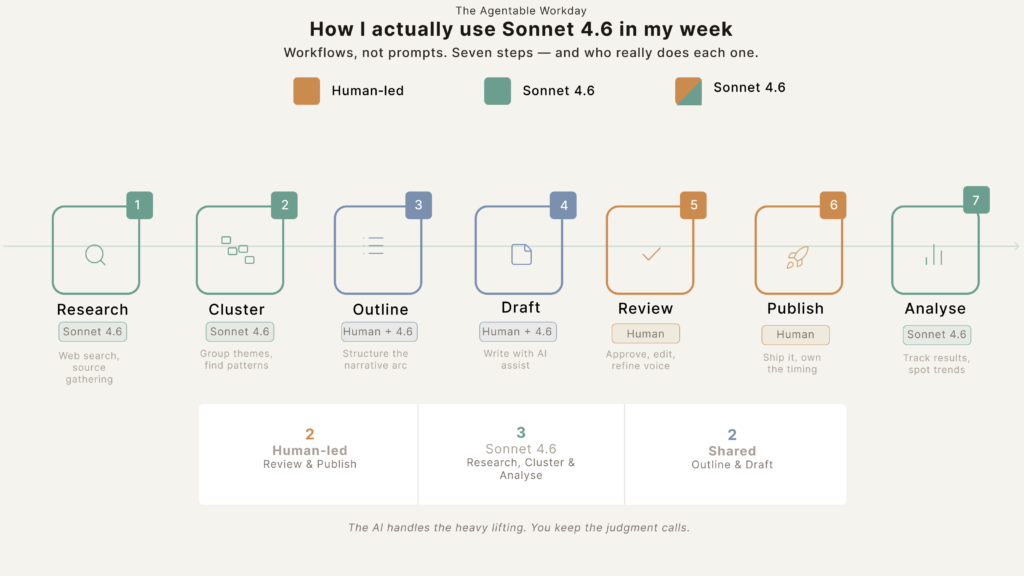
I think in workflows, not prompts.
Rather than asking Claude for a clever idea and stopping there, I map the whole flow: research → cluster → outline → draft → review → publish → analyse. Then I decide where Sonnet 4.6 should drive, where it should assist and where I stay fully in charge. That mindset borrows from the AI marketing best‑practice and AI marketing strategy work I have already done on my site.
I build prompt systems, not one‑off requests.
With the long context window described in the Claude release notes and Sonnet product page, I can give Sonnet 4.6 a living “pack” for my work: brand guidelines, tone rules, example campaigns, lists of “never say” and domain knowledge. That context sits alongside my actual request. Over time, I can refine that pack the way I would refine a playbook for a new hire.
I let computer use clean up the drudge work.
When I catch myself copying data between tools, exporting CSVs or stepping through the same reporting flow every week, I now flag that as “agentable”. Exporting reports, cleaning lists, updating CRM fields and checking competitor pages are all jobs I can imagine handing to a supervised Sonnet agent, especially given how its “computer use” is framed in Anthropic’s launch and in Amazon’s Bedrock announcement.
I keep validation as a hard rule.
In my earlier writing on Claude and marketing restraint and broader AI marketing, I argued that the real risk is not that models are too weak; it is that they are persuasive and unchecked. That does not change with Sonnet 4.6. If anything, the computer‑use angle makes it more urgent for me to build review and sign‑off into my flows before anything goes live.
7. Where I stay sceptical about the launch
As polished as this launch is, I do not take any of it at face value.
Anthropic highlights internal tasks and OSWorld, then uses confident lines about “near‑Opus‑level” coding. Public, standardised comparisons with rival models are left mostly to YouTube reviewers, who often favour dramatic titles or sweeping “everything you need to know” claims – for example early breakdowns like this Sonnet 4.6 walkthrough or “all‑you‑need” explainers that echo the talking points without fully stress‑testing them. I find those videos useful as demos, but not as the basis for serious decisions, even when they align with more measured write‑ups such as Android Headlines’ overview of Sonnet’s coding gains.youtube+3[androidheadlines]
I also notice how safety slides down the page. Anthropic’s own write‑up still talks about alignment, guardrails and testing in its Sonnet 4.6 launch post. Yet when I scan LinkedIn posts, partner blogs and launch videos, the focus is squarely on capability, speed and cost, as you can see in the LinkedIn news module and partner updates from AWS and others. If I care about risk – and I do – I have to bring those questions back into the conversation myself, rather than expecting the YouTube thumbnails to do it for me.anthropic+4[youtube]
Finally, I am wary of the simple “flagship power at budget pricing” story. Articles and videos quickly frame Sonnet 4.6 as a way to cut development or campaign costs, with headlines like “flagship power at budget pricing” and creator videos promising dramatic savings. Lower API prices help, but most projects are dominated by design, integration, governance and ongoing maintenance. Those remain very human. So I try not to promise anyone a 40% discount just because the tokens got cheaper.youtube+2[androidheadlines]
8. What I am actually doing with all this
For me, Sonnet 4.6, as the new default, is a prompt to act rather than a tech curiosity.
I audit my week for “agentable” tasks. I look for work that involves opening tools, copying data, filling forms and triggering actions. Those go on a list of flows I want to test with supervised agents, especially in the kinds of legacy and enterprise systems Anthropic and AWS highlight in their Bedrock announcement and the Sonnet 4.6 launch post.
I run structured experiments. Instead of playing with random prompts, I pick a workflow and run it two ways: current method versus Sonnet 4.6 in the loop. I track time, quality and error rate. That gives me evidence I can actually use when I talk to teams or write new pieces.
I move myself up‑stack. Whenever I feel threatened by automation, I ask what remains uniquely mine: judgment, taste, knowledge of the organisation, relationships. I try to move my role closer to those things and let the model take the repetitive pieces.
I curate my inputs. This launch alone has created dozens of posts, press hits and videos. I have learned to choose a small set of sources I trust – including my own slower, critical analyses – and ignore the noise. That is part of what I want my site to be: a place where I can revisit launches like Sonnet 4.6 with more distance, alongside pieces like my Sonnet 4.5 analysis, the “Keep Thinking” campaign breakdown and the wider Claude AI marketing and Anthropic marketing strategy archives.
Sonnet 4.6 is not Anthropic’s most powerful model. It is not their flagship. But because it is the default, and because it spans coding, documents and computer use, it is the one I expect to feel most in my day‑to‑day work, as even mainstream coverage like CNBC’s launch piece stresses.
I do not need to become an Anthropic fan. I do need a view on what “default AI” is allowed to do in my world, and what stays firmly in human hands.
Footnotes
External sources
- Anthropic, “Introducing Claude Sonnet 4.6”.[anthropic]
- Anthropic, “Claude Sonnet 4.6” product page.[anthropic]
- CNBC / LinkedIn, “Anthropic releases Claude Sonnet 4.6, continuing breakneck pace of AI model releases”.linkedin+1
- 9to5Mac, “Claude Sonnet 4.6 model brings ‘much‑improved coding skills’ and upgraded free tier”.[9to5mac]
- Android Headlines, “Claude Sonnet 4.6: Flagship AI power at budget pricing”.[androidheadlines]
- About Amazon, “Claude Sonnet 4.6 from Anthropic available in Amazon Bedrock”.[aboutamazon]
- Claude Help Centre, “Release notes”.[support.claude]
- LinkedIn launch posts on Sonnet 4.6 from Anthropic leaders, partners and media”.linkedin+5
- YouTube videos and reviews demonstrating Sonnet 4.6 and positioning it against other models.youtube+4
Internal sources (suchetanabauri.com)
- “Claude Sonnet 4.5 Marketing Analysis – Anthropic AI Launch Critique”.[suchetanabauri]
- “Selling AI Without Showing Product” (Claude as a thinking partner, marketing restraint).[suchetanabauri]
- “Deconstructing Anthropic’s Bold ‘Keep Thinking’ Gambit”.[suchetanabauri]
- AI marketing best practices archive.[suchetanabauri]
- AI marketing strategy archive.[suchetanabauri]
- Claude AI marketing archive.[suchetanabauri]
- Anthropic marketing strategy archive.[suchetanabauri]
- AI coding tools archive.[suchetanabauri]
- Digital assistant user interface design tag and related pieces.[suchetanabauri]