
Most AI brand channels are beige wallpaper. Anthropic’s new Claude channel is not. It is trying to do something far more ambitious: turn an LLM into a working character that quietly shows up everywhere real work happens – in Excel, PowerPoint, Figma, HubSpot, museums, even a Formula 1 garage – without ever becoming the main spectacle.
If you work in marketing and you’re still treating “AI content” as the extent of your strategy, that should bother you. This channel is a glimpse of where the real power (and differentiation) is moving: away from prompts and into how the model lives inside tools, teams, and stories. That shift mirrors the argument I made when I analysed Anthropic’s first big campaign in Deconstructing Anthropic’s Bold “Keep Thinking” Gambit – Claude works best when it’s framed as infrastructure, not spectacle.[suchetanabauri]
The centre of gravity is shifting from AI as output generator to AI as workflow engine. The Claude channel is one of the first big‑company attempts to show that in public.
In this article I will talk about how Claude’s channel is quietly sketching a new playbook for AI‑native brands – and why marketers who keep treating YouTube as a demo shelf are going to lose out to those who treat it as a world‑building lab for workflows.
The end of “AI as content machine”
Most AI marketing still revolves around the same tired idea: this tool helps you write more content, faster. You see the pattern everywhere: bright thumbnails, “secret” prompt lists, and endless “10x your output” claims.
Claude’s channel is clearly trying to escape that gravity. Rather than marketing the model as a content hose, the videos show it working inside specific, quite demanding jobs. Consider the spread of pieces you’ve recently consumed end‑to‑end:
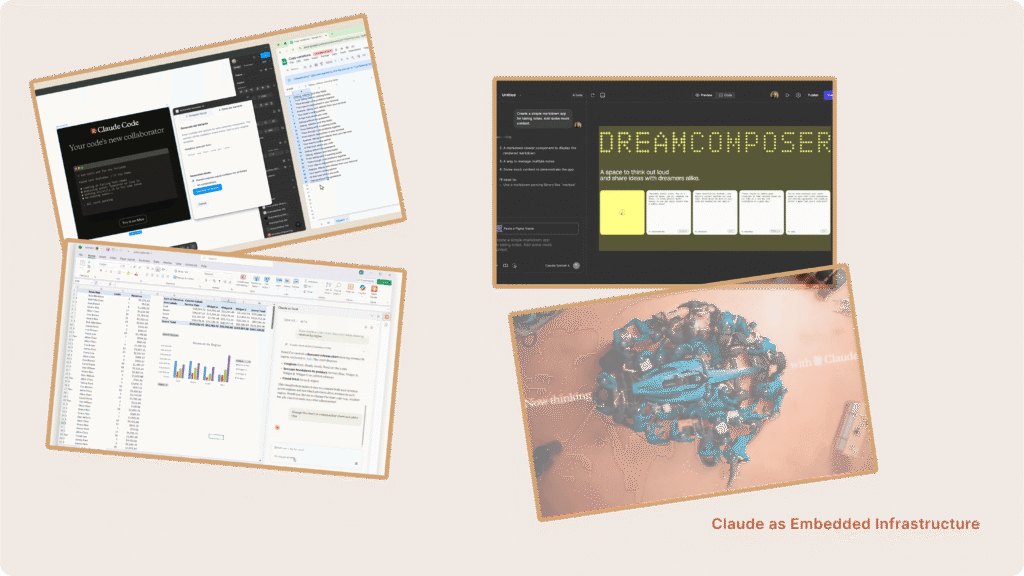
- Austin Lau at Anthropic using Claude Code to build a Figma plugin that cuts ad creative production from 30 minutes to 30 seconds, despite starting from “how do I open a terminal”. [YouTube] Claude blog
- Claude in Excel, acting as an in‑sheet analyst: debugging formulas, explaining inherited models, cleaning data, and building DCFs and forecasts in conversation. Anthropic YouTube
- Figma Make, where Claude powers prompt‑to‑prototype flows so designers can generate real, code‑backed interactions without touching an IDE. YouTube Claude x Figma
Infrastructure, not “more content”
The pattern continues beyond design and spreadsheets. HubSpot reports up to a 40% productivity lift across engineering, content, and customer success after adopting Claude across their stack. Claude x HubSpot YouTube A.A. Murakami’s The Moon Underwater at Mori Art Museum uses Claude as an invisible studio technician for an installation made of bubbles, fog rings, and plasma. Anarchy Daily YouTube Atlassian Williams F1’s “Thinking Partner” campaign then choreographs an entire race crew into a brain on the garage floor to dramatise Claude as part of pit‑stop‑level thinking. LBBOnline
Collectively, these stories make a simple point. This isn’t “Claude writes copy”. It is Claude as infrastructure: woven into workflows and environments that have nothing to do with content as marketers usually define it. When I unpacked Anthropic’s Sonnet 4.5 launch in Claude Sonnet 4.5: A Marketing Analysis, the same pattern showed up: less hype, more “here’s how serious teams actually use this”.
For marketers, that’s the first big wake‑up call. If you’re still benchmarking AI tools by “who writes the nicest LinkedIn post” while your competitors are wiring models into Figma, Excel, HubSpot and internal tools, you’re optimising for the wrong game.
If your AI story stops at “better content”, you’ve already lost to teams treating models as workflow engines hidden inside the stack.
2. From features to personae
Most SaaS channels are built around releases and tutorials. There is a new feature, you get a new video, and perhaps a customer logo slapped on top. Claude’s channel is doing something more narrative: it is sketching a set of archetypes.
If you map the videos to “who Claude is being” in each context, a pattern appears:
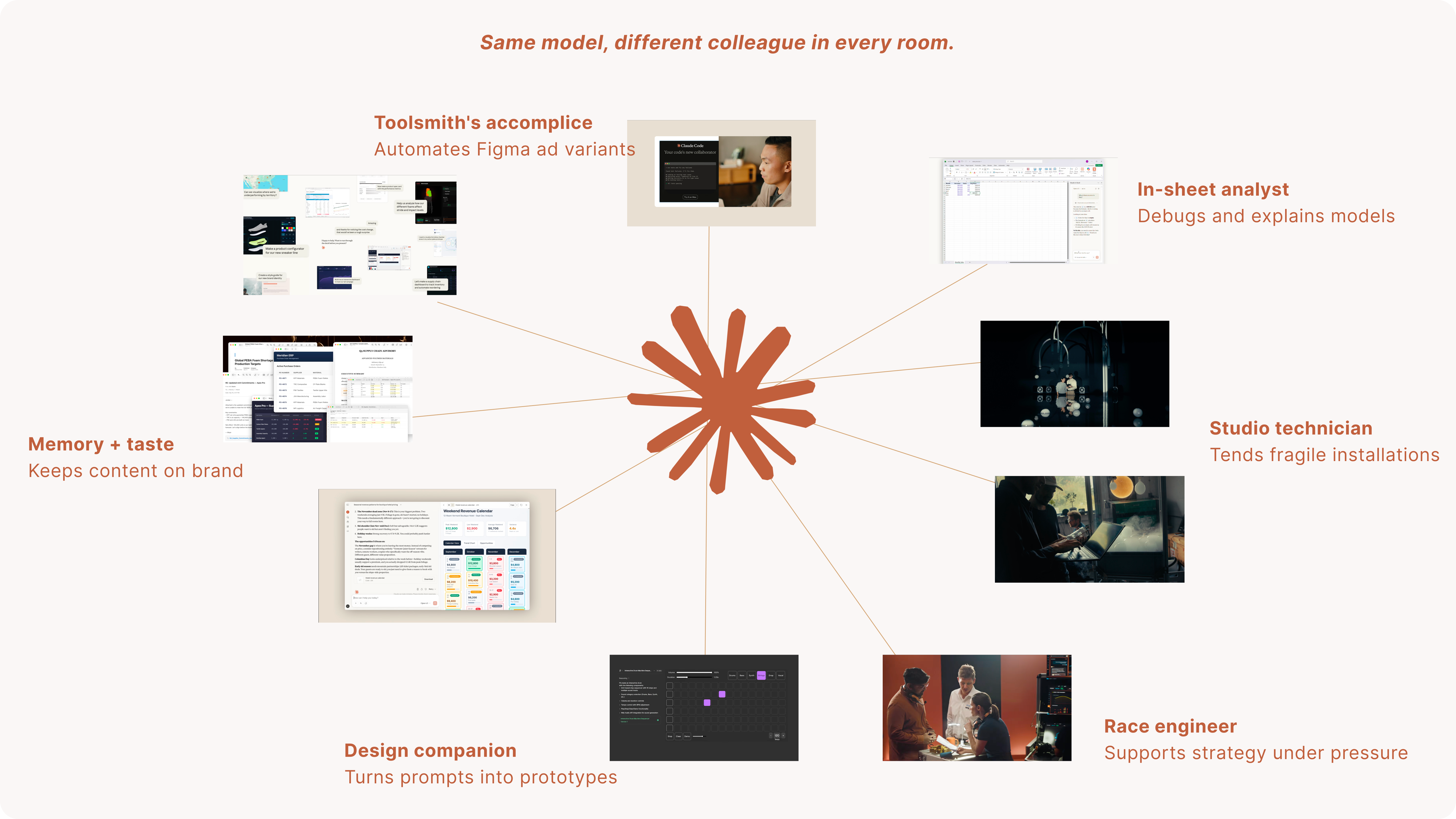
- In Austin’s Figma story, Claude is the toolsmith’s accomplice – a quiet co‑engineer helping a growth marketer automate a tedious ad‑creative workflow inside Figma and Google Docs.Claude blog YouTube
- In Excel, it is the in‑sheet analyst – someone who understands your workbook’s logic, not just token strings, and can explain your predecessor’s monster formulas without rolling its eyes.YouTube Claude in Excel
- In Figma Make, it is the code‑native design companion – a model that “just knows code better than most” and can turn prompts into prototypes that real developers respect.Claude x Figma YouTube
Claude as colleague, not magician
The same persona game keeps going. In HubSpot’s case study, Claude becomes the organisation’s memory plus taste – generating on‑brand marketing content, personalised CSM follow‑ups, and helping engineers navigate a sprawling codebase.LinkedIn YouTube In A.A. Murakami’s Moon Underwater, it shifts into the studio technician – a research assistant who has “read everything about bubbles” and helps manage fragile, semi‑autonomous physical systems.YouTube Mori Art Museum In Williams F1’s “Thinking Partner” film, it shows up as the extra race engineer – a brain on the pit wall, not a mascot on the car.Williams F1
The same model, six different personae. Crucially, it is almost never framed as the hero. Claude is backstage, in the pit lane, inside the spreadsheet. The human teams, contexts and tools are front‑and‑centre. That’s the same restraint that I have talked about was the brilliance of the original “thinking partner” spot in Claude’s “Thinking Partner” Video Is a Masterclass in Restraint.
This is a subtle but important departure from the usual AI narrative. Most AI marketing still treats the model as the magician: look what it can do. By contrast, Claude’s channel treats the model as the colleague: here is how it sits in someone else’s craft.
For marketers, that is a design pattern you can steal. Instead of “ChatGPT for X”, ask: what persona does our AI play in this team? What kind of colleague is it? Where does it physically live in their stack?
If your model doesn’t have a clear personality in context, it doesn’t have a brand. It has a spec sheet.
When you plan content around an AI product, pause at your next script and ask whether you are selling raw power or introducing a character your audience will actually want in the room.
3. Why this lands now: AI is moving from prompts to places
So why does this channel feel different now, in early 2026? The short answer is that the ecosystem has shifted around it. AI is quietly moving from prompt boxes to embedded agents in tools, and the Claude channel is one of the few places where you can see that change dramatised.
3.1 Deeper tool integrations
To start with, Claude isn’t just a web app. It has native add‑ins for Excel and PowerPoint, with shortcuts to open it inside the file, and support for multi‑sheet, multi‑step operations. It is also wired into Figma Make, powering an entire prompt‑to‑prototype experience rather than a one‑off plugin. On top of that, HubSpot has shipped the first CRM connector for Claude, so your CRM data can be queried and transformed in‑place.claude+8youtube+2
3.2 Serious, regulated domains
Beyond integrations, Anthropic is explicitly targeting financial services with Opus 4.6 and the Excel integration. The pitch is stronger reasoning and better transparency for modelling and analysis, which is a very different bar from “blog posts faster”. Excel‑specific content shows Claude building three‑statement models and CVR analyses in ways that invite scrutiny rather than hiding the maths.investing+6[youtube]
3.3 Operational metrics, not just vibes
In addition, there are numbers. HubSpot publicly talks about a 40% productivity lift across dev and content work, which is the sort of signal CFOs and COOs pay attention to, not just CMOs. That sits very comfortably with Anthropic’s broader emphasis on “anti‑hype” launches, which I dissected in my Sonnet analysis.[youtube]datastudios+4
3.4 Prestige collaborations
Finally, the collaborators matter. Figma, Williams F1, Mori Art Museum – these are carefully chosen partners that signal a certain level of craft, taste, and operational complexity. It is hard to imagine these brands gambling on a flimsy model or a shallow integration.mori.art+6[youtube]
Taken together, these shifts mean that “Claude for everyday work” actually denotes something concrete: Excel models, PowerPoint decks, Figma prototypes, HubSpot workflows, creative installations, and race strategy – not just “Claude can answer emails”.anthropic+2youtube+1
This is the “why now” for marketers, and it is exactly the shift I called out in my wider AI‑marketing essays under the AI Marketing and AI marketing best practices tags.suchetanabauri+1
In 2023–24, AI was mostly about language. In 2025–26, it’s about where the model sits – in which tools, in which workflows, under which constraints.
If your marketing does not reflect that, you are stuck in last cycle’s story – the one I’ve been calling “the era of ‘look at the AI’”, which, frankly, is over.
4. What the Claude channel gets right
The channel is far from perfect. Even so, it is clearly operating with a sharper thesis than most corporate AI feeds. That thesis is very close to what I talked about in Claude’s “Thinking Partner” Video Is a Masterclass in Restraint and Claude Sonnet 4.5: A Marketing Analysis: infrastructure, not innovation theatre.linkedin+2
4.1 Coherence across wildly different contexts
Across very different environments, the model is always framed as a thinking partner, not a content slot machine. You see this language explicitly in Anthropic’s Opus 4.6 announcements, in HubSpot’s case study, and in the Williams F1 partnership, which literally names Claude the team’s “Official Thinking Partner”.finance.yahoo+4
You can see a straight line from “Claude helps you debug a spreadsheet and model scenarios” to “Claude helps a race team reason through car development and race strategy”. Very few AI brands manage to keep that sort of narrative coherence across such different use‑cases.linkedin+3[youtube]
4.2 Taste without screaming
Instead of flexing parameter counts or running comparison charts, the channel borrows credibility from its collaborators. Figma says Claude “just knows code better than most”. A museum lets it run the back‑end of a delicate installation about impermanence. HubSpot credits it with significantly faster idea‑to‑prototype cycles in production systems.figma+5youtube+2
Moreover, these are not generic logos. They are brands with strong opinions and demanding stacks. For marketers, it is a reminder: the best proof your AI is any good is not your own voice – it is who trusts it in public, and what they trust it with.
4.3 Genre as strategy
You can also spot at least four different content genres on the channel:
- highly produced product explainers (Excel, PowerPoint, “everyday work”)youtube+2[anthropic]
- case‑study mini‑docs (HubSpot, Austin Lau, Figma Make)youtube+2claude+2
- cultural pieces (A.A. Murakami’s “Moon Underwater”)anarchydaily+1[youtube]
- brand cinema (Williams F1 partnership, with a Dan Tobin Smith BTS)creativereview+2
Most B2B channels barely manage one genre. This mix makes the Claude channel feel like a world, not a playlist of release notes – exactly the world‑building instinct I talked about in Claude’s “Thinking Partner” Video….[suchetanabauri]
5. Where the channel is still too clean
The slate is strong. Yet some gaps are obvious.
5.1 It is still fundamentally broadcast
The channel is carefully composed, but it is not yet a conversation. You never see a PM and a user arguing through trade‑offs live. The channel offers no “office hours” where someone debugs real Figma or Excel nightmares on camera. Nor does it show messy rebuilds of actual client decks.
As a result, a lot of the content feels like broadcast rather than dialogue. In a world where independent creators happily film themselves breaking AI tools in public, a brand‑only narrative can feel anaemic.
In AI marketing, your roughest, most honest video will often do more for trust than your glossiest anthem film.
If you are a marketer watching this, the lesson is not “be more polished”. In fact, it is almost the opposite: your roughest, most honest AI content will often be the most useful. This is especially true if you are selling into markets like India where people are wiring these tools into under‑resourced teams and unpredictable stacks – a theme I return to often in my AI Marketing notes.[suchetanabauri]
5.2 The world is very Global North
The stories are Figma, HubSpot, Tokyo museums, and European F1 garages. It is the elite circuit. There is almost nothing about small Indian agencies in Hyderabad, Nigerian fintechs, or municipal teams in São Paulo trying to triage chaos with AI.
That matters because AI’s real test is not “does it help a well‑funded San Francisco startup?”. It is “does it help a mid‑tier team working on patchy internet, with half their stack on legacy tools and the other half in WhatsApp?”.
If Anthropic – or you – wants to win those markets, the channel needs to show Claude in messier, poorer, more constrained realities, not just high‑design ones.
5.3 We do not see enough failure
Every story resolves beautifully. The plugin works. The pit‑stop choreography lands. The spreadsheet models balance. The fog rings behave.
Anyone who has tried to wire an LLM into production knows that is not the whole story. There are hallucinated metrics, brittle edge cases, inexplicable layout glitches, security reviews, prompt leaks, and compliance headaches.
Showing none of that makes for nice brand cinema. It does not help practitioners. The next phase of good AI marketing will look more like behind‑the‑scenes product ops: here is where the model broke, here is how the team debugged, here is what we changed – the kind of candour I argued for in my “anti‑hype” take on Anthropic’s strategy.[linkedin]
6. How marketers should respond
It is easy to watch this channel, nod appreciatively, and go back to writing “10 AI prompts for…” carousel posts. Resist that urge. Instead, use it as a template for how to reposition your AI story – and plug it into a broader AI practice, not one‑off gimmicks.
6.1 Shift from “AI content” to workflow stories
Rather than another generic blog about how your AI helps “marketers be more efficient”, pick one specific, soul‑crushing workflow and tell the story that way. For example:
- the way Anthropic shows Austin Lau using Claude Code to turn an ad‑creative bottleneck into a Figma plugin;claude+1[youtube]
- the way Claude in Excel is presented not as “AI in spreadsheets” but as “the thing that finally explains that cursed inherited model and fixes the #REF!s while you watch”;claude+1[youtube]
- the way Figma Make uses Claude to push designers one step further into interaction and behaviour, not just layout.builder+2[youtube]
Ask yourself one clean question:
What is the one awful ritual my audience performs every week that we could quietly kill with AI?
Once you have that answer, make the video, the article, and the workshop about that. Name the tool, yes, but centre the ritual.
6.2 Cast your model as a character
Borrow the persona game. Consciously decide who your model is in each context. Is it a meticulous analyst, a slightly chaotic co‑pilot, a pedantic compliance officer, or a generative creative partner?
Then:
- reflect that in the way you script product content, including the questions you ask and the tone of its answers;
- reflect it in visuals, by choosing carefully where it shows up – on screen, in diagrams, or backstage;
- reflect it in distribution, by deciding which tools and ecosystems you integrate with first.
Claude’s “thinking partner” positioning works because it is consistent: from Opus 4.6 in finance, to Excel and PowerPoint, to Williams F1, to HubSpot, the model is always described and depicted as a reasoner, not a content cannon. That is also the through‑line I have been tracking across all my Claude essays – from Thinking Partner to Sonnet 4.5.claude+7
If your AI story is still “we do everything for everyone”, you do not have a character. You have a fog machine.
6.3 Turn your YouTube into a lab
The Claude channel is halfway there. It has an interesting slate of films but not yet a sense of live experimentation. That gap is where you can leapfrog.
Instead of treating YouTube as a dumping ground for polished marketing assets:
- run live workflow experiments: “Can we rebuild this agency media plan with AI in 45 minutes?”, “Can we debug three real customer spreadsheets live with our model?”;
- film cross‑discipline pairings: a designer and a backend engineer exploring Figma Make plus your tool; a CSM and a data analyst picking apart HubSpot workflows with your AI;youtube+1claude+1
- showcase non‑Western contexts: a Chennai SaaS team using your model to make sense of GST filings; a Nairobi agency using it for multilingual campaigns; a tier‑2 university class using it to build prototypes without MacBooks.
This is harder than commissioning one glossy hero film. That is the point. The marketers who do the hard thing now will own the “AI in the real world” narrative in two years.
7. A practical three‑month plan
If you have read this far, you probably care about more than just prompt lists. So here is a concrete three‑month plan, inspired by what Claude’s channel hints at but does not yet fully do – and very much in line with the kind of AI‑career pivot play I have written about elsewhere.[linkedin]
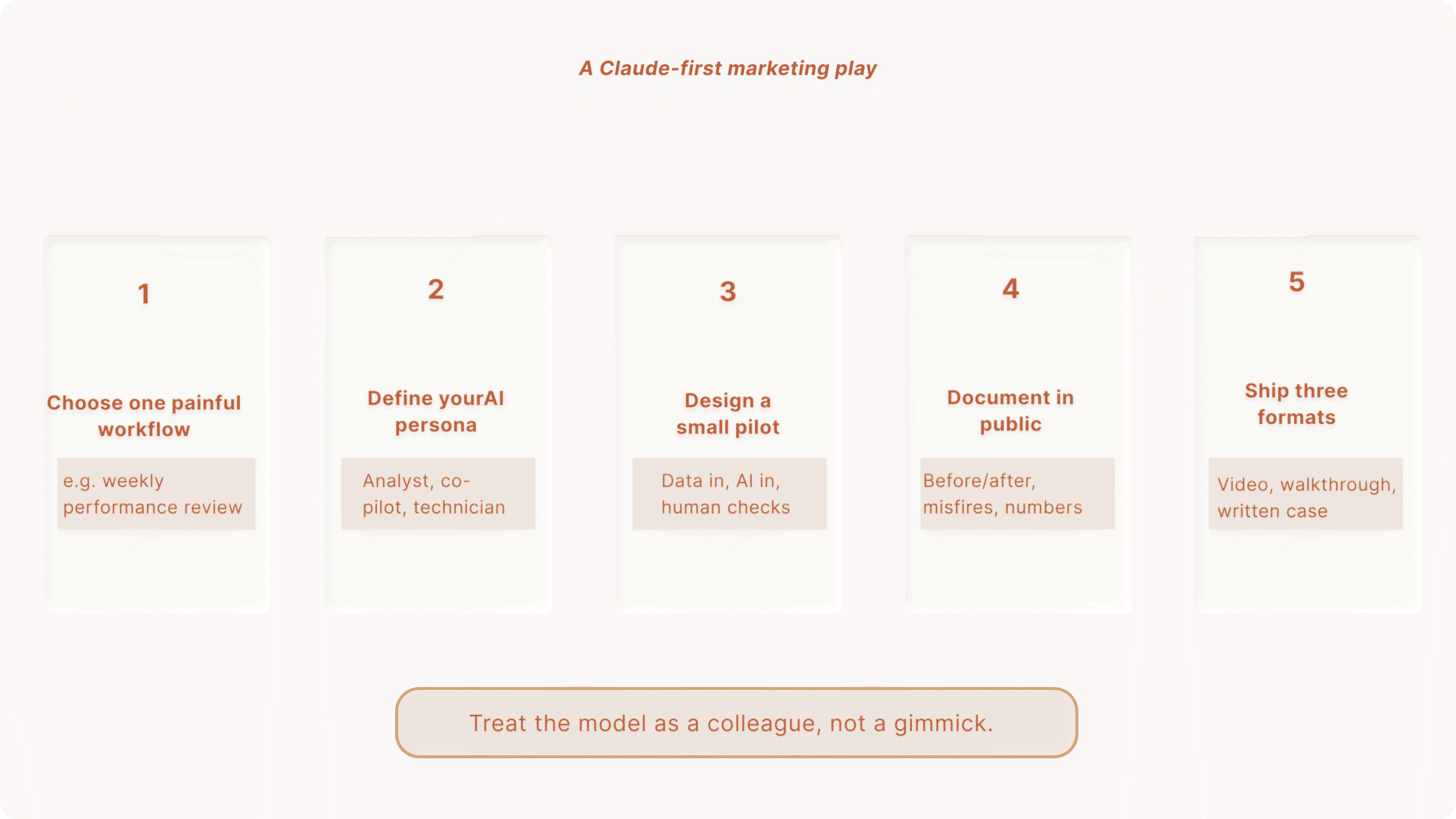
Step 1: Pick one workflow and one persona
Choose a single high‑pain workflow and a clear persona for your model. For example:
- Workflow: “weekly performance review across five ad platforms”.
- Persona: “Claude‑like analyst who lives in Sheets and your ad manager, not in a chat box”.
Step 2: Design a small pilot
Next, design a pilot integration or protocol. Even if you do not own the model, you can own the protocol: how data flows from tools into AI and back, how outputs are verified, how humans stay in the loop.
Step 3: Document it in public
Then, document it properly.
- Film the before/after.
- Show the misfires.
- Publish a short written case with real numbers (even directional) the way HubSpot did with its 40% productivity claims.datastudios+1[youtube]
Step 4: Ship three formats
Finally, ship three distinct formats.
- A tight two‑minute hero video for the impatient.
- A 20–30 minute messy walkthrough for practitioners.
- A written piece that casts the workflow as the main character, not your brand – and then lives alongside your other essays.
By the time you have done that once, you will have something vastly more interesting than “we added AI to our product”. You will have the beginnings of a world: a specific place, a specific kind of work, a specific model behaviour.
From there, you can do what Anthropic is doing with Claude: place that world next to others. Design. Finance. Art. Sport. Maybe, if you are paying attention to where growth is actually coming from, a call centre in Hyderabad or a hospital in Kochi.
Anthropic’s Claude channel is not perfect. It is too polished, too Northern, too light on failure. Even so, it is a serious attempt to answer a question that should be keeping marketers awake in 2026:
If AI is no longer a gimmick but a colleague, what does it look like to build a brand – and a YouTube channel – around that?
If your current AI content cannot answer that, it is time to rewrite the script.
Related reading on Claude and AI marketing
- Claude’s “Thinking Partner” Video Is a Masterclass in Restraint – why Anthropic’s earliest brand film made feeling the product, not the UI, the main event.[suchetanabauri]
- Claude Sonnet 4.5: A Marketing Analysis – what Anthropic’s launch strategy tells us about enterprise AI positioning.[suchetanabauri]
- Deconstructing Anthropic’s Bold “Keep Thinking” Gambit – how the first brand campaign reframed Claude as infrastructure, not spectacle.[suchetanabauri]
Footnotes – external and internal sources
- Anthropic, “Advancing finance with Claude Opus 4.6”, claude.com/blog/opus-4-6-finance.anthropic+1[ppl-ai-file-upload.s3.amazonaws]
- Anthropic, “Advancing Claude for Financial Services”, anthropic.com/news/advancing-claude-for-financial-services.[youtube]anthropic+1
- Anthropic, “Claude in Excel” product page and help centre docs.support.claude+2[youtube]
- Figma + Claude customer story, “Figma transforms ideas into interactive software with Claude”, claude.com/customers/figma.[youtube]claude+2
- Figma, “Introducing Figma Make: A New Way to Test, Edit, and Prompt Designs”.[youtube][figma]
- Anthropic, “How Anthropic uses Claude in Marketing”, claude.com/blog/how-anthropic-uses-claude-in-marketing.reddit+2
- Builder.io, “Figma Make: Bring designs to life with AI” and “Claude Code + Figma MCP Server”.[youtube]builder+1
- HubSpot + Claude customer story, claude.com/customers/hubspot, and HubSpot press release “HubSpot launches first CRM connector for Anthropic’s Claude”.hubspot+1youtube+2
- Data‑studios and trade‑press summaries of Claude’s enterprise deployments.[youtube]ai-herald+1
- A.A. Murakami and Mori Art Museum materials for “The Moon Underwater” within “Roppongi Crossing 2025: What Passes Is Time. We Are Eternal.”youtube+1mori.art+2
- Anthropic social posts on A.A. Murakami’s collaboration, including Claude’s role as studio collaborator.x+1[youtube]
- Anthropic + Atlassian Williams F1 partnership announcements, including press releases and campaign coverage: “Anthropic and Atlassian Williams F1 Team announce multi‑year partnership, naming Claude the team’s ‘Official Thinking Partner’”.shots+4[youtube]
- Anthropic webinar, “How to transform work with Claude in Excel and PowerPoint”.[youtube][anthropic]
- Suchetana Bauri, “Claude’s ‘Thinking Partner’ Video Is a Masterclass in Restraint”.youtube+1
- Suchetana Bauri, “Claude Sonnet 4.5: A Marketing Analysis”.[youtube][suchetanabauri]
- Suchetana Bauri, “Deconstructing Anthropic’s Bold ‘Keep Thinking’ Gambit”.[youtube][suchetanabauri]
- Suchetana Bauri, AI marketing notes and best‑practice posts under the “AI Marketing” and “AI marketing best practices” tags.suchetanabauri+1[youtube]
- Suchetana Bauri, LinkedIn essays on Anthropic’s anti‑hype strategy and AI‑marketing career pivots.claude+2