
The enterprise software giant’s Super Bowl gambit is bold, entertaining — and a near‑perfect distraction from its biggest product problem
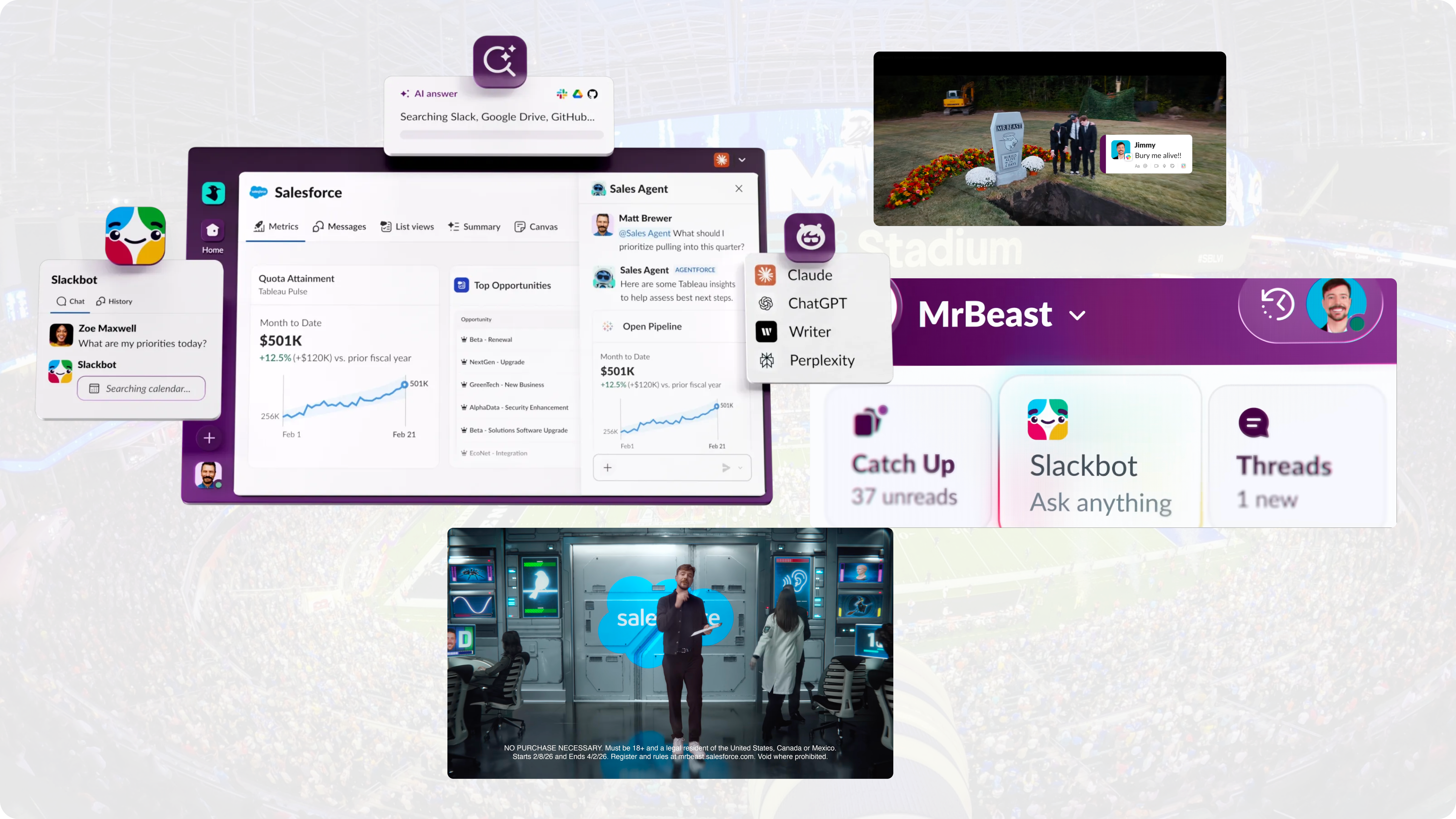
Here is a sentence that would have made no sense three years ago: a cloud computing company worth around $300bn handed full creative control of its most expensive advert to a 27‑year‑old YouTuber famous for burying himself alive and giving strangers islands. It might be the smartest thing Salesforce has done all year. That is not because the campaign is good (it is, in parts), but because of what it stops you looking at.
Salesforce’s Super Bowl LX campaign with MrBeast is an eight‑video content ecosystem that rolled out across January and February 2026. It culminates in a 30‑second spot during the fourth quarter of the game and a $1m interactive puzzle that requires participants to use Slack to win. The whole thing is ambitious, culturally literate, and structurally unlike anything a B2B brand has attempted at this scale. At the same time, it also acts as one of the most expensive pieces of misdirection in enterprise marketing history.
This isn’t just me breaking down a clever ad; I’m dissecting a deafening campaign wrapped around a shaky product story, in line with my wider work on marketing AI hype and how brands oversell the future.
The origin story everyone wants to tell
The campaign traces back to a tweet from MrBeast on 29 December 2025: “I’ve been sitting on an amazing Super Bowl commercial idea for years… someone please let me make your brand’s Super Bowl commercial.” Within 48 hours, Salesforce CEO Marc Benioff publicly replied and invited him to do exactly that. The two effectively struck a deal in full view of the internet.
That origin story works as a piece of marketing in its own right. By making the courtship public and seemingly organic, Salesforce turned what could have been a standard celebrity endorsement into a narrative — one that generated weeks of earned media before a single frame was shot. In mid‑January, a vlog‑style teaser showed MrBeast walking into Salesforce HQ in San Francisco, with employees trying to play it cool. Both sides agree on one condition: Salesforce products must be woven into the story.
Crucially, this authenticity claim rests on more than spin. Beast Industries already uses Slack and Salesforce to coordinate its production work, something Salesforce has profiled in a customer story. This is not just an endorsement. It is a real customer story dressed in creator clothing, and that distinction matters for how the campaign functions — and what it obscures.
What the eight videos actually do
Instead of a single advert, Salesforce built an ecosystem. Seven “Inside the Beast” episodes — most around 30 seconds, a couple running to a minute — rolled out on Salesforce’s YouTube channel between late January and Super Bowl Sunday. Each one shows a different slice of how Beast Industries uses Slack to coordinate its elaborate productions. The eighth video, “The Vault”, is the Super Bowl spot itself. It works as the spectacle payoff that turns all of that into a participatory event.
Across the series, you see an elephant eating prize money, a bear loose on set, a thousand fireworks needing last‑minute coordination, and even five million dollars in cash that has to be crumpled by hand. Every chaotic MrBeast production moment becomes proof that Slack — and its AI‑powered Slackbot — acts as the invisible backbone making it all work.
The messaging runs three layers deep. First, there is the emotional layer: MrBeast’s team does impossible, entertaining things. Then there is the functional layer: they cannot do any of it without Slack channels, Huddles and automations. Finally, Salesforce slips in the strategic layer: Slackbot behaves like “a teammate with agentic superpowers”, an accessible way of introducing its Agentforce AI platform to an audience that has never heard of it.
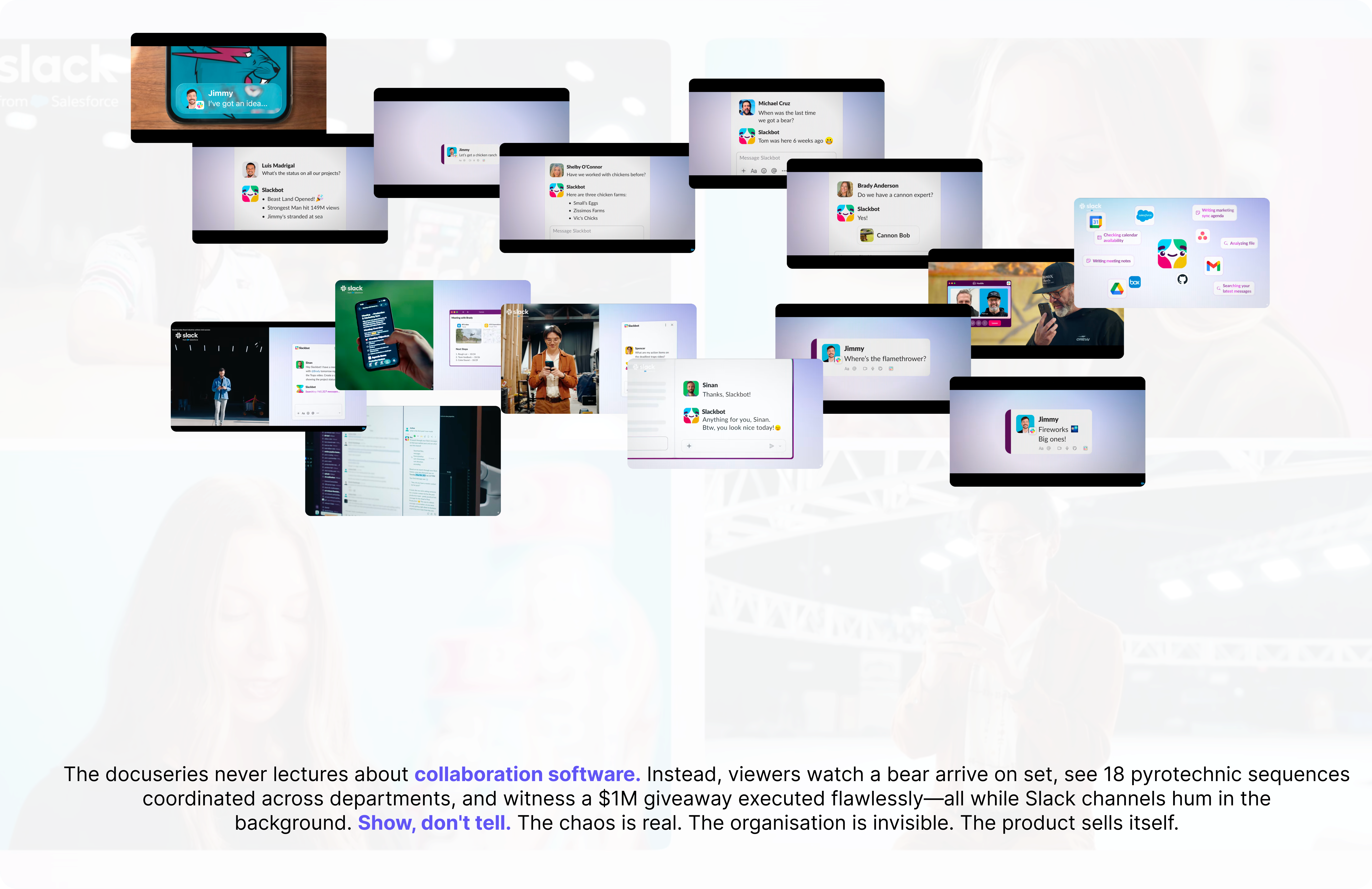
In that sense, this is “show, don’t tell” product integration done well. You see Slackbot surfacing answers in real time, Slack channels managing bear logistics, and Huddles coordinating high‑risk stunts. Nobody says “digital transformation” or “CRM” once. That restraint is refreshing — and rhymes with how I analysed Anthropic’s softer, more restrained approach in Selling AI Without Showing Product.
The Super Bowl spot as the capstone
“The Vault” does not follow the pattern of a classic big‑game advert. MrBeast locks $1m in a high‑security vault and challenges viewers to solve a chain of puzzles, telling them that the first person to Slack him the correct code wins. Clues hide in the commercial itself, in future MrBeast videos, across social media and even, reportedly, in public appearances.
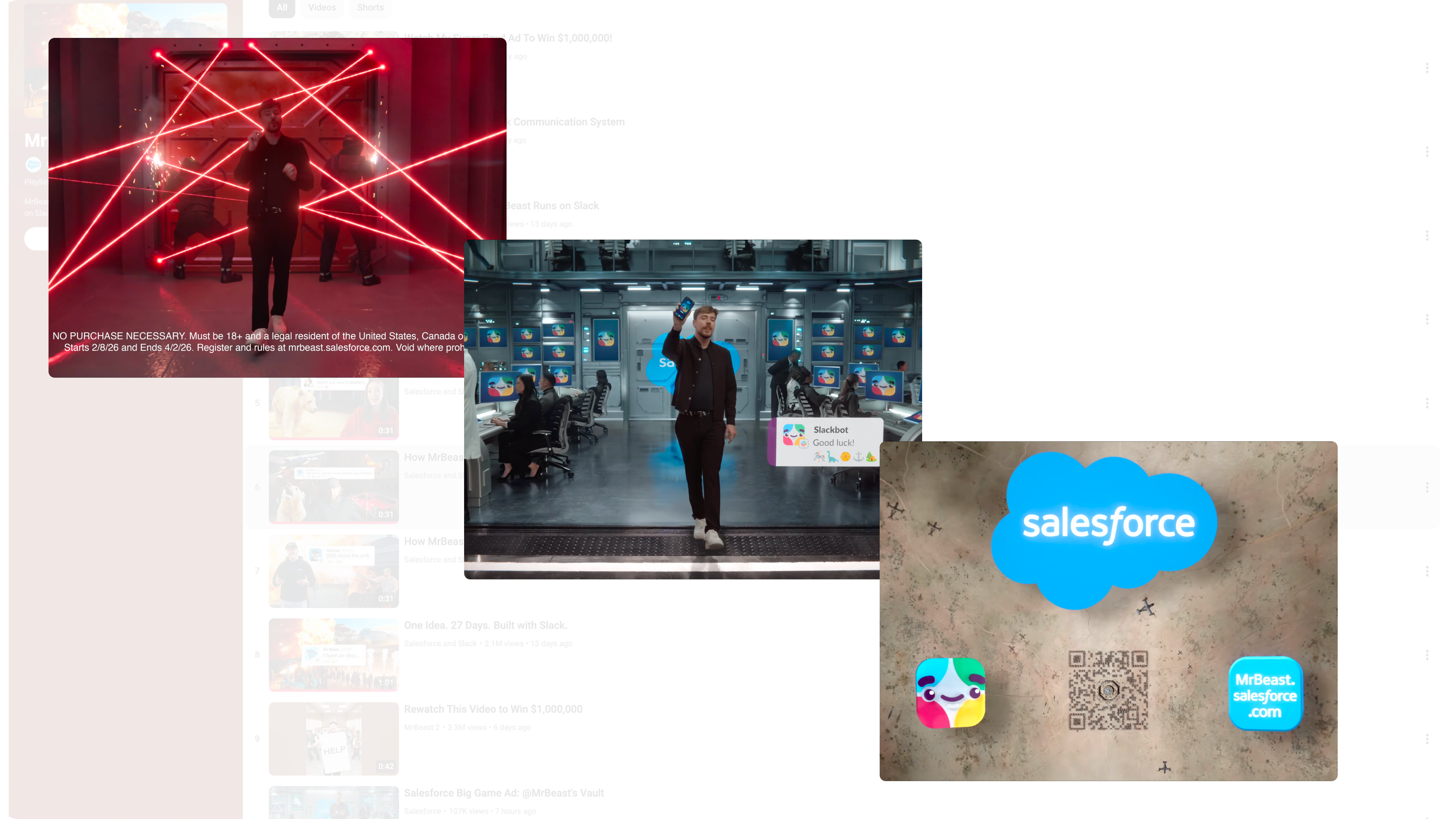
To start with, Slack becomes the entry mechanism. To win, you have to use Salesforce’s product. It does not just act as advertising; it turns into forced product adoption dressed up as a challenge. In addition, the puzzle extends the campaign long past game night. Most Super Bowl ads hold attention for 24–48 hours. This one is designed to keep people talking — and guessing — for weeks.
Most importantly, the mechanic leans into MrBeast’s existing format. Large‑scale challenges and outsized giveaways are what his 460‑plus million subscribers expect, according to recent channel stats. As a result, the puzzle feels like native MrBeast content wearing Salesforce’s colours. For many marketers, this is the most interesting learning: a Super Bowl ad turned into an onboarding funnel.
However, all of that cleverness relies on one fragile assumption. The product experience has to match the promise.
The brand‑recall problem nobody enjoyed admitting
Not everyone felt completely convinced. In its post‑game write‑up, Adweek warned that “Salesforce risks leaving casual viewers remembering the challenge more than the brand behind it. The ad may win the post‑game conversation — even if what Salesforce actually sells remains beside the point.”
This is the classic trap of spectacle‑driven advertising, and it bites harder when your hired creator has a larger brand than you do. In 30 seconds packed with lasers, vault doors, security guards, flying symbols and MrBeast’s trademark delivery, how much Salesforce brand meaning actually lands? Very little, if you ask most viewers.
By contrast, the short “Inside the Beast” episodes do a better job of explaining what Slack and Slackbot actually do. They show concrete use‑cases at a pace that makes sense in a feed. The Super Bowl spot just delivers the fireworks and the QR code. That trade‑off might be acceptable if the real‑world product experience felt equally magical.
It does not.
The product behind the curtain
Beneath the noise, Salesforce faces a stubborn problem. Agentforce — the AI agent suite that the company keeps billing as its future — has had a shaky start. An in‑depth report last year described how fewer than 5% of Salesforce customers paid for Agentforce, with most still sitting on trials. Internally, the company reorganised a team that had flagged deployment risks after those warnings clashed with Marc Benioff’s bullish narrative, then later rebuilt that capability when the concerns proved accurate.
At the same time, Salesforce removed the search bar from its own help pages and forced users to rely on Agentforce instead. Customers did not love the change. One Salesforce architect said “conversations often take longer than necessary, and I rarely get the specific information I’m looking for on the first try.” Community threads were blunter: “It’s called Agentforce because they force you to use it.”
Against that backdrop, Salesforce now spends roughly $8m on a campaign that frames Slackbot as a kind of omniscient teammate. That choice creates a credibility gap that no amount of slick editing can close. The puzzle literally tells people to use Slackbot to crack the code. When some of those people bounce off the real thing, the dissonance could hurt more than any short‑term awareness lift helps.
In other words, the marketing races ahead of the product — a pattern I have already dissected in depth in MY critique of Salesforce’s own AI positioning in Salesforce’s Agentforce Campaign Is Everything Wrong With B2B Marketing in 2026 (tagged under AI meets creativity and India media).
The audience mismatch — or long bet?
On paper, the audience pairing looks bizarre. In the six months before the campaign, there was virtually no overlap between MrBeast’s YouTube audience and Salesforce’s. MrBeast’s viewers skew young, with about 24% of them men aged 25–34, watching challenges, pranks and vlogs. Salesforce’s viewers skew older, with roughly 17% men aged 55+, watching career, employment and even cleaning content.
Many commentators jumped on that as proof of a mismatch. In practice, it looks more like the point. Salesforce is not talking to its current buyer at all here. Instead, it plants a flag in the minds of people who will be running teams and making procurement choices in five or ten years.
That is an audience‑arbitrage play most B2B companies feel too nervous to attempt. The Super Bowl becomes the bridge between two worlds that would never otherwise meet. If those viewers remember “Slack” when they land their first leadership roles, Salesforce will call the campaign a success.
Still, this kind of long bet only works if the product is ready when those future buyers arrive. If Agentforce remains stuck at single‑digit adoption, the brand equity will not have anything solid to attach to.
From McConaughey to MrBeast: a signal to the industry
Until recently, Salesforce’s Super Bowl presence looked very different. The company leaned on Matthew McConaughey and Woody Harrelson in polished spots that framed AI as something that needed to be grounded and guided. Those ads were clever and safe but largely forgettable.
This year’s context was brutal. According to Adweek’s tally, 23% of all Super Bowl LX adverts featured AI, with 15 out of 66 spots falling into the category. Viewers reported “WTF” as the most common emotional response to AI advertising, and at least one leading AI brand’s spot landed in the bottom three per cent for likeability over the past five years.
Set against that noise, Salesforce’s decision not to utter the word “agent” on screen looks deliberate. Rather than preaching about AI, the company hides the AI message inside a story about chaos and control. Ironically, that restraint might have produced one of the most effective AI‑adjacent ads of the night — very much in line with the “sell the transformation, not the tech” lesson I talked about at Anthropic’s launch in your Claude Sonnet marketing analysis.
For marketers, the takeaway is uncomfortable. When every brand shouts “AI” at full volume, the only way to stand out may be to shut up and show something interesting instead.
What marketers should actually steal from this
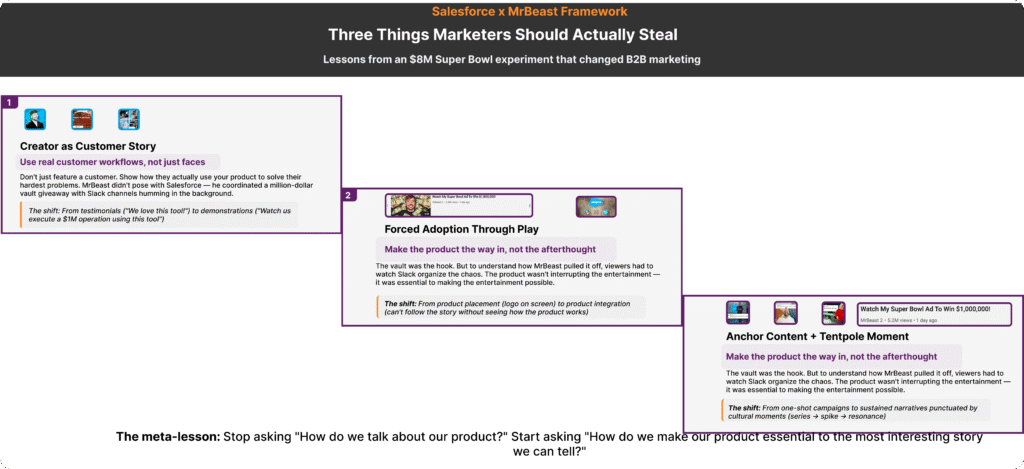
Strip away the spectacle and the contrarian LinkedIn takes, and three practical lessons remain.
First, creator‑as‑customer‑story beats creator‑as‑mascot. MrBeast does not just show up to read some lines. His 600‑plus‑person operation genuinely uses Slack and Salesforce to coordinate shoots across Antarctica, the pyramids and buried‑alive challenges. That reality is what makes the behind‑the‑scenes content feel different from traditional endorsements. Any brand with an interesting customer can recreate this pattern at a smaller scale.
Second, forced product adoption through play remains underused. Making Slack the mechanism to claim a $1m prize is the Trojan horse version of a lead form. Every person who enters creates an account and tries the product. It is blunt, but also more honest than pretending a “free e‑book” is a gift. At least the puzzle gives something back.
Third, the “anchor content + tentpole moment” structure is what big campaigns should look like now. Salesforce rolled out short, documentary‑style episodes in the weeks before the game, used the Super Bowl as a cultural spike, and then extended interest with an ongoing puzzle. No single asset has to do all the work. That pattern is healthier than pouring everything into one 30‑second film and calling it a day — a theme you also unpacked when I deconstructed Apple’s launch pace in your iPhone 17 Pro campaign analysis.
None of those ideas demand a Super Bowl budget. They do require a strong customer story, some operational courage, and a willingness to let creators shape the narrative.
The cost of getting the story wrong
Salesforce generated about $37.9bn in revenue in its 2025 fiscal year and spent roughly $12.9bn on sales and marketing. It also cut thousands of jobs over the past few years. Against that backdrop, paying a creator an estimated $7–8m for a single Super Bowl slot, plus production and prizes, was bound to attract criticism.
On LinkedIn, one commenter summed up the tension: Benioff “pays $10M+ a year for Matthew McConaughey to be a brand spokesman while he’s laid off tens of thousands.” That line resonated not because of its exact numbers, but because of the pattern it describes. Big‑ticket brand moments sit awkwardly beside aggressive cost‑cutting.
So the real question is not whether this campaign is creative. It clearly is. The sharper question is whether a company that cannot yet push its flagship AI product past single‑digit adoption should run the most expensive influencer campaign in B2B history — or whether that money would be better spent making Agentforce actually work.
Great marketing is the fastest way to expose a weak product. The better MrBeast makes Slackbot and Agentforce look, the more jarring it feels when real users run into latency, hallucinations or irrelevant answers. That gap between promise and reality is where trust leaks out.
Salesforce has built a campaign that will appear in marketing decks for years. Whether it shows up under “best practice” or “beware of this” depends less on view‑through rates and puzzle completions, and more on what happens after the hype fades. When the million dollars is gone, the QR codes have long expired and those new Slack users log in again on a random Tuesday, the experience they get will decide whether this was a masterstroke — or just a very shiny distraction.
External sources
- Salesforce Teams Up with MrBeast to Give Away $1 Million at Super Bowl 60 – Adweek
- Super Bowl Hot Take: Salesforce Turns the Game Night Into a MrBeast Game Show – Adweek
- AI Took Over the Super Bowl, Accounting for 23% of Ads – Adweek
- Salesforce CEO Marc Benioff Invites MrBeast for Super Bowl 2026 Ad – ALM Corp
- Super Bowl 60 Ads 2026: Complete Brand Tracker & Cost Guide – ALM Corp
- The Beast Is Out of the Bag: Salesforce Teases MrBeast Super Bowl 60 Ad – Adweek/MSN
- MrBeast, Salesforce Team Up for Super Bowl Commercial – Variety
- How MrBeast and Salesforce are Connecting New Audiences at Super Bowl LX – The Measure
- MrBeast And Salesforce Launch Million Dollar Puzzle Hunt – Evrim Ağacı
- Salesforce Super Bowl 2026 TV Spot, “The Vault” Featuring MrBeast – iSpot
- 2026 Super Bowl Video Advertising Report – iSpot
- Salesforce’s AI Agent Gamble Falters as Agentforce Struggles to Deliver – DevContentOps
- Salesforce Axes Search In Favor of Agentforce, Users Push Back – CX Today
- Salesforce Announces Fourth Quarter and Fiscal Year 2025 Results – Salesforce Investor Relations
- Salesforce: Marketing and Sales Expenditure 2015–2024 – Statista
- How Beast Industries Gets Each Million-View Shot With Slack – Salesforce Customer Story
- MrBeast YouTube Channel Stats – vidIQ
- How MrBeast Uses Slack to Manage 600+ People – YouTube
- How MrBeast Uses Slack to Solve Logistical Problems – YouTube
- How MrBeast Manages High-Risk Stunts using Slack Huddles – YouTube
- MrBeast’s Secret Slack Communication System – YouTube
- Behind the Chaos: MrBeast Runs on Slack – YouTube
- One Idea. 27 Days. Built with Slack. – YouTube
- Salesforce Big Game Ad: @MrBeast’s Vault – YouTube
Internal sources
- UX & Microcopy – Home
- Selling AI Without Showing Product: Claude as a Thinking Partner
- Claude Sonnet 4.5 Marketing Analysis: Anthropic’s AI Launch Critique
- Deconstructing Anthropic’s Bold “Keep Thinking” Gambit
- Apple’s iPhone 17 Pro Marketing: A Critical Campaign Analysis
- Google DigiKavach Campaign Analysis: When Television’s Favourite “Detective” Fights Digital Fraud
- September Smartphone Marketing 2025 – Hype or Real Value?