
Last week, Figma flew 15 designers to four global cities, plastered their work across billboards in Times Square and Paris, and filmed an 11-minute documentary about the whole thing. They also launched a game show where two employees design fictional hot sauce branding whilst spinning a chaos wheel. Combined production budget? Likely north of ₹2 crore. Measurable ROI? Absolutely impossible to calculate.
And that’s precisely the point.
Whilst CMOs everywhere are drowning in quarterly scrutiny—with 84% now viewing ROI as their primary budget metric and support for long-term brand investment dropping 11 percentage points in just one year—Figma is doing something counterintuitive. They’re creating campaigns so deliberately multi-objective that they become measurement-proof. Not through obfuscation, but through strategic multiplicity.
This isn’t sloppy marketing masquerading as creativity. Instead, it’s the most sophisticated response to 2026’s central marketing paradox: executives demand immediate ROI whilst simultaneously acknowledging that brand marketing outperforms performance marketing 80% of the time. Figma’s answer? Build campaigns that legitimately serve both masters at once.
The Measurement Crisis No One’s Talking About
Here’s what’s happening right now in boardrooms across B2B tech: CFOs are demanding marketing prove its value with monthly budget reports, whilst simultaneously, 87% of marketers report that measuring long-term campaign impact is becoming increasingly difficult. Moreover, confidence in measurement accuracy is predicted to drop 7% in 2026 as AI muddies attribution waters further.
The result? Only 55% of marketing leaders now allocate 60% or more of budgets to long-term brand building, down from 59% last year. Everyone knows the research—the famous 60:40 brand-to-activation split that supposedly maximises returns. However, when your CEO is breathing down your neck about Q1 pipeline, theory goes out the window.
The Pressure Points
Marketing leaders face mounting pressure from multiple directions. CMOs see support for brand building fade whilst ROI scrutiny intensifies. Meanwhile, finance teams want proof of performance. Sales teams want qualified leads. In addition, product teams want feature adoption. Each stakeholder demands different metrics, different timelines, different definitions of success.
Consequently, this fractured accountability creates paralysis. Teams optimise for the loudest voice in the room rather than the most strategic outcome. As a result, short-term activation wins budget because it’s defensible. Brand building becomes a luxury reserved for companies with patient capital and secure market positions.
Enter Figma with a radical proposition: what if you didn’t have to choose?
Strategic Multiplicity: The Campaigns That Refuse To Be Measured
Look at Figma’s international billboard campaign. On its face, it’s a straightforward out-of-home activation. However, examine the layers more closely:
Layer 1: Brand awareness play. Four global cities, massive screens, Instagram-worthy moments. Traditional OOH metrics apply—71% of consumers pay conscious attention to billboards, whilst 46% subsequently search online. Awareness achieved.
Layer 2: Product demonstration. Every artist explains their workflow using Figma Make, the AI prototyping tool launched at Config 2025. Essentially, you’re watching 15 detailed product tutorials disguised as artist profiles. Mercedes Affleck walks through building a weather visualiser “with no coding experience.” Similarly, Ayanesh from India shows how he used Figma Make’s AI prompts to generate interactive prototypes “in a matter of hours.”
The Product Demo Hidden in Plain Sight
This approach mirrors what I’ve previously analysed in Anthropic’s Claude campaign—selling AI without explicitly showing product features. Both campaigns prioritise outcomes over specifications, emotional resonance over technical demonstrations. Where Claude positions itself as a “thinking partner,” Figma positions Make as a creative enabler. Notably, both refuse the trap of feature-list marketing.
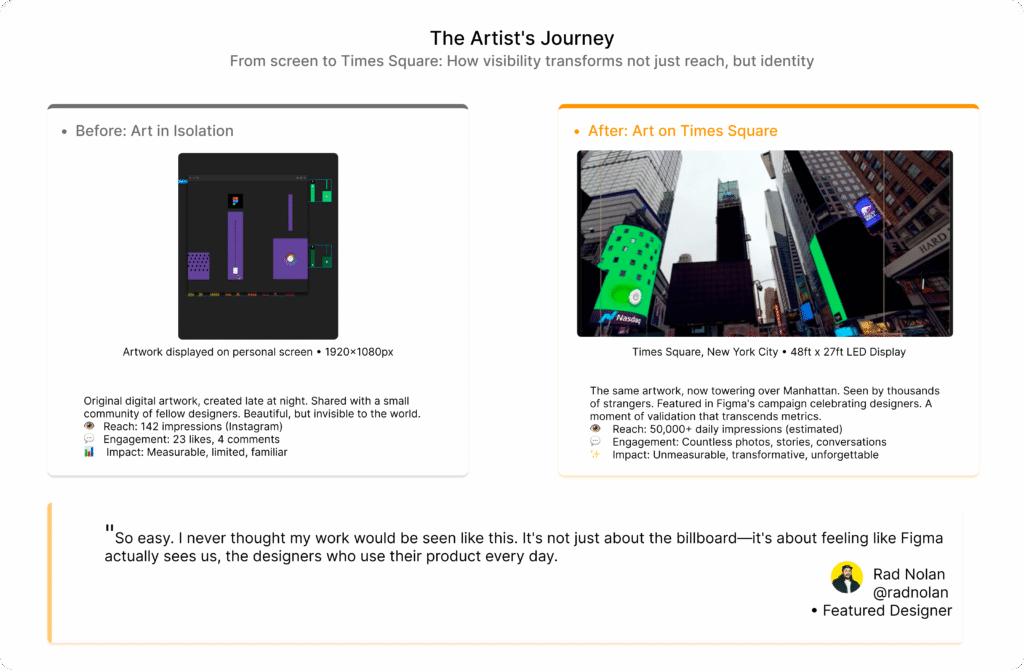
“The most sophisticated marketing doesn’t announce itself—it weaves product value into authentic human stories.”
Layer 3: Community validation. These aren’t paid influencers—they’re established community members with existing followings. When @radnolan (244K Instagram followers) shows his Times Square billboard and says “So easy, you know,” that’s authentic advocacy at scale. Furthermore, UGC-style content outperforms traditional brand creative by 38% CTR and reduces cost-per-acquisition by 25-50%.
Layer 4: Entertainment property. The documentary format creates owned media content. It’s watchable independent of purchase intent. In other words, people share it because watching artists react to seeing their work on massive screens is genuinely compelling television.
Which objective is the real objective? All of them. None of them. Ultimately, the campaign succeeds along any dimension you choose to measure it by.




The Chaos Wheel Strategy: Gamification as Product Education
Figma’s Design Roulette series takes this further. Product Manager Niko Klein and Product Designer Peter Ng design branding for fictional hot sauce “Veloce” whilst a spinning wheel forces random constraints: “use wrong scale objects,” “add melting element,” “something frozen and icy.”
It’s part game show, part product demo, part comedy sketch. About 35% of the eight-minute runtime delivers no direct product information—just banter, wheel-spinning, reactions. From a traditional performance marketing lens, that’s wasted media. Conversely, from a brand-building lens emphasising emotional connection, it’s the empathy required to make designers “feel seen.”
Why Entertainment Overhead Matters
The format demonstrates Figma’s AI image tools (expand, isolate, edit, remove background) through organic problem-solving rather than feature lists. Essentially, you’re not watching a tutorial; instead, you’re watching professionals navigate constraints in real time. The learning happens sideways.
Furthermore, this entertainment-first approach recognises a fundamental shift in B2B marketing. Technical audiences don’t want to be sold to—they want to be educated, entertained, and respected. The chaos wheel creates narrative tension. Random constraints force creative problem-solving. Meanwhile, genuine reactions humanise the technology.
“When entertainment and education merge seamlessly, product demonstrations stop feeling like sales pitches and start feeling like shared experiences.”
Compare this to the polished, scripted product demonstrations that dominated B2B SaaS marketing for decades. Those campaigns optimised for information density. In contrast, Design Roulette optimises for memorability. Which approach drives more product trials? Impossible to say. Which creates stronger brand affinity? Equally unclear. Which justifies the production investment? That’s precisely the point—the question becomes unanswerable.
The Multi-Objective Reality
What’s the KPI? Product adoption? Brand affinity? Video completion rate? Designer community engagement?
The answer is yes to all of the above. Brand marketing teams can measure emotional resonance and community sentiment. Meanwhile, product marketing teams can track Make feature awareness and trial starts. Content teams can analyse completion rates and social sharing. Similarly, community teams can monitor creator engagement and UGC amplification.
Every stakeholder gets validation. Every metric shows positive movement. As a result, the work compounds rather than conflicts.
Why This Only Works For Figma (And What That Teaches Us)
Before you rush to build your own chaos wheel, understand the prerequisites that enable this approach:
Market Dominance Creates Measurement Latitude
1. Market position matters. Figma commands 75% of the product designer market with 95% Fortune 500 penetration. They’re not fighting for category awareness—they already have it. Consequently, this creates room to experiment with formats that optimise for delight over conversion.
When you’re defending market share rather than capturing it, your marketing objectives shift fundamentally. Competitor threats come less from feature parity and more from paradigm shifts. For instance, Framer isn’t dangerous because it matches Figma’s capabilities—it’s dangerous because it collapses the design-to-production workflow entirely. Meanwhile, Adobe XD isn’t a threat anymore because Adobe effectively ceded the market.
The Community Moat Advantage
2. Authentic relationships enable genuine advocacy. The billboard campaign works because those 15 artists are already Figma users sharing genuine experiences. Attempting this without years of community investment risks exposure as paid promotion.
Figma spent a decade building these relationships through community-led growth strategies—free tiers for side projects, Config conferences, design evangelists running Friday competitions. As a result, that community now provides authentic advocacy impossible to manufacture through paid campaigns.
This mirrors insights from my analysis of Swiggy’s Wiggy 3.0 campaign—people-powered marketing only works when you’ve genuinely empowered your people first. Swiggy celebrated delivery partners because they’d already invested in partner welfare and recognition. Similarly, Figma celebrates designers because they’ve spent years building tools designers genuinely love.
“Community-led marketing without genuine community investment is just influencer marketing with extra steps.”
Visual Products and Demonstrable Value
3. Product type constrains execution possibilities. Design tools have inherent show-don’t-tell advantages. Watching someone build an interactive prototype in minutes is the value proposition. In contrast, B2B infrastructure companies selling database optimisation can’t replicate this.
If your product’s value manifests visually—design tools, creative software, presentation platforms—you can leverage entertainment formats naturally. However, if your product’s value lives in backend performance improvements, millisecond latency reductions, or infrastructure cost savings, you face different constraints. Entertainment can still work, but the demonstration challenge increases exponentially.
Organisational Alignment Enables Strategic Ambiguity
4. Executive support matters immensely. These campaigns require executive leadership comfortable with measurement frameworks that capture multiple objectives simultaneously. Most startups under quarterly pressure cannot sustain this ambiguity—CFOs demand single-source attribution.
The Budget Reality
Production budgets for these campaigns likely exceeded ₹2 crore when accounting for:
- Artist fees and travel (15 creators across 4 continents)
- Billboard placements in Times Square, Paris, Singapore, Tokyo
- Professional video production and editing
- Campaign coordination and project management
- Distribution and promotion costs
That investment only makes sense for companies with either:
- Sufficient revenue scale to absorb experimentation costs
- Strategic conviction that measurement ambiguity itself creates value
- Executive patience for 6-12 month performance windows
Most B2B SaaS companies have none of these prerequisites. Nevertheless, that doesn’t invalidate the strategic insight—it constrains the execution possibilities.
The Measurement Paradox: Why Precision Is Overrated
Here’s the uncomfortable truth making rounds in marketing circles: the more precisely you can measure something, the less it might actually matter.
Performance marketing optimises for measurable outcomes—clicks, conversions, cost-per-acquisition. These metrics are precise, trackable, and quarterly-reportable. However, every competitor has access to the same platforms, same targeting, same attribution models. As a result, precision becomes commoditised.
In contrast, brand marketing operates in murkier territory—mental availability, category distinctiveness, long-term loyalty. These are harder to measure, harder to prove, harder to defend in budget meetings. Nevertheless, research demonstrates they’re more effective at driving sustainable growth.
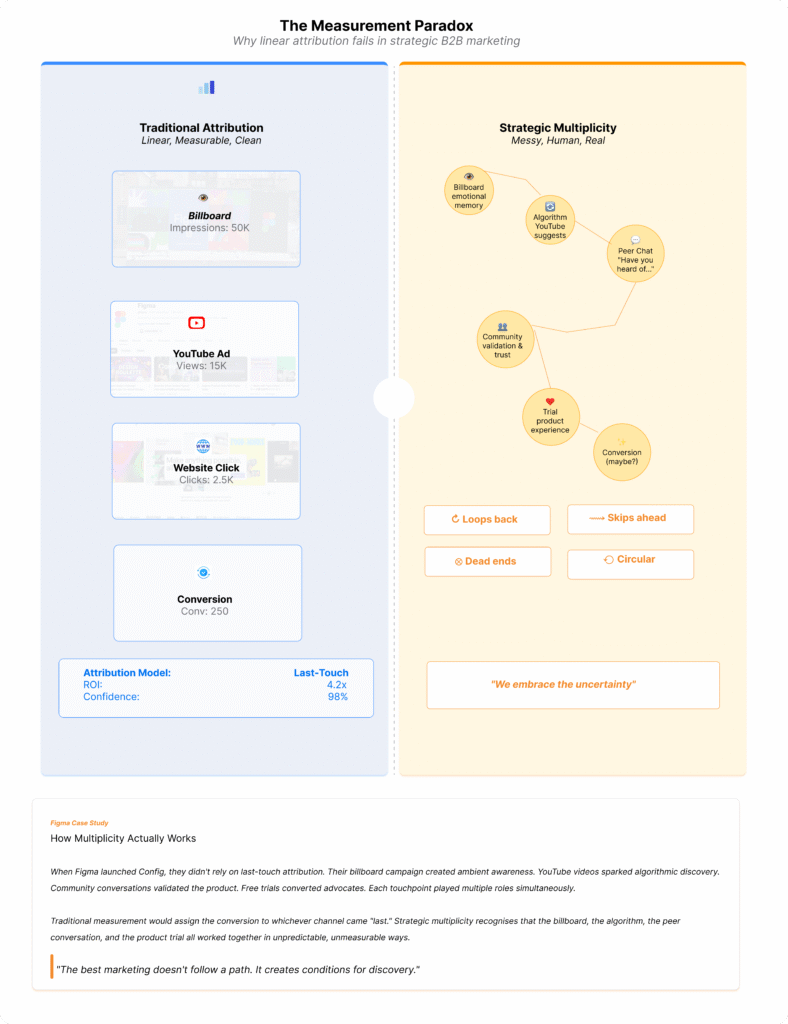
The Attribution Trap
The measurement crisis forces a choice: optimise for what’s measurable, or optimise for what works?
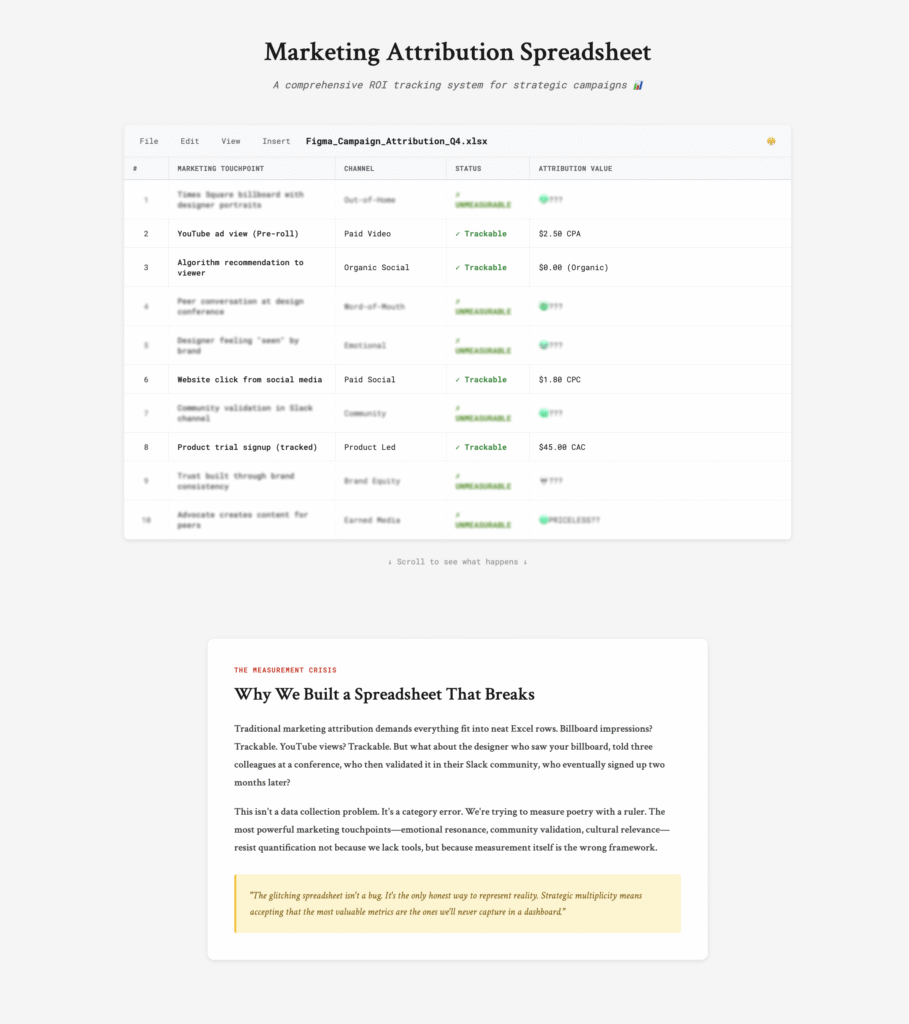
Consider the attribution challenge. A designer sees Figma’s Times Square billboard whilst visiting New York in October 2025. Two months later, they watch the behind-the-scenes documentary about the campaign on YouTube. A week after that, YouTube’s algorithm recommends Design Roulette—both videos dropped within three days of each other in late January 2026, creating a coordinated content blitz on Figma’s owned channel. Subsequently, the following month, their company evaluates design tools and the designer advocates for Figma during the selection process.
Which touchpoint gets credit? Traditional attribution models assign value based on trackable digital interactions—the YouTube views of both the documentary and Design Roulette. Meanwhile, the billboard exposure, despite potentially creating initial awareness months earlier, receives no attribution because it’s unmeasurable in standard frameworks. The physical OOH experience simply doesn’t register in digital attribution systems.
Yet the billboard might be the most valuable touchpoint precisely because it’s unmeasurable.
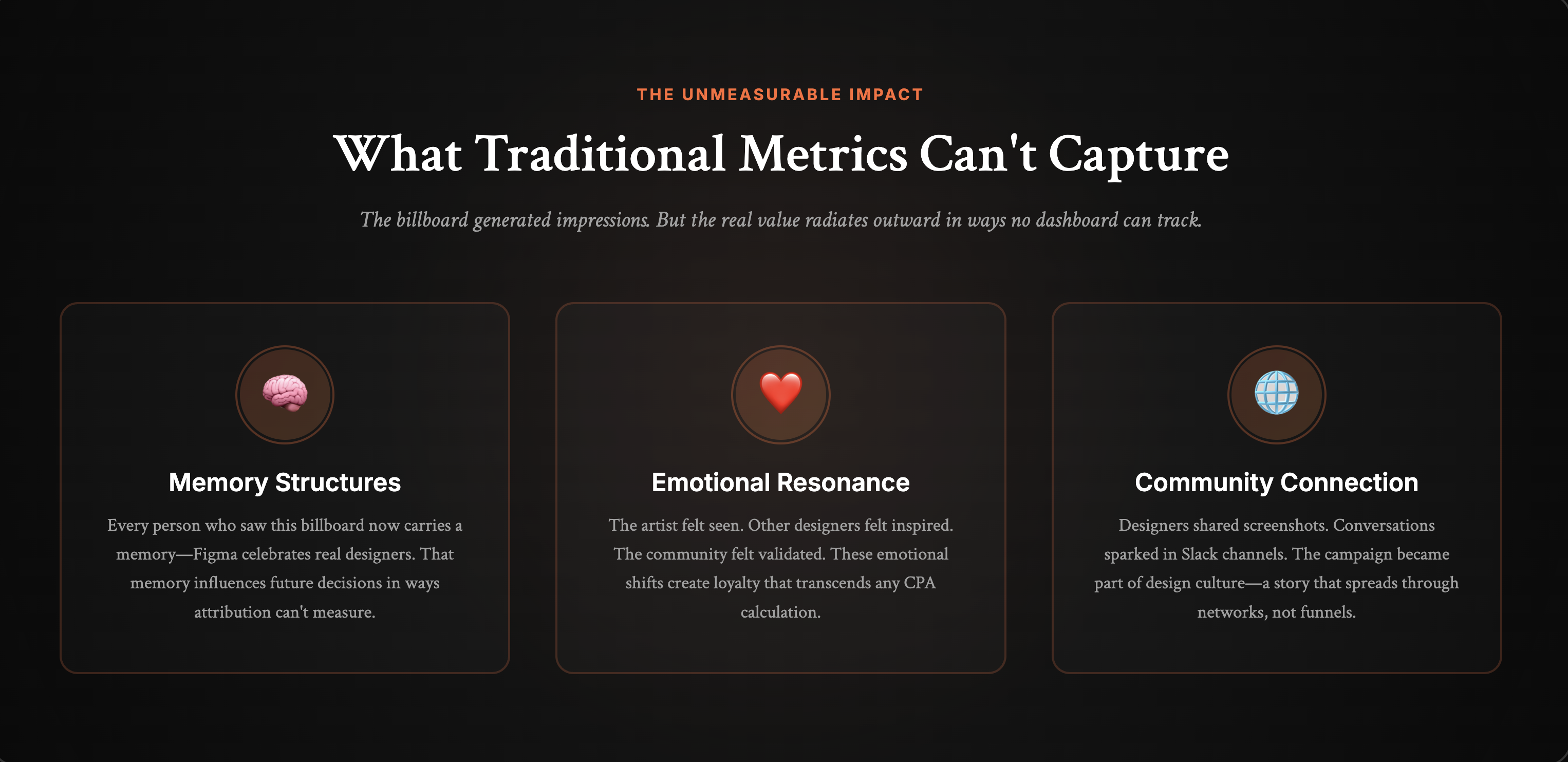
Physical presence in Times Square signals market dominance. Moreover, seeing your art elevated to that scale creates emotional resonance impossible to replicate through YouTube recommendations. The visceral experience of watching a massive screen display work you created in public space establishes memory structures that persist for years—far more potent than algorithm-driven video discovery.
“Attribution models optimise for what’s trackable, not what’s transformational.”
Strategic Ambiguity as Competitive Advantage
Figma’s campaigns suggest a third path—create work so multifaceted that it registers as valuable across all measurement frameworks simultaneously. Your brand team can claim the emotional storytelling win. Meanwhile, your product marketing team can count Make feature demonstrations. Your community team can track artist engagement. Similarly, your content team can measure video completion rates.
Everyone gets their metric. Everyone’s KPI improves. Consequently, the work compounds rather than conflicts.
This strategic ambiguity becomes competitive advantage when competitors are locked into singular measurement frameworks. Whilst they’re optimising click-through rates or conversion percentages, you’re building mental availability and community loyalty that compounds over years rather than quarters.
What Marketers Should Actually Do: Practical Applications
If you’re running marketing for a B2B SaaS company without Figma’s budget or market position, here’s what matters:
1. Stop Treating Brand and Performance as Separate Budget Lines
The research is definitive—integrated approaches boost both short and long-term performance more than either alone. Every piece of content should serve dual purpose. Specifically, your case study isn’t just demand gen fuel—it’s also brand credibility. Your thought leadership isn’t just awareness—it’s also sales enablement.
Look at each campaign asset through multiple lenses:
- Does this build brand awareness and drive product consideration?
- Can this support sales conversations and improve customer retention?
- Will this generate immediate pipeline and long-term category authority?
If the answer is no to the second objective, redesign the asset.
2. Embrace Measurement Ambiguity Strategically
The CMOs making progress aren’t defending pure brand budgets with soft metrics. Instead, they’re building shared planning, shared metrics tied to revenue influence over time, and accepting that proving precise attribution often matters less than demonstrating directional impact.
Document your measurement philosophy. Explain why certain campaigns optimise for long-term outcomes that won’t materialise in quarterly reports. Furthermore, build stakeholder alignment around portfolio approaches where some initiatives drive immediate results whilst others build sustainable advantages.
“The best marketing measurement frameworks balance accountability with acknowledgment that the most valuable outcomes often resist precise quantification.”
This requires executive education. Finance teams aren’t trying to kill brand building—they’re trying to understand how marketing budgets translate to business outcomes. Therefore, help them understand that the most valuable marketing often resists precise measurement.
3. Invest in Formats That Deliver Multiple Strategic Objectives
Look for campaign architectures where success along any dimension validates overall investment. For example, customer stories that function as both social proof and product education. Events that generate both pipeline and community loyalty. Content that serves both SEO and sales conversations.
The principle isn’t about doing more work—it’s about designing work differently. Instead of creating a product demo and a brand video and customer testimonial and thought leadership piece, create one asset that accomplishes all four objectives simultaneously.
This requires different creative briefs. Stop asking “What’s the primary objective?” Instead, start asking “What multiple objectives can this single execution serve?” Brief for multiplicity rather than singularity.
4. Build Community Before You Need It
Figma’s billboard campaign succeeds because they spent years cultivating designer relationships through free tools, conferences, and genuine celebration of the craft. Consequently, that community now provides authentic advocacy impossible to manufacture through paid campaigns. This is multi-year infrastructure work, not quarterly campaign thinking.
Community building requires patience most startups don’t have. Nevertheless, it’s precisely that long-term investment that creates sustainable competitive advantages. The relationships you build today become the advocacy networks that accelerate growth three years from now.
I’ve written extensively about founder-led marketing approaches that prioritise authentic community relationships over transactional influencer partnerships. Importantly, the principles apply beyond founder-led contexts—authenticity scales when it’s embedded in company culture rather than campaign tactics.
5. Accept That the Highest-ROI Work May Be Unmeasurable
When only 18% of B2B event technology vendors say their clients can demonstrate measurable returns despite events consuming 12% of annual budgets, maybe we’re measuring the wrong things. The value isn’t always in the attribution model.
This requires courage. Defending unmeasurable investments means accepting career risk. If the campaign fails, you can’t point to clear attribution. If it succeeds, you can’t prove causation. Essentially, you’re asking executives to trust your strategic judgement rather than your measurement precision.
However, consider the alternative. Optimising exclusively for measurable outcomes means ceding all unmeasurable advantages to competitors willing to accept measurement ambiguity. Mental availability, brand preference, community loyalty—these compound over time precisely because they resist quarterly measurement.
The Real Innovation Isn’t The Campaigns
What makes Figma’s approach genuinely sophisticated isn’t the billboard placement or the game show format. Rather, it’s the strategic confidence to create work that defies singular measurement.
Most B2B marketing exists in perpetual defensive crouch—justifying every pound spent, defending every campaign choice, proving ROI to sceptical finance teams. Unfortunately, this defensive posture optimises for measurements that are easy to defend rather than outcomes that actually drive growth.
The Confidence Signal
Figma demonstrates what becomes possible when you flip the script. Instead of creating campaigns and then scrambling to measure them, they’re designing measurement-resistant campaigns that succeed precisely because they refuse to be reduced to single metrics.
This requires market position most companies don’t have. It requires community relationships most brands haven’t built. Furthermore, it requires executive alignment most CMOs can’t secure.
However, it also reveals something important about where B2B marketing is heading. As AI-powered attribution becomes simultaneously more sophisticated and less trustworthy, as buyers complete 70% of research before sales conversations, as traditional lead generation gives way to demand creation, the competitive advantage shifts from measurement precision to strategic multiplicity.
What Winning Looks Like
The brands that win won’t be the ones with the cleanest attribution models. Instead, they’ll be the ones creating work so genuinely valuable across multiple dimensions that measurement becomes almost beside the point.
Think about how this differs from traditional campaign evaluation. Standard post-campaign analysis asks:
- Did we hit our awareness targets?
- What was our conversion rate?
- How does ROI compare to benchmarks?
These questions assume singular objectives and linear attribution. In contrast, Figma’s approach renders them partially irrelevant. The billboard campaign simultaneously builds awareness, drives product trials, strengthens community relationships, and creates owned media content. Therefore, evaluating it against any single metric misses the strategic intent.
“The future of B2B marketing belongs to those brave enough to create campaigns that succeed across multiple dimensions—even when that makes measurement harder, not easier.”
This isn’t measurement avoidance. It’s measurement sophistication. Rather than proving one thing conclusively, they’re demonstrating multiple things sufficiently. Rather than defending precise attribution, they’re documenting directional impact across stakeholder priorities.
The Uncomfortable Questions We Should Be Asking
If Figma’s approach represents evolved B2B marketing, what does that mean for the rest of us?
Can Strategic Multiplicity Scale Down?
Most companies lack Figma’s budget and market position. However, the principle—designing campaigns that serve multiple objectives simultaneously—applies at any scale. For instance, a startup with £10,000 can still create customer stories that function as product demos, thought leadership pieces that support sales conversations, or community initiatives that generate both goodwill and pipeline.
Does Measurement Ambiguity Always Serve Brands?
There’s genuine risk in unmeasurable marketing. Without clear attribution, poorly performing campaigns persist because no one can prove they’re failing. Strategic multiplicity can become excuse for strategic sloppiness. Nevertheless, the difference lies in whether ambiguity emerges from sophisticated campaign design or from absent accountability.
How Do We Distinguish Confidence From Privilege?
Figma can afford measurement-resistant campaigns because they’re market leaders with patient capital. Startups under quarterly scrutiny face different constraints. Calling this “sophisticated marketing” risks ignoring the structural advantages that enable such approaches. Perhaps the real innovation isn’t the campaigns—it’s the organisational positioning that makes them possible.
The Verdict: What This Means for 2026 and Beyond
Figma’s not solving the measurement crisis by measuring better. Instead, they’re solving it by building campaigns that make the question less relevant than it seems.
And whilst your CFO is probably still asking for the ROI spreadsheet, somewhere in Times Square, a designer is watching their art come to life on a screen the size of a building, thinking “I made this in Figma,” and immediately opening the app to try that new AI feature they just saw demonstrated.
That’s not measurable ROI. That’s better.
The measurement crisis facing B2B marketers in 2026 won’t be solved by better attribution models or more sophisticated analytics platforms. Rather, it’ll be solved by marketers brave enough to create work that succeeds across multiple dimensions simultaneously—even when that makes measurement harder, not easier.
The Three Essential Capabilities
For marketing professionals navigating this transition, the path forward requires three capabilities:
Strategic courage: Defending investment in work that won’t show immediate, measurable returns
Stakeholder education: Building alignment around portfolio approaches that balance measurable activation with unmeasurable brand building
Creative sophistication: Designing campaigns that legitimately serve multiple objectives rather than pretending singular campaigns are multi-purpose
Figma demonstrates all three. Most B2B SaaS companies demonstrate none. Consequently, that gap represents both the challenge and the opportunity facing marketing leaders in 2026.
The question isn’t whether you should copy Figma’s campaigns—you probably can’t and probably shouldn’t. Instead, the question is whether you can adopt the strategic principle: sometimes the most valuable marketing is precisely the kind that’s hardest to measure.
Related reading on strategic campaign design:
- How Anthropic Sells AI Without Showing Product – lessons in restraint and emotional positioning
- Swiggy Wiggy 3.0: People-Powered Marketing – building authentic community before leveraging it
- Google’s DigiKavach Campaign Analysis – cultural intelligence in tech marketing
What measurement challenges is your marketing team facing in 2026? I’m particularly curious how B2B SaaS marketers without Figma’s budget or market position are navigating the brand-versus-performance tension. Share your experiences in the comments, or connect with me to discuss campaign strategies that resist easy measurement but drive sustainable growth.
Footnotes & Sources
Primary Campaign Sources
- Meet the artists behind Figma’s international billboard campaign – Figma YouTube, January 23, 2026
- Design Roulette Ep 1: Random design challenge – Figma YouTube, January 26, 2026
Marketing Measurement & ROI Crisis (2026)
- CMOs see support for brand building fade while ROI scrutiny rises – Marketing Dive, November 18, 2025
- Will 2026 be more volatile for marketing? Here’s what the numbers say – Marketing Dive, December 11, 2025
- The ROI Challenge in B2B Marketing—and How AI is Changing – LinkedIn Marketing, August 13, 2025
- 9 Marketing Leaders Answer: Brand or Demand for 2026? – CMSWire, January 19, 2026
- The CMO’s Dilemma: Balancing Long-Term Brand Building with Short-Term Revenue Demands – Intense Group, November 6, 2025
Brand vs Performance Marketing Research
- Brand Marketing Drives Sales, ROI and Even Performance Campaigns Don’t Cut It – Analytic Partners, July 15, 2025
- Brand vs. Performance Marketing: Why Marketers Need Both – Core Creative, August 6, 2023
- The Art of Balancing Long-Term Branding and Short-Term Marketing – The Branding Journal, January 12, 2026
UGC & Creator-Led Campaign Performance
- Top UGC Ads That Prove Creator-Led Campaigns Work – Influencer Marketing Hub, December 21, 2025
- Why UGC Is Outperforming Studio Creative – Spray Marketing, December 31, 2024
- Business Case For UGC in Paid Marketing – Swanky Agency, November 3, 2025
B2B SaaS & OOH Advertising
- B2B SaaS Companies Spend a Lot on Billboards – Why? – Blip Billboards, July 31, 2022
- B2B SaaS Marketing in 2026: The Complete Strategy – Omnibound, January 22, 2026
- 2026 B2B SaaS Marketing Strategies That Actually Work – Vehnta, January 14, 2026
Figma Company & Product Research
- Report: Figma Business Breakdown & Founding Story – Contrary Research, May 1, 2025
- Config 2025: Pushing Design Further – Figma Blog, May 6, 2025
- Go From Design-to-Prototype in Minutes With Figma’s New AI Feature – eWeek, May 8, 2025
- Figma vs. Design Tools: Dominance, AI & Competition – Gurkha Tech, November 8, 2025
Community-Led Growth Strategy
- Figma’s community-driven path to success – Social Plus, January 18, 2026
- Figma’s Community-Led Growth: Building a $20B Brand – NoGood, January 6, 2025
- Community Growth at: Figma – Community Inc, December 31, 2024
B2B Marketing Measurement & Attribution
- The Importance Of Defining Event ROI In The B2B Context – Forrester, October 7, 2019
- Why B2B Marketing Struggles to Prove ROI (And Fixes) – Power Digital Marketing, August 19, 2025
- 5 ways to improve marketing measurement in 2026 – MarTech, January 8, 2026
Related Articles on SuchetanaBauri.com (Internal Links)
- How Anthropic Sells AI Without Showing Product – Claude Campaign Analysis – analysing restraint and emotional positioning in AI marketing
- Brand Anthem in the Age of Algorithms: Swiggy Wiggy 3.0 Campaign – lessons in people-powered marketing and authentic community building
- Google DigiKavach Campaign Analysis: When Television’s Detective Meets Digital Fraud – cultural intelligence and storytelling in tech marketing
- Founder-Led Marketing – approaches that prioritise authentic community relationships over transactional partnerships