
My client’s been more than fair. Not a chance.
That’s the entire plot. That’s the entire emotional arc of Apple’s new iPhone 17 Ceramic Shield 2 advertisement. Thirty-five seconds. Two lawyers. One phone. A mahogany table that has seen better days. And the implication that marriage, apparently, ends not with a bang but with a WHOOSH and a SLAM.
The Setup
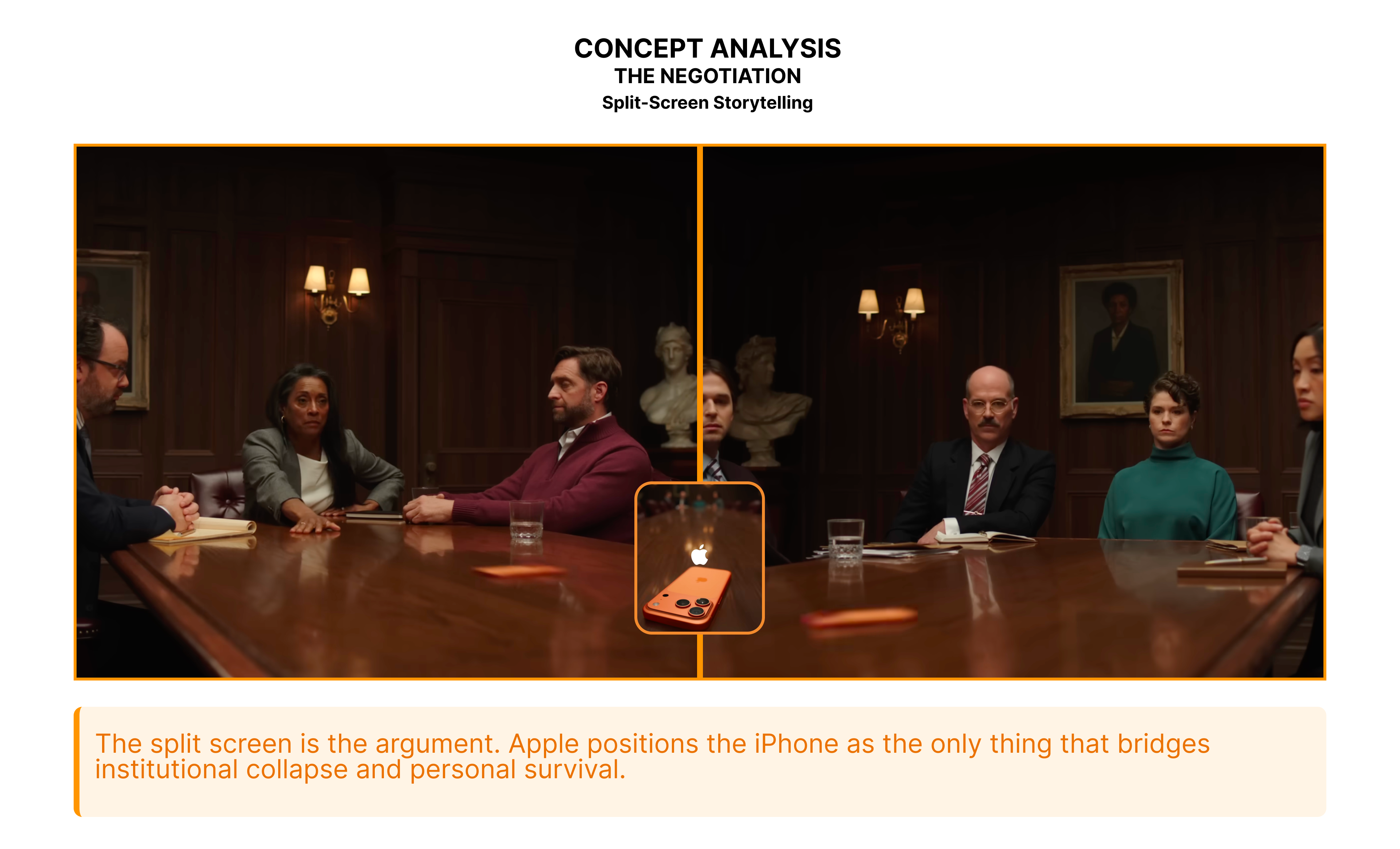
You know immediately what you’re watching. The room tells you everything: oil portraits of dead men, Roman busts symbolising permanence, brass fixtures suggesting old money, leather chairs arranged like a chess board. This is not a tech presentation. This is a divorce negotiation. One lawyer announces that her client has been “more than fair”—the universal legal phrase for “we have compromised enough, and if you reject this, it’s on you.” The phone slides across the table with the offer. Then it slides back. Then forward again. Each WHOOSH is the silence of consideration, the weight of refusal.
The other lawyer watches it slide.He says nothing. Then his client takes a look and states clearly: “Not a chance.” The phone slides one final time. SLAM. Negotiation over.
What’s Actually Happening
Apple has staged a moment that is genuinely devastating in most people’s lives—the legal dissolution of a marriage—and used it to sell scratch resistance.
Let that sink in for a moment. The company had approximately 35 seconds to convince you that Ceramic Shield 2 is durable, and instead of showing the phone surviving a drop or a key, Apple chose to show it surviving a divorce.
This is either the most emotionally intelligent marketing decision Apple has ever made, or the most cynical. Possibly both.
The Subtext
Here’s what Apple is actually saying, beneath the WHOOSH and the SLAM: We know that everything in your life is temporary. Your marriage might end. Your fairness might run out. The room full of expensive furniture and old traditions will prove fragile. But this phone—this phone will remain intact.
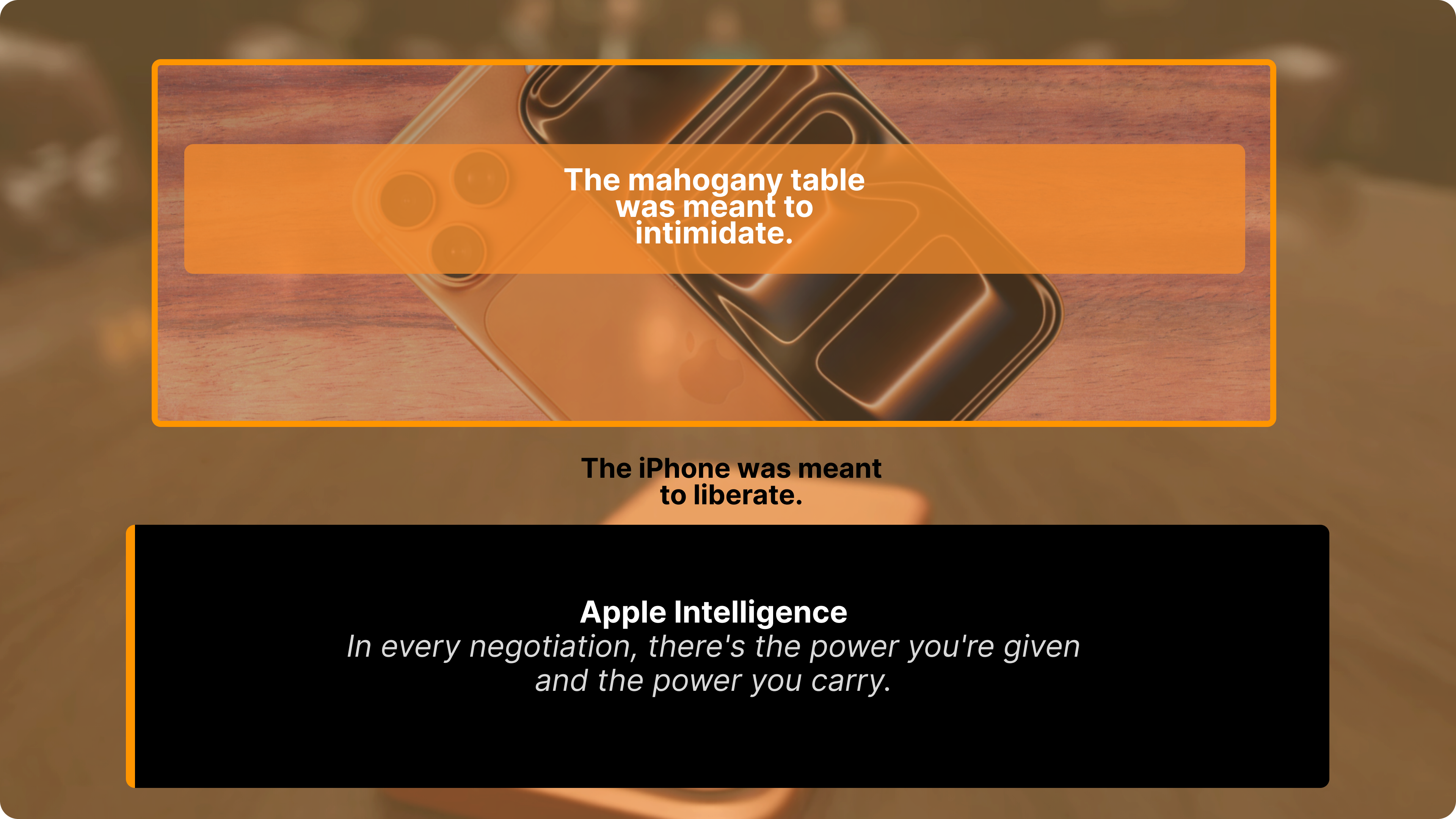
The mahogany table will bear marks. The institution will crumble. The marriage will dissolve. But the iPhone 17 Ceramic Shield glides across it all—with the offer, with the refusal, with the final rejection—and returns pristine. Nothing touches it. Nothing damages it. While the two women across from each other are making decisions that will reverberate through everyone’s lives—custody, assets, the legal unmaking of a promise—the iPhone simply exists. Unchanged. Unbroken. Indifferent.
It is not selling durability. It is selling the fantasy that something can survive the end of everything else.
That in a moment when fairness collapses and compromise fails, at least one object you own will remain whole.
For $999 and up.
The Production Design Speaks
The room is not accidental. An ultramodern glass office would have been too obvious. But a space that looks like it was decorated in 1958—wood paneling, brass, leather, oil paintings—suggests something subtler: that even in institutions designed for control and permanence, the underlying reality is rupture. The phone alone transcends this. It does not belong to the old world of mahogany and tradition, nor does it participate in their fragility. It simply exists outside the drama, unmoved and unmoving.
Also worth noting: these are two women conducting a divorce negotiation in a room historically designed for men to negotiate the fates of other men. Apple doesn’t draw attention to this. It doesn’t need to. The casting does the work. These are the people now in charge of endings, and they command the space with quiet authority. One offers terms. The other refuses. Both use the phone as a proxy for power.
The Emotional Economy
What Apple understands, and what makes this advertisement genuinely clever, is that people do not buy products for the benefits listed in spec sheets. They buy products for the emotions those benefits represent. No one has ever purchased an iPhone because they were excited about Mohs hardness or ceramic coatings. But everyone has fantasized about owning something—anything—that would not crack under pressure.
In a world where marriages end, where lawyers slide phones across tables in place of words, Apple is selling the comfort of knowing that at least one thing you own will survive intact.
That it will bear witness to your worst moments without being damaged by them. That it will slide with the offer, return with the silence, and emerge after the rejection—pristine and composed—while everything else shows wear.
This is psychologically brilliant. This is also kind of dark.
The Table That Nobody Mentions
One detail Apple carefully avoids: what happens to the furniture. There are no claims about the mahogany table’s resilience. There are no promises about how it will look after the phone slides across it twice—once with hope, once with finality. It simply bears the impact, like an institution under strain. Like a marriage. Like anything built to last that doesn’t.
The phone alone emerges from the negotiation unmarked. The table, the institution, the marriage—these things show wear. These things break. Only the phone survives undamaged.
What iPhone 17 Ceramic Shield Really Sells
Technically: scratch resistance. Three times more than before. Ceramic Shield 2. All the specs.
Actually: the fantasy that invulnerability is possible. That something can survive the end of everything else. That you can experience the worst rupture of your life and walk away with at least one thing that bears no marks of what you’ve lost.
That’s not a feature. That’s a promise. And Apple knows that in 2026, that promise is worth more than durability specs.
It’s worth $999 and up.
The Joke
The real joke—the New Yorker-style knife that enters quietly—is that Apple has accidentally made an advertisement that is more honest about modern life than they probably intended. They wanted to show a phone that survives stress. Instead, they’ve shown a world where marriages dissolve, where fairness expires, where the only thing that endures is cold, silent technology.
And we all got that. We all recognized it immediately. Because we’ve all been in rooms like that, or we fear we will be. And we’ve all wanted to own something—just one thing—that would not break when we do.
Apple is selling that want. For $999 and up.
The phone glides across the mahogany. Once with the offer. Once with the rejection. It returns untouched. The negotiation ends. The marriage is over.
But the phone remains.
That is the entire advertisement. That is the entire pitch.
And it’s going to work.