
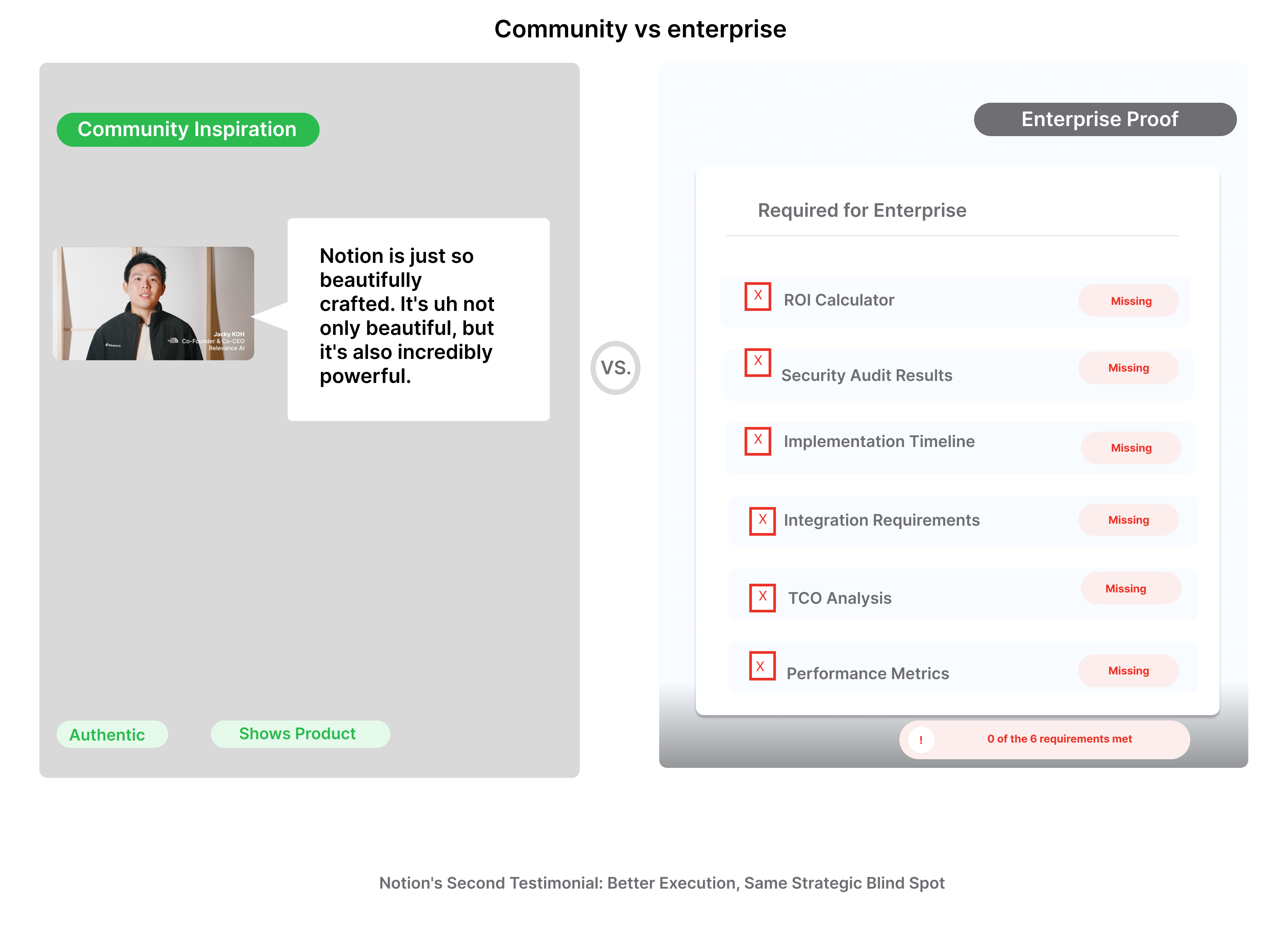
The Relevance AI testimonial shows progress: actual product demo, credible founder, specific use case. Yet it still chooses inspiration over evidence.
Two weeks after Notion’s healthcare testimonial stumbled through 89 seconds without showing the product, the company published another customer video. This time, it featured Jacky Koh, co-CEO of Relevance AI—a $37 million-funded, multi-agent platform with 40,000 AI agents created in January 2025 alone. Importantly, this version demonstrates Notion MCP (Model Context Protocol) actually creating documents. Progress, clearly.
Yet watching this 164-second testimonial, you encounter the same fundamental tension: Notion still markets like a community-beloved productivity tool when it needs to sell like enterprise infrastructure.
“Humans are subject matter experts, AI agents are your top employees, with the shared goal of eliminating busywork for everyone.”
That’s Koh’s closing philosophy—inspiring, quotable, completely unmeasured. So how much busywork actually got eliminated? For how many employees? And what time savings resulted? Notably, the video never answers. Similarly, when Notion’s Dr Jamie Phillips healthcare campaign buried its value proposition 37% through the runtime, we dissected how consumer-origin SaaS struggles with enterprise proof standards. This Relevance AI video improves tactically yet still reveals the same strategic blind spot.
If you’re building B2B SaaS testimonials—or evaluating whether your own marketing has matured past community enthusiasm into enterprise credibility—this comparison matters deeply. Additionally, check our analysis of Swiggy’s brand campaign strategy for similar lessons.
What Notion Fixed: Four Tactical Wins
1. The Product Finally Appears
Unlike the healthcare video where Notion’s interface never showed, this testimonial demonstrates the actual technology. Specifically, around the 86-second mark, Koh explains: “We use Notion MCP internally whenever we have a presentation. We would actually have the agent research the different prospects, then actually create a Notion doc so that we have talking points.”
Subsequently, you see the workflow: AI agent researches → creates Notion document → team has meeting prep automatically. That’s a concrete use case with visual proof. Best-practice testimonial frameworks consistently emphasize showing the interface in action, and Notion finally delivers here.
2. Credible Spokesperson With Daily Usage
Jacky Koh isn’t a corporate spokesperson reading marketing copy. Rather, he’s a non-technical co-CEO who co-founded Relevance AI in 2020, raised $24 million in Series B funding (May 2025), and serves enterprise clients including SafetyCulture and Activision. Importantly, he uses Notion daily to run a company building the exact technology Notion wants to sell to: multi-agent AI platforms.
This positioning makes Koh a peer validator for Notion’s target audience—technical teams adopting AI agent workflows. Furthermore, research on B2B testimonial effectiveness shows that credibility comes from relevant experience, not just enthusiasm. In this case, Notion chose well.
3. Specific Use Case Explained
Rather than vague claims about “democratizing knowledge,” Koh describes a precise workflow:
- Problem: Team needs meeting prep for prospect presentations
- Solution: Agent researches prospects, writes Notion doc with talking points
- Outcome: “Document as much as possible but also reshare as much as possible”
Admittedly, “reshare as much as possible” remains somewhat vague. However, the workflow itself is concrete enough that another AI platform CEO could imagine replicating it. Comparatively, the healthcare video never explained how clinical governance became searchable—just that it did.
“Knowledge sharing is central to what I do. It’s about building relationships”
That opening sets the philosophical tone, yet Koh follows through with tactical application. Structurally, this mirrors KitKat’s balance of emotional resonance and functional clarity—although Notion doesn’t quite nail the equilibrium yet.
4. Enterprise Credibility Signals
Throughout the testimonial, Koh mentions tangible scale indicators:
- “40,000 AI agents created on our platform in January 2025 alone”
- Clients like SafetyCulture (75,000+ customers globally), Activision
- “Multi-agent system platform where you can build and deploy AI agents”
These aren’t consumer hobby projects. Consequently, when Koh endorses Notion, he’s implicitly saying: a company serving Fortune 500 enterprise clients trusts Notion for mission-critical knowledge management. That B2B signal carries weight the Dr Phillips video lacked.
What Notion Still Gets Wrong: The Metrics Gap
Here’s where progress stalls. Despite demonstrating the product and choosing a credible spokesperson, the video commits the same cardinal sin as the healthcare testimonial: zero quantifiable outcomes.
The Missing Numbers That Matter
Watch carefully and you’ll notice Koh never states:
- “We reduced meeting prep time by X hours per week”
- “Our team onboarded Y new employees using Notion documentation in half the usual time”
- “Before Notion MCP, we spent Z% of our day searching for information—now it’s instant”
Instead, you only hear qualitative praise:
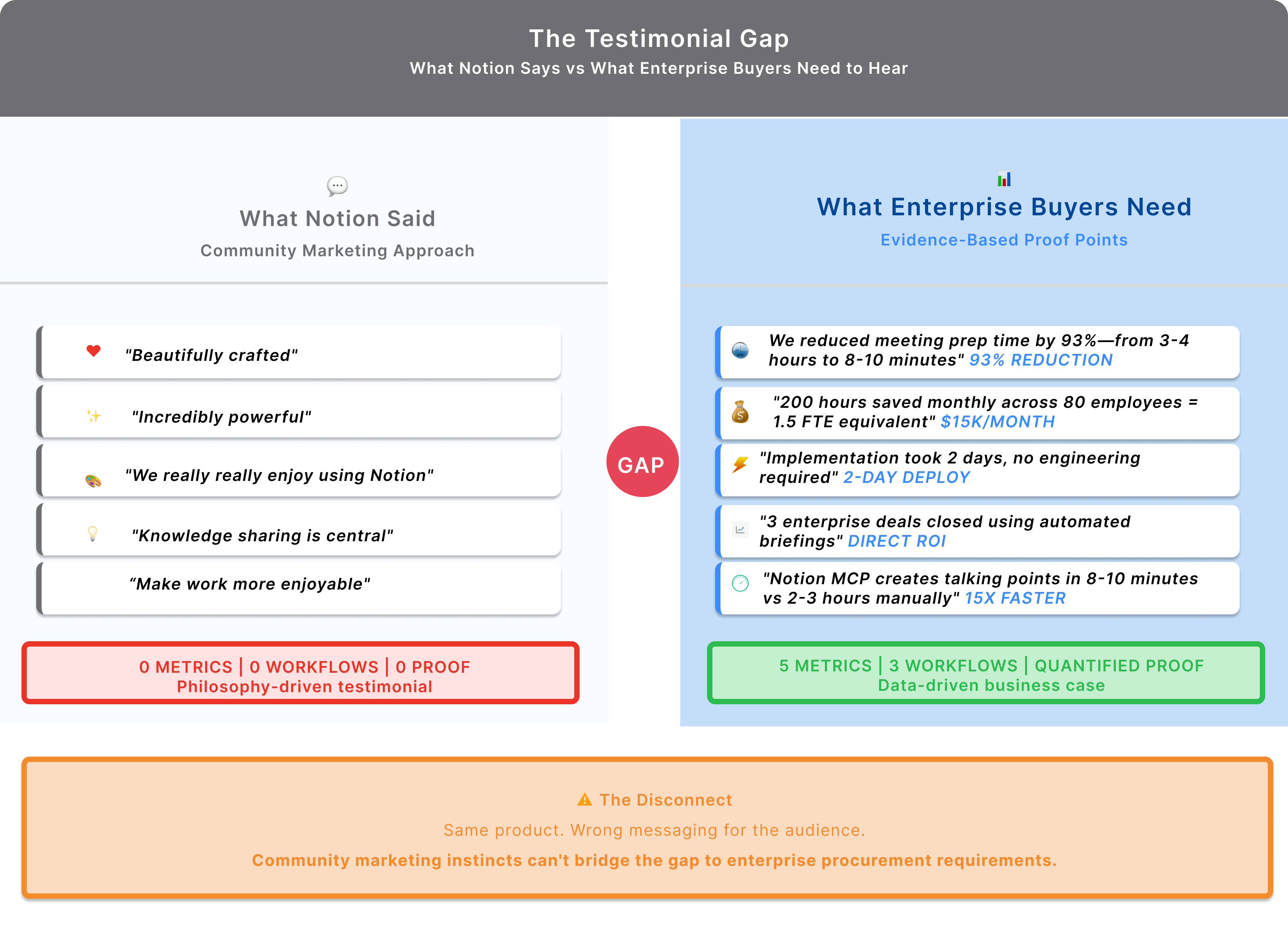
- “Beautifully crafted”
- “Incredibly powerful”
- “We really really enjoy using Notion”
Research from Bayleaf Digital demonstrates that B2B testimonials with “specific metrics build credibility,” yet 73% of SaaS testimonial videos skip them entirely.
Notion remains in that 73%. Notably, Relevance AI itself touts measurable results in its own marketing: “40x increase in agents created YoY,” “$24 million Series B,” “80 employees up from 19 in 2023.” They understand numbers persuade. Yet their Notion testimonial omits every metric.
Why This Pattern Persists
Ultimately, this happens because Notion’s DNA remains community-led, where enthusiasm substitutes for ROI. Their $10 billion valuation was built on bottom-up adoption: individuals fell in love with Notion, then convinced their teams. Subsequently, metrics didn’t matter—feeling productive was enough.
Enterprise procurement doesn’t work that way. Moreover, healthcare buyers (Dr Phillips’ audience) and AI platform CTOs (Koh’s peers) make decisions through spreadsheets comparing vendor ROI. When your testimonial says “incredibly powerful” without defining “powerful,” you’ve lost the CTO.
The Demonstration Paradox: Showing vs Proving
Here lies a subtle but critical distinction: this video shows the product but doesn’t prove the value.
What We See vs What We Need
Around 1:26, Koh explains: “We use Notion MCP internally. Whenever we have a presentation, we would actually have the agent research prospects, then create a Notion doc with talking points.”
That’s a demonstration—you see the workflow described. However, it’s not proof of value because critical questions remain unanswered:
Unanswered Question #1: How long did meeting prep take before Notion MCP? Alternatively, how long does it take now?
Unanswered Question #2: How many people on the Relevance AI team use this workflow? Is it Jacky alone, or 80 employees?
Unanswered Question #3: What happens when the AI agent gets information wrong? How does quality control actually work?
Unanswered Question #4: How long did implementation take? Alternatively, did it require engineering resources or was it truly no-code as claimed?
The Enterprise Buyer’s Dilemma
Consequently, an enterprise buyer watches this and thinks: That sounds useful, but I have no idea if it’s worth the investment, implementation time, and change management headache. Comparatively, effective SaaS testimonials answer these questions explicitly with before/after timelines and quantified improvements.
Notion demonstrates what the product does but never proves why it matters more than alternatives. Similarly, the Maybelline Mumbai Mirage campaign showed stunning visuals without proving brand differentiation—beautiful execution without strategic substance.
The Philosophy Problem: Inspiration Doesn’t Scale to Enterprise
Listen to Koh’s framing throughout the testimonial:
- “Knowledge sharing is central to what I do. It’s about building relationships.”
- “Humans are subject matter experts, AI agents are your top employees.”
- “We want to essentially free up a lot of this busy work, this boring and repetitive work.”
- “Make work much more enjoyable.”
“You want your AI agent to perform like your top employee rather than people that have no context over your business.”
These are beautiful, human-centered, philosophically sound statements. Frankly, they’d work brilliantly in a keynote presentation at a tech conference. Community-driven audiences love this messaging because it aligns values and vision.
What Enterprise Procurement Actually Needs
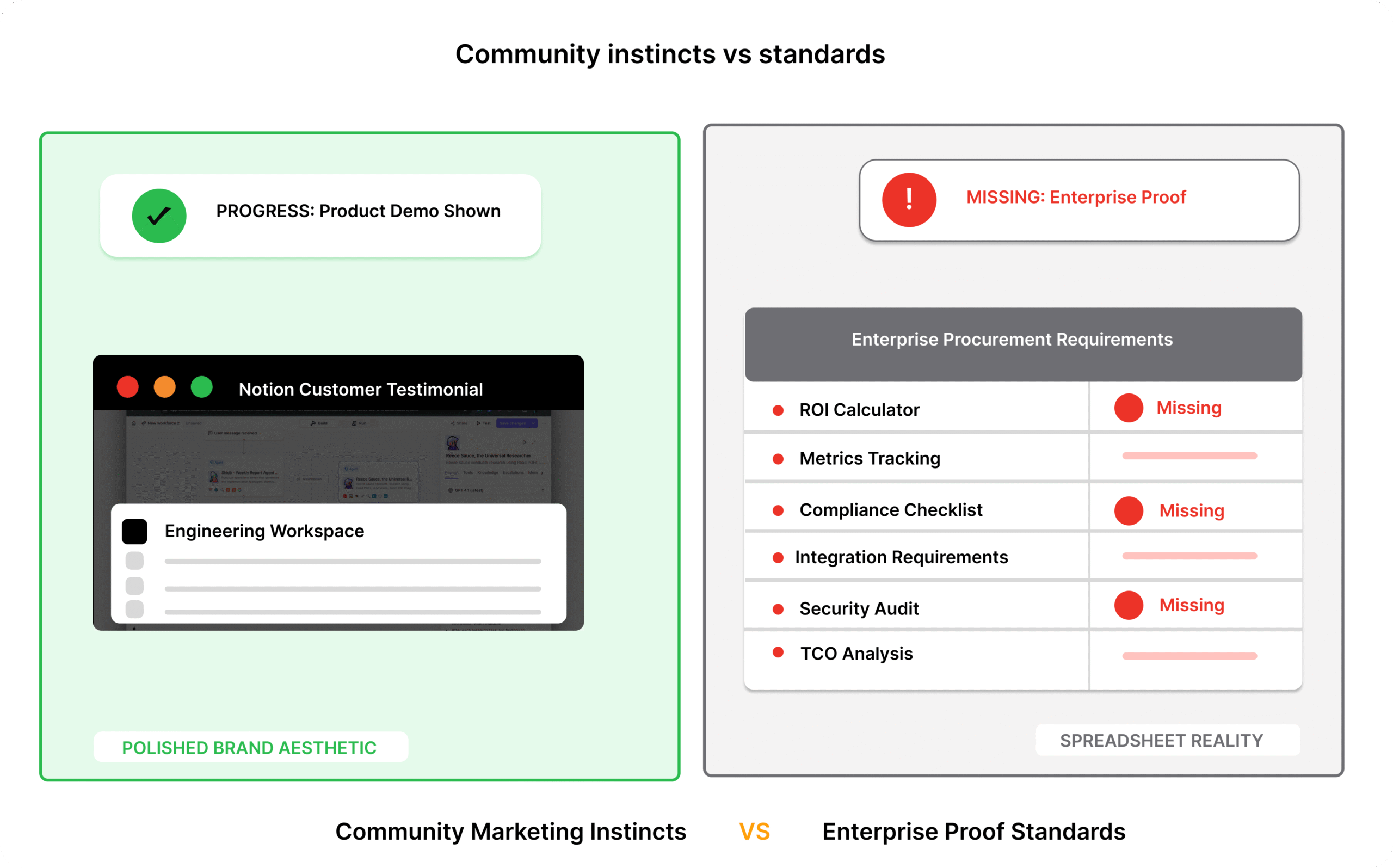
Yet enterprise buyers need operational proof, not philosophical alignment. When a CTO evaluates Notion MCP against competitors like Microsoft’s AI integrations or Confluence’s knowledge management, they’re not asking “Does this make work enjoyable?” Instead, they’re asking:
- “What’s the TCO (total cost of ownership) over 3 years?”
- “How does this integrate with our existing tech stack (Salesforce, Jira, Azure)?”
- “What’s the security model—can we control which agents access which documents?”
- “What happens if Notion MCP goes down—do we have an SLA?”
- “How many support tickets per month do similar-sized customers file?”
Remarkably, the testimonial addresses exactly zero of these questions. Instead, it pitches a vision: AI agents as top employees eliminating busywork. Inspirational? Absolutely. Purchase-decision sufficient? Not remotely.
What This Reveals About Notion’s Strategic Blind Spot
Two testimonial videos in two weeks. One featuring a healthcare CMO, another featuring an AI platform co-CEO. Both demonstrate Notion’s product more explicitly than past campaigns. Importantly, both feature genuinely credible spokespeople. Both describe specific use cases.
Yet both prioritize philosophy over proof.
The Community DNA Problem
This isn’t coincidence—it’s strategic DNA. Notion grew to $10 billion by inspiring individuals to adopt. Their community-led growth playbook emphasized:
- Templates shared peer-to-peer (inspiration-driven)
- Ambassador programs rewarding enthusiasm (community-building)
- Horizontal use cases appealing to everyone (broad accessibility)
- Bottom-up adoption where individuals convince teams (viral growth)
Notably, that strategy succeeded spectacularly. Notion became synonymous with modern productivity. Their Reddit communities, Discord servers, and YouTube tutorial ecosystem created unprecedented organic awareness.
The Enterprise Reality Gap
However, enterprise sales demand fundamentally different marketing:
- ROI calculators showing cost savings (data-driven)
- Security whitepapers detailing compliance (risk-mitigation)
- Implementation guides estimating timeline (project-planning)
- Top-down validation from multiple stakeholders (consensus-building)
- Comparative analyses versus competitors (competitive intelligence)
Notion keeps making testimonials that win community love but fail enterprise procurement. Moreover, this gap compounds with each market they enter. Healthcare requires clinical evidence standards. AI agent platforms require technical integration proof. Financial services would require audit trail documentation.
Philosophically inspiring testimonials can’t bridge these gaps.
The Competitive Context: Why This Urgently Matters
Relevance AI raised $24 million in May 2025 specifically to accelerate AI agent platform development. Meanwhile, competitors are flooding the market:
- Microsoft is building multi-agent capabilities directly into Microsoft 365
- Retell, SmythOS, Gooey.AI, Cykel AI all offer no-code agent platforms
- Salesforce is integrating AI agents into CRM workflows
- Confluence (Atlassian) offers knowledge management with AI search
The Market Growth Imperative
Furthermore, the multi-agent AI market is projected to grow from $5.25 billion (2024) to $52.62 billion (2030)—a 46.3% compound annual growth rate. Additionally, 85% of enterprises expect to implement AI agents by end of 2025.
This explosive growth means buyers have choices. Consequently, when evaluating Notion MCP versus competitors, they’ll compare:
- Implementation speed: How fast can we deploy this across 1,000 employees?
- Integration depth: Does it work with our existing systems (Slack, Teams, Salesforce)?
- Pricing transparency: What’s the per-seat cost at scale?
- Support quality: Do we get dedicated account management or generic help desk?
Where Notion Falls Short
Notably, Notion’s testimonials don’t address any of this. Meanwhile, competitors are publishing:
- Detailed case studies with implementation timelines
- ROI calculators showing projected savings
- Technical architecture diagrams
- Security certifications (SOC2, GDPR compliance)
- Comparison tables versus alternatives
Specifically, when enterprise buyers can’t find operational proof in testimonials, they assume it doesn’t exist. That’s not fence-sitting—that’s procurement best practice. If you can’t quantify value, you can’t justify budget allocation.
What Notion Should Have Done Differently
Imagine this testimonial reshot with enterprise proof standards:
Opening (15 seconds)
“Before Notion MCP, our team at Relevance AI spent 3-4 hours per week manually preparing meeting briefings. That’s 15% of our knowledge work time—across 80 employees, that’s 12 full-time equivalents wasted on busy work.”
Problem Establishment (30 seconds)
“As a multi-agent AI platform, we dogfood our own technology. But human expertise still matters—our agents need access to our accumulated knowledge about prospects, market positioning, competitive intelligence. Previously, that knowledge lived in Slack threads, Google Docs, someone’s brain. Finding it meant interrupting teammates or guessing.”
Solution Implementation (45 seconds)
“We implemented Notion MCP in November 2024. Initial setup took 2 days—connecting our integration token, granting page-level permissions, configuring our agent workflows. No engineering resources required; our operations team handled it. Within a week, we had our first automated briefing doc.”
Results Quantified (30 seconds)
“Now, 90% of our meeting prep happens automatically. Our agents research prospects, pull relevant context from Notion pages, and generate talking points in 8-10 minutes versus the 2-3 hours manual process. That’s a 93% time reduction. Across our team, we’ve reclaimed roughly 200 hours per month—equivalent to hiring 1.5 additional people without increasing headcount.”
Validation (20 seconds)
“Critically, quality hasn’t dropped. Our sales team reports briefings are more comprehensive because the agent surfaces connections we’d miss manually. We’ve closed 3 enterprise deals where the automated briefing directly contributed to demonstrating domain expertise.”
CTA (10 seconds)
“If you’re building AI agent workflows and need knowledge management that scales, book a demo at notion.com/mcp. See exactly how we set this up.”
What This Achieves
Total runtime: 2 minutes 30 seconds (similar length to current video)
Notice the difference? Every claim is quantified:
- 3-4 hours per week → 8-10 minutes (93% reduction)
- 80 employees → 200 hours monthly saved → 1.5 FTE equivalent
- Implementation: 2 days, no engineering required
- Quality validation: 3 deals closed with briefing contribution
- Clear CTA with next step
Notably, this version would still feature Jacky Koh’s authentic voice and Relevance AI’s credibility. However, it would replace philosophical inspiration with operational proof—exactly what enterprise procurement demands.
Why This Pattern Keeps Repeating
After analyzing both the Dr Phillips healthcare video and now the Relevance AI testimonial, a clear pattern emerges: Notion has one playbook, and it’s the wrong one for enterprise.
The Community Playbook
Their community-led growth instincts say:
- Make it inspiring (emotional connection builds viral momentum)
- Show the vision (people share aspirational content)
- Let customers evangelize authentically (forced corporate messaging kills community trust)
- Focus on horizontal appeal (more use cases = more potential adopters)
These instincts built a $10 billion productivity phenomenon. Undeniably successful.
The Enterprise Requirements
Yet enterprise procurement operates on different principles:
- Make it measurable (ROI justifies budget allocation)
- Show the proof (finance teams need numbers, not narratives)
- Validate through multiple stakeholders (one testimonial is insufficient—need clinician + IT + compliance)
- Focus on vertical depth (horizontal breadth creates “jack of all trades, master of none” perception)
The Persistent Mismatch
Notion keeps applying community tactics to enterprise challenges. Moreover, each new vertical they enter—healthcare, AI agents, potentially financial services or manufacturing next—requires even more specialized proof.
Healthcare buyers need clinical governance compliance documentation. AI platform CTOs need integration architecture diagrams. Financial services compliance officers need audit trail specifications.
Philosophically inspiring testimonials about “eliminating busy work” and “making work enjoyable” don’t address these requirements. Consequently, Notion’s testimonials generate awareness (community strength) but fail conversion (enterprise weakness).
The Bigger Implication for SaaS Marketing
This analysis matters beyond Notion. Specifically, every consumer-origin SaaS pursuing enterprise faces this same tension:
Figma built design dominance through bottom-up designer adoption, yet enterprise security sales require IT procurement validation.
Slack became ubiquitous through team-level viral growth, yet competing with Microsoft Teams demands enterprise architecture integration proof.
Canva democratized design for millions of individuals, yet corporate brand management requires permission hierarchies and asset governance.
Your community moat doesn’t translate to enterprise sales. Community marketing builds bottom-up momentum, whereas enterprise marketing requires proof, process, and patience.
The Fundamental Lesson
Each company discovers the same painful lesson: the marketing that built your valuation can’t capture the enterprise revenue that sustains it.
Furthermore, the solution isn’t abandoning community. Rather, it’s operating two parallel marketing engines:
Community marketing (B2C + SMB): Inspiration-driven, philosophy-heavy, template-focused, ambassador-led, viral mechanics, horizontal appeal.
Enterprise marketing (B2B top-down): Evidence-driven, metrics-heavy, implementation-focused, stakeholder validation, procurement integration, vertical depth.
Notion hasn’t fully committed to the second engine yet. Their testimonials still lean heavily toward the first. Consequently, they’re leaving enterprise revenue on the table while competitors build the proof architecture buyers actually need.
What This Means for Your SaaS Marketing
If you’re managing B2B SaaS testimonials—or evaluating whether your own marketing has matured beyond community enthusiasm—ask these diagnostic questions:
Content Audit
- Do our testimonials include 3+ quantified metrics per customer? (time saved, cost reduced, revenue increased, efficiency gained)
- Can a procurement team extract ROI projections from our case studies without contacting sales?
- Do we address implementation timeline, integration requirements, and support model explicitly?
- Have we validated messaging with multiple stakeholder personas (end-user + IT + finance + compliance)?
Competitive Comparison
- When buyers compare us to alternatives, can they find differentiation proof in our testimonials?
- Do we explain why our approach works better, not just that it works?
- Have we documented security, compliance, and audit capabilities that enterprise buyers require?
Conversion Tracking
- What percentage of testimonial viewers book demos? (If < 5%, your content isn’t persuasive enough)
- How many deal cycles include testimonial content as decision factor? (If sales doesn’t reference them, they’re not credible enough)
- Do lost deals cite “lack of proof” or “couldn’t justify ROI”? (If yes, your testimonials failed their purpose)
The Ultimate Test
Ultimately, inspiration builds awareness. Evidence closes deals. Community enthusiasm generates viral growth. Quantified proof wins procurement budgets.
Notion’s Relevance AI testimonial shows they’re learning—product demonstration is progress. However, until they commit to enterprise proof standards, they’ll keep making beautiful testimonials that enterprise buyers appreciate but don’t purchase from.
Healthcare desperately needs better clinical governance tools. AI platforms desperately need robust knowledge management. Notion MCP genuinely solves real problems for both markets.
Strategically, the product is sound. The strategy is sound. The execution still defaults to community instincts when it needs enterprise discipline.
Sources & Further Reading
Relevance AI, Series B Funding Announcement
TechCrunch, Relevance AI Raises $24M for AI Agent Platform
Notion, Notion MCP Help Center Documentation
MLVeda, Multi-Agent AI Systems for Enterprise Intelligence
Content Beta, Best Testimonial Video Examples
Bayleaf Digital, B2B Testimonial Best Practices
First Round Review, How Notion Does Marketing
No Good, Notion Growth Strategy Analysis
Bessemer Venture Partners, Meet the Founders of Relevance AI
Competitive Intelligence Alliance, How Notion Grows Case Study