
How the world’s leading CRM turned a genuine product into a cautionary tale about hype, trust, and the gap between what you promise and what you deliver
It’s the first week of January 2026, and Salesforce has just wrapped another glittering World Tour event. Twelve thousand customers are now “building agents,” we’re told. The company has unveiled 20 new Agentforce features in two months. Marc Benioff continues his media blitz, declaring Microsoft Copilot dead on arrival. Production values are impeccable. Messaging is relentless.
And yet, if you listen carefully to Salesforce’s own people—the admin evangelists recording their annual predictions podcast on New Year’s Day—you hear something else entirely. Building agents may be easier than expected, they admit, but “there’s still plenty of work to be done to get organisational buy-in.” Setup with Agentforce, the tool they predicted would launch in 2025? Still in closed pilot. The biggest barrier to Agentforce adoption? “Data debt”—organisations whose systems are too messy for AI to work properly.
This is the gap that matters in 2026. Not the gap between Salesforce and its competitors, but the chasm between what the marketing promises and what customers can actually achieve.
It’s a gap that’s costing Salesforce credibility, costing customers time, and offering the rest of us a masterclass in how not to market enterprise AI.
Why this matters now
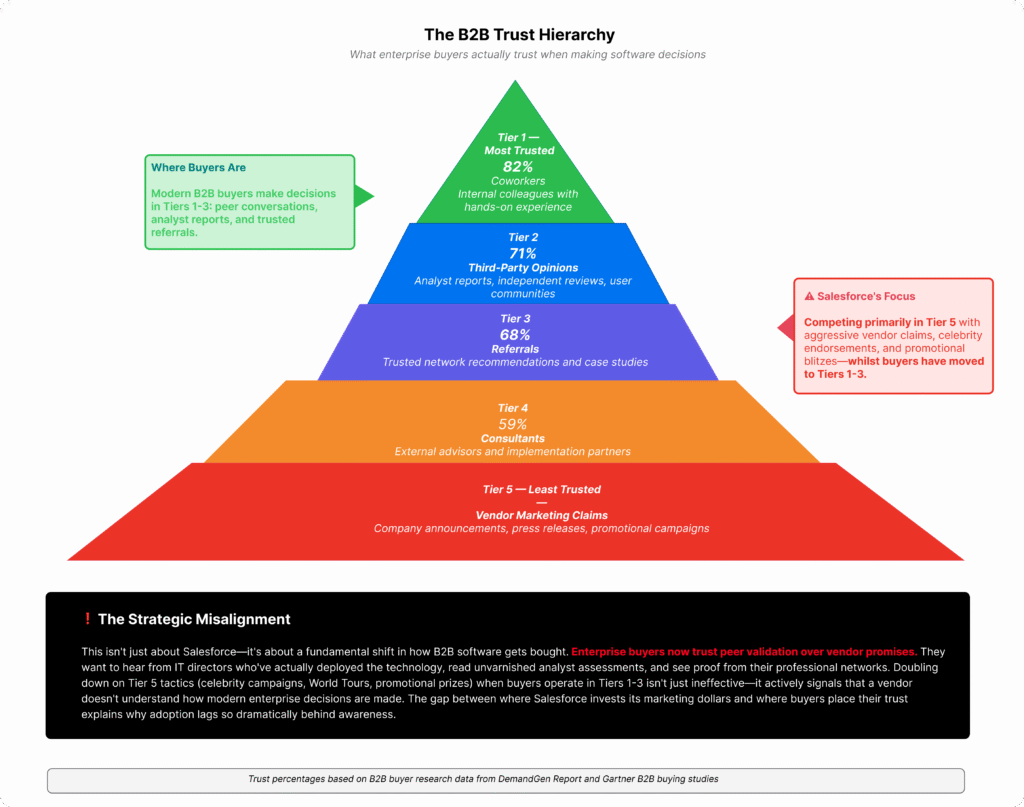
B2B buyers in 2026 face what researchers are calling a “fundamental trust deficit in vendor promises.” Buyers are almost twice as likely to do business with vendors they trust, yet most vendors fail to establish that trust before shortlists are formed. Eighty-five per cent of buyers choose from their day-one shortlist, and 78% select products they’d heard of before starting research. If trust isn’t there early, you become invisible.
At the same time, regulatory bodies are actively prosecuting AI-washing—the practice of making false or exaggerated claims about AI capabilities. The US Securities and Exchange Commission recently fined a fintech firm for falsely claiming to be the “first regulated AI financial advisor” when its AI use was negligible. Honesty and transparency in AI marketing aren’t optional, the Department of Justice has made clear.
This is the environment Salesforce is operating in. An environment where 69% of SaaS customers cite unmet expectations as the primary reason for churn, where enterprise buyers increasingly rely on third-party opinions over vendor claims, and where 84% of users prefer human contact to AI assistants despite 75% of marketers betting their strategy on AI.
Against this backdrop, Salesforce’s Agentforce campaign offers an urgent case study. Because it reveals not just one company’s marketing missteps, but the systemic problems plaguing B2B tech marketing as we enter what many are calling the “defining year for AI agents.”
The numbers don’t add up
Start with the metrics Salesforce uses to claim success. In December’s World Tour NYC keynote, the company announced 12,000 customers are building agents—up from the 8,000 deals it had signed by mid-2025. Sounds impressive. Until you realise that of those 12,500 customers who’ve “adopted” Agentforce, only 6,000 represent paid engagements. That’s an 8% adoption rate across Salesforce’s customer base.
According to Fortune’s reporting, this is the “fastest adoption of any product” the company has released. Yet Benioff himself admitted at Dreamforce 2025 that “innovation is outstripping customer adoption” and the company must work to “get those customers into adoption mode.”
When your CEO acknowledges a gap between product capability and customer readiness, but your marketing continues to declare victory, you’ve got a credibility problem.
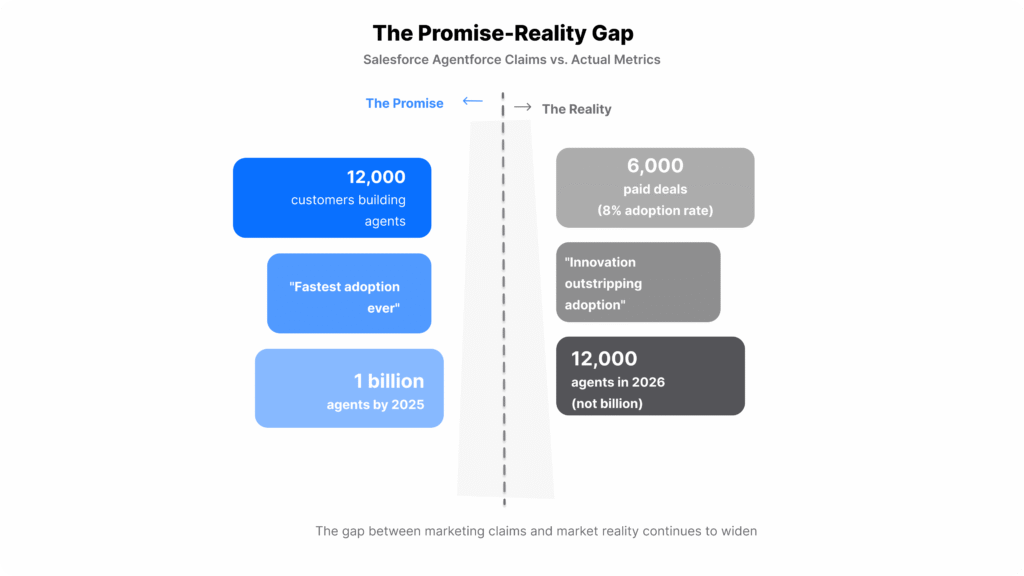
Compare this to Benioff’s original vision: “one billion agents by the end of 2025.” We’re now in 2026, with 12,000 customers building agents. Even if each customer built 100 agents—a wildly optimistic scenario—that’s 1.2 million agents.
The billion-agent promise wasn’t a stretch goal. Fantasy masquerading as forecast is more accurate.
The tactics reveal the anxiety
When adoption lags, marketing gets aggressive. Salesforce’s tactics in late 2025 revealed an organisation increasingly anxious about its own narrative.
Forcing usage to manufacture metrics
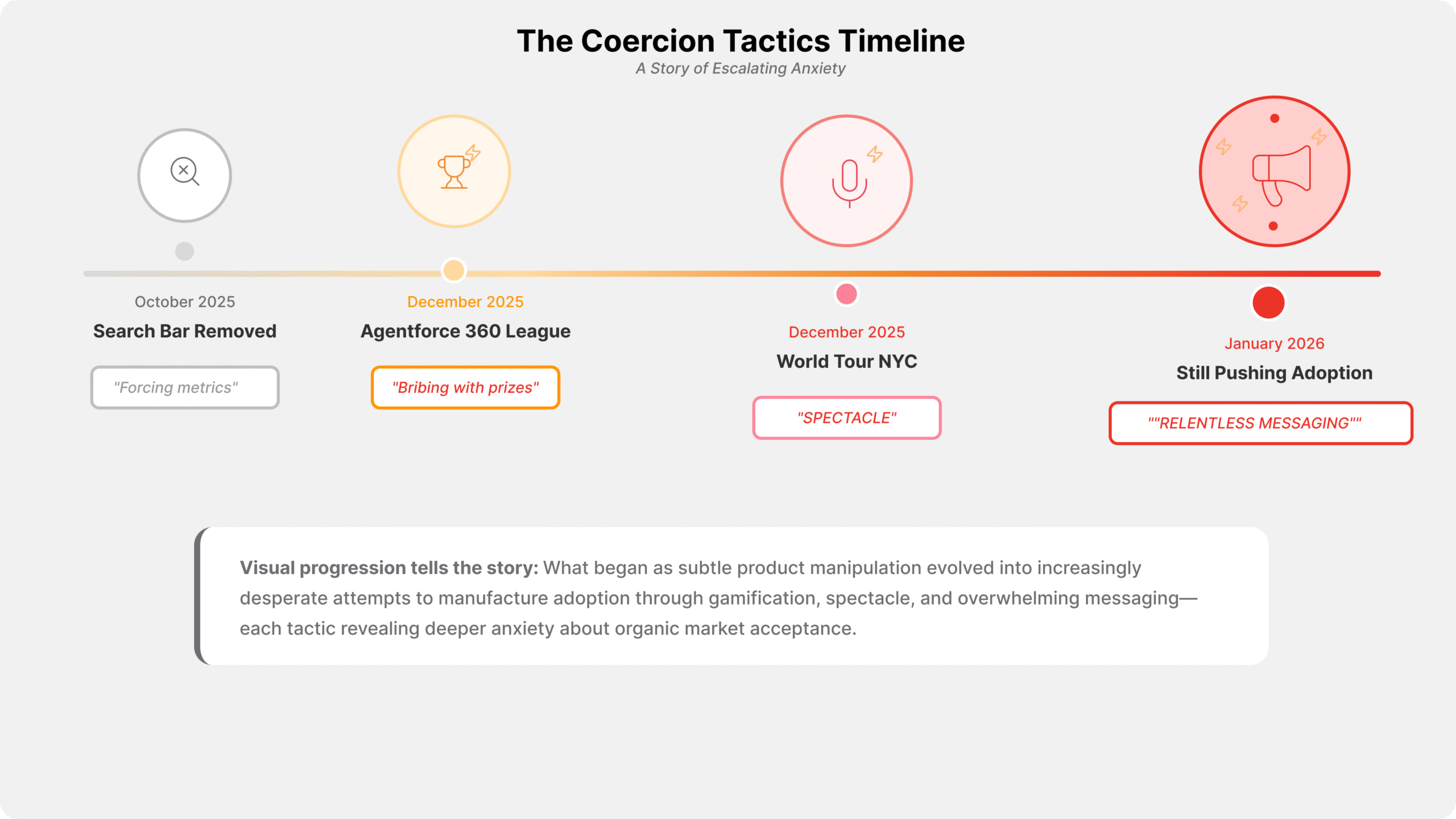
In October, the company quietly removed the search bar from its help.salesforce.com support portal, forcing users to interact with Agentforce instead. Community response was swift and damning. Users accused Salesforce of “prioritising AI adoption metrics over user experience” and designing the change “to inflate usage stats for Agentforce to impress shareholders, rather than address real customer needs.”
Confidence? Hardly. Desperation dressed up as product strategy is more like it.
If Agentforce delivers the value Salesforce claims, users shouldn’t require coercion to adopt it. Forcing usage to manufacture metrics doesn’t build trust—it erodes it.
Gamification as substitute for value
Then there’s the gamification approach. Salesforce’s Agentforce 360 League—a two-month learning programme running from December 2025 to January 2026—promises MacBook Airs, PlayStation 5s, and other prizes to teams that build the most AI agents. The programme targets India specifically, with team-based competitions and “real use cases from retail, finance, manufacturing.”
Nothing’s inherently wrong with incentivising learning. But when you’re offering consumer electronics to drive adoption of enterprise software, you’re admitting the value proposition isn’t self-evident. The programme’s messaging is telling: “AI is changing pretty fast… we need to stay ahead.” Translation: we’re shipping features faster than customers can absorb them, and we need you to keep up.
What the video content reveals
Salesforce’s YouTube channel offers an unintentionally honest portrait of a company struggling to align capability with communication.
Feature velocity over customer readiness
The World Tour NYC demo focuses heavily on new features: Agentforce Builder with its AI assistant, AgentScript for deterministic logic, Intelligent Context for parsing unstructured data, Agentforce Observability for monitoring agent performance. These are genuine technical advances. Problems emerge in the framing.
“We move fast,” the presenter emphasises multiple times. “Over the course of four releases, we’ve built the tools, infrastructure, and out-of-the-box resources you and your organisations need.” Subtext: we’re innovating at breakneck speed. Implication: you should be too.
But customers aren’t asking for velocity. Reliability, predictability, and—above all—agents that actually work in their messy, real-world environments are what they need.
When Salesforce’s own admin evangelists note that “admins couldn’t even get Agentforce buy-in at their organisations without a clear governance story,” the problem isn’t feature velocity. Foundational readiness is the issue.
The demo-reality disconnect
The disconnect becomes starker when you examine what users are actually experiencing. Analysis of G2 Reviews and Reddit discussions reveals that 77% of B2B Agentforce deployments fail due to data quality issues and UX limitations. One Reddit user who sat through an Agentforce pitch documented a demo where the agent allowed appointment cancellation using only an email address—no verification, no authentication. “That means if I wanted to improperly cancel someone else’s appointment, all I would need is their email address,” they noted.
When your “Trust Layer” messaging collides with unauthenticated demos, you’ve undermined your entire positioning.
The rebrand carousel
Then there’s the naming problem. What began as Einstein was rebranded to Einstein GPT, then became part of the Einstein 1 Platform, which spawned Einstein Copilot, which was upgraded and renamed Agentforce in January 2025. By mid-2025, Salesforce was moving beyond even this, rebranding core products: Sales Cloud became Agentforce Sales, Service Cloud became Agentforce Service, Marketing Cloud became Agentforce Marketing.
Genuine confusion proliferates in the ecosystem. Reddit administrators ask: “Is Agentforce designed to slowly replace Einstein?” They note that “many of the name alterations are primarily for marketing purposes.” When your branding strategy requires a decoder ring, you’re optimising for launch buzz rather than customer clarity.
Constant renaming signals strategic uncertainty. A company searching for the right story rather than confidently telling one it believes—that’s what it suggests.
Each rebrand resets brand equity, requiring customers and partners to relearn terminology and repositions previously promoted capabilities as suddenly obsolete. Industry analysis notes that Salesforce’s rebrand frequency has accelerated precisely as AI hype has intensified—correlation that isn’t coincidental.
The India campaign: consumer tactics for enterprise buyers
Salesforce’s May 2025 India campaign featuring Rahul Dravid—former head coach of the Indian men’s cricket team—reveals another dimension of the problem. Two digital films position Dravid in relatable business roles: a bike dealership owner, a resort manager. Creative approach demonstrates how Agentforce enables personalised customer engagement.
Mass visibility doesn’t equal enterprise adoption
Pure consumer marketing defines the media strategy: 1,000 branded cabs across Mumbai, Delhi, and Bangalore; bus wraps; mixed-media print combining animation with static imagery. Salesforce’s India marketing director claims the goal is making Salesforce “a trusted name in Indian households.”
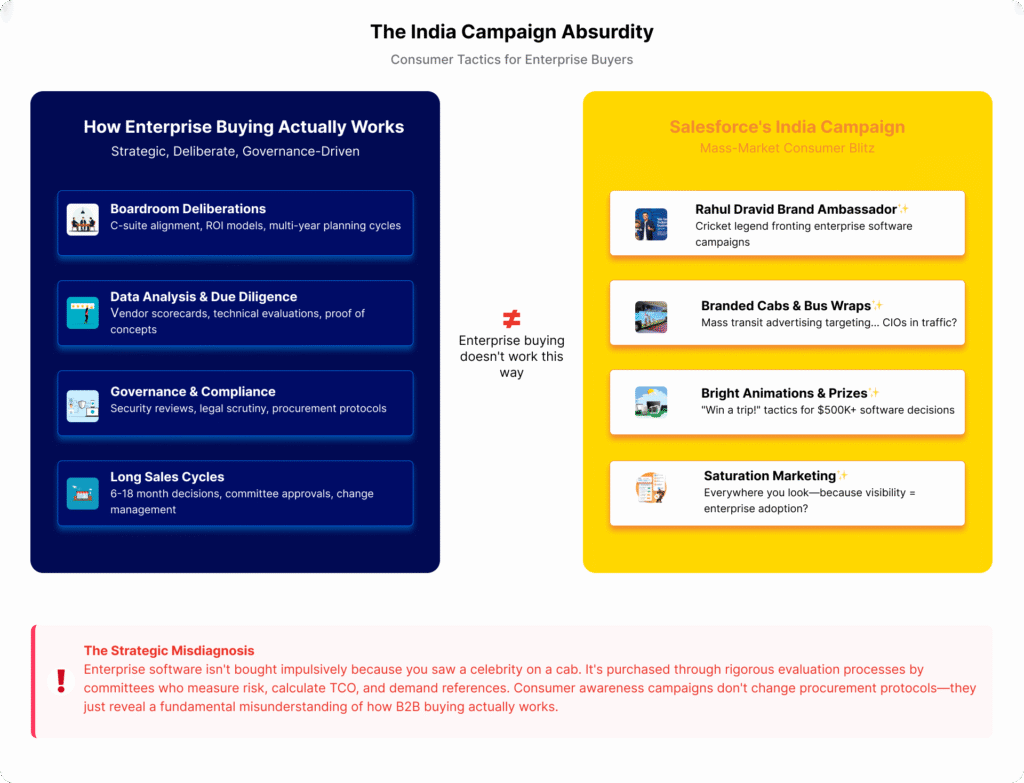
Here’s the problem: household recognition isn’t synonymous with enterprise adoption. B2B buying decisions aren’t made on the basis of bus-wrap visibility. Extensive evaluation, proof-of-concept testing, governance review, and security assessment precede those decisions. Research shows that B2B buyers spend nearly 75% of their journey researching anonymously, consuming up to 15 pieces of content before purchase. Third-party opinions (71%), referrals (68%), and consultants (59%) command far more trust than vendor marketing.
Deploying consumer-marketing tactics—celebrity endorsements, mass transit advertising, prize competitions—for an enterprise product suggests a misdiagnosis of the adoption challenge. Awareness isn’t the barrier to Agentforce adoption. Data readiness, governance clarity, technical debt, and organisational change management are the real obstacles.
Bus wraps don’t solve data debt.
What Salesforce could do differently
None of this suggests Agentforce is bad product. Technical capabilities are real. The Atlas Reasoning Engine, multi-agent orchestration, and Data Cloud integration represent genuine advances in making AI actionable within enterprise workflows. But technical capability without customer readiness is just expensive R&D.
Leading with honesty over aspiration
What would honest marketing look like? Acknowledging the journey rather than declaring arrival would be a start. Messaging might sound like: “Enterprise AI adoption requires data readiness. Here’s how we help you audit and prepare.” Or: “Agentforce works best in these specific use cases. Let us show you where to start small and scale thoughtfully.” Or even: “Most organisations have 18-24 months of data work before they’re AI-ready. Here’s our roadmap for getting there together.”
Conference-hall electricity comparable to “what AI was meant to be”? This wouldn’t generate that. Billion-agent predictions? Those wouldn’t emerge either. But it would build the commodity most valuable in 2026’s trust-deficit environment: credibility.
Metrics that matter
Customer success metrics that matter—time-to-first-value, adoption rates by cohort, reduction in manual work—could replace deal counts in Salesforce’s reporting. Honest implementation timelines that account for data preparation could be published. A diagnostic tool helping customers assess their Agentforce readiness before they commit budget could be created.
Moving beyond competitive attacks
Most importantly, positioning every competitor as a failure could stop. Aggressive Microsoft attacks—comparing Copilot to “Clippy 2.0,” declaring it will “not be around”—create a narrative where Salesforce’s value depends on competitor incompetence rather than its own merit. When Microsoft responded by noting 60% of Fortune 500 companies use Copilot with 60% quarter-over-quarter growth, Salesforce looked less like a category leader and more like an anxious incumbent.
What marketers should learn
The Agentforce campaign matters beyond Salesforce because it crystallises broader problems in B2B tech marketing circa 2026.
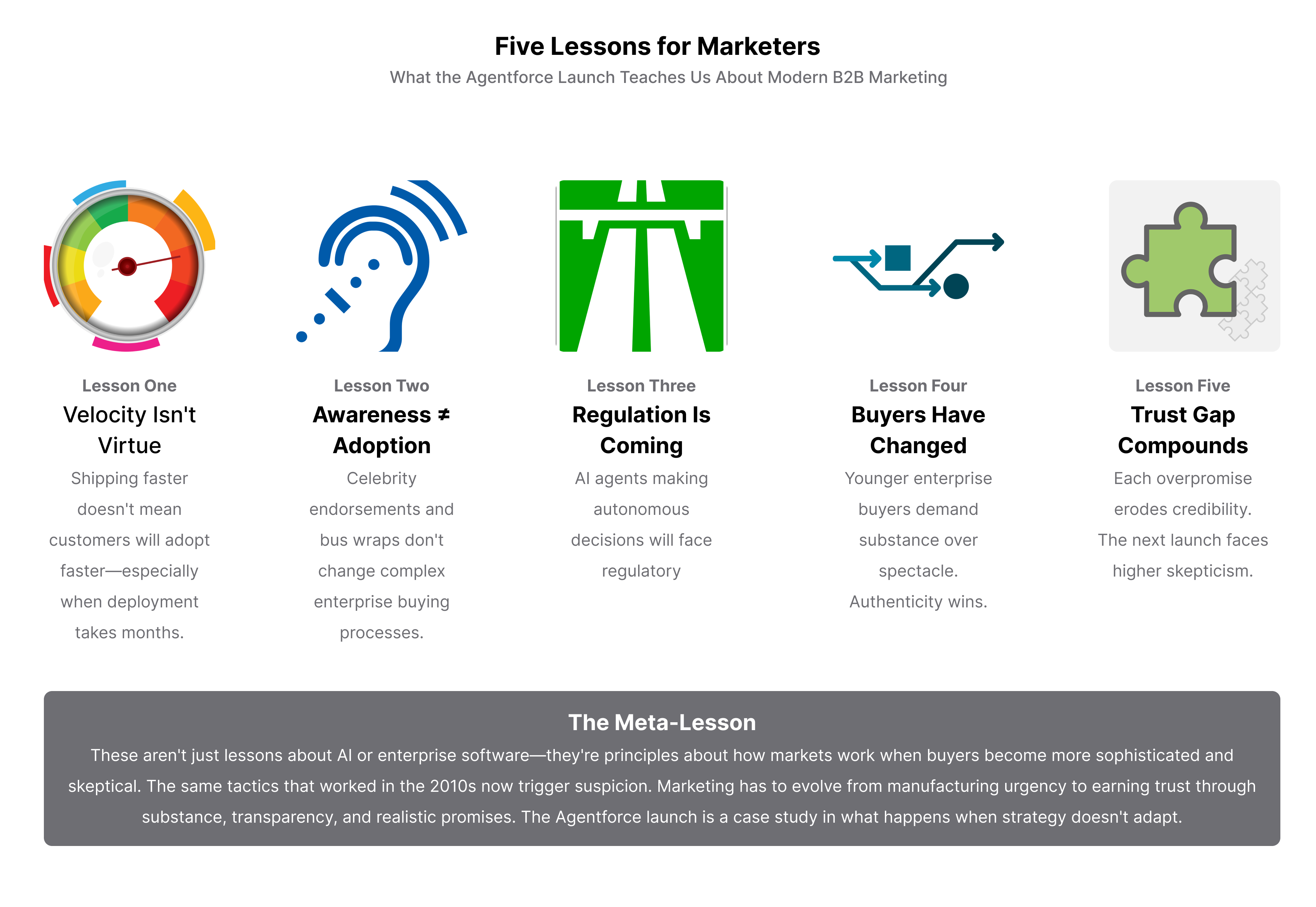
Velocity isn’t virtue
Shipping 20 features in two months doesn’t help customers if they can’t implement the five features you launched last quarter.
Feature velocity has become a substitute metric for customer value—a way to demonstrate “innovation” that actually just creates complexity debt.
This mirrors what we’ve seen in smartphone marketing’s September siege, where brands mistake launch frequency for genuine differentiation.
Awareness doesn’t equal adoption
You can plaster a product across every available surface—YouTube, LinkedIn, bus wraps, prize competitions—and still fail to move customers from evaluation to implementation if the foundational requirements aren’t addressed. Marketing can’t compensate for product-market-fit challenges or organisational readiness gaps.
Regulation is coming
The SEC and DOJ aren’t making idle threats. Active prosecution of AI-washing is happening now, and the definition of “false claims” includes not just capabilities that don’t exist but also implementations that require far more customer effort than marketing materials suggest. If your demo works in controlled environments but fails with real customer data, that’s a claim accuracy problem.
Buyers have changed
Millennial decision-makers now represent 60% of B2B purchasing, and they bring consumer-grade expectations for transparency and authenticity. Exaggeration? They can detect it. Claims get verified through third-party sources. Vendors they trust get chosen, and that trust must be established before they ever fill in your contact form.
The trust gap compounds over time
Every overpromise that leads to implementation struggle creates scepticism that affects not just that vendor but the entire category. When research shows that AI-washing “erodes trust in AI among consumers, investors, and other stakeholders,” and that “if stakeholders consistently encounter overhyped and underdelivering AI products, scepticism toward genuine AI advancements will grow,” the stakes become existential.
Your own credibility isn’t the only thing at risk—you’re poisoning the well for everyone.
The path forward
Salesforce isn’t alone in these practices. Most B2B tech companies are running some version of this playbook: aggressive launch rhetoric, feature velocity as proxy for value, competitive attacks as differentiation strategy, awareness campaigns that substitute for adoption enablement. Higher volume and production value are simply Salesforce’s distinguishing features.
But 2026 is different. Combination of regulatory scrutiny, buyer scepticism, and economic pressure means the gap between promise and delivery has real consequences. Years of work are needed to rebuild trust once it’s eroded. Customers burned by unmet expectations don’t just churn—they become active detractors. And in an environment where third-party validation carries more weight than vendor claims, detractors matter more than ever.
The authenticity opportunity
Substantial opportunity awaits marketers willing to lead differently.
In a landscape of hyperbole, honesty becomes differentiation. In an environment of AI-washing, specificity builds trust.
In a market saturated with “revolutionary” claims, incremental but reliable progress becomes the story worth telling. As we explored in Swiggy Wiggy 3.0’s people-powered marketing, authenticity isn’t just a nice-to-have—it’s the foundation of lasting brand connection.
Abandoning ambition? Not at all. Grounding ambition in customer reality is what’s required. Leading with readiness assessment rather than transformation promises. Measuring success by adoption depth rather than deal breadth. Building product marketing around the journey customers actually take, not the journey you wish they’d take.
What Salesforce needs to do
Salesforce has the resources, talent, and—genuinely—the technical capability to make Agentforce succeed. Courage to market it honestly is what it needs. Acknowledging that enterprise AI adoption is measured in years, not quarters. Admitting that most organisations require substantial preparation work. Leading with governance frameworks and data readiness rather than billion-agent visions.
Until then, Agentforce will remain a cautionary tale. Not about whether AI agents can transform enterprise workflows—they can—but about whether B2B marketing can evolve beyond hype cycles to meet buyers where they actually are.
In 2026, with trust at a premium and scepticism the default, that evolution isn’t optional. It’s survival.
For more on B2B marketing’s trust crisis, see the Search Engine Journal’s analysis of how to win buyers in 2026, MarketingProfs’ investigation into AI-washing risks, and Salesforce’s own Agentforce announcements. Analysis of customer experiences draws from independent reviews and community discussions. Market context informed by Forbes and Fortune reporting.