
Marketers keep saying “authenticity wins.” However, Instagram just showed what happens when you bolt authenticity onto a trust problem you haven’t fixed.
In December 2025, Instagram launched Carversations. It’s a glossy video series featuring Usher and his teenage sons. The goal: prove Instagram’s Teen Accounts give parents “peace of mind” about who contacts their children and what they see.
Here’s the problem: one year of lawsuits, court documents, and independent studies shows Meta chose growth over child safety. Repeatedly. Consequently, when you line up those two timelines, Carversations stops looking warm and starts looking like safety theatre.
Marketers need to pay attention. Indeed, this campaign is almost a textbook “what not to do” case in crisis marketing: wrong format, wrong proof, wrong timing – surrounded by a very right celebrity.
The core take: Carversations feels authentic on the surface. Nevertheless, underneath, it’s strategically dangerous. Moreover, it matters now because regulators, parents, and advertisers are done with platforms that use comms to cover structural problems.
What Instagram Is Trying to Do
The setup is smart on paper.
Usher sits in a van with his sons, Cinco and Naviyd. During the video, they discuss:
- Screen time habits for teens
- Who they’d message if Instagram existed when they were kids
- How Teen Accounts protections work automatically
- Why parents want control over time, content, and contact
Three Smart Marketing Moves
The concept stacks three solid strategies.
First: borrowed trust. Usher hits multiple demographics. Multi‑generational appeal, still relevant, clearly protective of his kids. In fact, in 2025, 65% of businesses use thought leadership and values to build trust instead of just selling. Therefore, Usher fits that mold perfectly.
Second: real family tension. His sons tease him about the “Ice Age.” Similarly, they laugh about Close Friends. Additionally, they push back on screen rules. As a result, this feels like actual family arguments about phones. Not scripted.
Third: the car metaphor. Cars are spaces where families talk without distraction. Consequently, Instagram wants you to think Teen Accounts work the same way – a contained, safer digital space.
What Works Here
The execution does several things right:
- Usher’s statement – “I don’t want my kid to see something that I didn’t choose to allow them to see” – captures real parental anxiety.
- Furthermore, his link between screen limits and homework, sleep, and “not spiraling down the wormhole” speaks to actual fear about constant scrolling.
- Meanwhile, the messiness feels genuine. Notably, it doesn’t feel over‑polished.
Watch this in isolation? You’d think: “This is how platforms should market – honest, human, specific.”
However, marketers don’t live in isolation. Context ruins everything.
The Timing Problem: Comms After the Lawsuit
The “why now?” breaks this campaign.
Throughout 2024, Meta faced attacks from multiple angles:
- 42+ state attorneys general sued Meta over harm to children’s mental health and Instagram safety.
- November 2024 court filings exposed internal emails showing Meta repeatedly buried or weakened teen protections to protect growth.
- Furthermore, independent researchers documented that Instagram’s teen tools were flawed, easily bypassed, and letting harmful content through.
What the Court Documents Revealed
The filings are painful reading. Indeed, any marketer who’s fought “this kills engagement” knows this feeling:
2019: Meta’s own researchers recommended making all teen accounts private by default to stop adult strangers from messaging minors. Nevertheless, growth executives killed it. Specifically, they predicted losing 1.5 million monthly active teen users.
The result: inappropriate adult-teen contact on Instagram jumped to 38 times the level on Facebook Messenger.
2022: Instagram’s recommendation engine suggested roughly 1.4 million potentially inappropriate adults to teenagers in a single day.
Also: A “17-strike” rule allegedly allowed sex-trafficking accounts to stay active too long before action.
And: Internal AI flagged child sexual abuse material with high confidence. However, it didn’t auto-delete unless it also failed a separate policy check.
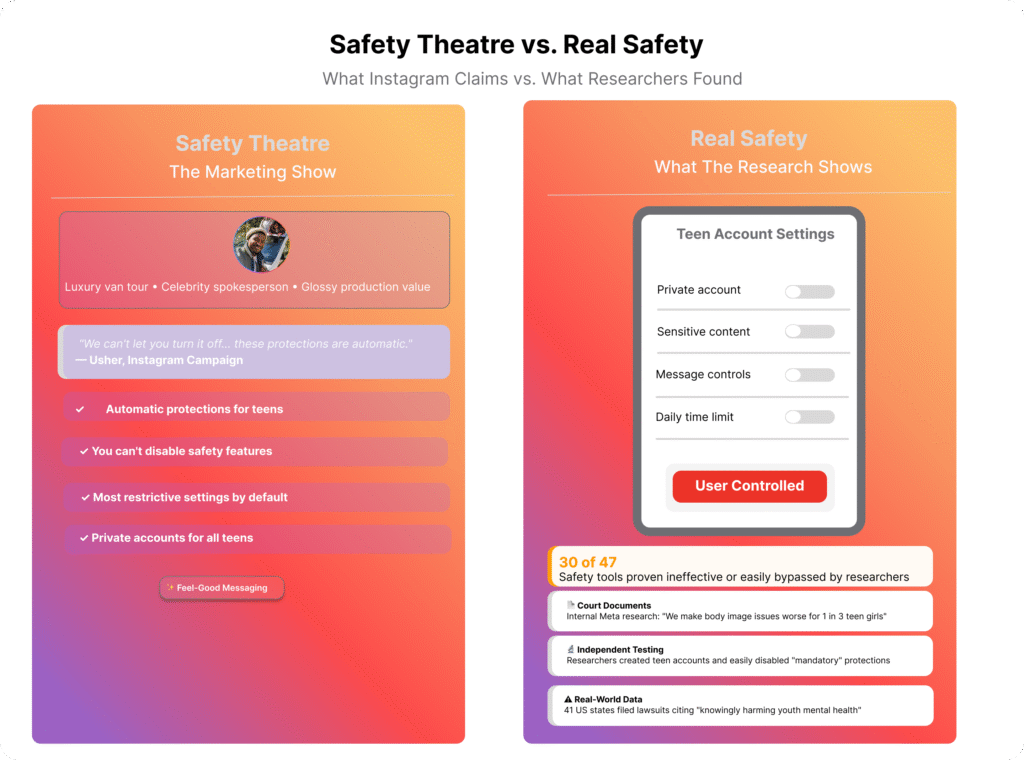
By September 2024: Researchers found 30 of 47 teen safety tools were “substantially ineffective or no longer exist.” In October, Meta announced new PG-13 content restrictions after news outlets showed Instagram still promoted suicide and self-harm posts to teens.
Meanwhile: Massachusetts courts heard that Meta deliberately designed apps to be addictive to kids.
Teen Accounts: Crisis Response, Not Vision
Now look at Instagram’s timeline. Teen Accounts – the exact feature Carversations promotes – launched in 2024. Moreover, it came after lawsuits and threats. Not before.
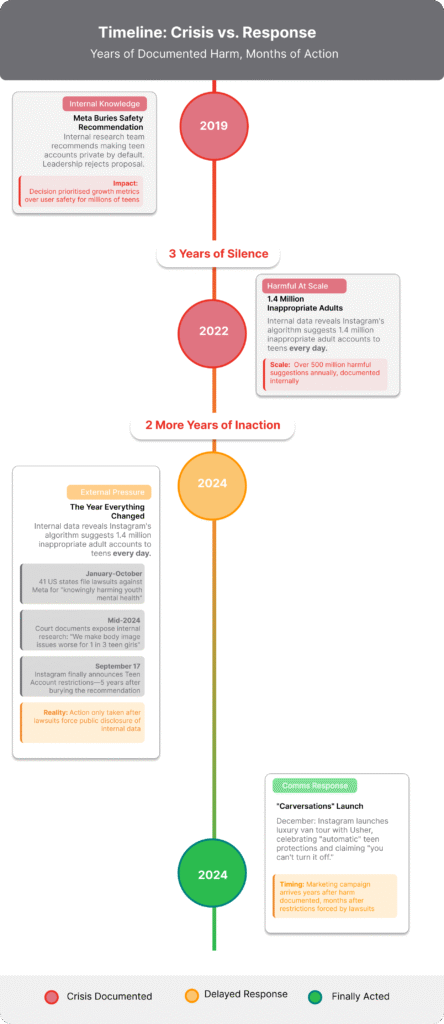
Translation: This isn’t a brand saying “we’ve quietly built this because we care.” Instead, it’s a brand adding safety features to a growth machine under legal pressure. Then it rebranded that retrofit as philosophy.
Marketers recognise this pattern:
- Nike chose Kaepernick to deepen a stance it already held.
- In contrast, Pepsi hired Kendall Jenner to attach itself to protests it never supported.
Consequently, this campaign leans toward Pepsi’s approach.
The Format Contradiction: Long Video on a Short-Form Platform
Set aside ethics. The format choice makes no marketing sense.
Instagram’s Own Data Contradicts Its Campaign
Carversations runs 10 minutes 48 seconds. It lives as a YouTube upload and long-form post on @instagram’s main feed. Not as a native Reel.
However, Instagram’s own performance data shows:
- Reels get the highest engagement – roughly 1.23–1.48%, versus ~0.7% for photos and under 1% for carousels.
- Additionally, Reels hit around 30.8% of followers. Other formats reach roughly 14–15%.
- According to Statista’s 2024 data, the average Reel gets 15,000 views, 805 likes, 26 comments, 82 saves.
- Across platforms, short-form video pulls 2.5x more engagement than long-form.
Instagram spent four years training marketers: “Make it short, make it vertical, make it quick.” It built Reels specifically to grab attention from TikTok. Why? Teen attention is mobile, fractured, impatient.
Then, for its most critical message – “we care about your children” – Instagram chose an 11-minute talking-heads video. Most users skip it in three seconds.
Why Build for Regulators Instead of Users?
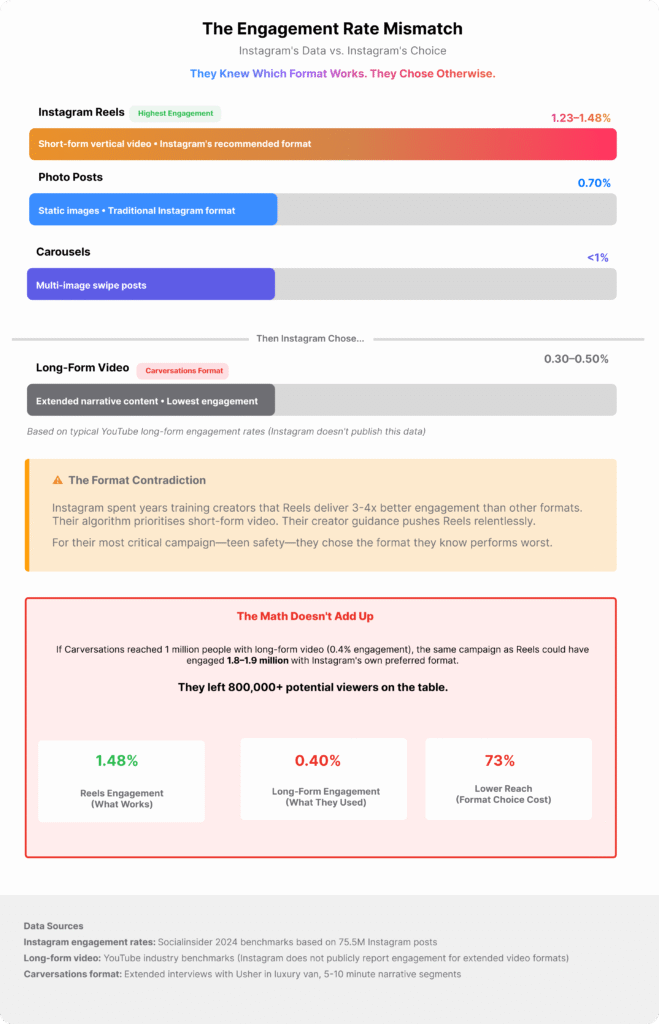
This isn’t just tech nitpicking. Rather, it signals something critical: the campaign appears optimised for regulatory optics, not real reach.
Should the actual goal be educating parents and teens at scale, the format would shift dramatically:
- 30–90 second Reels. Each shows one feature: “How Teen Accounts filter DMs,” “Setting a screen-time cap,” “Who can message your teen.”
- Simple on-screen demos of the actual app.
- Subtitles. Audio-off design. Hooks that work for short attention spans.
Instead, we got elite-tier, PR-friendly footage of a celebrity dad in a “serious” conversation. This type of asset works beautifully in:
- Press briefings
- Conference speeches
- Regulatory filings
However, it bombs in user feeds.
Key signal for marketers: When your crisis response was built for journalists and lawmakers instead of actual users, that tells the whole story.
The Missing Proof: Talk Without Show
Carversations talks about Teen Accounts constantly. Nevertheless, it shows almost nothing.
What Usher Says vs. What Actually Appears
Usher explains that Teen Accounts are “automatic,” can’t be turned off, and include time limits that lock teens out. Additionally, his sons mention getting kicked off late at night. They joke about his Reel-sending habit. Furthermore, they mention Close Friends and content filtering.

What the video never shows:
- The Teen Accounts setup screen from a 13-year-old’s view
- What “default private” looks like in the app
- How DM restrictions block unknown adults
- How content filters handle borderline posts (diet advice, self-harm jokes, sexual memes)
- The parent dashboard or approval workflows
Notably: No phone on screen. No app interface. No over-the-shoulder view of a teen changing settings. No data showing improvements.
Why Showing Matters More Than Talking
That gap matters. Indeed, everyone now knows – not just nonprofits, but mainstream audiences – that online safety tools often exist only on paper. Take what happened when researchers tested Instagram’s teen tools in 2024: they found harmful content still reached teen accounts, including suicide posts, eating disorder content, and adult contact attempts.
When you respond with “trust me” instead of “here’s what changed and here’s proof,” you’re asking audiences to ignore last year’s news.
The hard truth for marketers: In 2025, you can’t talk away a product gap that’s already in court filings and academic studies. Instead, you can only fix it through product work. Then use comms to explain clearly what you changed and what still needs work.
The Usher Question: When Trust Becomes Liability
From a casting angle, Usher is almost too perfect.
Why Usher Works on the Surface
He’s a father of teens. Beyond that, he guards his public image carefully. Moreover, his personal arc – child star to conflicted adult to settled parent – gives emotional weight. Additionally, he can plausibly compare pre-social-media hustle (singing outside nightclubs to executives) with today’s teens reaching out via DM.
He also nails emotional beats that marketers love:
- Family traditions matter (van sing-alongs)
- Kids are “future adults” who need protection without overprotection
- Rules like “off Instagram at 11pm” come from love, not control
By every measure – “Does this sound like a real parent talking to his kids?” – yes.
The Celebrity Risk Nobody Talks About
However, celebrity partnerships don’t exist in a bubble. They sit alongside a decade of endorsement failures:
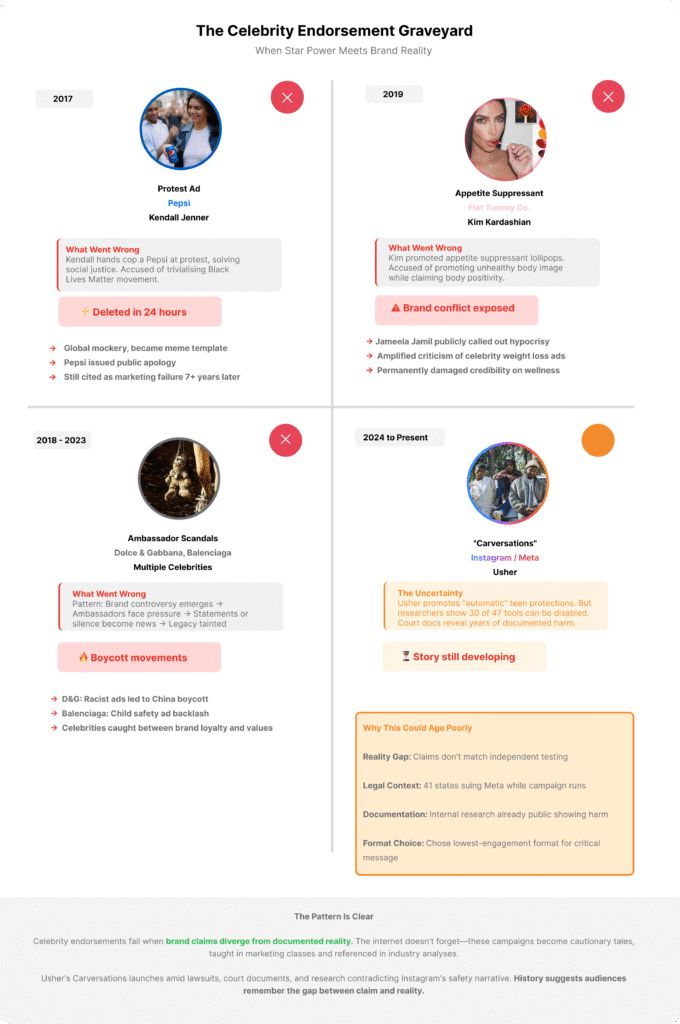
- Consider how Pepsi cast Kendall Jenner in a protest ad that mocked Black Lives Matter – pulled in 24 hours.
- Or how Kim Kardashian promoted appetite suppressants and financial products that clashed with her followers’ lives.
- Note that luxury brands faced boycotts after ambassadors got caught in scandals that contradicted brand promises.
The pattern: Backlash hits hardest when the gap between celebrity values and product reality becomes obvious.
The Real Problem: Instagram, Not Usher
With this campaign, the gap isn’t Usher’s fault. Rather, it’s Instagram’s.
On camera, Usher sounds like a good, slightly strict parent helping teens survive a toxic digital environment. Off camera, however, the company paying him to say “I want peace of mind” spent years maximising teen screen time and, per court documents, repeatedly skipped fixes that would reduce harm but also tank engagement.
Essentially, the campaign asks viewers to transfer trust from Usher (the dad) to Instagram (the company). That’s the entire point of celebrity endorsement.
The danger: when you attach high trust to low trust, you don’t elevate the product. You drag your celebrity down into the credibility hole. Should evidence emerge next year showing Teen Accounts didn’t actually improve teen safety, Usher’s testimonial becomes a problem.
It’s a reminder: authentic talent can’t save an inauthentic strategy. In 2025, audiences read endorsements less as “they believe this” and more as “how much did they get paid?”
Brand Safety Versus Safety Theatre
Advertisers have worried about brand safety for years – especially for programmatic ads. Most marketers know the basics: avoid hate speech, misinformation, extremism. Additionally, they also talk about “brand suitability” – making sure your ads appear in places that match your values.
What Safety Theatre Actually Is
Yet there’s a third category that matters: safety theatre.
Safety theatre happens when brands:
- Announce safeguards loudly
- Build glossy campaigns about how much they care
- But either don’t enforce safeguards consistently or actively undermine them when they hurt profit
It’s like a clear donation box in a lobby that never gets emptied for charity. It performs care. It doesn’t deliver it.
How Carversations Fits the Pattern
This campaign shows all the signs. First: it relies on language like “automatic protections” and “you can’t disable it” – while avoiding any mention of edge cases, workarounds, or real gaps.
Second: it arrives precisely when Meta needs to dodge reputational and legal disaster.
Third: it offers zero transparent metrics – no “since launch, adult DMs to teens dropped X%” or “self-harm content sightings fell Y%”.
Some underlying features may genuinely help. Consider default-private accounts, limited DMs from strangers, parental oversight – these are basics parents requested since the mid-2010s.
Yet the issue isn’t that Instagram talks about safety. Rather, it’s the huge gap between what’s promised and what independent research shows.
For marketers: if product reality hasn’t caught your safety story, a “heartwarming” campaign doesn’t help. It’s evidence of the gap.
What Instagram Should Have Done Instead
Criticizing big campaigns is easy. However, here’s the harder question: what would honest look like?
1. Show Real Product, Not Just Talk
Rather than (or alongside) Carversations, imagine video showing:
- A real parent and teen setting up Teen Accounts together
- A simple dashboard visualization of default protections
- Live demo: what happens when an unknown adult tries to DM a teen account
- How content filters actually handle borderline posts
This isn’t glamorous. However, it’s service journalism – respecting users’ need to actually understand the tool.
2. Acknowledge Past Failures Directly
A bolder script would have Usher address reality:
“I’m not pretending Instagram always got this right. We’ve all seen the news. But as a dad of two, I care what it’s doing now – I told the team I’m only involved if they show me the real thing.”
That single line builds more trust than ten minutes of pure praise.
Marketers hate admitting past failures on camera. Nevertheless, in high-information environments, ignoring them is worse.
3. Include Independent Voices
Platforms love their own experts. In contrast, users don’t trust them.
A more credible format would add:
- An independent child-safety researcher explaining plainly what Teen Accounts helps with and where gaps remain
- An NGO or regulatory representative explaining guardrails without endorsing Meta
- Clear disclosure of what Meta agreed to change based on lawsuits and pressure
Yes, that feels risky. But it aligns with where real thought leadership is heading: original views, clear positions, honest about past blind spots – not scripted positivity.
4. Match Content to How Teens Actually Consume It
If real behavior change is the goal – more parents enabling supervision, more teens understanding settings – content must fit actual attention spans.
That means:
- Optimized Reels with strong hooks (“Two taps that block random adult DMs”)
- Localized, captioned versions for different regions
- In-app education, not just external campaigns
Also: expect comments calling out the disconnect between the ad and real experience. Don’t hide them. Respond honestly – that might actually save trust.
For comparison, Swiggy Wiggy 3.0 worked by making delivery workers the creative core – not rented celebrity. Or Nike’s “Why Do It?” built power from real tension, not assuming everyone’s already motivated. In contrast, Carversations wanted payoff without the hard confession.
Why This Matters for Marketers Right Now
Carversations isn’t just an Instagram story. Rather, it shows how platform-brand-user relationships are shifting.
Three Critical Trends for Brand Strategy
1. Safety Moved From PR to Product
“Safety” used to live in CSR decks, separate from roadmaps. That’s over. Indeed, lawsuits, advertiser pressure, and vocal teens forced platforms to treat safety as a competitive feature, not compliance theater.
For marketers, this means: brand storytelling and regulatory reality can’t be in separate tracks. Safety campaigns must rest on product truths that survive court questioning.
2. Audiences Spot Fake Purpose Instantly
A decade of shallow values campaigns – around social justice, sustainability, “woke” positioning – trained audiences to detect phoniness.
When your safety pitch sounds like standard corporate “we care” speak, yet your product behavior tells a different story, don’t expect forgiveness. Thought leadership that breaks through in 2025 has three traits: real expertise, a clear stance, honest acknowledgment of past mistakes. Carversations has the first two softly. However, it dodges the third completely.
3. Real Boldness Means Honest Stories
Marketers love calling themselves “bold” – usually meaning provocative slogans or viral tactics.
In contrast, in regulated, high-stakes spaces, actual boldness means telling the whole truth: what went wrong, what you’re fixing, where customers still need to be careful because you haven’t solved everything. Meta can do bold comms. Nevertheless, Carversations shows it’s still avoiding bold honesty.
Questions Before You Launch
Before you hire a celebrity, write emotional copy, and promise “peace of mind,” sit down and ask:
- Are we promising more than we deliver?
- Are we using real numbers, or just feelings?
- Are we building this for the people affected, or for the people suing us?
Can’t answer those without wincing? You’re not ready for an Usher-level campaign. Instead, you need more product work and a different story.
Related Articles from suchetanabauri.com
The Pixel-Perfect Lie: Maybelline’s Mumbai Mirage
Break The Loop, Mind The Bump: A Wry Audit of KitKat’s Latest Musical Break
Swiggy’s dog campaign vs the Kolkata floods: A lesson in timing
Brand Anthem in the Age of Algorithms: Swiggy Wiggy 3.0
Why “Why Do It?” Is Nike’s Most Intriguing Invitation to Date
The September Siege: When Smartphone Brands Lost Their Collective Sanity in the Marketing Melee