
On December 8, Anthropic announced Claude Code integration with Slack. The move was technically modest: drag coding tasks directly from Slack conversations into Claude’s development environment. However, the strategic implication is profound. Anthropic is executing a land-and-expand play that treats enterprise workflow infrastructure as the true competitive battleground. Meanwhile, it’s encoding Claude into the daily habits of millions of developers who already live in Slack.
This isn’t about better code generation. It’s about making Claude indispensable.
The $1 Billion Question: Why Claude Code Generated Revenue Faster Than Nearly Any Product in Tech
Claude Code reached $1 billion in annualised revenue within six months of launch. For context, that’s faster than ChatGPT achieved $1 billion annual revenue, which took nearly two years. Neither product achieved these figures through consumer adoption alone.
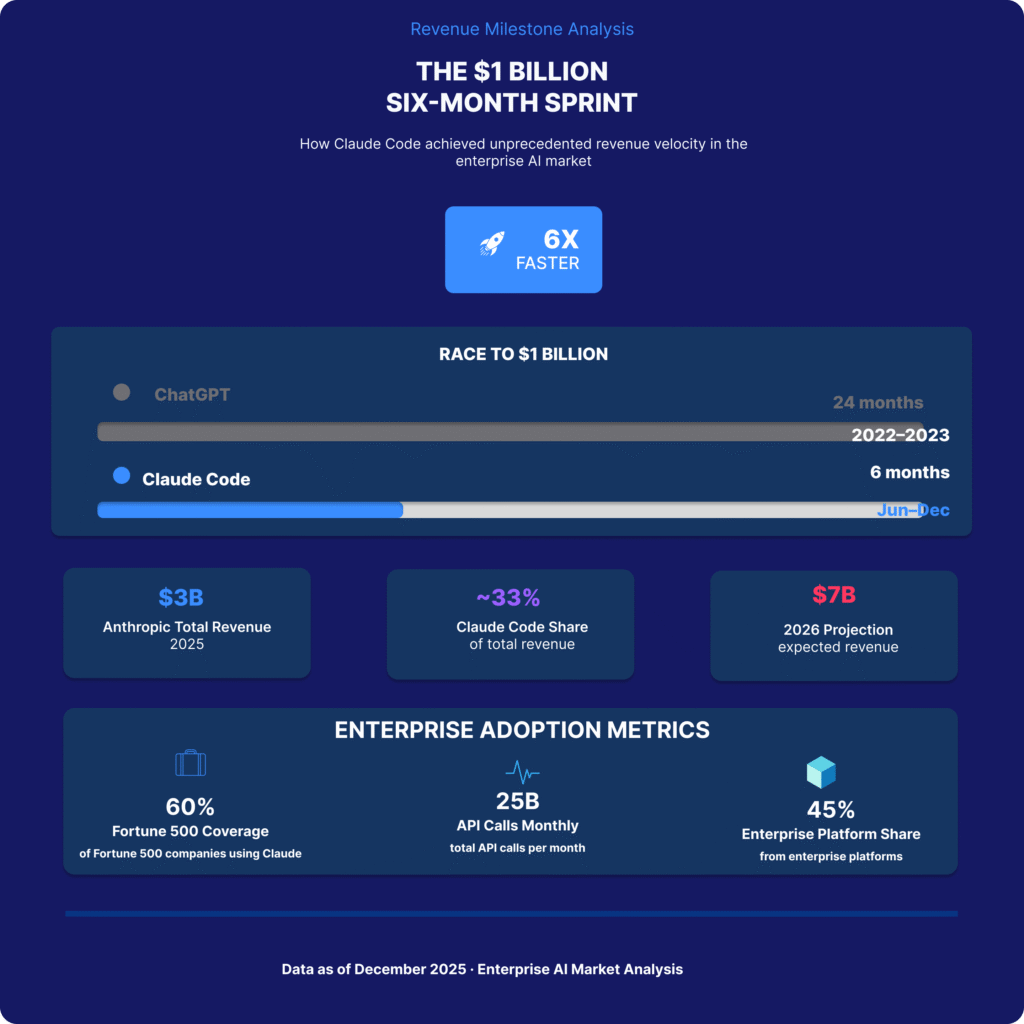
The difference reveals a crucial shift in how AI companies win: enterprise lock-in beats consumer virality. Anthropic captured this motion earlier and more decisively than OpenAI.
Developers don’t choose Claude Code in isolation. Instead, they’re adopting it within organisations where Claude is already embedded across 60% of Fortune 500 companies’ productivity suites. The company processes more than 25 billion API calls per month, with 45% originating from enterprise platforms. Meanwhile, Claude’s market share in the enterprise AI assistant space reached 29%, closing the gap with ChatGPT.
This matters because enterprise adoption follows a different trajectory than consumer adoption. It’s slower to acquire but dramatically harder to displace.
Anthropic is projecting $70 billion in revenue by 2028, with 80% of current revenue coming from enterprise customers. The company aims to nearly triple annualised revenue by 2026, accelerating from $3 billion to approximately $7 billion.
Claude Code hitting $1 billion isn’t an outlier. It’s proof that enterprise willingness to pay for AI coding infrastructure has reached escape velocity.
Slack as the Invisible Infrastructure Layer: Why 80% of Developer Context Lives in One Place
Anthropic’s timing with the Slack integration reveals sophisticated market understanding. Slack holds 40%+ penetration in developer-heavy startups and agile environments. Among companies with fewer than 500 employees, Slack leads with 52% market share. Among developers and engineering teams, Slack usage is 54% more prevalent than Microsoft Teams.
Moreover, Slack’s enterprise segment contributed more than $1.1 billion in revenue, representing nearly half of total revenue. This concentration means that integrations into Slack aren’t peripheral—they’re core to how enterprise software gets adopted.
Developers discuss code architecture in Slack threads. They debug production issues in channels. They document release notes in Slack conversations. All of that context previously existed in isolation.
By connecting Claude Code directly to these conversations, Anthropic has achieved something deceptively powerful: the ability to move seamlessly from discussion to execution without context loss.
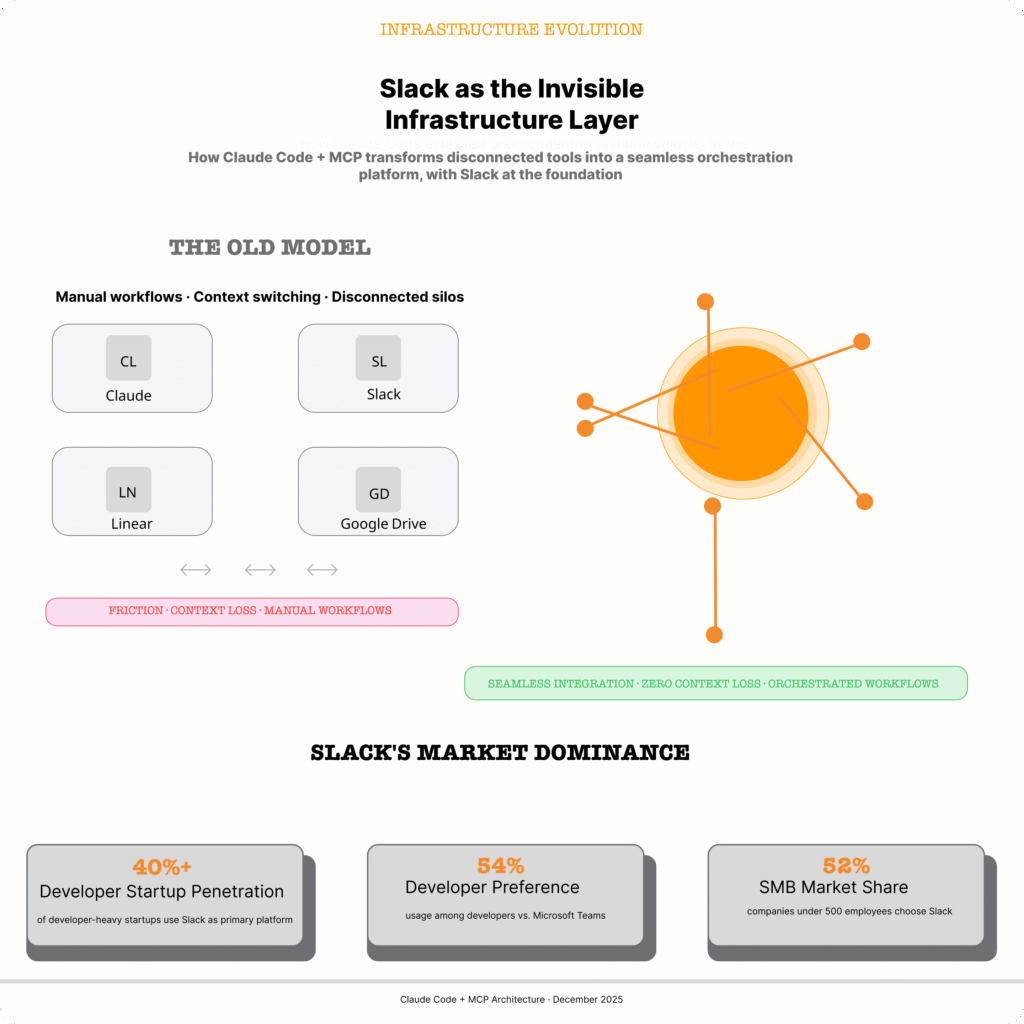
The demonstration video shows the mechanic. A Slack conversation about a feature request becomes a Claude Code session, which then generates the implementation. The developer can iterate without leaving the conversation thread. This eliminates friction—the single biggest barrier to tool adoption in enterprise environments.
Why Embedding Matters More Than Excellence
Superior code generation capabilities matter less than embedding Claude into the context where developers already work. This follows a principle demonstrated across Anthropic’s connector strategy: access and context trump raw capability.
The Model Context Protocol (MCP), donated to the Linux Foundation, enables Claude to access files, apps, and workflows directly. Organisations can now pull completed tickets from Linear, retrieve release note templates from Google Drive, and generate production-ready documentation—all within a single Claude session. This transforms Claude from a conversational interface into a workflow orchestration layer.
Anthropic has established 10,000+ MCP servers across development, productivity, communication, business, and automation categories. Competitors including ChatGPT, Cursor, Gemini, and VS Code have adopted MCP. However, Anthropic controls the narrative and owns enterprise adoption.
The Connector Economy: How Infrastructure Becomes Competitive Moat
Here’s what most observers missed: Claude Code isn’t a product. It’s an interface to enterprise workflow infrastructure. The real value resides in what Claude can connect to—Slack, Linear, Google Drive, Salesforce, Notion, and dozens of other tools where actual work happens.
Traditional B2B software competed on features. Modern AI infrastructure competes on ecosystem access. Anthropic recognised this earlier than competitors.
When developers use Claude to pull sprint tickets from Linear, generate release notes, and post them to Slack, they’re not just using Claude. They’re using Claude as the hub connecting multiple systems. Each connection increases switching costs.
After this pattern repeats across dozens of workflows, replacing Claude becomes organisationally expensive.
This is how platform lock-in works in the AI era. It’s not enforced through licensing restrictions. Instead, it emerges through integration depth and context richness. The more workflows Claude orchestrates, the more embedded it becomes in organisational routines.
The Enterprise Revenue Model Nobody Discusses
Anthropic’s pricing strategy reveals this logic. Team plans start at $25 per user per month. Enterprise plans involve custom negotiation, with some organisations paying $100–$1,000 per seat depending on usage.
This is dramatically higher than consumer pricing, but significantly lower than Salesforce, Workday, or ServiceNow—traditional enterprise software. The pricing positions Claude as infrastructure rather than an application. It’s designed to scale across organisations, not to maximise per-transaction value.

The bet: organisations will spread Claude adoption across engineering teams, product teams, customer support, and eventually, marketing and operations. Each team expands the use case, justifies greater budget allocation, and creates organisational dependency.
What Workflow Automation ROI Actually Means in 2025
For marketing professionals evaluating Claude Code adoption, understand what drives the business case. Research shows 92% of early adopters of AI-powered automation reach positive ROI, earning $1.41 for every dollar spent. This isn’t marginal.
Workflow automation leads to 66% of knowledge workers reporting increased daily output. HR departments saw 69% reduction in processing time for onboarding after automation implementation. Error reduction reaches 40% to 75% compared to manual work.
More significantly, 85% of managers report that automation helps teams focus on critical business goals. This is the insight driving adoption: automation doesn’t eliminate jobs—it redirects human effort from repetitive tasks to strategic work.
Claude Code’s value proposition maps directly to this ROI framework. Development teams spend significant time searching through documentation, context-switching between systems, and recreating boilerplate code. Claude reduces this friction. The result: developers write more production code and spend less time on setup and scaffolding. Multiply this efficiency gain across an entire engineering organisation, and the $1 billion revenue milestone becomes comprehensible.
The Strategic Play: Ecosystem Lock-In vs. Model Superiority
Anthropic’s positioning diverges fundamentally from OpenAI’s. OpenAI competes on model quality. Anthropic competes on workflow integration and ecosystem depth.
These represent different competitive strategies with different market implications.
Model superiority is reproducible and temporary. OpenAI’s advantages erode as competitors release better-performing models. Ecosystem depth, however, compounds over time.
The more connectors Anthropic ships, the more valuable Claude becomes. The more organisations integrate Claude into workflows, the higher the switching costs for competitors.

This strategy mirrors Microsoft’s historical approach: not necessarily building the best software, but making it undeniable to use it within existing organisational systems. Anthropic is replicating this for AI infrastructure.
The Slack integration announcement on December 8 and the Model Context Protocol donation on the same day were coordinated. The message was clear: Anthropic controls the infrastructure layer, not just the interface layer.
For organisations still evaluating enterprise AI strategies, this distinction matters. Choose based on integration depth and connector quality, not just base model performance. By 2026, when these decisions compound into organisational routines, that choice will determine whether you’ve outsourced workflow orchestration to an embedded partner or a conversational interface.
What This Means for Digital Marketers
The implications extend beyond engineering teams. Marketers operating in organisations using Claude will eventually encounter it in workflows. Support teams using Claude to draft customer communications. Product teams using Claude to analyse feedback. Operations teams using Claude to automate reporting.
Each adoption point increases organisational dependency. This is why Anthropic projects $70 billion in revenue by 2028. The company isn’t trying to dominate consumer AI. It’s building enterprise infrastructure so deeply embedded that replacing it becomes organisationally unthinkable.
For teams marketing AI products to enterprises, learn from Anthropic’s approach: distribution beats algorithm. Integration depth beats model superiority. Ecosystem access beats point solutions. This is how sustainable enterprise AI advantage is built—not through research breakthroughs, but through infrastructure that enterprises organise around.
Claude Code’s $1 billion in six months isn’t remarkable because it’s a great coding tool. It’s remarkable because Anthropic has positioned Claude as the control plane for enterprise workflow orchestration. That distinction is the difference between a product and a platform, between temporary advantage and durable competitive moat.
For more analysis of how AI companies position themselves for enterprise dominance, explore my examination of brand storytelling in tech launches, marketing failures in the AI era, and how Google’s infrastructure plays shape market strategy.
Sources
Anthropic Product Launches:
- Claude Code in Slack integration announcement — Anthropic (Dec 8, 2025)
- Model Context Protocol donation and Agentic AI Foundation — Anthropic (Dec 8, 2025)
- Claude Code getting started with connectors — Anthropic YouTube (Dec 11, 2025)
- Claude Code in Slack video — Anthropic YouTube (Dec 8, 2025)
Claude Code & Enterprise Adoption:
- Claude Code reaches $1 billion annualized revenue — AI Certs
- Claude Code $1B in 6 months analysis — ZDNet
- Anthropic acquires Bun runtime as Claude Code hits milestone — Anthropic
- Claude Code Slack integration strategic analysis — Silicon Angle
- Anthropic’s Claude Code in Slack overview — Startup Researcher
Anthropic Financial Performance:
- Anthropic projects $70B revenue by 2028 — TechCrunch
- Anthropic aims to triple revenue in 2026 — Reuters
- Anthropic hits $3 billion annualized revenue — Reuters
- Anthropic statistics 2025 — TapTwice Digital
- Anthropic revenue and valuation analysis — Sacra
Claude API & Enterprise Metrics:
- Claude AI statistics and market share 2025 — SQ Magazine
- OpenAI vs Anthropic revenue comparison — Where’s Your Ed At
- Claude Enterprise plan details — Anthropic
- Claude pricing plans and API costs — Intuition Labs
Model Context Protocol & Enterprise Integration:
- MCP in enterprise: real-world applications — Xenoss
- Why enterprises adopt MCP — LTIMindtree
- MCP server in enterprises — TrueFoundry
- Securing MCP for enterprise adoption — Mirantis
- MCP enterprise adoption guide — Gupta Deepak
- 2026: The year for enterprise MCP adoption — CData
Slack Enterprise Integration:
- Slack statistics and enterprise trends 2025 — SQ Magazine
- Why Fortune 100 rely on Slack Connect — Slack Blog
- Slack enterprise solutions — Slack
- Slack usage and growth statistics — Fueler
Workflow Automation ROI:
- ROI of workflow automation — Smart Flow
- Workflow automation comprehensive guide — Workato
- Breaking down ROI of workflow automation — Yoro Flow
- Workflow automation market forecast — Research Nester
- AI coding assistant trends — TechWings
- AI coding assistant market analysis — DataInsights Market
- State of AI code quality 2025 — Qodo
- AI adoption in 2025 developer survey — Stack Overflow
- Atlassian developer experience report 2025 — Atlassian
Related Articles from suchetanabauri.com: