
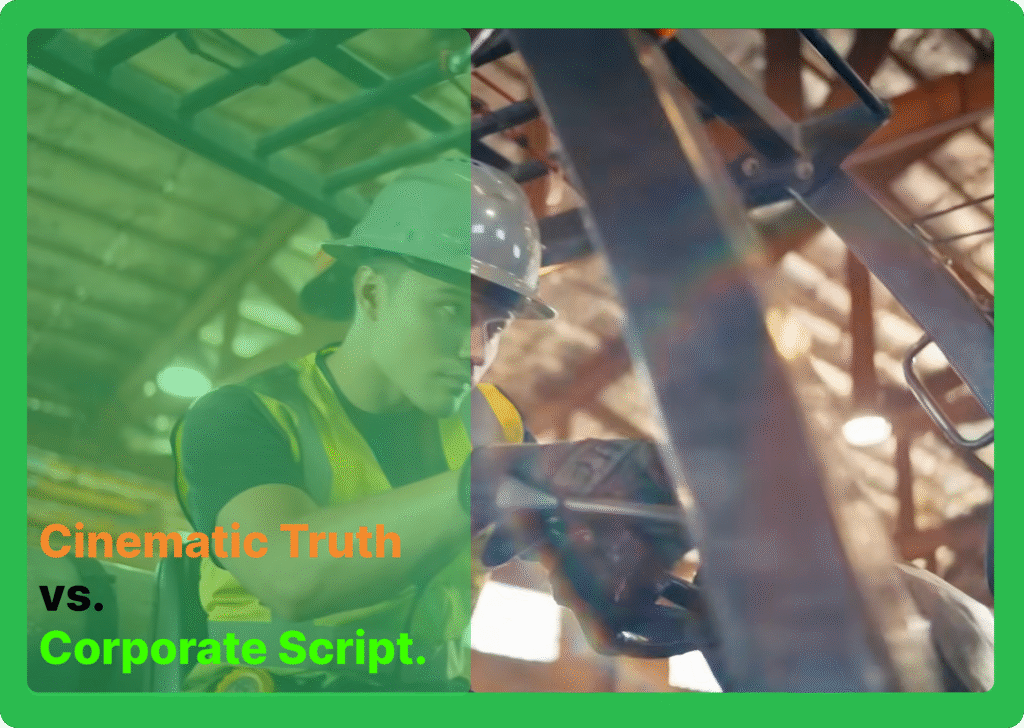
Yesterday, OpenAI released two short films that look, at first glance, like genuine documentaries. One features Richard Lane, a steel salvage manager in Reno, managing the challenges of an 86-year-old family business. Meanwhile, the other showcases the Sharp family, fourth-generation seed farmers in South Carolina, wrestling with handing over the farm to the next generation. However, both films follow a familiar testimonial path: hardworking people face real problems, and subsequently, they discover that ChatGPT offers unexpected solutions.
Undoubtedly, the production values are flawless. For instance, the handheld camerawork, background noise, and subjects speaking directly to the camera in sun-weathered workshops all scream “authenticity.” This is a documentary style applied to what are, fundamentally, customer testimonials. Nevertheless, the format deliberately hides that reality.
In essence, these are advertisements wearing documentary clothing—and rather smart ones at that.
Timing is Everything
Significantly, the timing matters. OpenAI dropped these videos merely days after CEO Sam Altman reportedly sent an internal “code red” memo about competitive threats from Google. Furthermore, the company simultaneously released its first “State of Enterprise AI” report. This report claims that ChatGPT Enterprise usage grew eightfold in a year; specifically, it asserts that workers save 40-60 minutes daily using the tool.techcrunch+2
Consequently, the videos serve as the emotional balance to those dry statistics. They offer proof, apparently, that AI adoption isn’t just happening in Silicon Valley conference rooms. On the contrary, they suggest it is thriving in the most grounded, real-world American workplaces imaginable.
The Testimonial Disguised as Documentary
Here is what we can learn from these films: they represent a smart evolution of the testimonial format. Traditional testimonials are obviously promotional—usually talking heads in corporate offices praising products. Documentary-style testimonials, by contrast, borrow the style of objective observation. They position the brand not as a director, but rather as a watcher. The brand appears to be merely recording stories that, coincidentally, happen to fit perfectly with the product’s sales pitch. As a result, the persuasion attempt is more artful because it is less visible.recruitrooster+3
Currently, this approach dominates B2B marketing simply because it works. In fact, research shows that documentary-style testimonials create stronger emotional connections than old-school formats. Viewers often see them as more trustworthy and, crucially, less pushy. Moreover, B2B tech companies see a 52% average ROI from video case studies, largely because the format effectively speeds up complex sales cycles.c-istudios+2
The Curious Case of the Digital Leap
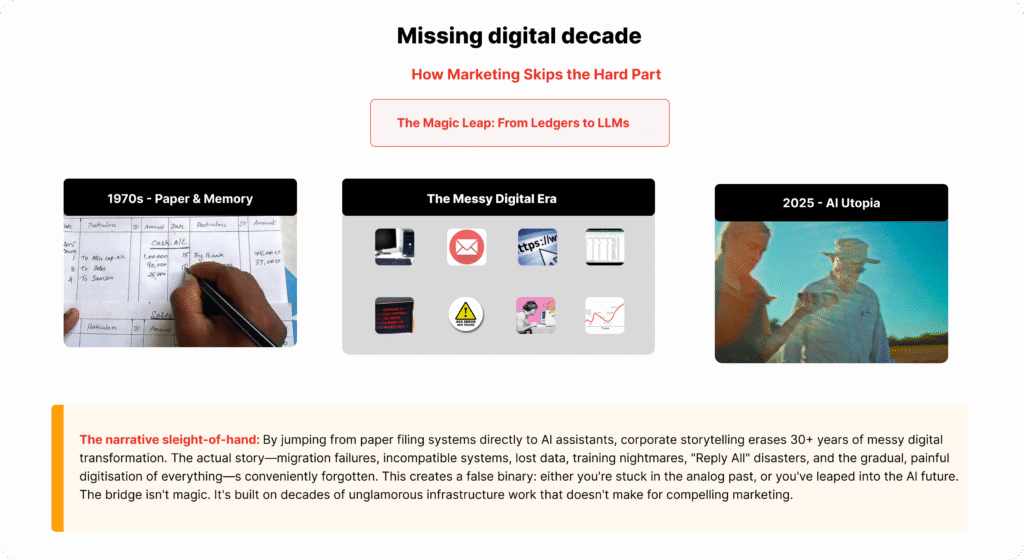
However, there is a strange detail in the Reno steel yard testimonial that deserves a closer look. OpenAI’s description states the business “once ran on paper and memory” before adopting ChatGPT. Richard Lane mentions his grandfather’s paper-based systems with a touch of nostalgia, describing them as “cringeworthy”. Then, apparently, ChatGPT arrives and transforms everything.
But what happened in between? Where is the mention of basic computers? Email systems? Inventory software? Customer databases? Online ordering platforms? Even small manufacturing shops typically went through some form of digital change over the past 20 years. Yet, oddly, this 86-year-old business seems to have jumped directly from paper ledgers to advanced AI.
This narrative elision is revealing… Oddly, this 86-year-old business seems to have jumped directly from paper ledgers to advanced AI.
Skipping the Messy Middle
This missing piece of the story is revealing. It suggests one of three possibilities, and none of them help the testimonial’s credibility. First, the business did adopt digital tools over the decades, but mentioning them would ruin the dramatic “paper to AI” story. Second, the business truly resisted all computers until ChatGPT—which raises serious questions about why AI worked where basic tech failed. Third, and perhaps most likely, the testimonial is editing reality to create a better emotional story.logannonfiction+1
The omission matters because it skips over crucial context. If Reno Salvage had adopted even basic digital tools—spreadsheets, email, a simple website—that would have required changing how they work. It would have involved training staff and fixing workflows. In other words, it would have involved precisely the kind of struggle and learning curve that is mysteriously missing from the ChatGPT story.journals.sagepub+2
A Pattern of Selective Memory
Most legacy businesses didn’t jump straight to AI; rather, they gradually moved to digital tools over decades. They built websites in the early 2000s. They moved inventory to Excel. They adopted email. They struggled with each change. Employees pushed back. Systems failed. Yet, somehow, in this testimonial, ChatGPT integration is seamless.siliconrepublic+2
This selective memory serves a purpose. By erasing the messy reality of previous technology adoption, OpenAI can present AI as uniquely easy—so natural that even an 86-year-old business can adopt it overnight. The implication? If you struggled with computers before, don’t worry. AI is different. AI is easier. AI just works.pmc.ncbi.nlm.nih+1
Interestingly, the Sharp family’s farm testimonial follows a similar pattern. We hear about a handwritten crop book dating to 1971, uploaded to ChatGPT. But what about the decades between 1971 and 2024? Did the farm never adopt computer records? GPS tractors? Weather apps? Again, the testimonial creates a leap from analogue to AI, erasing the entire digital era.
The Authenticity Paradox Comes Home
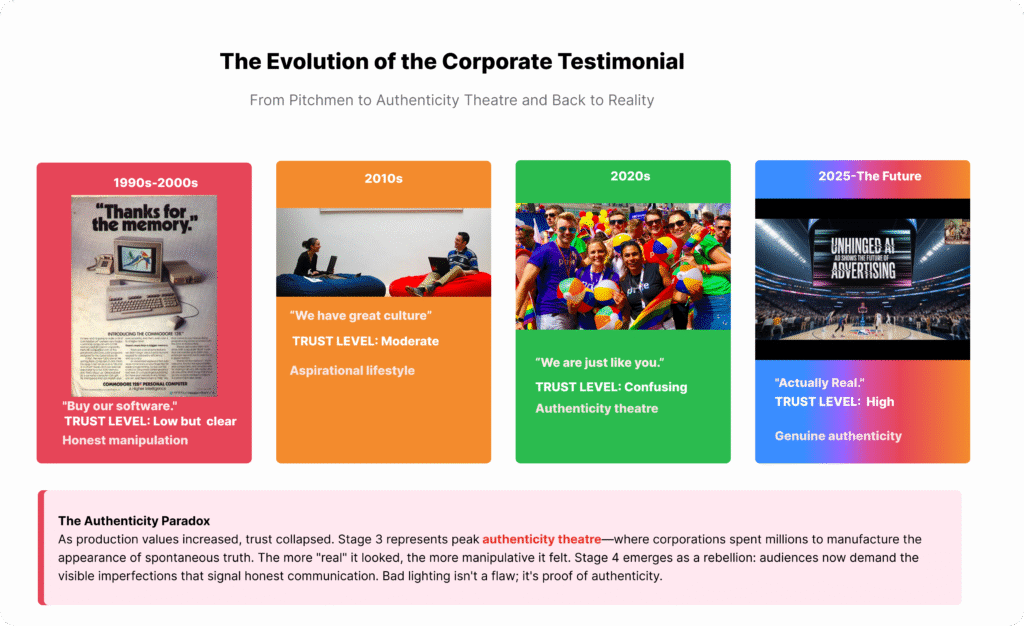
These videos arrive at a strange moment for marketing. “Authenticity” has become the industry’s most overused word; yet, consumer trust in brands sits at historic lows. In fact, 71% of consumers globally say they trust companies less than they did a year ago. Furthermore, among Gen Z—who now wield significant spending power—59% are more likely to support brands that show vulnerability rather than those presenting themselves as perfect.basis+4
So, what is the response? Brands have begun performing authenticity with the same calculation they once applied to dreams. First, they produce “raw” behind-the-scenes content that actually required 47 takes. Next, they use “candid” testimonials where lighting is suspiciously perfect. Finally, they craft “unscripted” customer stories that sound, unfortunately, suspiciously scripted.anvisdigital+3
The Trap of Performed Realness
This phenomenon is what researchers call “the authenticity paradox.”
Specifically, when authenticity becomes a planned marketing strategy, it often stops being real.
Instead, it becomes a performance, or a carefully crafted impression of openness. Consequently, consumers, who are getting better at spotting fake content, can see right through it.agilitypr+4
The challenge with testimonial videos is particularly sharp. Traditional testimonials announce themselves as ads. In contrast, documentary-style testimonials pretend to be neutral. OpenAI’s videos walk this line carefully. On one hand, the production is polished enough to feel professional. On the other hand, it is rough enough to feel real. The subjects are articulate but not overly rehearsed. Furthermore, the locations are genuinely gritty—steel yards and farm fields. Ultimately, however, this is a testimonial for business software that likely costs thousands of dollars a year.cognitivefilms+3
What Coca-Cola Learned the Hard Way
For a warning on how this can backfire, consider Coca-Cola’s AI-generated Christmas ads. For two years in a row, the company has released holiday ads created almost entirely with AI. Yet, both times, the negative reaction was swift. Critics called the 2024 version “soulless,” while the 2025 version was called “a sloppy eyesore”.contentgrip+4
The interesting bit? Coca-Cola’s Global VP insisted the ads were successful. However, social media data told a very different story. Positive reactions dropped from 23.8% to 10.2% after the launch. Although the company saved money and time, the damage to their reputation may cost them more.marketingdive+2
What went wrong? Fundamentally, Coca-Cola broke a key rule: holiday advertising is emotional.
By choosing efficiency over emotional truth, Coke accidentally showed what AI is really good for: saving money, not creating meaning.
In contrast, OpenAI’s testimonials avoid this trap by focusing on humans. The AI is present but in the background. Thus, the message becomes: AI doesn’t replace people; it helps people.marketingaiinstitute+2
Real vs. Aesthetic Authenticity
If you are a marketer watching these videos and thinking about your own campaigns, here is what actually matters. First, documentary-style testimonials work, but only when the substance is genuine. B2B brands see measurable ROI from video testimonials, such as 44% higher conversion rates. However, that effectiveness depends on deep authenticity, not just the “look” of authenticity. The moment your “real customer story” feels staged or your testimonial sounds like a script, you have lost.thinkbrandedmedia+5
Amazon’s Five Star Theater campaign shows exactly what OpenAI’s videos miss. It showcases genuine awkwardness and unpolished truth. Benedict Cumberbatch performing actual customer reviews about carpet cleaners celebrates the gap between performance and reality. Therefore, it honours the truth of the reviews without pretending they are something they are not.
Transparency is No Longer Optional
Sixty-two per cent of consumers say they would trust brands more if companies were honest about their marketing tactics. The brands surviving the current trust crisis are those being honest about what is a paid testimonial versus independent proof. Silence, on the other hand, increasingly looks like guilt.bostonbrandmedia+2
Consider the contrast with marketing campaigns that use perfect computer graphics. OpenAI’s testimonials make a similar mistake. They use a realistic style to sell a version of AI adoption that is separated from most people’s messy experience. The production values suggest neutral truth when, in reality, these are carefully chosen success stories.
Production Polish vs. Emotional Truth
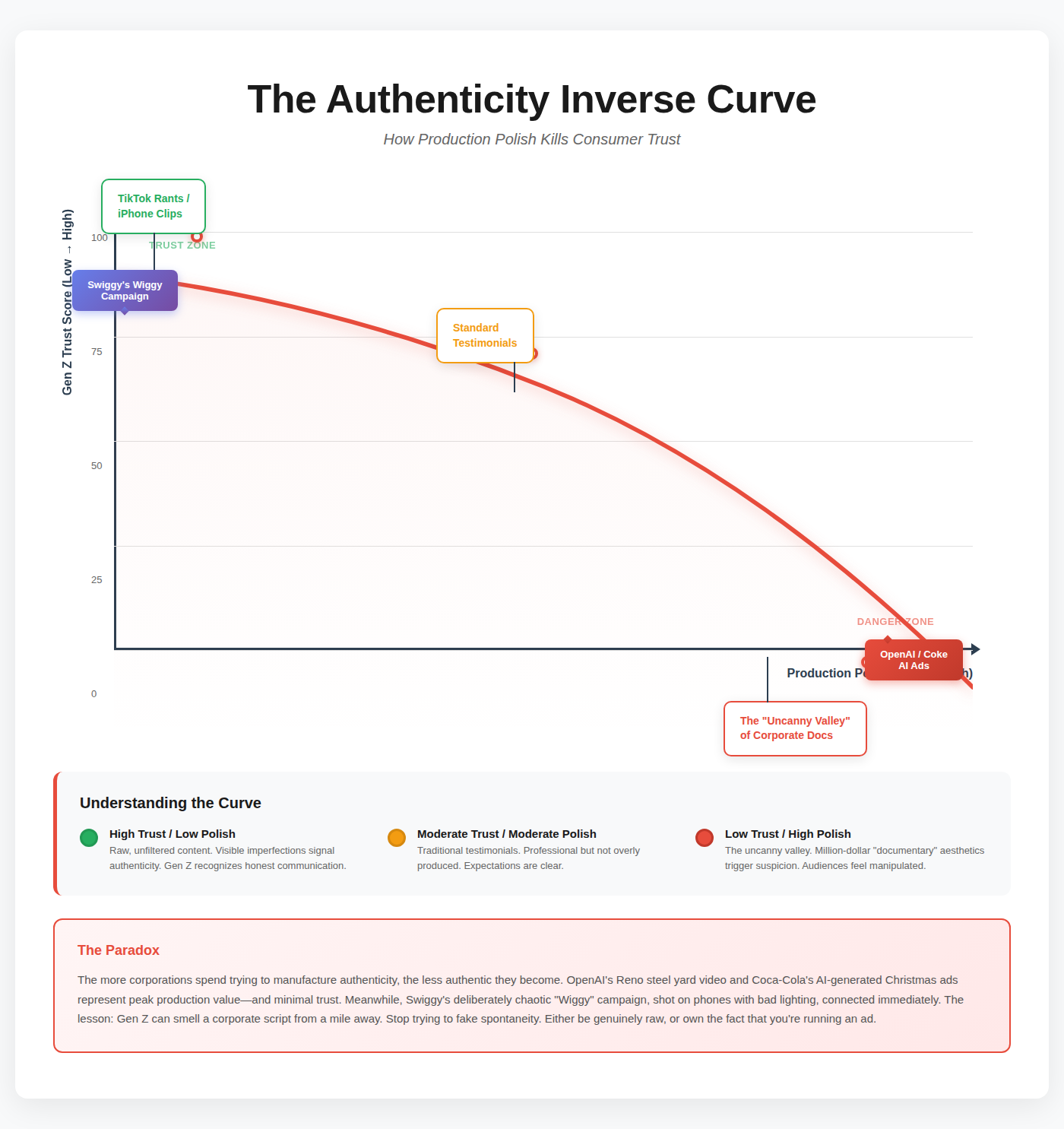
Interestingly, high production values and emotional truth are often opposites in testimonial videos.
The most effective employee and customer testimonials are not those with expensive equipment. Rather, they are often raw, user-generated clips shot on phones. People don’t want a polished testimonial; instead, they want the raw version they will actually experience.moonb+1
Research shows that unscripted, genuinely candid testimonials perform better precisely because viewers can detect truth. When a testimonial looks too good, sounds too smooth, and shows zero friction, audiences rightfully become suspicious.smallfilms+2
Swiggy’s Wiggy 3.0 campaign succeeded because it focused on actual delivery partners without hiding the format. The campaign turned gig workers into stars through music and community stories. It wasn’t pretending to be neutral; crucially, it was openly by workers, for workers. That is the truth OpenAI’s testimonials mimic but never reach.
The Harder Work Nobody Wants to Do
Here is the uncomfortable truth: authentic testimonials require authentic experiences worth talking about.
You cannot fake your way to trust with better cameras.
Similarly, you cannot build emotional connection through tricks. The brands that will survive are not those perfecting fake documentaries. Instead, they are those doing the harder work of delivering experiences customers genuinely want to support.averi+3
This means showing when your product doesn’t work perfectly. Furthermore, it involves acknowledging trade-offs openly in testimonials. For instance, brands should feature customer stories that include frustrations alongside successes. Above all, brands must resist the pressure to present AI adoption as easy magic.pmc.ncbi.nlm.nih+2
OpenAI’s testimonials do not do this. They cannot, because they are fundamentally ads dressed in documentary clothing. They exist to speed up sales and, ultimately, make resistance feel silly. That isn’t necessarily wrong—it is simply what marketing does. However, marketers should see the technique for what it is.technologyreview+2
The real opportunity isn’t in making your testimonials look more like documentaries. Rather, it is in creating customer experiences worth testifying about honestly.
That is the work that actually builds trust. In 2025, with consumer trust falling, that difference isn’t just an idea—it is business survival. The marketers who understand this won’t be the ones perfecting the “look” of truth. They will be the ones investing in the real thing.newdigitalage+2
Footnotes:
- https://www.youtube.com/watch?v=WeBuFsJ8k-0
- https://www.youtube.com/watch?v=J6imKdMmb2U
- https://techcrunch.com/2025/12/08/openai-boasts-enterprise-win-days-after-internal-code-red-on-google-threat/
- https://indianexpress.com/article/technology/artificial-intelligence/chatgpt-enterprise-use-up-by-8-yoy-employees-saving-40-60-mins-daily-openai-study-10410911/
- https://cdn.openai.com/pdf/3c7f7e1b-36c4-446b-916c-11183e4266b7/chatgpt-usage-and-adoption-patterns-at-work.pdf
- https://recruitrooster.com/employee-testimonial-videos/
- https://www.moonb.io/blog/employee-testimonial-videos
- https://c-istudios.com/documentary-style-vs-traditional-ads-choosing-the-right-format-for-your-campaign/
- https://roosmith.com/blog/branded-documentaries-vs-traditional-advertising
- https://thinkbrandedmedia.com/blog/which-undustries-see-the-biggest-roi-from-video-case-studies/
- https://logannonfiction.org/documentary-films-and-the-manipulation-of-facts/
- https://www.documentary.org/column/bridging-credibility-gap-drawing-line-manipulation-documentary
- https://journals.sagepub.com/doi/full/10.1177/08944865231152283
- https://pmc.ncbi.nlm.nih.gov/articles/PMC11602465/
- https://theconvivialsociety.substack.com/p/resistance-is-futile-the-myth-of
- https://www.siliconrepublic.com/business/3-steps-legacy-business-ai-integration-brand-identity
- https://blog.graphers.io/how-ai-can-drive-revenue-growth-in-legacy-industries-aeaa782927c7
- https://www.linkedin.com/pulse/across-divide-combining-ai-legacy-systems-industries-jerry-quandt-rjbic
- https://pmc.ncbi.nlm.nih.gov/articles/PMC11780378/
- https://eprints.soton.ac.uk/467974/1/HCII2022_Pickering_etal_2022_FINAL.pdf
- https://basis.com/blog/navigating-the-consumer-trust-crisis-what-brands-need-to-know
- https://www.bostonbrandmedia.com/news/the-state-of-brand-trust-in-2025-global-insights-from-recent-studies
- https://www.agilitypr.com/pr-news/branding-reputation/3-effective-ways-for-brands-to-communicate-authenticity-in-a-skeptical-marketplace/
- https://www.amraandelma.com/gen-z-marketing-behavior-statistics/
- https://www.kofluence.com/gen-z-influencers-the-ultimate-2025-marketing-guide/
- https://anvisdigital.com/the-authenticity-paradox-how-trying-to-be-authentic-made-your-brand-fake/
- https://smallfilms.com/employee-testimonial-video/
- https://www.cognitivefilms.com/unscripted-testimonial-videos-win/
- https://www.averi.ai/blog/the-authenticity-paradox
- https://aijourn.com/the-authenticity-paradox-why-ai-driven-marketing-needs-more-humanity/
- https://theteam.co.uk/blog/brand-authenticity-and-scepticism-staying-true-to-your-brand/
- https://www.seenit.io/blog/8-best-employee-video-testimonials-and-why-they-work/
- https://www.spielcreative.com/blog/corporate-video-cost-2025/
- https://flearningstudio.com/corporate-video-production-costs/
- https://www.contentgrip.com/coca-cola-ai-holiday-ad-backlash/
- https://www.marketingdive.com/news/why-coca-cola-keeps-pushing-limits-generative-ai-despite-backlash/804739/
- https://www.marketingaiinstitute.com/blog/criticism-ai-coke-holiday-ad
- https://www.nbcnews.com/tech/innovation/coca-cola-causes-controversy-ai-made-ad-rcna180665
- https://www.reddit.com/r/technews/comments/1oongu1/cocacolas_new_ai_holiday_ad_is_a_sloppy_eyesore/
- https://www.brandingmag.com/jim-misener/what-does-authenticity-mean-in-the-age-of-ai/
- https://www.forbes.com/councils/forbesagencycouncil/2025/07/10/building-brand-trust-in-an-era-of-public-skepticism/
- https://www.frontify.com/en/guide/brand-authenticity
- https://www.thoughtlab.com/blog/branding-in-2025-authenticity-purpose-and-personal/
- https://www.technologyreview.com/2024/06/08/1093356/propagandists-are-using-ai-too-and-companies-need-to-be-open-about-it/
- https://www.foleon.com/blog/branded-content-marketing
- https://gibion.ai/blog/ai-generated-testimonials-social-proof-automation/
- https://newdigitalage.co/strategy/authenticity-artificial-intelligence-ai-2025-henry-collins-redpill/
- https://business.dcu.ie/marketing-trends-for-2025-ai-authenticity-and-evolving-consumer-preferences/