
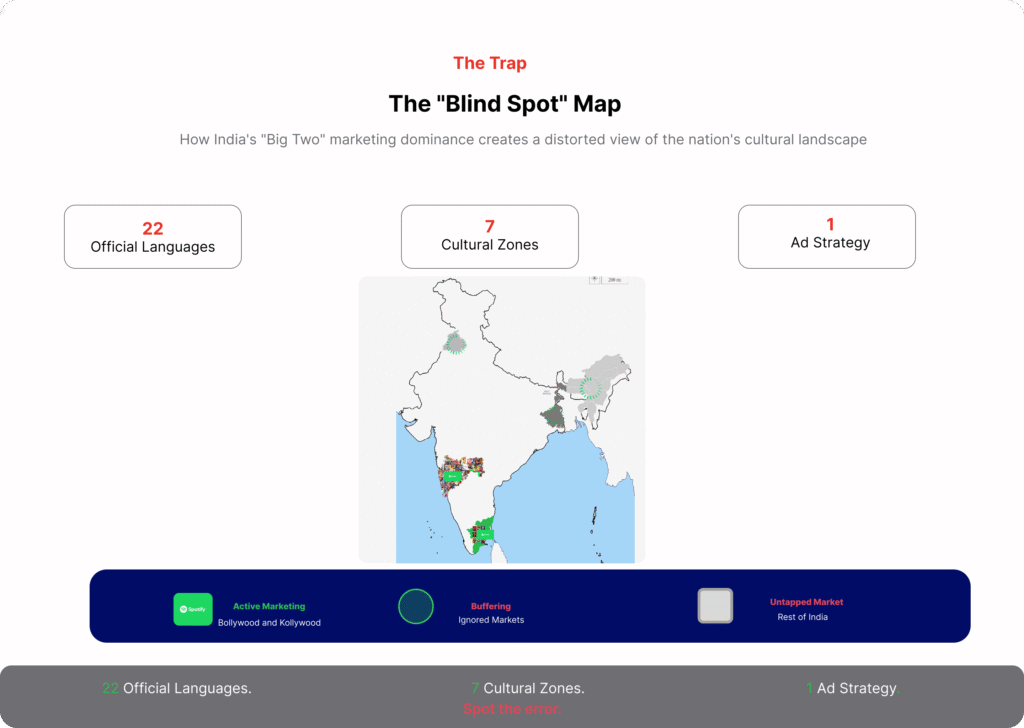
The “Spotify Wrapped” campaign has dropped. For marketers in Mumbai and Chennai, it is a masterclass in hyper-localisation. However, for everyone else in India, it serves as a glaring reminder of the “Two-India” problem that still plagues our marketing and advertising industry.
Spotify’s 2025 Wrapped campaign, featuring Emraan Hashmi & Raghav Juyal for the Hindi belt and Sarathkumar (as Nattamai) for the Tamil market, is arguably the finest piece of advertising work we have seen this year. Furthermore, it is funny, culturally rich, and miles ahead of the lazy dubbing we usually suffer through. In fact, compared to the generic celebrity campaigns we’ve seen from brands like Amazon, which treat Indian consumers as a single group to be shouted at, this feels like a genuine attempt at a conversation.
But let’s be honest about what is missing. By pouring its entire budget exclusively into the “Big Two” (Bollywood and Kollywood), Spotify—and by extension, most national brands—is sitting on the fence. Instead of taking a risk, they are playing it safe in a country that is exploding with subcultures that don’t speak Hindi or Tamil. Moreover, India’s musical identity is far more complex than just a movie soundtrack.
Here is a deep dive into why the “Nattamai vs. Emraan” strategy is both a triumph of execution and a trap of strategy. Additionally, we will explore what you, as a marketer, can do to avoid making the same mistake in 2026.
The Triumph: Finally, “Culture” Over “Translation”
First, we must give credit where it is due. Spotify didn’t just translate a script; they translated a feeling.
This is a significant step up from their earlier, more generic celebrity charm offensives featuring stars like Kareena Kapoor and Saif Ali Khan. Those campaigns often felt like they could have been ads for soap or insurance.
In contrast, the genius of this year’s campaign lies in its understanding of “The Reveal.” This is the moment of tension between who we pretend to be and who our headphones know we are.
1. The Structure of the “Inside Joke”
The Hindi ad works because it taps into a specific millennial guilt: the secret love for the “serial kisser” era of 2000s Bollywood. Specifically, it is a meta-joke about how we publicly act cool—represented by Raghav Juyal’s Gen Z swagger—but privately stream Murder 2 soundtracks on loop. When Emraan Hashmi deadpans that half of Gen Z was born because his songs were playing in the background, he isn’t just selling a playlist. Rather, he is validating a generational experience. Essentially, he is telling the audience: “I know your guilty pleasure, and I am in on the joke.”
2. The Symbols of Authority
The Tamil ad works even better because it revives a 30-year-old meme. Sarathkumar’s “Nattamai” isn’t just a film character; he is the template for authority in Tamil pop culture. He represents the strict teacher, the unyielding father, and the village headman whose word is law.
Therefore, for a brand to take this symbol of rigid tradition and reveal that he secretly listens to Oorum Blood —a viral, autotuned, hyper-modern track from the movie Dude—is a stroke of brilliance.
Consequently, it destroys the “boomer vs. zoomer” divide in 30 seconds.
It tells the Tamil user that Spotify is a safe space where even the strictest Nattamai can let his guard down.youtube
This is Hyper-Localisation 1.0: You don’t sell the product; you sell the inside joke. If you get the joke, you belong to the community.
The Trap: The Lazy “Big Two” Dominance
However, if we zoom out, the campaign reveals a massive blind spot.
By treating India as “North = Hindi” and “South = Tamil,” brands are ignoring the actual data on their own platforms.
This oversight echoes the mistakes made by smartphone brands in their frenzied “September Siege” launches, where spectacle often drowned out genuine user connection.
India is not a duopoly. On the contrary, it is a continent pretending to be a country.
When a global giant like Spotify ignores this reality, they leave money—and loyalty—on the table.
1. The Bengal Contradiction: Intellect vs. Pop
West Bengal is arguably the most “musical” state in the republic. It is a market where music is not just entertainment; it is cultural capital. For instance, Kolkata has a thriving indie scene—Bangla Rock, modern folk-fusion, and a rap scene that is gritty and political—that rivals Mumbai’s.
Yet, national campaigns consistently bypass Bengali culture. They assume a Hindi ad will “pass” in Kolkata because urban Bengalis speak Hindi. However, this is a fundamental misunderstanding of the Bengali consumer.
Don’t just hire a star; hire the adda culture… hire the meme, not just the actor
- The Data: Regional language streaming (excluding Hindi/English) grew 30% in 2025. Bengali is a massive driver of this, yet it gets no hero campaign.playgeet
- The Missed Opportunity: Imagine a campaign featuring the satirical wit of a band like Chandrabindoo. They are the masters of the Bengali “inside joke,” bridging the gap between Bhadralok intellectualism and everyday chaos. The script could have played on the unique cultural tension between the “high culture” of Rabindra Sangeet—which every Bengali is forced to listen to, if not learn—and the reality of their private playlists.
Furthermore, we often forget that Kolkata, much like Delhi and Mumbai, is a stronghold of English music consumption. A significant chunk of the urban population here lives in a sonic world defined by Western pop, classic rock, and jazz, not just Bollywood or Tollywood. By serving them a “massy” Hindi ad, brands ignore their most premium user base. Acknowledging this specific duality—the public intellectual who quotes Chandrabindoo vs. the private listener blasting Dua Lipa or classic rock—would have broken the internet in the East. Instead, they get the Emraan Hashmi ad, which feels culturally irrelevant to a kid in Kalyani or a rock fan in somewhere in Calcutta.
2. The Punjab Disconnect: Global Stars, Local Silence
The omission of Punjab is even more baffling. Currently, Punjabi music is India’s biggest cultural export. Artists like Diljit Dosanjh, AP Dhillon, and Karan Aujla are filling stadiums in Canada, the UK, and Australia. In fact, Punjabi pop is the only Indian music that genuinely competes on global charts.
For instance, even Spotify’s own premium events strategy has recognised the power of artists like Karan Aujla, creating exclusive, ticketed experiences for super-fans. Yet, when it comes to their mass-market Wrapped ad campaign, they retreat to the safety of Bollywood actors.
- The Irony: Spotify’s global charts are dominated by Punjabi tracks. Nevertheless, their ad campaign uses a Bollywood actor (Hashmi).musicplus
- The Message: This tells the Punjabi youth—arguably the most high-value music consumers in the country—that their culture is still secondary to Mumbai’s film industry. Furthermore, it reinforces the idea that Punjabi music is just “party music” for Bollywood films, rather than a standalone industry titan.
Spotify’s global charts are dominated by Punjabi tracks, yet their ad campaign uses a Bollywood actor. The authenticity of the artist is the marketing.
3. The “South” is Not a Single Block
Perhaps the laziest assumption in Indian marketing is that a Tamil ad covers the “South.” This ignores the distinct cultural identities of Kerala (Malayalam), Karnataka (Kannada), and the Telugu states (Andhra/Telangana).
- Kerala: The Malayalam film and music industry is currently enjoying a golden age of “New Gen” content. It is intellectual, grounded, and distinct from the masala of Tamil or Telugu cinema. A Malayalam user watching a dubbed Tamil ad feels the same alienation as a French person watching a dubbed German ad.
- The Missed Opportunity: Instead of a generic ad, imagine leveraging a band like Avial. They are pioneers of “alternative Malayali rock,” blending folk poetry with grunge. Featuring them would signal to the sophisticated Malayali audience that Spotify understands their unique blend of tradition and rebellion.
- The Telugu Giant: With the global rise of Tollywood (RRR, Pushpa), the Telugu market has a massive sense of pride. Therefore, ignoring them in favour of a Tamil-only Southern strategy is a risky move in 2025.
The “Cinema Crutch”: Why Brands Are Scared of Musicians
This brings us to the most uncomfortable truth about the 2025 Wrapped campaign: It’s still selling cinema, not music.
Spotify is a platform that supposedly “democratised” music. It allowed independent artists to bypass labels and find their audience directly. Yet, when it comes time to spend the marketing millions, they revert to the safety of the Silver Screen.
- Emraan Hashmi is an actor known for lip-syncing songs.
- Sarathkumar is an actor known for delivering verdicts.
Where are the musicians?
In the West, Spotify campaigns feature Taylor Swift, Bad Bunny, or The Weeknd. They put the creators of the music front and centre. However, in India, we are still terrified that a musician isn’t “famous enough” to carry a campaign.
Where are the musicians? In the West, they feature The Weeknd. In India, we are still terrified that a musician isn’t ‘famous enough’ to carry a campaign.
Why not feature Hanumankind, whose track Big Dawgs was a global phenomenon? Similarly, why not feature King, whose cross-genre appeal is massive? Or consider Prateek Kuhad for the indie crowd.
The reliance on actors suggests a lack of confidence. It says: “We don’t trust that a musician has enough pull to sell a music app.” In a year where independent music consumption grew by 30% and non-film music is eating into Bollywood’s share, this feels like a backward step. Moreover, it reinforces the old-fashioned idea that music in India is just a background score for a movie star’s face. Essentially, it tells the independent artists on the platform: “We love your streams, but we don’t respect your brand.”digitalmusicnews+1
It’s still selling cinema, not music… It reinforces the archaic idea that music in India is just a background score for a movie star’s face.”
The Rise of the “Real” India: Bhojpuri & Haryanvi
If we look beyond the metros, the numbers tell a different story. The Bhojpuri and Haryanvi music markets are exploding. This is the “Real India”—the massive demographic in UP, Bihar, and Haryana that is coming online for the first time.
These users are digitally savvy, they consume massive amounts of data, and they are fiercely loyal to their local stars. For example, companies like Saregama are heavily investing in Haryanvi music catalogs, recognising the immense potential of this region. Yet, premium brands like Spotify treat them as invisible.storyboard18
A Bhojpuri campaign—perhaps playful, self-aware, and acknowledging the raw energy of the genre—is not “rural marketing” anymore; it is mass marketing. The Bhojpuri industry has its own superstars like Maithili Thakur (who bridges folk and pop), whose music videos regularly clock hundreds of millions of views. Similarly, in Haryana, artists like Sapna Choudhary have transcended regional boundaries to become national icons of dance and music.open.spotify+1
By ignoring these belts, Spotify is essentially saying that their platform is for the “sophisticated” urbanite. Consequently, they are ceding the massive heartland to competitors like YouTube Music who (by virtue of being video-first) dominate these regions effortlessly.
The Psychology of “Wrapped”: Why We Need to Be Seen
To understand why this representation matters, we need to look at the psychology behind Spotify Wrapped itself. It isn’t just a data dump; on the contrary, it is a mirror.
According to behavioral science, Wrapped leverages “quantitative fixation”—our love for measuring our lives in numbers. It turns our private listening habits into a public badge of identity. Therefore, when we share our Wrapped, we are saying, “This is who I am.”irrationallabs
But for a user in Kolkata, Kochi, or Kanpur, that mirror is currently broken. When the ad campaign that celebrates this feature doesn’t look like them or sound like them, it breaks the immersive spell. Instead of seeing themselves, they are reminded that they are secondary characters in the national narrative.
If Spotify truly wants to be the soundtrack of India, it needs to reflect the whole of India, not just the parts that fit neatly into a Bollywood or Kollywood box.
How to Act: The “Tier-2” Pivot
If you are a brand manager planning your 2026 roadmap, don’t just look at the Spotify ad and say, “Cool, let’s get a Tamil actor.” Instead, look at what they didn’t do. Here is your playbook for the next year:
1. Stop treating “South” as a Single Block
If you have the budget for two ads, don’t just do Hindi and Tamil. Rotate. Next year, do Hindi and Malayalam. The engagement rates from a Kerala audience that finally feels “seen” by a global brand will dwarf the returns from a saturated Tamil market. Tap into the distinct “New Gen” Malayalam cinema vibe—it’s cooler, smarter, and highly shareable.
2. Move Beyond the “Metro” Mindset
The growth is in Tier-2 and Tier-3 cities. The user in Lucknow or Patna is not looking for Emraan Hashmi nostalgia; rather, they are looking for representation of their own chaotic, vibrant reality. Brands often fail in rural markets because they copy-paste urban strategies. Don’t make that mistake.socialsamosa+1
3. Hire the Culture, Not Just the Face
Spotify succeeded with “Nattamai” because they hired the meme, not just the actor. This is crucial.
- In Bengal: Don’t just hire a star; hire the adda culture. Build a campaign around the fiercest rivalry in the East: Mohun Bagan vs. East Bengal, but make it about playlists.
- In Punjab: Don’t hire an actor to play a singer. Hire the singer. Let Diljit be Diljit. The authenticity of the artist is the marketing.
- In the Northeast: Why not tap into the vibrant hip-hop scene of Shillong or Kohima? Artists like Moko Koza (Nagaland) or Khasi Bloodz represent a youth culture that is entirely distinct from mainland India but incredibly influential online.
This approach mirrors the success of Swiggy’s “Wiggy” campaign, which celebrated the real people behind the brand rather than just glossy ambassadors. It worked specifically because it felt true.
4. Embrace the “Cringe”
One of the reasons the Nattamai ad works is that it embraces the so-called “cringe” factor of the song Oorum Blood. Brands are often too terrified of being associated with “low-brow” viral trends. But in 2025, “cringe” is just another word for “unfiltered joy.”
If your brand is too cool to acknowledge what people actually listen to (Bhojpuri beats, autotuned remixes, cringe pop), you aren’t being premium; you’re being irrelevant.
The Verdict: Be Brave or Be Forgotten
Spotify’s 2025 Wrapped campaign is a brilliant execution of an outdated strategy. It perfects the “Hindi-Tamil” formula just as that formula is beginning to lose its relevance. In other words, it is the best version of the old way of doing things.
As marketers, we need to stop being lazy. India has 22 official languages and at least 7 major distinct pop-culture zones (Punjabi, Bengali, Marathi, Telugu, Tamil, Malayalam, Hindi). If your budget only covers two, you aren’t a national brand; you’re just a “big city” brand.
Ultimately, the future isn’t about dubbing Emraan Hashmi into Bengali. It’s about finding the Emraan Hashmi of Bengal.
It’s about realising that the kid in Kochi and the student in Chandigarh are living in different worlds, and they deserve different soundtracks.
Until national brands summon the courage to look beyond the “Big Two,” they will continue to be tourists in their own country.
They will keep visiting the same two cities, eating the same hotel food, and wondering why they never truly understand the locals.
Footnotes:
- Oorum Blood is a viral hit from the Tamil movie Dude (2025).youtube
- Gaana & Spotify data on regional streaming growth (2025).mediabrief
- Spotify “Loud & Clear” report on Indian artist discovery (2024-25).musicplus
- Social Samosa report on regional marketing pitfalls.socialsamosa
- PlayGeet report on independent music growth in India (2025).playgeet
- Kworb YouTube music charts (2025).kworb
- Irrational Labs on the behavioral science of Spotify Wrapped.irrationallabs
- Saregama’s acquisition of Haryanvi music catalogs (2025).storyboard18
- Analysis of product failures in rural Indian markets.essmart-global
- https://www.youtube.com/watch?v=AnstAd2bUh8
- https://playgeet.com/blog/independent-music-boom-india-2025-playgeet
- https://www.musicplus.in/indias-streaming-economy-thrives-11-2b-first-time-discoveries-on-spotify/
- https://www.digitalmusicnews.com/2024/03/11/spotify-india-film-music/
- https://www.storyboard18.com/digital/saregama-expands-footprint-in-haryanvi-music-acquires-nav-records-75216.htm
- https://open.spotify.com/playlist/7wUlySndUi69nef6WdcKod
- https://kworb.net/youtube/index.html
- https://irrationallabs.com/blog/spotify-wrapped-behavioral-science/
- https://www.socialsamosa.com/experts-speak/how-brands-can-better-connect-regional-india-this-festive-season-9763938
- https://www.essmart-global.com/4974/
- https://mediabrief.com/gaana-bharat-ka-gaana-campaign-2025-growth/