
TL;DR: Amazon’s new ad campaign isn’t trying to sell you anything. It’s performing your unfiltered customer reviews back at you—and it’s working because audiences are exhausted by polished corporate nonsense. This signals a massive shift in what actually moves people to buy in 2025.
The first time you watch Amazon’s “Five Star Theater” campaign, you might think it’s broken. A burly, hairy man confesses to wearing his mother’s slippers and sitting naked by a fire, wrapping himself in the feeling. Another reviewer compares her boyfriend pillow to an actual partner—except it doesn’t snore or fart. A third reviewer for a bidet would “sell my firstborn child,” then adds: “He’s 40, so there might be a struggle.”
These are real Amazon customer reviews. They’re being performed by a serious actor in theatrical lighting. Furthermore, they’re some of the cleverest ads any major brand has shipped in months.

This is happening at the exact moment when the advertising world is breaking apart. Consumers are tired. Moreover, they’re distrusting. They want authenticity so badly that 90% of Gen Z and millennials say it’s a key factor in deciding which brands to support. They’ve been sold to relentlessly, and consequently, the traditional playbook—aspirational imagery, fake happiness, carefully scripted testimonials—is dead.
Amazon’s response? Stop selling. Instead, start performing the actual chaos of human desire.
The Death of the Aspirational Ad
For decades, advertising used a simple formula: show people what they could become if they bought your product. The car that makes you powerful. The coffee that makes you sophisticated. The pillow that lets you sleep like a person in an insurance commercial.
This model worked, broadly, because most people had never felt truly seen by a corporation. Brands understood demographics, perhaps. Yet they did not understand you—the specific, embarrassing, contradictory versions of yourself you inhabited when nobody was watching.
Advertising spent decades selling us the version of ourselves we could become. Amazon just sold us the version we actually are.
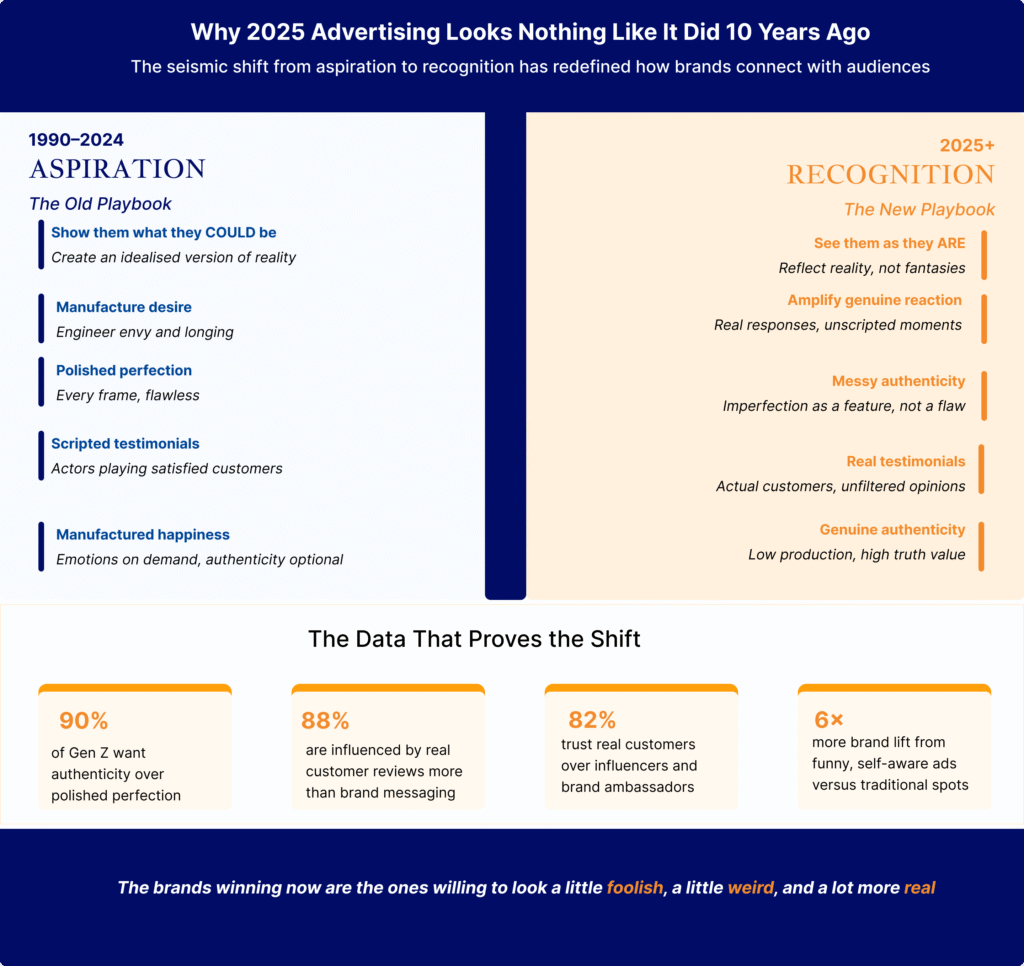
Then something shifted. Research shows that polished, high-production ads are losing ground to content that feels real. Crucially, 90% of consumers say authenticity matters when deciding what brands they support. Gen Z consumers prove particularly ruthless: 82% of Gen Z would trust a company more if it used images of real customers in its marketing.
This isn’t just a preference anymore. Instead, it’s become a survival mechanism. The world feels chaotic, the future uncertain, and young people are drowning in financial anxiety and environmental dread. Under these circumstances, the last thing they want from a brand is a fantasy they know is impossible. They want to be seen. They crave permission to be weird, gross, and human.
Consumers are exhausted by polished corporate nonsense. They don’t want to be sold a fantasy they know is impossible. They want permission to be weird, gross, and human.
Amazon understood this better than most. Rather than creating ads about products, they made ads from the internet’s most unfiltered testimonial platform. The move is both brazen and obvious—which is exactly why nobody else has really done it.
Why Customer Reviews Have Become the Most Valuable Marketing Asset
Here’s what’s remarkable: Amazon didn’t invent this treasure. It’s been sitting in plain sight, hiding in the reviews section of every product page.
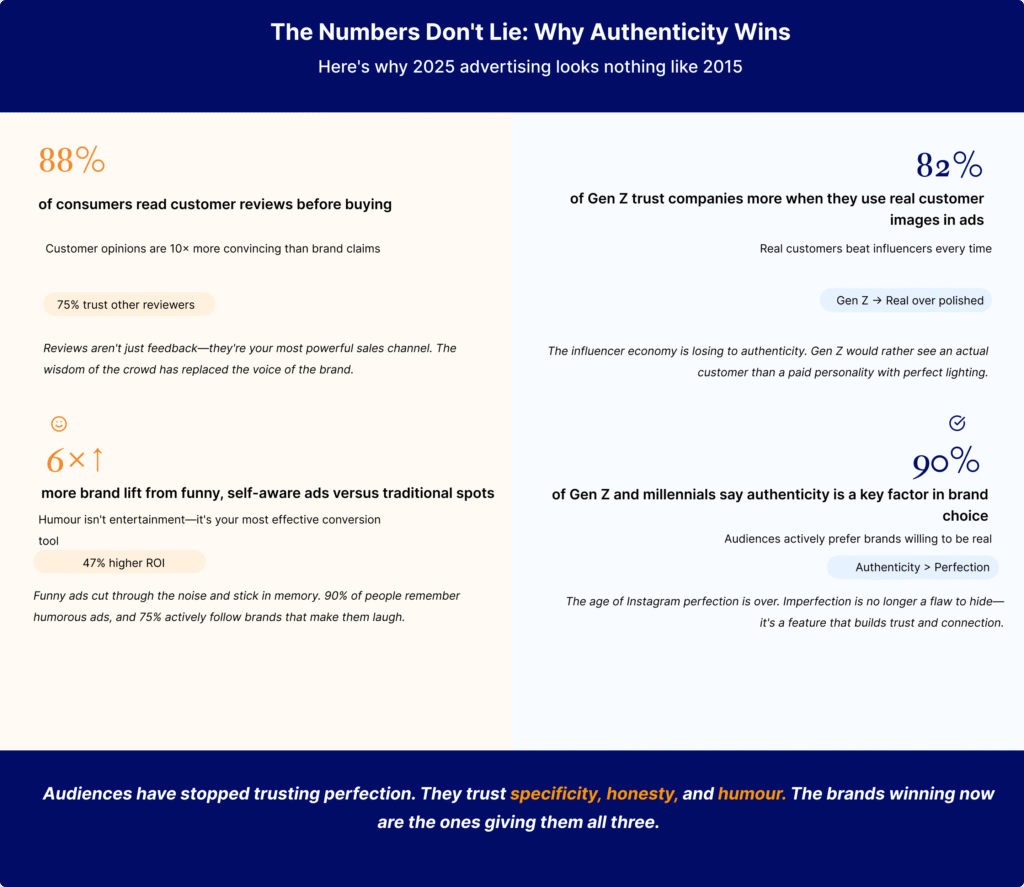
Consider the data: 88% of consumers read other buyers’ reviews before making an online purchase, and 75% trust the opinions left by other internet users. Customer reviews influence buying decisions more reliably than any celebrity or influencer partnership. What makes this especially valuable is that reviews are free, they’re authentic, and they’re often accidentally hilarious because people aren’t performing—they’re simply existing in the Amazon review space, which has become a weird, unfiltered genre of internet culture all its own.
The data backs this insight up. The average online shopper needs to see at least 112 reviews before trusting a product. More detailed positive reviews, newer dates, and higher review counts all increase trust. Moreover, genuine customer reviews—both positive and negative—prove transparency and help improve products, making brands more real and credible.
What Amazon realised is that these reviews are already working. They do the job. They turn strangers into buyers. So why not take them seriously as advertising? Why not give them the theatrical treatment, the professional actor, the production value—and let the absurd, specific, deeply human testimonials do the actual selling?
The Strategic Genius of “Serious Actor Performs Customer Reviews”
The framing of this campaign—”Real Amazon customer reviews performed by a real serious actor”—is where the real trick lives.
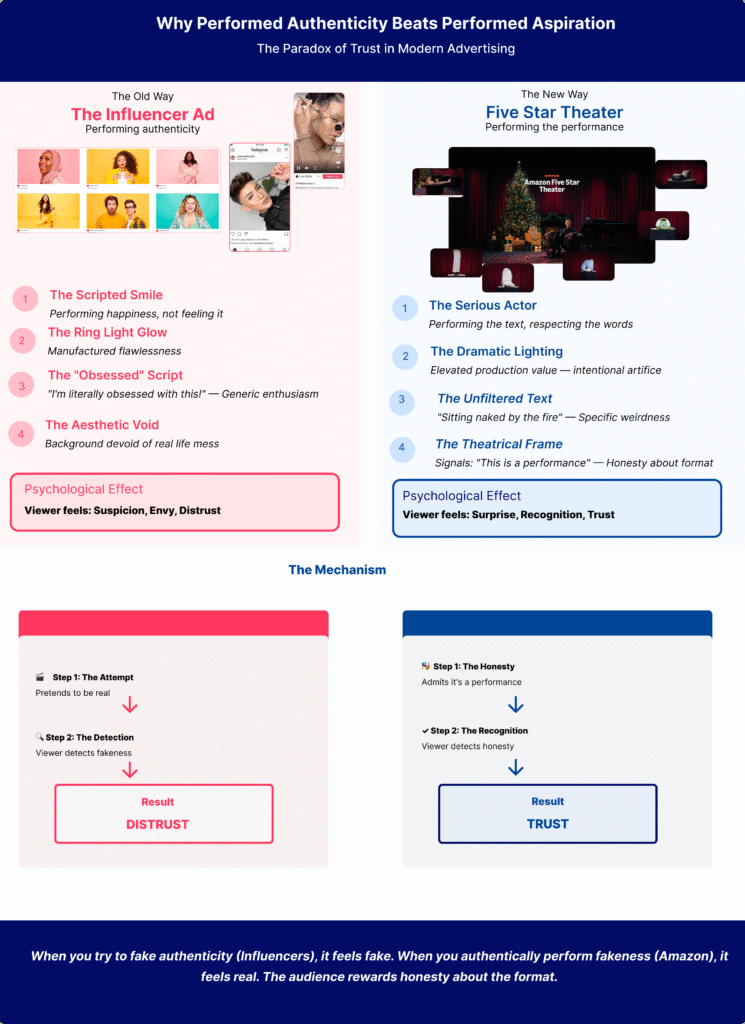
By using theatrical performance, Amazon admits that all testimonials are, in some sense, performed. But here’s the crucial difference: the performance here isn’t masking the product. Instead, it highlights the review. The actor isn’t selling the bidet. Rather, the actor presents the review as a cultural moment worthy of real attention. This frames customer testimonials as stories, not ads. It gives them worth.
Solving the Trust Problem
This approach solves a problem that traditional advertising has struggled with for years: how do you build trust when people have stopped believing in ads altogether? The answer isn’t to try harder at ads. Rather, it’s to stop advertising and start celebrating something that already exists—genuine human reaction to a product.
Each video in the series runs between 30 seconds and 1 minute. All of them use narrative specifics rather than feature lists. Take the “Green Machine” ad: it doesn’t tell you the product cleans carpets. Instead, it tells you about a family of eight dealing with stomach flu mess, blueberry pie on a white couch, and desperation. The product emerges as the hero of a genuinely messy domestic crisis. Similarly, the “Penguin Pajamas” review spirals into surreal Arctic imagery and regurgitated sardines before circling back to a simple claim: they’re cosy.
The Rise of Absurdist Marketing
This is absurdist marketing—a trend that’s absolutely big in 2025. Brands like Duolingo, Ryanair, and Liquid Death lean into chaos, unhinged content, and weirdness because it cuts through the noise. Fundamentally, in an attention economy that rewards chaos, only unexpected content stops people from scrolling.
Yet Amazon isn’t chasing weird for its own sake. The absurdity emerges naturally from real human testimonials. A man really did write that review about the slippers. Someone genuinely did compose an Arctic penguin fantasy about pyjamas. Amazon isn’t inventing the weirdness; it’s amplifying what already existed, hiding in the reviews section, waiting to be discovered.
The Numbers Behind Humour and Authenticity
Why does this work? Because humour is driving huge marketing results in 2025. Research reveals that funny ads deliver 6 times more brand lift, 47% higher return on ad spend, and greater recall. Moreover, 90% of people remember funny ads, and 75% are more likely to follow humorous brands on social media.
But at a deeper level, humour makes brands more relatable, adds personality and truth to brand voice, and helps audiences connect on a personal level. It turns a faceless company into something that feels human and approachable. Additionally, it disrupts what people expect and offers relief from the polished, corporate tone most ads adopt.
Why Funny Content Spreads
Funny content gets shared more, helping brands reach more people naturally. Posts with humour beat serious posts across all metrics. Combine that with authenticity, and you’ve got a formula that works. According to research, 80% of consumers prefer brands that personalise experiences, and importantly, consumers who feel a brand is authentic don’t mind small price increases.
This creates a powerful cycle: authentic, funny content spreads wider, reaches more people, and builds stronger emotional bonds. The result? Customers who trust the brand enough to overlook minor pricing shifts.
What This Means for Marketers in 2025
Amazon’s campaign marks a significant cultural moment. It proves that the old advertising playbook is genuinely broken.
Marketers have spent decades trying to make desire through aspiration. Show someone the car. Show someone the holiday. Show someone the version of themselves they could become if they bought this thing. Yet that requires trust in the brand, in the message, in the idea that happiness can be bought.
That trust is gone. Gen Z and millennials grew up surrounded by ads and got really good at spotting when a brand isn’t being real. They quickly identify brands that try too hard or seem dishonest—and when they do, they walk away.
The New Playbook: Testimonial Over Aspiration
The new playbook isn’t aspirational. It’s testimonial. It’s real. It’s messy. User-made content and authentic, low-fi storytelling work best, precisely because they feel less scripted and more human. They build trust faster.
For marketers, this shift has several practical takeaways:
- First, stop trying to script authenticity. The moment you try to manufacture realness, it breaks. Amazon’s clever move was to take something that already existed—unfiltered customer reviews—and treat it as the content itself, rather than a starting point for manufactured storytelling.
- Second, lean into specifics. Generic customer testimonials feel fake. “I love this product!” tells you nothing. “I wear these slippers and sit naked by the fire and feel like I’m wrapped in a fur coat and don’t want to be let out” tells you everything. Specifics fight marketing artifice. Interestingly, they’re also the highest form of authenticity.
- Third, use humour as a strategic tool. Humour isn’t just entertainment. It builds emotional bonds, helps you stand out in a crowded space, and makes your brand feel human. Importantly, humour works only when it comes naturally from the content, not when you’re forcing a joke.
- Fourth, respect your audience’s smarts. Younger consumers spot condescension from a mile away. They want brands to treat them like they understand that a slipper isn’t going to change their life. What they actually want is for brands to say that sometimes, small comforts matter, and that’s enough.
The Risk: When Humour Overshadows the Product
There’s a genuine weakness in this approach that marketers should think about: specifics and humour can sometimes overshadow the product itself.
A viewer watching the bidet ad might laugh without considering a purchase. The entertainment value is so high that it could actually lower purchase intent. The campaign focuses so much on the review experience that audiences might forget what’s being reviewed.
Additionally, the theatrical framing walks a tightrope. If audiences see the actor’s delivery as too polished or too performed, the authenticity advantage collapses. There’s a real risk that people see it as mocking the customer rather than celebrating them.
And here’s the core limitation: not every product can use this kind of approach. You need reviews that are already funny, already specific, already human. You can’t force this. You can’t script vulnerability. The moment a brand tries to manufacture this kind of authenticity, the whole thing falls apart.
Why Now?
We’ve reached peak ‘fake authenticity.’ When everyone is performing relatability, the only radical move left is to actually be real.
Why is Amazon running this campaign in November 2025, right as the holiday shopping season kicks into high gear?
Because this is the moment when consumers guard themselves most against ads. They’re scrolling through endless product recommendations. They’re seeing personalised ads everywhere. They’re exhausted by choice and decision fatigue. In this context, the last thing they want is to be sold to.
But here’s what changes: if a brand can make them laugh first, make them feel seen, make them remember what it feels like to be human and weird and specific, they’ll pay attention. They’ll watch the whole thing. They’ll share it. They’ll think of it when they’re standing in front of a shelf deciding what to buy.
Critically, they’ll trust that the product might actually deliver on what the review promises. Because the review performs the same emotional truth that they themselves might feel. It’s not performing aspiration. It’s performing recognition.
The Bigger Picture: Authenticity as Competitive Advantage
Amazon’s “Five Star Theater” campaign doesn’t exist alone. It’s part of a broader shift happening across advertising right now.
Brands like Duolingo lean into chaos. State Farm plays with name-based comedy. Andrex makes people laugh about awkward toilet moments. Wendy’s built a loyal audience through edgy, relatable social media. The pattern is clear: the brands winning in 2025 are the ones willing to look a little foolish, a little weird, and a lot more real.
For marketers, the implications are significant. This isn’t just about making funnier ads. It’s about completely rethinking what advertising is supposed to do. For decades, ads created desire. Now, they create connection. Polished perfection is no longer the goal; what matters is relatability, not polish.
The brands that understand this—that see customer testimonials not as raw data to manage but as storytelling material—will win the next phase of consumer attention. Meanwhile, the brands that keep trying to sell aspiration will lose.
The Bottom Line
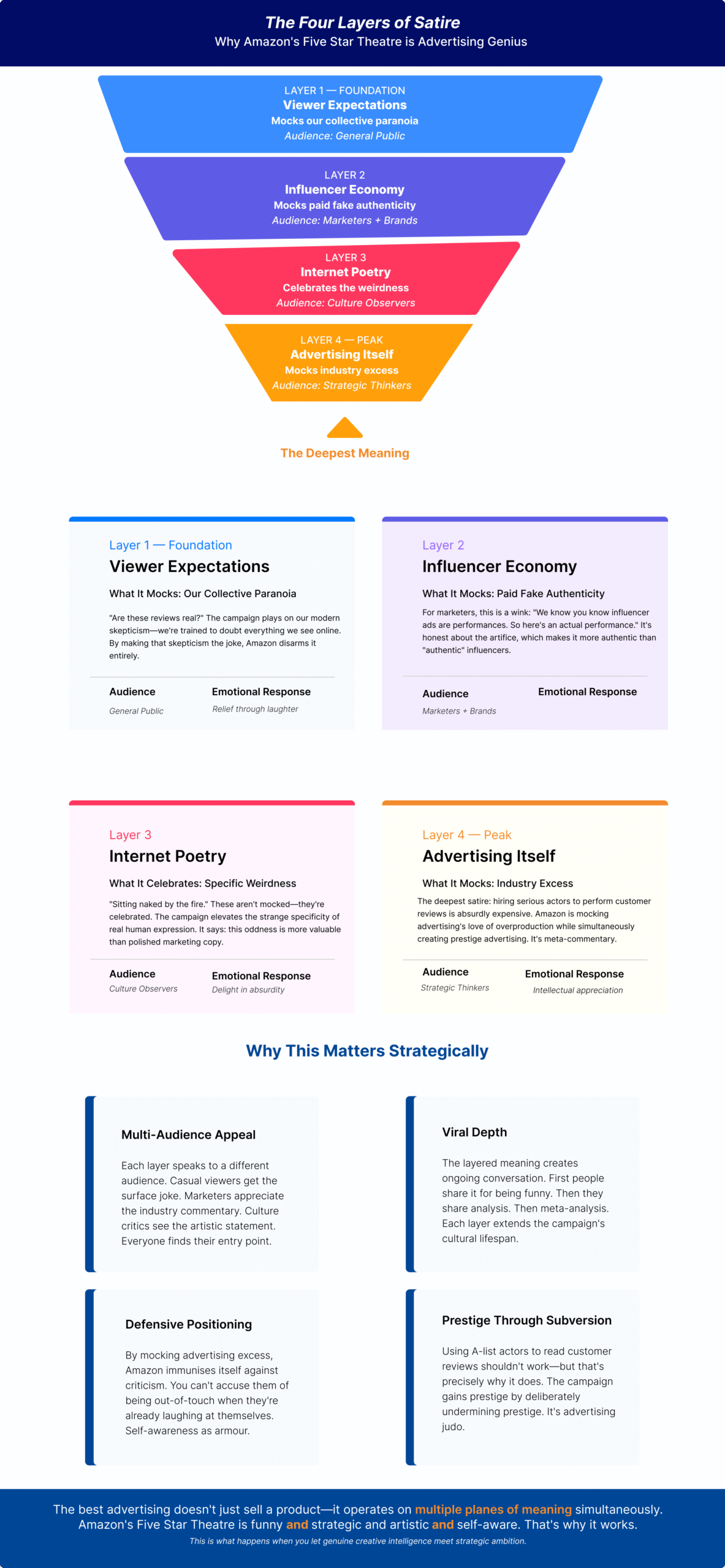
Amazon’s “Five Star Theater” works because it stops trying so hard. It takes something that already exists, something authentic, something unguarded, and gives it the kind of production value and creative attention that companies usually reserve for heavily scripted campaigns.
In doing so, it acknowledges a truth that the ad industry has been slow to accept: people don’t want to be sold to anymore. They want to be seen. They like their weirdness. They want brands that understand humans are messy, contradictory, and occasionally hilarious.
Amazon gave them that. And in the process, it showed what the next generation of effective advertising actually looks like.
The age of aspiration is over. The age of recognition has begun.
Footnotes & Sources
Research on customer review influence
Gen Z authenticity preferences
Polished ads losing ground to authentic content
Absurdist marketing trends 2025
Trust over loyalty for younger consumers
User-generated content authenticity
Customer review trust statistics
Emerging marketing trends summary
Social media humor effectiveness
Internal Links (for suchetanabauri.com)
- [Break the Loop, Mind the Bump: A Wry Audit of KitKat’s Latest Musical Break] – On absurdist humour in advertising and irreverent brand voice
- [Brand Anthem in the Age of Algorithms] – On people-powered marketing and authentic brand storytelling
- [The Alchemy of Animated Heritage: How a Brazilian Studio and a Small Boy With Gloved Hands Disrupted India’s Paint Wars] – On how brands succeed by celebrating consumer stories rather than corporate narratives
- [Tea/Monsoon campaign analysis] – On moment-driven marketing and emotional brand connection