
Two smartphone ads dropped on the same day. One ignores its rivals entirely. The other has spent two years mocking them. Both are working—and the lesson for marketers is counterintuitive.
On 24 November 2025, Apple and Google released flagship smartphone advertisements within hours of each other. Apple’s 65-second spot for the iPhone 17 Pro features men in dinner jackets performing surreal feats to an operatic crescendo, never once showing the phone in use. Google’s minute-long “It’s Pixel, Actually” reunites Thomas Brodie-Sangster and Martine McCutcheon from Love Actually to demonstrate the Pixel 10 Pro’s 100x zoom—while the ex-child star laments that tourists keep recognising the phone, not him.
These are not merely two advertisements. They are philosophical declarations—opposing answers to a question every marketer eventually confronts: Should you acknowledge your competitors, or pretend they don’t exist?
The conventional wisdom says confident brands don’t mention rivals. Apple has built a trillion-dollar empire on this premise. But Google has spent the past two years systematically dismantling that orthodoxy through its #BestPhonesForever campaign, which portrays iPhone and Pixel as awkward frenemies whose conversations repeatedly expose Apple’s feature deficits. Just five days before the Love Actually ad, Google released a Wicked: For Good parody in which an anthropomorphised iPhone literally thanks Pixel for “inspiring” its AI features.suchetanabauri+1
The surprising truth? Both strategies are working. And the reason illuminates something important about how brand positioning actually functions in mature markets.
The Market Reality Neither Ad Mentions
Before analysing creative philosophy, consider the battlefield these ads land on.
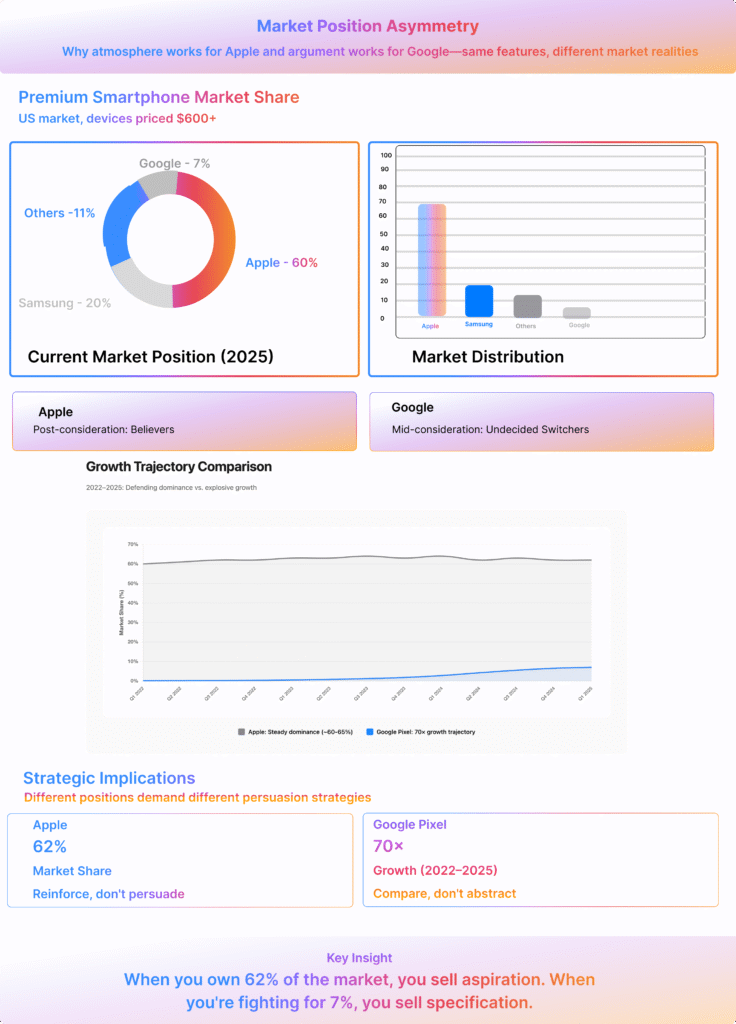
Apple holds 27% of the global mobile vendor market, Samsung 20%, with Xiaomi, Vivo and Oppo fighting over the remainder. But in the premium segment—phones over $600—Apple commands an extraordinary 62% market share. This isn’t dominance; it’s near-monopoly. Samsung trails at 20%, and everyone else is fighting for scraps.youtubesuchetanabauri
Except Google. In the past three years, Pixel’s US market share in the $600+ segment has grown from 0.1% to 7%—a 70-fold increase. September 2025 marked a single-month sales record, with Pixel volumes up 28% year-on-year. Globally, Google doubled its premium smartphone sales between H1 2024 and H1 2025, earning a top-five ranking for the first time.suchetanabauri+2
These numbers matter because they reveal the strategic logic behind each brand’s advertising approach.
Apple advertises from a position of overwhelming market power. Google advertises from a position of rapid growth against a dominant incumbent.
The creative executions flow directly from these market realities—but not in the ways you might expect.
Apple’s Gospel of Abstraction
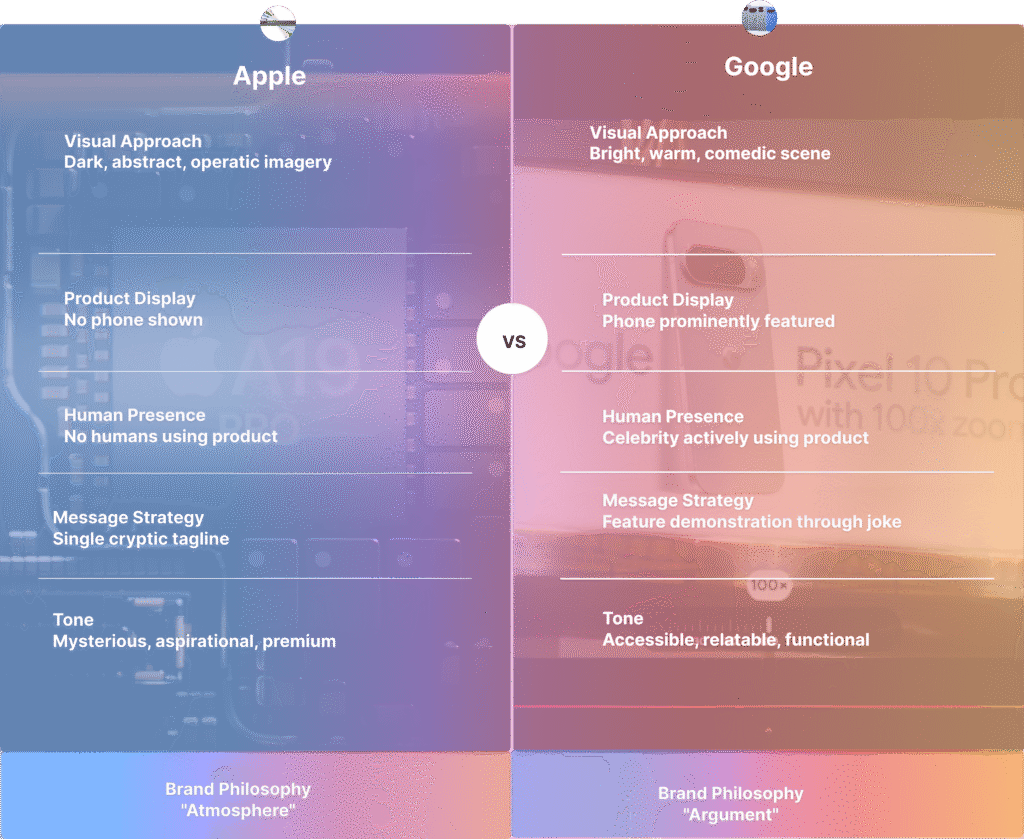
Apple’s “Peak Performance” spot is 65 seconds of deliberate confusion.
Thunder crashes. An operatic voice announces that “the Apple A19 Pro chip is vapor cooled.” Men in formal attire juggle and play piano. The word “Stupendae” is sung. Something crashes. The end.
The only concrete claim: the chip can “juggle over 35 trillion complex tasks a second.” What does that mean? Nothing comprehensible. That’s the point.suchetanabauri
Apple’s advertising philosophy, codified in Mike Markkula’s 1977 marketing manifesto, rests on three principles: Empathy (understand customer needs better than they do), Focus (eliminate everything nonessential), and Impute (ensure every touchpoint signals quality).
This framework treats advertising as atmosphere rather than argument. The goal isn’t to convince; it’s to reassure existing believers while signalling exclusivity to aspirants.
(For a deeper dive into how Apple’s iPhone 17 Pro launch balanced innovation claims with strategic restraint, see my earlier critical campaign analysis.)prezi
The vapor chamber—Apple’s first major thermal redesign in years, featuring laser-welded aluminium with deionised water cooling—is genuinely interesting technology. But Apple doesn’t explain it. Instead, the ad translates technical innovation into emotional resonance through pure metaphor. The bet: consumers in premium segments respond to feelings more reliably than specifications.suchetanabauri
What Apple doesn’t do is equally revealing. The ad contains no competitor references, no feature comparisons, no pricing signals, no use-case demonstrations, and no human actors using the actual phone.
This isn’t laziness; it’s doctrine. Apple’s marketing teams extensively analyse competitor communications, but the output never surfaces as direct comparison. The underlying message: the iPhone exists in a category of one. No meaningful comparison is possible.suchetanabauri
For a company commanding 62% of the premium segment, this positioning is strategically coherent. Why introduce the concept of alternatives to consumers who’ve already bought into your ecosystem?
Google’s Theatre of Strategic Mockery
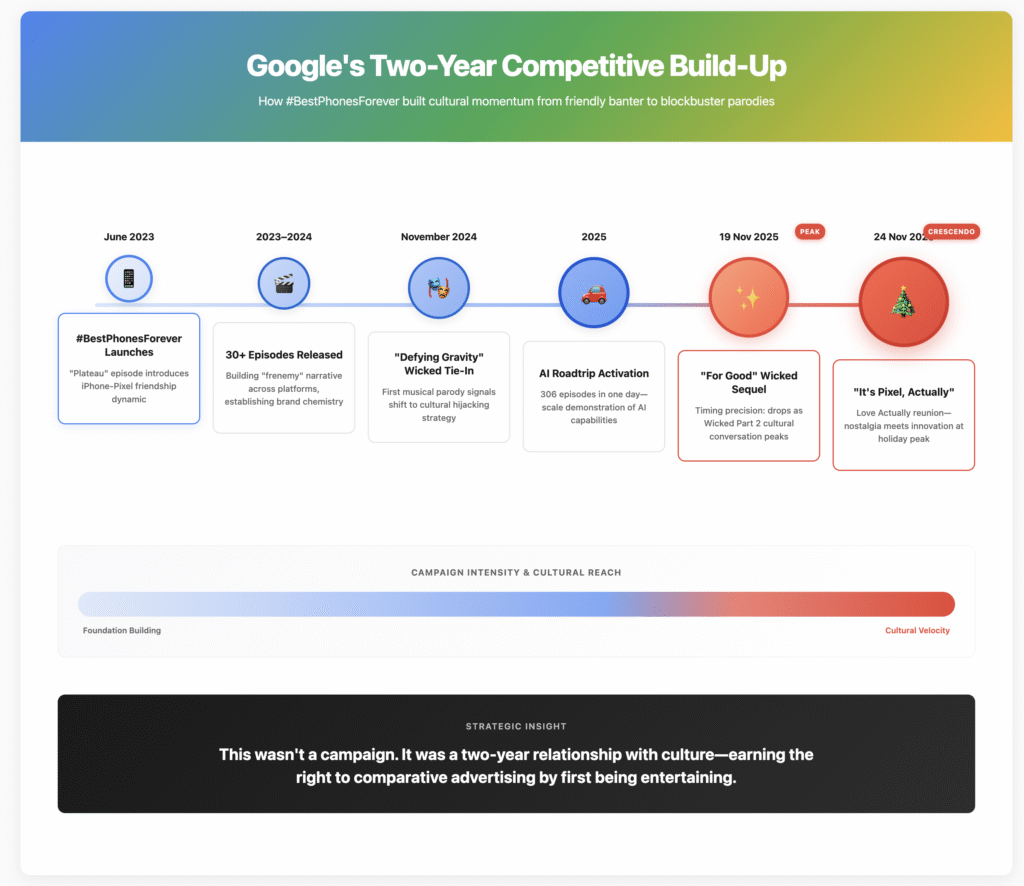
Google’s approach couldn’t be more different—and it begins not with this week’s Love Actually ad, but with two years of preparatory work.
The #BestPhonesForever campaign, launched in 2023, has produced over 30 episodes depicting iPhone and Pixel as “frenemies” in an animated universe where the devices converse about their respective capabilities. The conceit allows Google to make comparative claims through comedy rather than confrontation.
When the iPhone character admits it still lacks a feature Pixel has had for years, the criticism lands softly—wrapped in entertainment value rather than aggressive positioning.userexperienceawards
This is comparative advertising wearing a comedian’s mask. Academic research consistently shows that comparative ads outperform non-comparative alternatives in sales effectiveness, particularly for challenger brands.
But direct comparison risks consumer backlash—viewers may perceive the advertiser as “mean” or manipulative. The #BestPhonesForever format solves this problem by making comparison the content rather than the subtext.suchetanabauri
The Wicked parody, released 19 November, escalates the approach.
A purple iPhone plays Glinda while a green Pixel plays Elphaba. They duet on “For Good”—with the iPhone singing that Pixel’s innovations have “changed me for good.” The timing coincides with Wicked: For Good‘s theatrical release, hijacking $330 million worth of promotional attention.suchetanabauri+1
Then comes the Love Actually reunion. By securing actual cast members—Brodie-Sangster and McCutcheon—rather than mere references, Google achieves emotional legitimacy a pure parody would lack. The 100x zoom is demonstrated through the joke’s construction: tourists spot Thomas from extreme distance, but they’re excited about the phone, not the actor.
Every comedic beat directly illustrates capability.
(This approach to cultural moment-jacking shares DNA with Maybelline’s Mumbai CGI mirage—another case where borrowed cultural equity drove campaign virality.)suchetanabauri
Google’s campaign also leverages generative AI at unprecedented scale. During an “AI Roadtrip” activation, the team used Gemini 1.5 Pro, Imagen 2 and Cloud Text-to-Speech to produce 306 personalised #BestPhonesForever episodes in a single day, sending the phone characters to 74 countries based on real-time fan suggestions. This transforms advertising into participatory entertainment.suchetanabauri
The Paradox: Both Approaches Are Working
Here’s what should puzzle marketers: Apple’s “don’t acknowledge competitors” and Google’s “relentlessly mock competitors” strategies are both producing results.
Apple’s Q3 2025 shipments grew 9% year-on-year—the fastest among top-five smartphone vendors. Its premium segment dominance actually increased. Meanwhile, Google’s 35% year-on-year growth represents the fastest expansion of any brand in the market, and its US premium share has grown 70-fold since 2022.thelivenagpur+1
How can opposing strategies both succeed?
The answer lies in market position asymmetry.
Apple advertises to maintain an existing empire. Its customers aren’t comparison-shopping; they’re ecosystem-locked and loyalty-bound.
Acknowledging alternatives would plant doubt where none currently exists. The goal is reinforcement, not persuasion.
Google advertises to build a new empire. Its customers are comparison-shopping—they’re the consideration-stage consumers weighing whether to switch from iPhone or Samsung.
For this audience, direct comparison isn’t aggressive; it’s helpful. The #BestPhonesForever campaign essentially does their research for them.
The critical insight: the same creative strategy can be right for one brand and catastrophic for another, depending on market position.
Apple attempting Google’s comparative approach would be disastrous—it would legitimise the comparison, suggest Apple feels threatened, and undermine the “category of one” positioning. Google attempting Apple’s atmospheric abstraction would be equally mistaken—it would forfeit the comparative advantage (AI features, camera capabilities) that justifies the switching cost.
This same principle—matching creative execution to market position—explains why Swiggy’s people-powered Wiggy 3.0 campaign worked for a platform seeking community differentiation, while atmospheric brand-building might have fallen flat.
What This Means for Your Brand
If you’re a marketing leader watching these campaigns, the temptation is to pick a side: “We should be more like Apple” or “We should be more like Google.” Both conclusions miss the point.
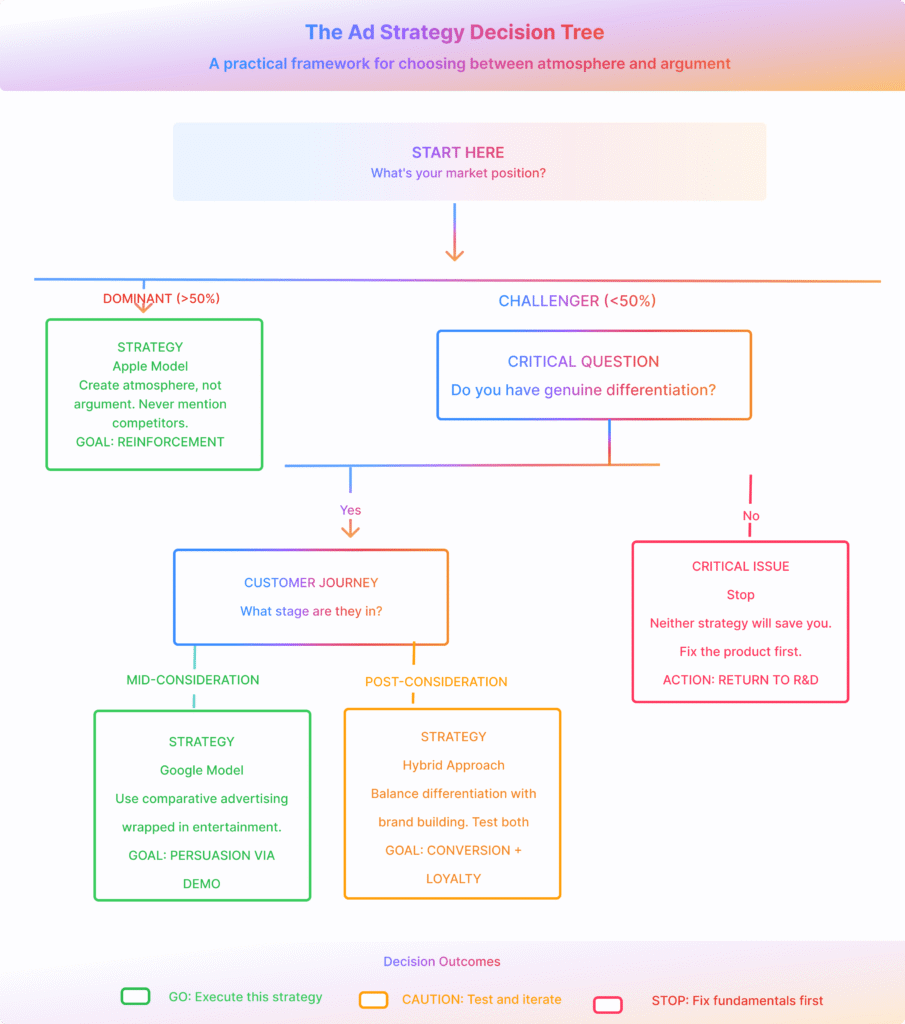
The strategic question isn’t which approach is “better.” It’s which approach matches your market position.
Here’s how to think through it:
- If you dominate your category (like Apple): Your advertising should create atmosphere, not argument. Avoid mentioning competitors—even to critique them—because doing so introduces the concept of alternatives to customers who’ve already chosen you. Focus on emotional resonance, brand mythology, and the feeling of belonging to an exclusive community. Your goal is reinforcement, not persuasion.
- If you’re a challenger with genuine differentiation (like Google): Comparative advertising is your friend, but execution matters enormously. Raw comparison (“We’re better than X”) triggers defensive reactions. Comparison wrapped in entertainment (“Look at these two phones having a conversation”) delivers the same information without the psychological backlash. Invest in formats that make comparison the content, not the subtext.
- If you’re a challenger without genuine differentiation: Neither approach will save you. Apple’s atmospheric advertising requires brand equity you haven’t earned. Google’s comparative approach requires product advantages you don’t have. Fix the product first.
- Regardless of position, consider serialisation. The #BestPhonesForever campaign’s 30+ episodes create a narrative universe that rewards repeat engagement. This isn’t traditional reach-and-frequency advertising; it’s entertainment programming that happens to feature products. The AI Roadtrip activation—306 episodes in one day—demonstrates how generative AI can scale participatory marketing without sacrificing brand voice. (For more on how AI is reshaping marketing execution, see my analysis of Claude Sonnet’s launch strategy and NVIDIA’s marketing evolution.)linkedin
- Finally, match creative approach to customer journey stage. Apple’s atmospheric ads work because its customers are post-consideration—they’ve already decided. Google’s comparative ads work because its customers are mid-consideration—they’re actively weighing options. Advertising that mismatches creative approach to journey stage wastes budget at best and actively damages positioning at worst. (Nike’s recent “Why Do It?” campaign offers another masterclass in meeting consumers where they are emotionally.)
The Strategic Truth Hidden in Plain Sight
The November 2025 smartphone ad war reveals something marketing discourse often obscures: there is no universal best practice.
The right creative strategy depends on market position, competitive dynamics, customer journey stage and brand equity—factors that vary by company, category and moment.
Apple and Google are both right—for themselves.
Apple is right to ignore competitors when commanding 62% of the premium segment. Google is right to mock competitors when growing 35% annually from a 7% base.
The mistake would be for either to adopt the other’s playbook.
For marketers, the lesson isn’t to copy Apple or copy Google. It’s to understand your own market position clearly enough to determine which philosophy fits. That requires honesty about where you actually sit in the competitive landscape—not where you wish you sat.
The best advertising in the world cannot overcome strategic confusion about who you are and who you’re talking to.
Apple knows it’s talking to believers. Google knows it’s talking to the undecided. Both craft campaigns accordingly.
Do you know who you’re talking to?
Footnotes
suchetanabauri: Apple YouTube, “iPhone 17 Pro | A19 Pro Chip | Peak Performance,” 24 November 2025
Related Reading on suchetanabauri.com
- Apple’s iPhone 17 Pro Marketing: A Critical Campaign Analysis — How Apple’s launch balanced innovation claims with strategic restraint
- The Pixel-Perfect Lie: Maybelline’s Mumbai Mirage — When CGI cultural hijacking works (and when it doesn’t)
- Brand Anthem in the Age of Algorithms: Swiggy Wiggy 3.0 — People-powered marketing in India’s gig economy
- Why “Why Do It?” Is Nike’s Most Intriguing Invitation to Date — Empathy-led digital marketing that meets consumers where they are
- Claude Sonnet Marketing Analysis — How AI companies are evolving their launch strategies
- NVIDIA Marketing Strategy Analysis — Multi-lens analysis of tech marketing evolution
- Amazon Celebrity Marketing Strategy — How global brands adapt strategies across markets
- https://suchetanabauri.com/category/blog/page/12/
- https://suchetanabauri.com/tag/swiggy-wiggy-3-0-campaign/
- https://www.youtube.com/watch?v=-CeKRjEIxyM
- https://suchetanabauri.com/tag/content-creator-tools/
- https://suchetanabauri.com/swiggy-wiggy-3-0-campaign-employee-advocacy/
- https://bestmediainfo.com/2016/07/asian-paints-gives-birth-to-professionals-at-its-colour-academy
- https://suchetanabauri.com/tag/digital-strategy/
- https://suchetanabauri.com/tag/swiggy-marketing-analysis/
- https://prezi.com/p/hujemhpbtavc/asian-paints/
- https://suchetanabauri.com/tag/platform-strategy/
- https://suchetanabauri.com/tag/meta-parody-campaign/
- http://userexperienceawards.com/2013-submissions/asian-paints-website/
- https://suchetanabauri.com/tag/brand-trust/
- https://suchetanabauri.com/tag/brand-campaign-paradox/
- https://campaignme.com/tag/kitkat/
- https://suchetanabauri.com/tag/marketing-decision-making/
- https://suchetanabauri.com/nike-why-do-it-campaign-analysis/
- https://thelivenagpur.com/2020/05/30/asian-paints-launches-a-campaign-for-safe-painting-service-targeting-the-safety-of-painters-and-their-families/
- https://suchetanabauri.com/tag/writers-block/
- https://www.linkedin.com/in/kumar-pratik-a3b9a7100
- https://suchetanabauri.com/tag/maybelline-india/
- https://www.behance.net/search/projects/Asian%20Paints%20animation?locale=en_US
- https://suchetanabauri.com/tag/marketing-critique/
- https://www.fabelmedia.com/asian-paints
- https://www.youtube.com/watch?v=o1PiqdZqYGQ
- https://www.youtube.com/watch?v=iPf0kjbt6ZQ
- https://www.asianpaints.com
- https://www.youtube.com/watch?v=tP3qhBzvES8
- https://www.asianpaints.com/about-us.html
- https://x.com/asianpaints
- http://www.youtube.com/watch?v=dREvqy1iGUE
- https://aapkapainter.com/products/paints/asian-paints-price
- https://suchetanabauri.com
- https://suchetanabauri.com/tag/brand-strategy-analysis/
- https://suchetanabauri.com/tag/collage-of-six-iconic-nike-just-do-it-posters-and-campaigns-in-orange-bordered-frames/
- https://suchetanabauri.com/ux-microcopy/
- https://suchetanabauri.com/tag/global-brand-strategy/
- https://suchetanabauri.com/tag/a-solitary-runner-crossing-a-bridge/
- https://suchetanabauri.com/seo-web-copy/
- https://suchetanabauri.com/apples-iphone-17-pro-marketing-a-critical-campaign-analysis/
- https://suchetanabauri.com/the-great-punctuation-purge-how-ai-flattened-our-writing-into-a-syntax-smoothie/
- https://suchetanabauri.com/amazon-celebrity-marketing-strategy-global-campaigns-cultural-adaptation/
- https://suchetanabauri.com/nvidia-marketing-strategy-analysis-september-2025/
- https://suchetanabauri.com/claude-sonnet-4-5-marketing-analysis-anthropic-ai-launch-critique/
- https://suchetanabauri.com/tag/punctuation/
- https://suchetanabauri.com/google-performance-advisor-campaign-stephen-curry-analysis/
- https://suchetanabauri.com/spotify-india-campaign-analysis-kareena-saif-it-gets-you/
- https://suchetanabauri.com/prime-video-milind-soman-campaign-wellness-marketing-analysis/
- https://suchetanabauri.com/my-time-at-elms/
- https://suchetanabauri.com/tag/ux-design-artificial-intelligence/