
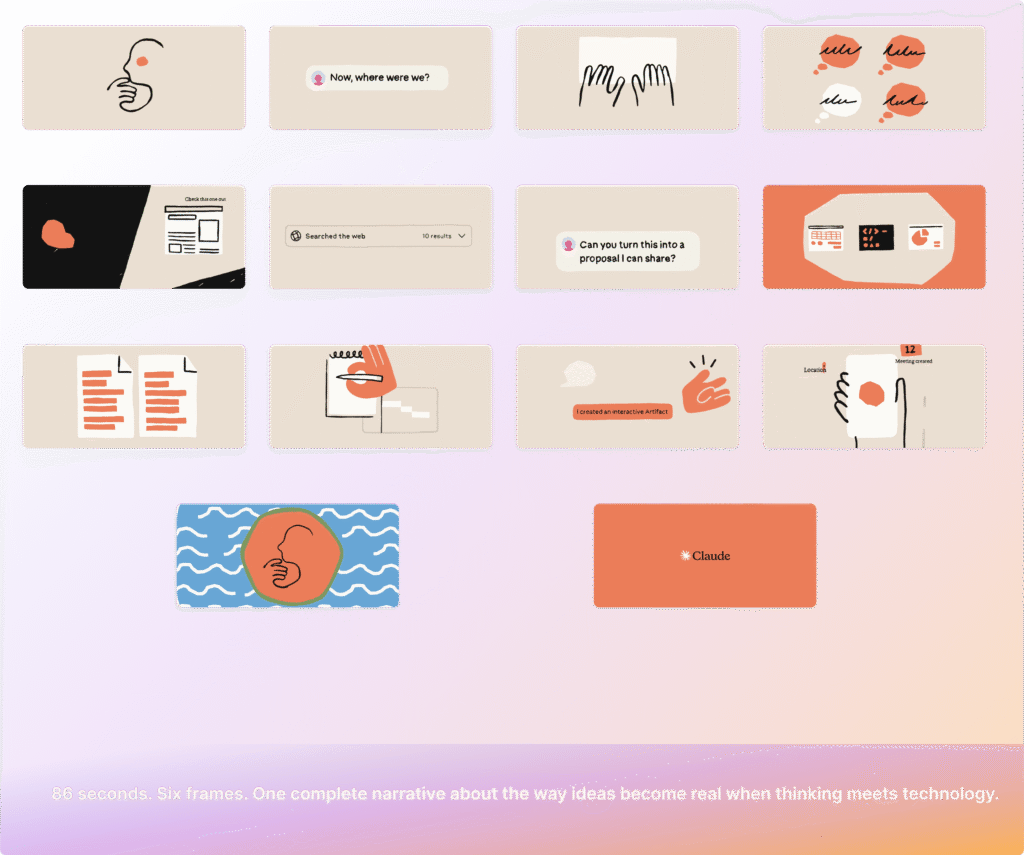
On 20 November 2025, Anthropic released an 86-second video that doesn’t behave like marketing. There’s no parade of features, no direct competitor swipes, nor breathless claims of revolution. Instead, the film whispers a radical proposition: perhaps the best AI marketing isn’t about the AI at all.
The film—”Turning Claude into your thinking partner”—charts the arc of an idea using minimal line art and abstract gestures. Each frame moves us from “a glimmer” to research, creation, and quiet completion—”By evening, it was done”—without ever showing a user, a desk, or a digital dashboard. “The idea was always yours. With Claude as your thinking partner, you made it real.”
Notably, the hero is the thought itself; Claude operates mostly in the background.
It’s the most audaciously confident piece of product storytelling in ages. While the rest of tech trumpets benchmarks and features, Anthropic instead creates something softer—a carefully tuned sense of feeling.
If you’re a marketer, especially if you’re wrestling with how to position AI or tech products, this video should be your case study for the next quarter. Here’s why.
The Market Context: Why Restraint Wins Right Now

Let’s confront reality: most people are tired of AI hype. Three years into the generative boom, we’ve hit the wall. Fatigue is setting in. Consequently, every SaaS solution now claims to be “AI-powered.” Similarly, every deck references GPT. Every LinkedIn post starts, “I asked ChatGPT to…”
As a result, scepticism has replaced excitement. The numbers tell the real story: while ChatGPT draws fifty times the traffic, Claude is responsible for 40 per cent of OpenAI’s revenue.
Therefore, marketers must sell trust, not tricks.
Buyers and users want assurance that new tech fits quietly into their world, not that it shouts the loudest.
Anthropic’s answer is almost architectural: restraint, not razzle-dazzle. Moreover, the company understands that trust is built not by louder claims, but by a quieter, more persistent whisper of relevance. Their film doesn’t try to convince you that Claude is powerful. Rather, it asks how using Claude feels—and what it means for your idea.
The loudest isn’t always the most effective.
As Indian smartphone campaigns proved this September, the loudest isn’t always the most effective. See comparison
What the Video Actually Does (and Doesn’t Do)
Watch Claude’s video with the sound off. Notice what’s missing: product screenshots, UI walkthroughs, or even so much as a stylised human. In contrast, these 86 seconds rely on abstract line art over a calm, cream canvas—gestural hands, loose profile shapes, thought bubbles at various stages of clarity.
This isn’t just design simplicity. Rather, it’s narrative strategy. There’s no desk, no commute, no avatar. Instead, the human experience is suggested—never shown outright. The role of Claude is there in the arc, not the detail. The storyline is all metaphor: hands for action, bubbles for thought, movement for continuity. Crucially, the AI is an implied presence, not the centre of attention.
This is a clever dodge of the common credibility trap. When marketers lean hard on interface demos, users grow sceptical. However, Claude sidesteps this; instead of telling you how smart it is, it makes you feel what’s possible. It becomes, in effect, a whisper of potential rather than a megaphone for power.
Every word of the transcript reinforces this restraint:
“Your idea was hungry. Hungry for answers and connections. Claude helped you look, reading alongside you.”
Note how the verbs are gentle, supportive—not dominant.
Contrast this with the jargon-laden promises of most SaaS launches: automates, eliminates, transforms! In those cases, the transaction is everything. Claude, on the other hand, bakes collaboration, humility, and continuity into every line and every visual metaphor. See wider trend analysis.
The Feature Integration You Barely Notice
Curiously, the film reveals six new product features—memory, voice, file creation, Chrome extension, mobile/desktop continuity—yet never labels or depicts them.
“Claude remembered it.”
“Reading alongside you.”
“Turn this into what? A deck, spreadsheets, documents…”
“You left your desk. Your idea followed into your phone.”
Each is communicated by suggestion: a hand sketching, a bubble filling, a page appearing. Nothing is literal; everything is suggestive.
Breakdown for reference
See Chrome Extension details
File creation feature
Mobile/Desktop sync
Calendar, maps integration
This is not simplicity for design’s sake. Instead, it’s a strategic bet: features date quickly, but an evocative experience lasts.
Anthropic trusts viewers to connect the dots rather than bullet-pointing the roadmap.
What’s the message here for marketers? Never just list what your AI does. Rather, paint a picture—sometimes abstract—of what your user can achieve.
Why “Thinking Partner” Is Positioning Genius
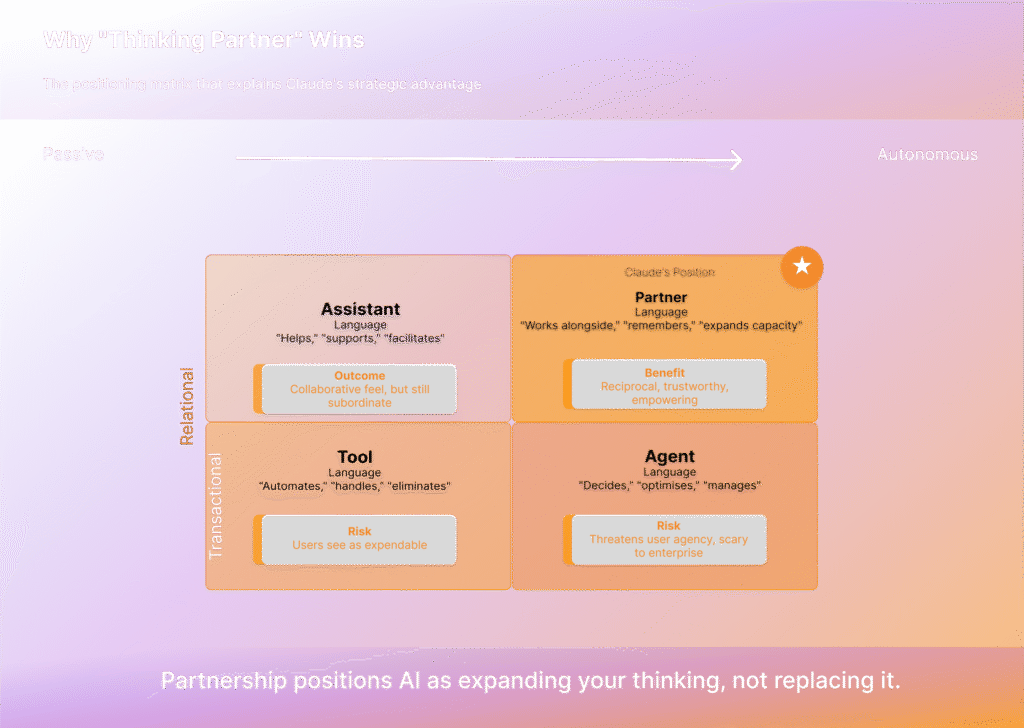
The phrase “thinking partner” does a lot of heavy lifting. Specifically, it sidesteps the old binaries (servant vs. oracle, tool vs. agent) and instead conjures up a sense of collaborative, ongoing partnership.
“Thinking partner” promises increased capacity—not just efficiency. Moreover, it broadens the horizon of what users can imagine, not merely automate. Furthermore, it invites habitual usage, not one-off transactions.
Partners stick with you; tools get replaced.
The phrase also calms those perennial fears—what if AI outsources too much thinking? The language, paired with abstract visuals, assures us that “the idea was always yours.”
Marketers, take heed: position your AI as making users wiser, not as being the wisest entity in the room.
The Emotional Architecture: How the Video Actually Works
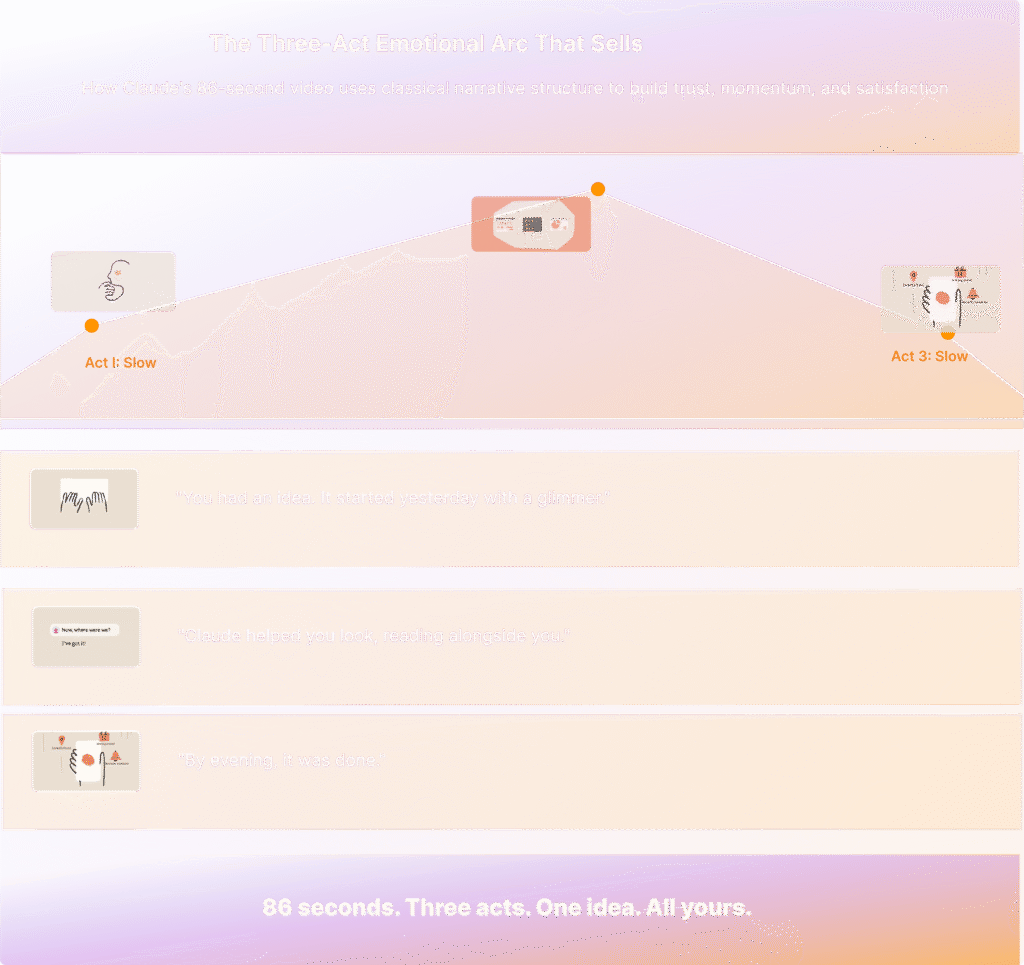
Fundamentally, this is a three-act story: setup (“glimmer”), the messy middle (activity, thought, progress), and resolution (quiet satisfaction).
However, here’s the twist: it is told through rhythm and metaphor rather than explanation.
- Start: A lone profile, a single thought bubble. Slow, contemplative pace. Vulnerability—forgetting, rediscovering.
- Middle: More bubbles, gesture lines, hand shapes. Subsequently, the pace increases. The narrative becomes tangled, layered—echoing real creative work.
- End: Visual calm returns. There’s a sense of arrival—”By evening, it was done.”
No demonstrations, just mood. For marketers, this is a lesson in show-don’t-tell.
Consequently, abstract visual poetry can often communicate value better than annotated screen grabs.
You’ll see echoes of this approach in breakthrough Indian digital campaigns as well. Example More on emotional resonance
What This Means for Marketing AI Products Right Now
If you’re marketing AI, here’s how to see (and feel) afresh:
Stop selling intelligence. Sell outcomes. No one cares about your model’s benchmarks; they care about finishing the work that matters.
Show feeling, not just product. Use abstract visual metaphor; lean into rhythm and suggestion, not annotated UI tours.
Frame AI as continuity, not interruption. Let your value be invisible but present—like Claude. Therefore, integration should feel seamless rather than additive.
Use restraint as strategy. If everyone else is shouting about features, whisper about experience and partnership. Consequently, you’ll stand out by being quieter, not louder.
Prioritise emotional resonance. If you have to choose between showcasing features and creating feeling, choose the latter. Emotions drive decisions more than specifications ever will.
Design for the user’s self-concept. Elevate agency; leave them—and their ideas—as the hero. As a result, adoption feels like empowerment rather than replacement.
Adoption feels like empowerment rather than replacement.
The Enterprise Subtext: Who This Is Really For
Don’t mistake the gentle graphics for a consumer play. In fact, Anthropic’s focus is enterprise, not casual users. Their restraint speaks to business buyers who crave reliability and trust over flash.
The features—however abstracted—matter to professionals managing sensitive, complex projects. Therefore, abstract visuals here signal confidence, not absence. Enterprise buyers interpret restraint as competence, not limitation.
Why Now Matters
The market is moving inevitably away from razzle-dazzle and toward reliability. Moreover, we’re past the “look what AI can do!” phase. Marketers should position AI as infrastructure, not innovation—a collaboration, not a tool.
Position AI as infrastructure, not innovation—a collaborator, not a tool.
Anthropic’s video is the new blueprint: minimise the product, maximise the experience.
Consequently, this approach will define the next wave of successful AI marketing.
The Uncomfortable Question
Can this approach scale? “Thinking partner” promises intimacy and nuance—but will it hold up at the hyper-scale of a global platform? Anthropic is rolling out memory and context carefully, balancing privacy and user control. However, as adoption grows, keeping the marketing promise true becomes harder.
Marketers: under-promise, over-deliver. Trust is won where experience matches restraint.
What You Should Do on Monday
- Audit your messaging: Count features vs. outcomes; screen grabs vs. moods. Try subtracting product shots. As a result, you might discover your message becomes clearer, not weaker.
- Map the emotional journey: What does your user feel at each step? Therefore, design around feelings first, features second.
- Find restraint: The most sophisticated marketing shows less, not more. Consequently, focus on what to remove rather than what to add.
- Test partnership language: “Works alongside”, “helps you”, not “automates”, “handles for you”. Then, measure which resonates more deeply with your audience.
- Show less product, imply more experience: Follow Anthropic’s example—abstract is not just elegant, it’s strategic. As a result, your marketing will feel more human and less corporate.
The AI market will reward whoever can make users feel clever, not just automate cleverness.
Claude’s video points to a quiet revolution. Most marketing still misses it.
You have 86 seconds to change that.
Related Reading:
- AI-Washing in Digital Marketing: When September’s Smartphone Launches Lost the Plot
- Brand Anthem in the Age of Algorithms: Swiggy Wiggy 3.0’s People-Powered Playbook
Sources & Further Reading
On Claude’s Features & Positioning:
- Anthropic (2025, November 19). “From Chatbot to Thinking Partner.” Claude Blog.
https://www.claude.com/blog/your-thinking-partner - Anthropic (2025). “Meet your thinking partner.” Claude Product Overview.
https://www.claude.com/product/overview - Anthropic (2025, June 25). “Claude Desktop Extensions: One-click MCP server installation.”
https://www.anthropic.com/engineering/desktop-extensions - Anthropic (2025, April 30). “Claude can now connect to your world.” Claude Blog.
https://www.claude.com/blog/integrations - Anthropic (2025). “Download Claude.”
https://www.claude.com/download
On Memory & Enterprise Features:
6. Tom’s Guide (2025, October 23). “Claude Memory just launched and it syncs with ChatGPT.”
https://www.tomsguide.com/ai/claude-just-unlocked-memory-that-syncs-with-chatgpt-heres-how-it-works
- Palmer, S. (2025, September 11). “Claude AI Gets Automatic Memory for Business Users.” Shelly Palmer.
https://shellypalmer.com/2025/09/claude-ai-gets-automatic-memory-for-business-users/ - Reworked (2025, September 11). “Claude AI Gains Persistent Memory in Latest Anthropic Update.”
https://www.reworked.co/digital-workplace/claude-ai-gains-persistent-memory-in-latest-anthropic-update/ - Winsome Marketing (2025, September 8). “Claude’s New Memory Feature: A Strategic Move for Enterprise AI.”
https://winsomemarketing.com/ai-in-marketing/claudes-new-memory-feature-a-strategic-move-for-enterprise-ai
On Competitive Context:
10. SaaStr (2025, July 7). “Anthropic May Never Catch OpenAI. But It’s Already 40% as Big.”
https://www.saastr.com/anthropic-may-never-catch-openai-but-its-already-40-as-big/
- Makebot (2025, November 7). “Claude vs. ChatGPT | 2025 Comparison of Anthropic & OpenAI.”
https://www.makebot.ai/blog-en/claude-vs-chatgpt-2025-comparison-of-anthropic-openai - Digital Ocean (2025, October 9). “Claude vs ChatGPT: Which AI Assistant Wins in 2025?”
https://www.digitalocean.com/resources/articles/claude-vs-chatgpt - Fortune (2025, September 14). “New studies show what people really use ChatGPT and Claude for.”
https://fortune.com/2025/09/15/openai-chatgpt-claude-anthropic-work-personal-use-new-data/
On AI Design & Human-AI Collaboration:
14. Rector, J. (2025, August 1). “AI’s Paradigm Shift: Human‑Centric Interfaces and Predictive Intelligence.”
https://johnrector.me/2025/08/01/ais-paradigm-shift-human%E2%80%91centric-interfaces-and-predictive-intelligence/
- Kentz, M. (2025, May 13). “AI Personality Matters: Why Claude Doesn’t Give Unsolicited Advice.” Substack.
https://mikekentz.substack.com/p/ai-personality-matters-why-claude - Economic Times (2025, November 20). “The Future of Consulting: How AI is Creating a New Frontier of Data-Driven Intelligence.”
https://economictimes.com/tech/artificial-intelligence/the-future-of-consulting-how-ai-is-creating-a-new-frontier-of-data-driven
On Emotional Design & Storytelling:
17. The Gutenberg (2025, September 14). “AI-Powered Storytelling: Boost Brand Recall & Loyalty in 2025.”
https://www.thegutenberg.com/blog/ai-powered-storytelling-how-brands-can-stay-top-of-mind/
- DeepWriter (2025, October 9). “Q&A: Using AI for Emotional Writing.”
https://deepwriter.com/qanda-using-ai-for-emotional-writing/