
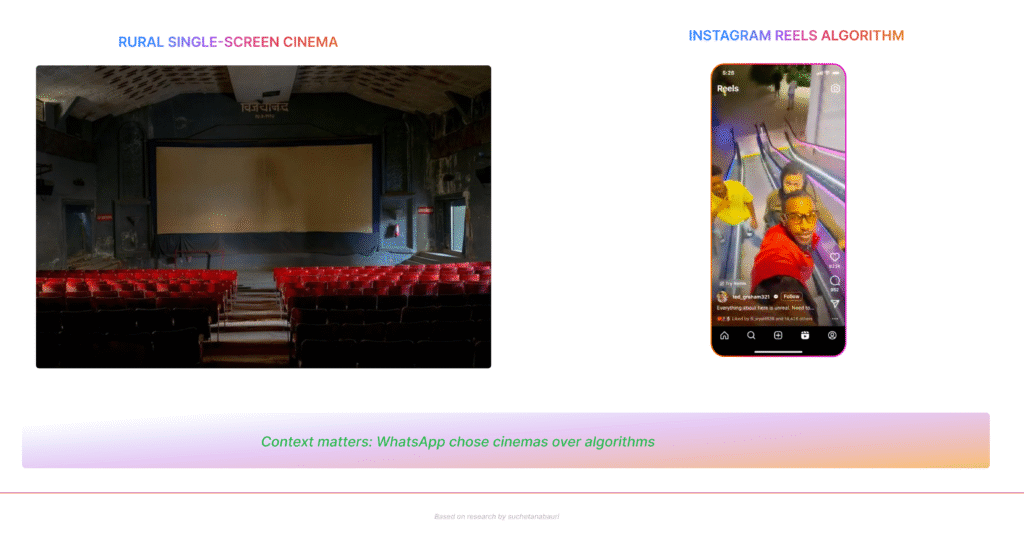
Here we are in late November 2025, wrapping up a year where every marketing trend deck promised us that short-form video would eat everything, attention spans had collapsed to goldfish territory, and anything longer than 60 seconds was dead on arrival. Then WhatsApp dropped a nine-minute film about two strangers falling in love through voice notes—and screened it in rural single-screen cinemas and travelling vans across 240 villages.
Not a product demo. Not a celebrity-fronted awareness play. Instead, it’s a proper narrative film, shot in regional dialect, with cinematic craft and zero brand mentions until the final frame. This campaign challenges every assumption we marketers have made about what works now. As we close out 2025 and start planning for next year, this is the work we should study—not because long-form is “back,” but because WhatsApp understood something most brands have forgotten: context trumps convention.
The Economic Reality No One’s Saying Out Loud
Let’s be honest about why most brands won’t make a nine-minute film. It’s not because audiences can’t handle it—it’s because boardrooms can’t justify it. Short-form video dominates 2025 marketing spend because the ROI case is straightforward: produce fast, distribute cheap, measure instantly. Meanwhile, Reels, Shorts, and TikTok-style content deliver views at volume, engagement rates that look impressive on dashboards, and completion rates you can show your CFO.
The numbers back this up: mobile commerce hit 56.5% of holiday sales in 2025, and platforms built for micro-content drove the bulk of discovery traffic. When marketing budgets tightened this year amid economic uncertainty, brands doubled down on what converts fastest—and that’s rarely nine minutes of anything. I’ve written before about how September’s smartphone marketing frenzy revealed this exact pressure: brands chasing impressions over substance, vanity metrics over real outcomes.
Why WhatsApp Bet Against the Trend
Meanwhile, WhatsApp made a calculated strategic bet against instant-return marketing. They knew retention drops sharply after 30 seconds (down to 37%) and plummets to 20% by the one-minute mark for typical social content. They knew a nine-minute branded film would get destroyed on YouTube or Instagram. Importantly, they made it anyway—because they weren’t playing for digital platform metrics. Instead, they were playing for something else entirely.
Here’s the part that matters: this gamble only works if you know why you’re making it and where it will live. WhatsApp did. Most brands wouldn’t.
But Here’s What the Data Actually Shows
The received wisdom says long-form is dead. However, the actual data shows something more useful: long-form and short-form serve different jobs, and combining them beats either alone by 72%.
Short-form captures attention and drives discovery. In contrast, long-form builds trust, establishes authority, and drives conversions. A 2025 ClearVoice survey found 72% of marketers say long-form content generates more qualified leads than short-form, while short-form dominates social engagement. They’re not competitors; rather, they’re partners in different stages of customer decisions.
Context Changes Everything
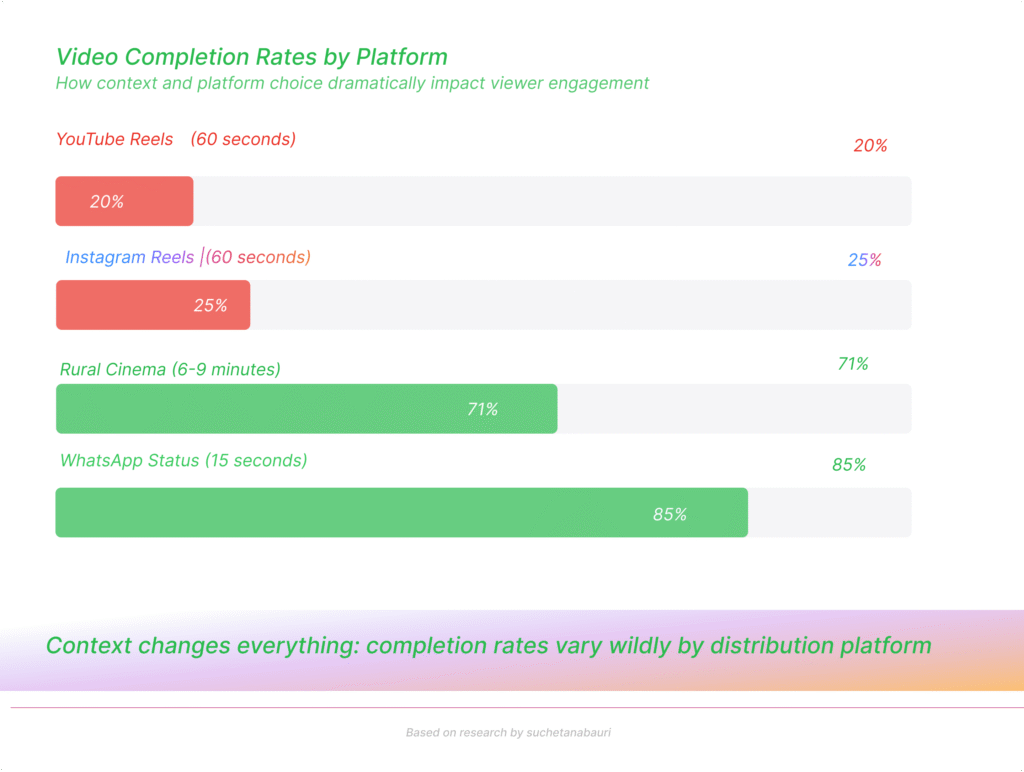
But here’s where context matters: those completion rate stats—37% at 30 seconds, 20% at 60 seconds—measure social scroll behaviour, not cinema behaviour. When people sit down in a single-screen theatre in rural Madhya Pradesh expecting a story, their attention isn’t fragmented by infinite scroll. The passive, leaned-back experience of cinema changes retention completely. A six-minute branded story in the right context achieved 71% engagement when the narrative was “interesting, unique, and inspiring.”
WhatsApp’s Distribution Strategy
WhatsApp’s distribution strategy wasn’t an afterthought—it was the foundation. They didn’t dump a nine-minute film on Instagram and hoped. Instead, they took it to:
- Single-screen cinemas in semi-rural and rural areas where families gather for social entertainment, not algorithmic content feeds
- Travelling cinema vans visiting 240+ villages—community screenings where the film is the event, not competing with thumb-scrolling
- OTT platforms (Zee5, JioHotstar) where it’s positioned as a “short film,” not a “brand ad,” elevating perceived value
In those contexts, nine minutes isn’t too long. It’s appropriately cinematic. Critically, it signals respect for the audience’s time and intelligence.
The Three-Part Strategy Most Marketers Missed
Part 1: The 9-Minute Emotional Film
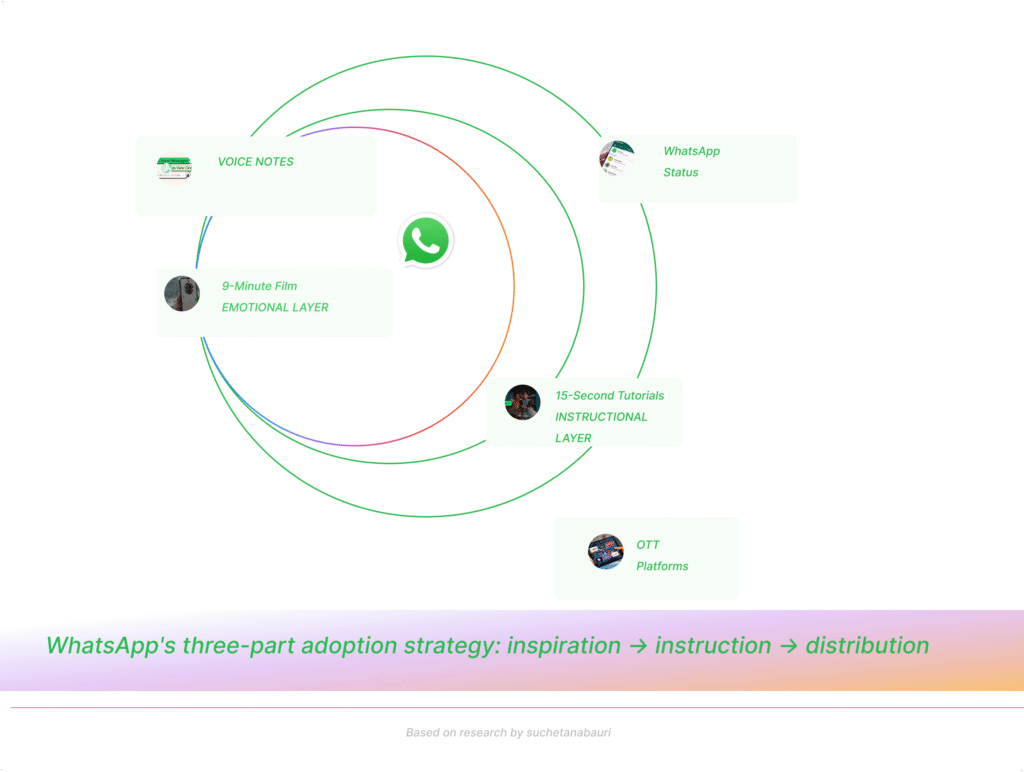
WhatsApp didn’t just make a film. Instead, they built a three-part adoption strategy where each component serves a specific job. The first layer creates cultural legitimacy.
Baatan Hi Baatan Mein positions voice notes not as a “feature” but as acts of love—borrowing the “pebbling” metaphor from Gentoo penguins who gift pebbles as affection gestures. The film shows Aasha and Manoj, migrant workers separated by distance, building intimacy through accumulated voice and video notes. These aren’t grand gestures—they’re micro-moments. A joke. A video note. “Did you eat?”
This creates the why: emotional permission to see voice notes as meaningful, not just functional. It’s the kind of emotional storytelling that actually works when it’s culturally precise, not generic.
Part 2: The 15-Second Ambient User Guides
Zero text overlays. No jargon. Just peer-to-peer demonstration in Hindi. A friend shows another friend: “Press mic, record, send. That’s it.” Completely wordless, mobile-friendly, and shareable.
These tutorials remove the how: friction disappears when instruction is visual, not text-based—critical for low-literacy or first-time smartphone users. By showing instead of telling, WhatsApp makes the feature accessible to everyone.
Part 3: Distribution Innovation
Takes the content to where rural audiences actually gather—fairs, markets, community cinema nights.
Distribution isn’t separate from the message; rather, it is the message.
By investing in experiential screenings, WhatsApp signals: “You matter enough for us to come to you.”
Most brands make one film and hope it goes viral. Therefore, WhatsApp made a three-act adoption strategy: inspiration, instruction, distribution. That’s not just content marketing—that’s how you change habits at scale.
Why This Works in Rural India (And Why That’s the Point)
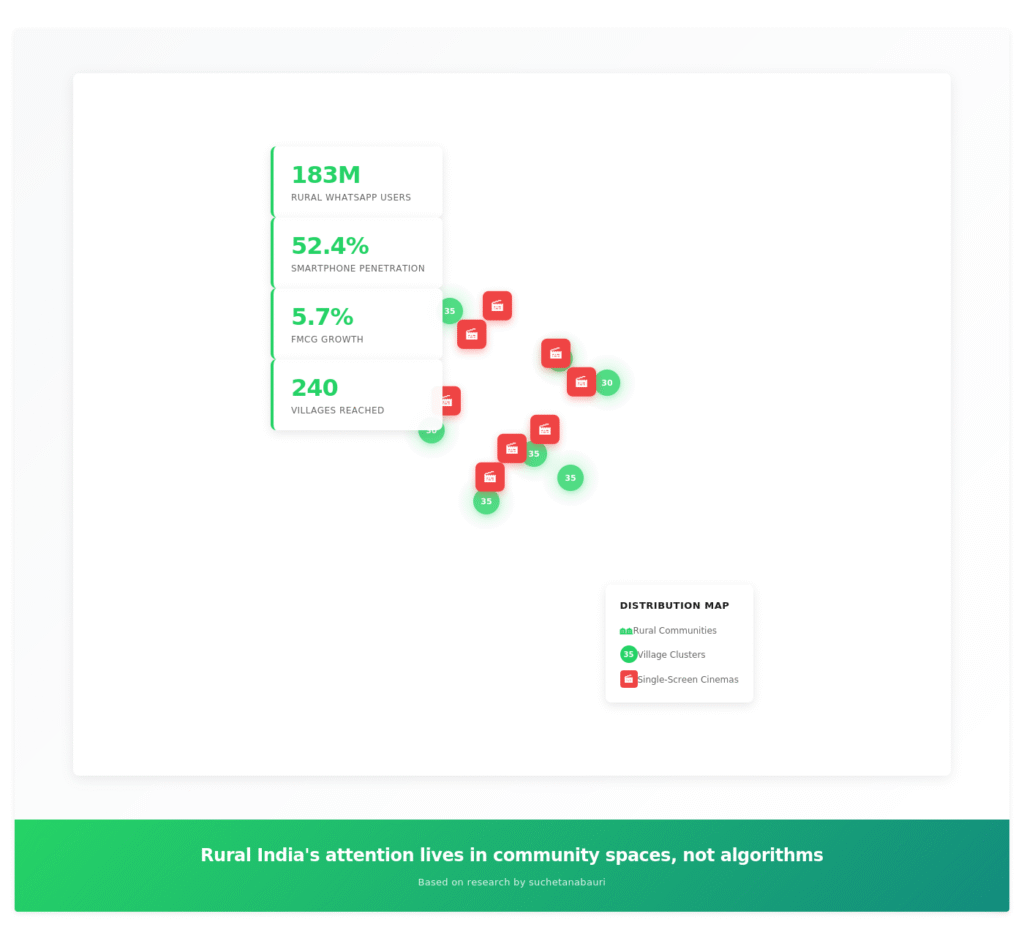
As 2025 ends, rural India isn’t a future opportunity—it’s the current growth engine. FMCG sales in rural markets outperformed urban areas for the seventh consecutive quarter, with 5.7% volume growth in September 2025. Additionally, rural consumers now drive India’s internet adoption, with 52.4% smartphone penetration and 183 million WhatsApp users.
But here’s what urban marketers miss: rural India doesn’t just want cheaper products or simplified messaging—it wants culturally intelligent engagement.
I’ve analysed this gap before in my piece on Durga Puja marketing missteps—when brands ignore cultural codes, even festival campaigns fall flat.
What Rural Audiences Actually Respond To
Successful rural campaigns in 2025 shared three key elements:
- Local immersion: Brand representatives from within communities who speak regional dialects
- Tactile experience: Product demos, mobile vans, hands-on interaction at haats (village markets)
- Cultural integration: Aligning campaigns with harvest festivals, fairs, local celebrations
WhatsApp’s Baatan Hi Baatan Mein nails all three. The film is shot in authentic North-Central Madhya Pradesh dialect, set in a real quarry (not a studio), and distributed via community cinema—the traditional social gathering space in rural India. This isn’t “rural marketing.” Rather, it’s marketing with rural cultural codes embedded from the start.
The Strategic Timing
The timing matters too. As we close 2025, marketers are finalising 2026 budgets. Rural penetration isn’t experimental anymore—it’s a strategic priority. Brands like Coca-Cola, HUL, Asian Paints, and HDFC Bank proved rural campaigns drive 60%+ sales lifts when done with cultural respect. Therefore, WhatsApp’s campaign gives brands a playbook: invest in narrative depth, distribute experientially, and treat rural audiences as sophisticated story-consumers, not simplified markets.
The Question You Should Actually Be Asking
Stop asking: “How long should my video be?” Instead, ask: “Where will it live, and what behaviour do I want to change?”
Length is a symptom of context, not a strategy. A 15-second tutorial works on WhatsApp Status because users expect quick tips. Conversely, a 9-minute film works in rural cinemas because audiences expect stories. Both are “correct” because they match platform, expectation, and goal.
From Platform-First to Audience-First
The real innovation in this campaign isn’t that WhatsApp went long—it’s that they matched format to audience context instead of defaulting to platform norms. They didn’t ask “What does the algorithm reward?” Critically, they asked “Where does our audience actually pay attention, and what do they expect there?”
That shift—from platform-first to audience-first—is what separates work that cuts through from work that gets ignored.
In 2025, fragmented media, tightened budgets, and privacy changes forced marketers to rethink media effectiveness. The winners didn’t just improve ad spend; they rethought where attention lives and designed for that reality.
Rural India’s attention lives in community spaces—cinemas, fairs, WhatsApp groups, word-of-mouth networks.
Urban India’s attention fragments across apps. B2B buyers’ attention lives in long-form thought leadership and case studies. Your customers’ attention has a geography and a set of expectations. Meet them there, or waste your budget shouting into the void.
What to Do in 2026
As you plan next year’s content calendar, here’s what this campaign teaches you:
1. Audit Your Content by Context, Not Length
Map where your audience encounters your brand. Then ask: does the format match the context? A nine-minute story doesn’t belong on Instagram, but a 15-second demo doesn’t belong in a cinema. Stop forcing one-size-fits-all. Build audience-specific content strategies instead.
2. Pair Long-Form Emotion with Short-Form Utility
Use storytelling to build legitimacy and aspiration. Meanwhile, use micro-content to remove friction and educate. WhatsApp’s dual approach—film for emotion, tutorials for adoption—proves that blended strategies deliver 72% higher ROI than single-format plays.
Make both, distribute strategically. For examples of what happens when brands get this wrong, see my analysis of Kajaria’s Gresbond campaign—formulaic content built for quick consumption without substance.
3. Invest in Distribution Innovation, Not Just Production Value
The film’s craft matters, but the cinema van strategy is what made it work. In 2026, ask: can we bring our content to community spaces (physical or digital) where our audience actually gathers? Experiential distribution builds word-of-mouth in ways paid media can’t match.
4. Design for the Hardest-to-Reach User First
WhatsApp’s text-free tutorials work for low-literacy users—but they also work for everyone. Accessibility-first design doesn’t limit your audience; instead, it expands it. If your content requires reading, typing, or prior tech fluency, you’re locking out millions of potential users.
I’ve written about this tension in Apple’s accessibility advertising—stunning emotional storytelling can’t replace structural accessibility.
5. Measure Cultural Impact, Not Just Engagement Rates
Stop obsessing over completion percentages and start tracking behaviour change.
Did voice note usage increase in target regions? Did word-of-mouth grow? Did brand sentiment shift? WhatsApp didn’t make this film to rack up YouTube views—they made it to legitimise a feature and shift adoption.
Your 2026 KPIs should reflect real business outcomes, not vanity metrics.
For more on why this matters, read my breakdown of brand storytelling versus immediate attribution.
6. Take a Position on Long-Form
Most brands won’t invest in nine-minute stories because CFOs want quarter-over-quarter returns. However, if you’re building for long-term loyalty, cultural credibility, or rural penetration, short-form alone won’t get you there.
Decide: are you building for this quarter’s dashboard, or next year’s market position?
The Counter-Trend That Actually Matters
As 2025 closes and we head into 2026, the loudest voices will keep shouting about shrinking attention spans, the dominance of Reels, and the death of anything over 60 seconds. Ignore them. Or at least, ignore the absolutism.
What WhatsApp proved with Baatan Hi Baatan Mein is that good storytelling still works—not because “storytelling is timeless” (true but useless advice), but because they matched narrative ambition to audience reality.
They didn’t make a long film for a short-form platform. Instead, they made a cinematic story for cinema contexts, backed it with micro-tutorials for mobile contexts, and distributed it where rural India actually gathers.
That’s not nostalgia. That’s strategy.
So as you plan 2026, stop asking whether long-form or short-form “wins.” Ask where your audience’s attention lives, what behaviour you need to change, and what format fits that context. Then build for that—not for what LinkedIn thought leadership posts say you should do.
The future isn’t short-form or long-form. It’s audience-focused marketing.
And the brands that figure that out will own 2026.
Related Reading on SuchetanaBauri.com
- September Smartphone Marketing 2025: When Brands Lost Their Collective Sanity
- The Festival Marketing Paradox: When Retail Campaigns Miss the Mark
- Creative Reality Check: Kajaria’s Gresbond Campaign
- Apple’s Accessibility Advertising: Between Sincerity and Spectacle
- Airline Marketing Paradox: Air India Express Campaign Analysis
- Emotional Storytelling in Marketing: What Actually Works
Research sources include Economic Times, Campaign India, Google Think, WARC, Forbes, and 39 additional industry publications.