
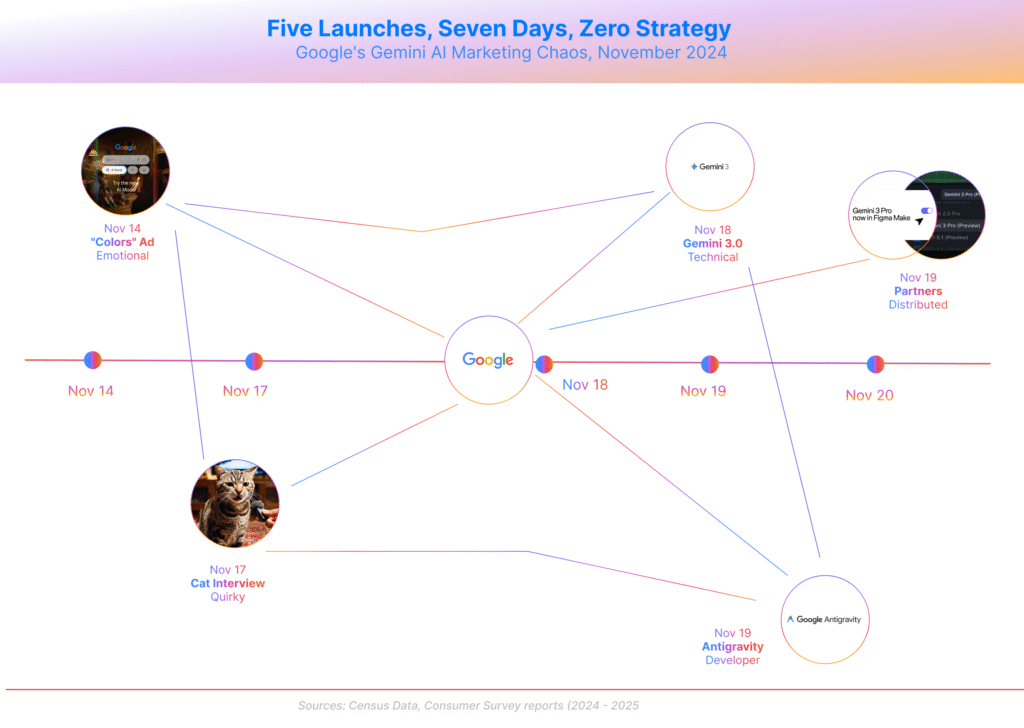
On November 14, Google India launched “What Colors Feel Like?”—a tearjerker about a mother explaining colours to her blind son using AI Mode. Three days later came “Honest Cat Interview”—quirky meme content featuring few snarky cats. Twenty-four hours after that, Google announced Gemini 3 with corporate jargon targeting premium subscribers.
I published an analysis arguing this wasn’t creative diversity—it was strategic paralysis. Three contradictory campaigns in five days proved Google didn’t know what AI Mode was for.
Then the week got stranger.
Within 72 hours, Google announced Gemini 3 for enterprise alongside Antigravity (an entirely new AI-native IDE), while partners like Figma independently announced their own Gemini integrations—each telling their own story, on their own timeline, with their own positioning priorities.
Three Google-led campaigns plus multiple partner announcements. One week. Every possible audience. Zero coherent positioning.
And here’s the uncomfortable truth: This messy, incoherent strategy might actually work.
If you work in product, marketing, or strategy, what’s happening at Google right now isn’t just chaos—it’s a masterclass in how distribution can beat positioning when you already own the infrastructure. Moreover, it reveals why that should terrify every startup trying to compete on product quality alone.
The Week Google Tried to Own Everything (While Partners Told Their Own Stories)
Let’s map what actually happened :
“What Colors Feel Like?” campaign (India)—AI Mode as emotional accessibility tool for parents and families.¹
“Honest Cat Interview” campaign—AI Mode as fun everyday companion for Gen Z.²
Gemini 3 announcement—technical superiority platform targeting premium subscribers and enterprise customers, with “state-of-the-art reasoning and agentic capabilities.”³
Google Antigravity launch—entirely new AI-native IDE where autonomous agents plan, code, test, and debug software.⁴
Partner integration announcements—Figma independently announced Gemini 2.5 Flash integration for AI image generation with 50% latency reduction; GitHub integration mentioned in Google’s enterprise blog as partner testimonial, not coordinated launch.⁵
That’s three Google-led campaigns plus partner announcements happening simultaneously—targeting five different audiences with five different value propositions in seven days.
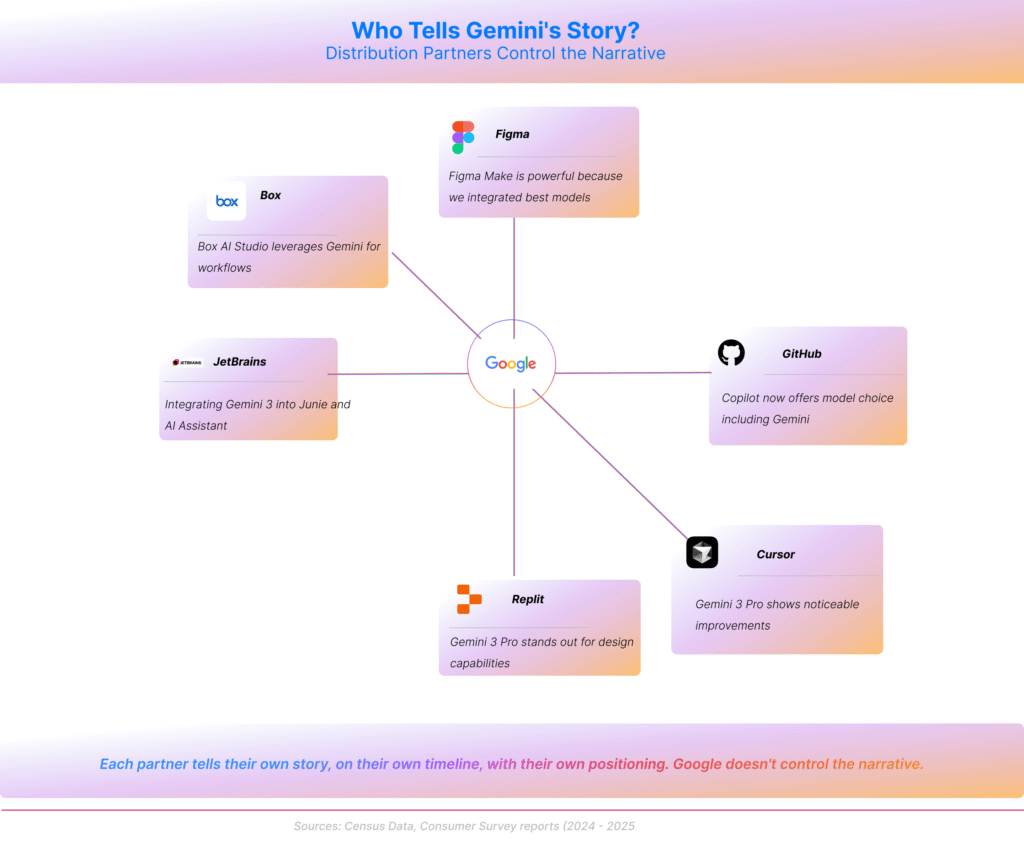
And here’s what makes it even messier: Google isn’t even controlling the integration narrative.
Figma and GitHub are announcing on their own schedules, for their own audiences, with their own positioning priorities.
From a positioning perspective, this isn’t just chaos—it’s distributed chaos where Google doesn’t even own the messaging calendar.
Why “Noise” Is Actually Strategy When You Own Distribution (Even If You Don’t Control The Messaging)
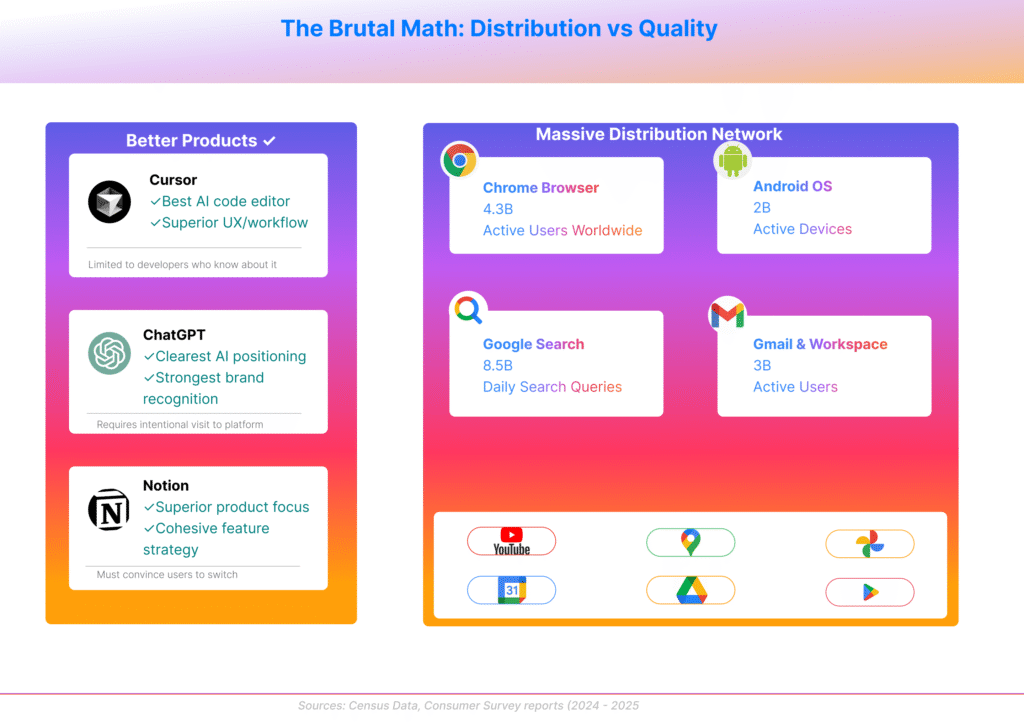
Here’s the counterargument I need to address: Maybe scattered positioning doesn’t matter when you have 4.3 billion Chrome users, 2 billion Android devices, and Google Search processing 8.5 billion queries daily.
Moreover, when partners like Figma and GitHub independently announce Gemini integrations, it creates additional “third-party validation” noise that benefits Google even without coordinated messaging.
The math is brutal for competitors:
- Cursor has the best AI code editor. But developers have to discover it, download it, and switch.
- Google has a messier AI code tool (Antigravity). However, Chrome users see it promoted in-browser. Additionally, developers already using GitHub Copilot encounter Gemini there too—announced by GitHub, not Google.
- ChatGPT has clearer positioning. Yet users have to open a separate tab and remember to use it.
- Gemini has confused positioning. Nevertheless, designers encounter it in Figma (announced by Figma). Developers encounter it in GitHub Copilot (announced by GitHub). Google doesn’t even need to coordinate—partners do the distribution work.
- Notion spent years perfecting “AI-powered knowledge base” positioning. Still, it requires conscious adoption.
- Google just integrated Gemini into Workspace, which 3 billion people already use for work.
The uncomfortable pattern: Distribution beats positioning when you already own the defaults.
Google doesn’t need users to understand what Gemini is. Instead, they just need users to encounter it enough times across enough surfaces that it becomes the path of least resistance.
This isn’t strategy as we are taught in business schools.
This is strategy as industrial-scale distribution leverage.
And the truly terrifying part? It’s probably going to work.
The Three Advantages That Make Chaos Viable (For Google Only)

Let me be clear: This strategy only works if you already have Google’s distribution moat. For everyone else, it’s still catastrophic. But for Google specifically, the scattered launch approach has three massive advantages:
1. Attention Is the New Adoption Funnel
Traditional marketing: Position clearly → attract target audience → convert users.
In contrast, Google’s approach: Saturate attention across every surface → users encounter Gemini repeatedly → familiarity breeds trial.
Every launch generates news cycles. “What Colors Feel Like?” trending in India. Subsequently, tech press covering Antigravity. Meanwhile, design Twitter buzzing about Figma integration. Simultaneously, developer YouTube reviewing GitHub features.
Each launch puts “Gemini” in front of different audiences. Cumulatively, Google achieves omnipresence—not through one clear campaign, but through coordinated noise.
The bet: Encounters matter more than understanding. If users see “Powered by Gemini” across six different contexts, they’ll assume it’s important even if they don’t know exactly what it does.
For a startup, this would fail—you’d dilute your limited marketing budget across too many messages. For Google, with effectively infinite reach, it’s attention saturation as strategy.
As I examined in my analysis of September’s smartphone marketing chaos, where brands prioritised spectacle over substance and borrowed credibility over earned trust, Google’s multi-campaign approach reveals a similar pattern: launch velocity mistaken for strategic momentum.
2. The Default Advantage Compounds Over Time
Chrome browser. Android OS. Google Search. Gmail. YouTube. Google Maps. Google Photos. Google Workspace.
Google doesn’t need to convince users to switch. Rather, they just need to integrate Gemini into tools users already use every single day.
Consider the actual user journey:
A designer working in Figma encounters Gemini image generation. They try it because it’s there, not because they sought it out. It works well enough. Consequently, they use it again. Eventually, it’s just “the AI button in Figma.”
Similarly, a developer Googling an error message sees a Gemini-powered answer. They don’t choose it—it’s just the default suggestion. It’s helpful enough. As a result, they encounter it again tomorrow. And the next day. Eventually, they’re using it without thinking.
This is how defaults win. Not through superior positioning, but through relentless presence at the moment of need.
The scary part for competitors: Users won’t even realise they’re “choosing” Gemini. Instead, they’re just using the tools they already use, which now happen to have Gemini embedded.
3. Conversion Doesn’t Require Understanding
Traditional product marketing assumes users need to understand what your product is and why it’s better before they’ll adopt.
In contrast, Google is betting on a different model: Users will adopt through ambient encounter, not conscious choice.
You don’t need to understand that Gemini powers six different features. Rather, you just need to find each individual feature useful enough to use again.
- Parents trying AI Mode because they saw the Colors ad don’t need to know about Antigravity.
- Likewise, developers using Antigravity don’t need to know about the cat meme campaign.
- Similarly, designers using Figma integration don’t need to understand Gemini 3’s enterprise positioning.
Each audience encounters one slice of Gemini in their specific context. The positioning confusion doesn’t matter because no single user sees all campaigns simultaneously.
Google isn’t building one coherent brand for one target audience. Instead, they’re building six micro-brands for six micro-audiences, all sharing infrastructure.
This is incoherent—but it might not matter.
The Partner Announcement Problem: Google Loses Narrative Control
When Figma announces Gemini integration, they’re not positioning Gemini—they’re positioning Figma Make (their AI product).
Figma’s message: “We’ve integrated the best AI models (including Gemini) to make our design tool more powerful.”
Google’s intended message (presumably): “Gemini powers creative workflows across industry-leading platforms.”
These are different stories. Figma is the hero; Gemini is the ingredient. That’s fine for partnerships—but it means Google has even less control over how users understand what Gemini is for.
Looking at Google’s Gemini 3 enterprise blog, integrations are presented as customer testimonials, not coordinated product launches:⁶
- Loredana Crisan (Figma CDO) quoted about Gemini 3 Pro in Figma Make
- Joe Binder (GitHub VP) quoted about Gemini 3 Pro in GitHub Copilot
- Quotes from Cursor, JetBrains, Replit, Box, Wayfair, Shopify
This is traditional enterprise sales playbook: “Here are respected partners validating our technology.”
But it creates even more positioning fragmentation:
- Each partner integrates Gemini for their own use case
- Each partner announces on their own timeline
- Each partner positions Gemini as ingredient in their product story
- Users encounter Gemini in 6+ different contexts with 6+ different framings
Google isn’t orchestrating a coordinated launch. They’re enabling partners to announce whenever ready, however they want.
For enterprise credibility, this makes sense. For brand positioning clarity? Catastrophic.
Why This Should Terrify Startups (And Excite Regulators)
If you’re building an AI product to compete with Google, this analysis should be deeply unsettling.
You can have:
- Better positioning (Cursor vs Antigravity)
- Clearer brand (Notion vs Workspace AI)
- Superior product (ChatGPT vs Gemini on many benchmarks)
And still lose because Google owns distribution infrastructure you can’t replicate.
As I explored in my analysis of Apple’s September 2025 marketing strategy, even world-class companies need strategic clarity when launching new categories. However, Apple also benefits from owning the smart phone ecosystem—a distribution moat that makes messy product launches survivable.
Google’s advantage is even more extreme. They don’t just own devices—they own the browser, the search engine, the email client, the office suite, and the mobile OS that most of the world uses daily.
This is why antitrust matters. Not because Google’s products are necessarily worse (they’re often genuinely good). Rather, because platform power allows you to win without needing strategic clarity.
Regulators should be watching this week’s launches closely. Multiple simultaneous product launches across owned platforms isn’t innovation—it’s leveraging existing monopoly power to foreclose competition in adjacent markets.
But Here’s Why This Strategy Still Has Fatal Flaws
I’ve made the strongest case for Google’s approach. Now let me explain why it’s still fundamentally broken—even with distribution advantages.
1. Encounter Doesn’t Equal Trust
Users might encounter Gemini across six surfaces. However, that doesn’t mean they’ll trust it for high-stakes work.
Consider the actual adoption barrier:
A developer encounters Gemini code suggestions in Chrome. Fine for throwaway prototypes. But will they trust autonomous Antigravity agents to write production code for their startup? Not without strong positioning that builds credibility.
Similarly, a designer tries Gemini image generation in Figma. Fun for mood boards. But will they use it for client deliverables without understanding quality guarantees, licensing, and support? Not without enterprise-grade brand trust.
Distribution gets you trial. Trust gets you retention.
Google’s scattered launches achieve omnipresence but don’t build the credibility needed for users to bet their work on these tools.
As I explored in my analysis of Claude Sonnet 4.5’s launch strategy, Anthropic succeeded by building enterprise trust through transparent benchmarking, clear use cases, and validated customer testimonials—precisely what Google’s scattered approach lacks.
2. Developer and Professional Markets Require Positioning Clarity
Consumer products can sometimes win on defaults and convenience. In contrast, professional tools require explicit value propositions.
Why? Because adoption decisions are different:
- Consumer: “Is this convenient right now?”
- Professional: “Will this tool be supported in 18 months? Does my company allow it? What’s the SLA? Where’s the documentation? Who else uses this? What if it fails during a client demo?”
Developers evaluating Antigravity need to know: Is this a Google Labs experiment that might shut down (like Wave, Reader, Inbox)? Or is this core Google infrastructure with long-term commitment?
Likewise, designers integrating Gemini into Figma workflows need to know: Are the image generation licensing terms clear for commercial work? What’s the uptime guarantee?
Google’s scattered launches provide no answers. Each micro-audience gets a feature announcement but no strategic clarity about long-term commitment.
This is why Cursor can still win despite having 1/1000th of Google’s distribution. They provide what professionals need: clear positioning, reliable support, and confidence that the tool won’t be sunset in six months.
3. The Internal Dysfunction Signal Is Real
When multiple teams ship multiple products in seven days with no apparent coordination, it tells sophisticated buyers something important: Internal dysfunction.
Professional buyers read between the lines:
“If Google can’t coordinate their own launches, can I trust them to coordinate my team’s migration to their tools?”
“If Google’s left hand doesn’t know what the right hand is doing, what happens when I have a support issue that spans products?”
“If Google treats Gemini positioning as disposable (emotional one day, technical the next), how seriously should I take this as enterprise infrastructure?”
For consumer tools, dysfunction might not matter. For professional tools competing against Anthropic, OpenAI, and focused startups, it absolutely does.
What Google Should Still Do (Even With Distribution Advantages)
Even granting that distribution might make scattered launches survivable, Google would achieve better outcomes with strategic focus:
1. Pick a Flagship, Make Everything Else Supporting Evidence
My recommendation: Antigravity as flagship, everything else as proof points.
Why: Autonomous agent development is technically defensible, high-value, sticky (high switching costs once adopted), and has measurable ROI.
The narrative: “Gemini powers the autonomous agents in Antigravity. We’re proving the technology works across consumer (AI Mode), creative (Figma), and code (GitHub) workflows—but our flagship bet is developer productivity.”
Launch all products—but communicate clear hierarchy so users understand what matters most.
Similarly, Apple’s iPhone 17 Pro campaign demonstrated how clear hierarchy works: leading with Camera Control as flagship innovation while treating other features as supporting evidence.
2. Commit to One Tonality Publicly, Test Others Quietly
Keep the consumer campaigns (Colors, Cat) in India/emerging markets as growth tests. However, don’t give them equal promotional weight to enterprise launches.
Developers shouldn’t encounter whimsical cat memes when researching whether to trust Antigravity for production code. Tonality matters for credibility.
3. Measure What Actually Matters: Retention, Not Reach
Internal KPIs should shift from “impressions generated” to “daily active professional users” and “percentage of users still active after 90 days.”
Success metrics:
- Developers switching from Cursor and staying
- Designers embedding Gemini into daily Figma workflows
- Enterprise teams adopting for mission-critical reasoning tasks
Vanity metrics:
- Launch press coverage
- Social media buzz
- Campaign video views
Distribution advantages mean Google will always achieve high reach. Consequently, the real test is whether encounter converts to sustained professional adoption.
As I documented in my analysis of Google’s Performance Advisor campaign with Stephen Curry, even celebrity partnerships and high-production campaigns can undersell sophisticated AI technology when authenticity and clear value propositions are missing.
The Bigger Truth: Platform Power Makes Strategy Optional (Until It Doesn’t)
Here’s the uncomfortable lesson from this week:
Google can violate every principle of sound product positioning—and probably still “win” through distribution leverage.
Clear positioning? Optional when you own Chrome.
Consistent tonality? Optional when you control Search defaults.
Strategic focus? Optional when you can embed across Workspace.
This is what platform power looks like in practice. Not just market dominance—the ability to succeed despite making strategic mistakes that would kill any competitor.
But there’s a limit.
Distribution gets you encounters. However, it doesn’t get you trust for high-stakes professional work. It doesn’t get you love from users who have real choice. Furthermore, it doesn’t get you the fierce advocacy that compounds into ecosystem lock-in.
Google might achieve “good enough” adoption through defaults. Nevertheless, they’ll struggle to achieve “best in class” loyalty.
Meanwhile, Cursor, Anthropic, and Perplexity are building exactly that loyalty through superior positioning—betting that professional users will overcome distribution disadvantages when tools are meaningfully better.
The question isn’t whether Google’s scattered launch strategy works. Rather, it’s whether “works” is enough when you’re trying to become infrastructure for the next decade of software development.
For consumer tools, defaults matter most. In contrast, for professional infrastructure, trust matters most.
Google’s approach optimises for the former while competing in the latter.
That mismatch will haunt them—distribution advantages or not.
TL;DR: Distribution Can Beat Positioning (But Shouldn’t)
The case for Google’s chaos working:
- They own Chrome (4.3B users), Android (2B+ devices), Search (8.5B daily queries)
- Scattered launches create omnipresence—users encounter Gemini everywhere
- Defaults win when switching costs are high and distribution is infinite
- Each micro-audience only sees relevant slice—positioning confusion doesn’t matter to individuals
The case it still fails:
- Encounter doesn’t equal trust for professional, high-stakes work
- Developers and designers require positioning clarity for adoption confidence
- Internal dysfunction signals risk to enterprise buyers
- Competitors build loyalty through focus, which compounds over time
The lesson for everyone else:
- If you have Google’s distribution, scattered positioning might be survivable
- If you don’t (you don’t), it’s catastrophic
- Clarity beats resources—unless resources include owning the entire internet
- Even then, clarity would still be better
The deeper truth:
Platform power makes strategy optional—until sophisticated buyers choose competitors offering superior positioning, trust, and long-term commitment.
Google’s betting that defaults matter more than excellence.
History suggests that works until it suddenly doesn’t.
Footnotes
- Google India, “What Colors Feel Like? | Google AI Mode,” YouTube, November 14, 2025, https://www.youtube.com/watch?v=Jb4JqqHoFGo
- Google India, “PoV: Honest Cat Interview 🐈 | Google AI Mode,” YouTube, November 17, 2025, https://www.youtube.com/watch?v=J9Mx9IDL-M0
- Google Blog, “A new era of intelligence with Gemini 3,” November 17, 2025, https://blog.google/products/gemini/gemini-3/
- Google Antigravity, “Introducing Google Antigravity, a New Era in AI-Assisted Software Development,” November 18, 2025, https://antigravity.google/; VentureBeat, “Google Antigravity introduces agent-first architecture for asynchronous, verifiable coding workflows,” November 18, 2025
- Fortune, “Gemini 3 and Antigravity, explained: Why Google’s latest AI releases are a big deal,” November 19, 2025, https://fortune.com/2025/11/19/google-gemini-3-antigravity-ai-explained/; Figma Blog, “Introducing Figma AI,” November 2025
- Tiwary, Saurabh, “Bringing Gemini 3 to Enterprise,” Google Cloud Blog, November 2025, https://cloud.google.com/blog/products/ai-machine-learning/gemini-3-is-available-for-enterprise
Internal references:
Bauri, Suchetana, “The September Siege: When Smartphone Brands Lost Their Collective Sanity in the Marketing Melee,” suchetanabauri.com, September 2025, https://suchetanabauri.com/the-september-siege-when-smartphone-brands-lost-their-collective-sanity-in-the-marketing-melee/
Bauri, Suchetana, “Apple’s September 2025 Marketing Symphony: Deconstructing Five Videos That Rewrote the Tech Playbook,” suchetanabauri.com, September 2025, https://suchetanabauri.com/apples-september-2025-marketing-symphony-deconstructing-five-videos-that-rewrote-the-tech-playbook/
Bauri, Suchetana, “Claude Sonnet 4.5 Marketing Analysis: Why Anthropic’s AI Launch Shows More Restraint Than Ambition,” suchetanabauri.com, 2025, https://suchetanabauri.com/claude-sonnet-4-5-marketing-analysis-anthropic-ai-launch-critique/
Bauri, Suchetana, “Apple’s iPhone 17 Pro Marketing: A Critical Campaign Analysis,” suchetanabauri.com, September 2025, https://suchetanabauri.com/apples-iphone-17-pro-marketing-a-critical-campaign-analysis/
Bauri, Suchetana, “Google Performance Advisor Campaign: Stephen Curry Analysis,” suchetanabauri.com, 2025, https://suchetanabauri.com/google-performance-advisor-campaign-stephen-curry-analysis/
Bauri, Suchetana, “When Google Runs Two Opposite Campaigns at Once, It’s Not Creativity—It’s Panic,” suchetanabauri.com, November 2025, https://suchetanabauri.com/google-ai-product-positioning-chaos-three-campaigns/
Bauri, Suchetana, “Disability Representation in Advertising: India’s Wake-Up Call,” suchetanabauri.com, November 2025, https://suchetanabauri.com/disability-representation-advertising-india/