
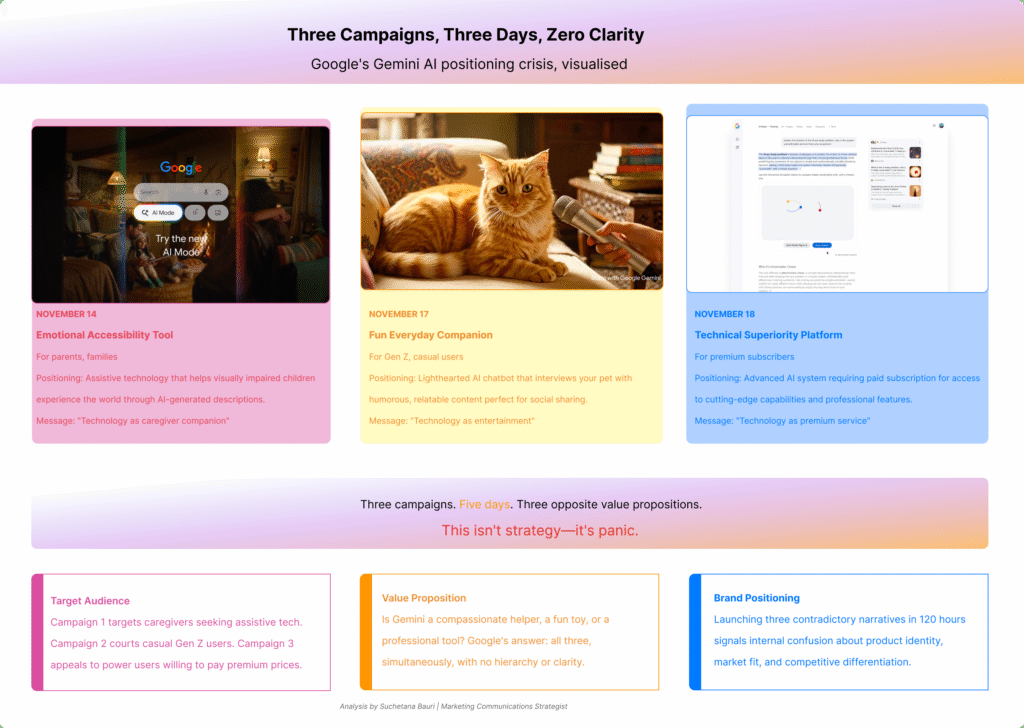
Within 4 days after Google India launched “What Colors Feel Like?”—a tearjerker about a mother explaining colours to her blind son using AI Mode—the brand dropped “Honest Cat Interview”: 58 seconds of number of smug cats explaining why they sit on remotes and pushes things off tables.
Same product. Same market. Completely opposite messages.
The “Colors” ad positioned AI Mode as the solution to life’s most profound human questions—accessibility, learning, connection. Meanwhile, the “Cat” ad positions AI Mode as your quirky companion for internet randomness—memes, silliness, mid-week boredom.
If you work in brand strategy, content, or creative, you should be paying attention.
Because when a company as smart as Google runs two campaigns this contradictory within days of each other, it’s not creative variety. Instead, it’s strategic confusion dressed up as A/B testing.techcrunch+1
Moreover, the confusion reveals something every marketer needs to understand right now: nobody—not even Google—knows how to position AI products yet.
The Tale of Two Campaigns (Or: Pick a Lane)
Let’s start with what actually happened.
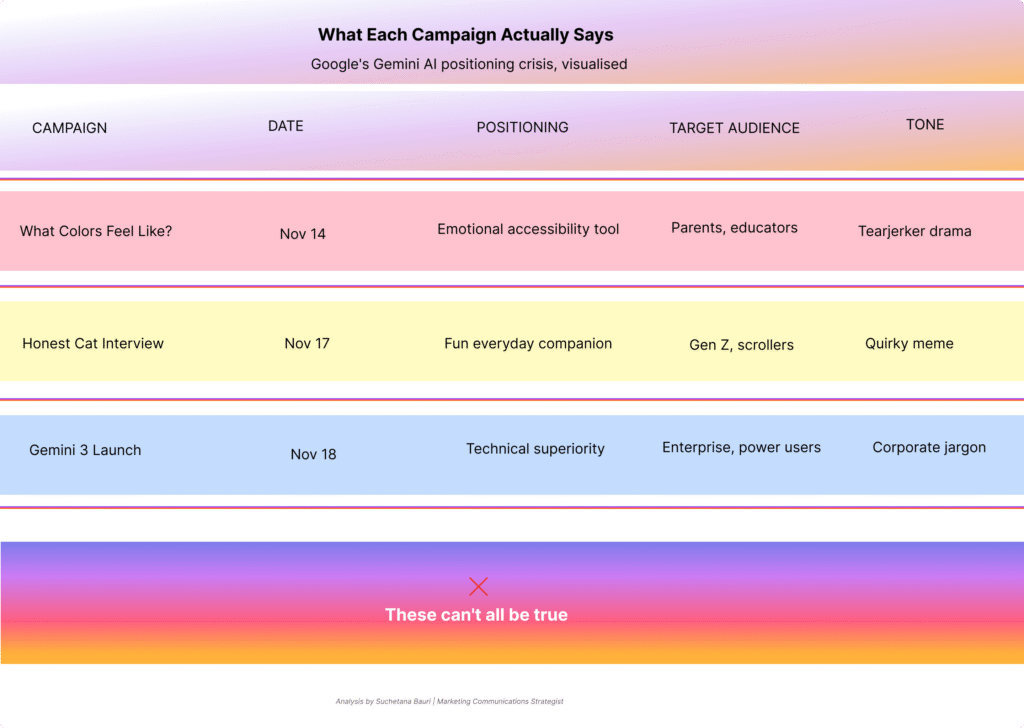
Campaign One: Emotional Family Drama
“What Colors Feel Like?” launched on November 14, 2025:
- Hindi-language family drama
- Mother asks AI Mode how to explain colours to her blind son
- High production values, beautiful camera work, emotional music
- Positions AI Mode as tool for complex, emotionally tough questions
- Message: “AI helps with what matters most”
- Risk: Using disabled children as emotional props
As I explored in my analysis of disability representation in Indian advertising, the “Colors” campaign falls into the “inspiration porn” trap—using a disabled child as backdrop for able-bodied empathy rather than centering disabled agency.
Campaign Two: Internet Meme Culture
“Honest Cat Interview” dropped on November 17, 2025:
- POV-style internet meme format
- Cats answer silly interview questions in deadpan Hindi-English mix
- Low-fi look, shot on what looks like a phone
- Positions AI Mode as a fun companion for random, silly queries
- Message: “AI makes everyday questions fun”
- Risk: Makes the technology seem unimportant
These aren’t variations on a theme. Rather, they’re fundamentally different value claims.
The Contradiction That Reveals Everything
One says AI Mode is for serious people with serious questions. Conversely, the other says AI Mode is for anyone with 30 seconds to kill and a cat video habit.
One builds brand status. By contrast, the other builds shares.
One targets emotional decision-makers (parents, educators). In contrast, the other targets Gen Z scrollers.
And here’s what should worry anyone managing a major product launch: both campaigns avoid answering the same question—why would I switch from traditional Google Search to AI Mode?
Why This Matters Now: Every Tech Company Has This Problem
Google isn’t alone in this positioning mess. Indeed, look across the AI landscape right now:
- ChatGPT moves between “your AI assistant for work” and “talk to it about anything!”
- Perplexity can’t decide if it’s “research tool for pros” or “answer engine for everyone.”
- Microsoft Copilot swings between “business productivity” and “creative companion.”
- Claude (yes, I see the irony) markets itself as “thoughtful AI” but still hasn’t defined what that means in practice.
The Pattern Everyone’s Missing
The repetition is identical across the industry: tech companies have built powerful tools but haven’t figured out the jobs those tools are built to do.
Therefore, they run multiple campaigns hoping something resonates. Emotional messaging gets tested. Next, functional features get highlighted. Then, quirky tonality gets a turn. Finally, serious positioning gets tried.
What they don’t do is commit to a clear positioning because committing means making a choice. Furthermore, making a choice means accepting that some potential users won’t be the target.
In a land grab for AI adoption, nobody wants to narrow the focus.
The Cat Ad: What It Gets Right (And Why That’s Not Enough)
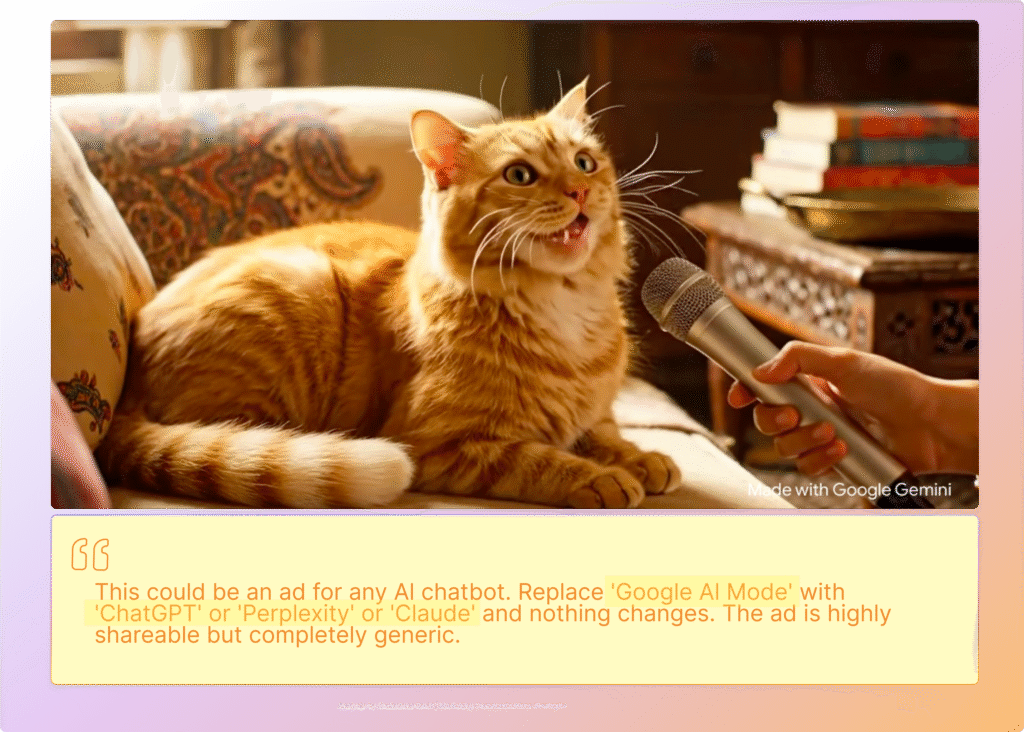
Credit where it’s due: “Honest Cat Interview” is genuinely entertaining.
The dialogue is sharp. Similarly, timing is perfect. Additionally, the cat’s deadpan delivery “They are gifts. You are welcome. Be more grateful maybe” is legitimately funny.youtube
Why Animal Advertising Works in India
The format taps into internet culture perfectly—POV videos, honest interview memes, the universal appeal of snarky cat content. Furthermore, research consistently shows that animal-led advertising works in India: Vodafone’s pug triggered “pug mania,” Lijjat Papad’s bunny is remembered decades later. As a result, the insight remains true: “Cuteness sells—animals, babies, what have you. It is a positive, pure emotion that can universally appeal cutting across genders, backgrounds and social classes”.theprint
What the Cat Ad Avoids (Intentionally or Not)
The ad also avoids every trap the “Colors” campaign fell into. Specifically, no emotional manipulation exists here. Moreover, no inspiration porn dynamics emerge. There’s no disabled child used as backdrop for able-bodied empathy. Instead, just few cats are being cats, showing that AI Mode can handle fun, quirky queries.
But here’s the strategic problem: this could be an ad for any AI chatbot.
Replace “Google AI Mode” with “ChatGPT” or “Perplexity” or “Claude” and nothing changes. The cat’s responses don’t show anything unique to Google. Rather, they show generic talk-with-AI capability that every competitor offers.
Consequently, the ad is highly shareable but completely generic.
What “Colors” and “Cat” Both Reveal: Google Doesn’t Know What AI Mode Is For
Both campaigns are beautifully done dodges of the same core question: What can AI Mode do that traditional Google Search cannot?
The Value Claim Vacuum
“Colors” says: AI Mode handles complex, emotionally tough, multi-part questions.
Response: But how often do I ask those? Besides, isn’t that what I’d use ChatGPT for?
“Cat” says: AI Mode makes everyday questions fun and conversational.
Response: But traditional search already works perfectly for cat behaviour questions. Why switch?
Neither campaign explains a job to be done that only AI Mode can handle.
Compare This to Actual Product Clarity
Compare this to how McDonald’s India positioned EatQual—the accessible packaging campaign I analyzed in my disability representation article. Notably, EatQual worked because:
- Clear problem: People with limited upper limb mobility couldn’t eat burgers independently
- Real solution: Hexagonal packaging designed for one-handed use
- Immediate benefit: Independence, dignity, ease
- Lasting difference: No competitor had solved this
The value claim was: “If you have limited upper limb mobility, you can now eat our burgers independently.” Clear. Specific. Actionable.
In contrast, Google’s AI Mode claim is: “Use this for… questions? Conversations? Complex stuff? Random stuff? All of it?” Vague. Contradictory. Confusing.

The Uncomfortable Pattern: A/B Testing as Strategy Replacement
Here’s what’s really happening: Google is using advertising as market research rather than as market positioning.
How This Plays Out in Practice
The company doesn’t know which message will work, so it’s running two opposite campaigns to see which gets more reaction. Subsequently, whichever performs better will inform the next round of creative.
This is A/B testing dressed up as strategic confidence.
Why This Approach Fails
Moreover, it’s a terrible way to position a product for three reasons:
First, it trains users to see your product as whatever they want it to be—which sounds good until you realise it means nobody knows what it actually is. Consequently, products that try to be everything become nothing special.
Second, it wastes the scarcest resource in marketing: attention. You get maybe 3-5 seconds to communicate “this is for you because it solves this problem.” Therefore, running contradictory campaigns means half your audience sees the wrong message and tunes out.
Third, it signals internal uncertainty to competitors, talent, and investors. When Microsoft sees Google running emotional family drama one day and cat memes three days later, they read it correctly: Google hasn’t figured out AI Mode’s positioning yet. As a result, that’s blood in the water.
What Marketers Can Learn: The Danger of “Testing Everything”
If you’re managing a product launch right now—especially in AI, but this applies to any new category—here’s what Google’s campaign contradiction teaches:
Testing is good. However, testing instead of deciding is catastrophic.
When to Test vs When to Commit
Yes, you should test messages. Similarly, iteration based on data makes sense. But at some point, you need to commit to a positioning even if it means ruling out potential uses.
Examples of Clarity Winning Over Hedging
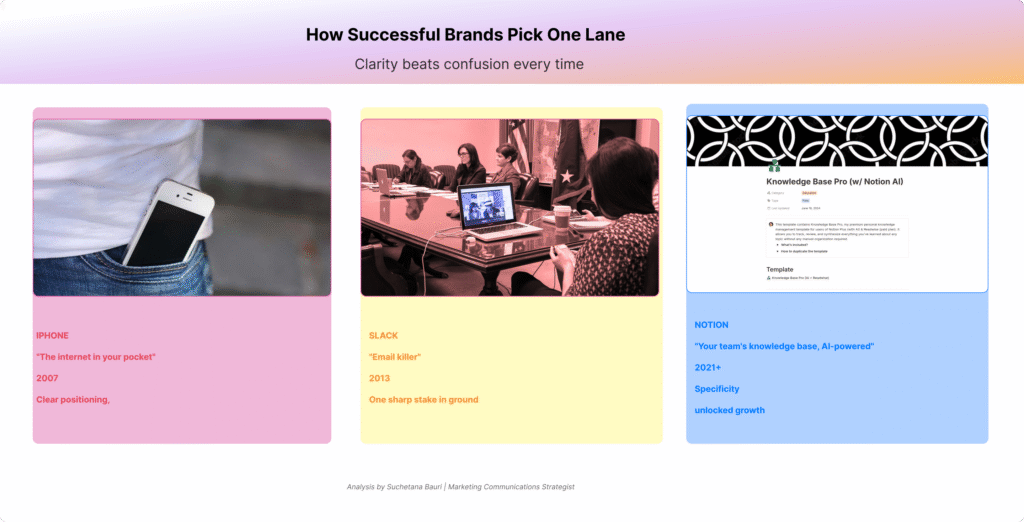
Apple didn’t position the iPhone as “a phone for everyone who might want to make calls, or listen to music, or browse the web, or…” Instead, they positioned it as “the internet in your pocket.” Clear. Specific. Left room to grow but gave people a reason to care now.
As I examined in my analysis of Apple’s September 2025 marketing strategy, Apple consistently demonstrates how clarity of positioning drives adoption—even when showcasing multiple product features.
Likewise, Slack didn’t position itself as “a tool for communication and collaboration and file sharing and video calls and…” Rather, they positioned it as “email killer.” One sharp stake in the ground.
Similarly, Notion spent years being “all-in-one workspace for notes, docs, wikis, databases…” and only found product-market fit when they narrowed to “your team’s knowledge base, AI-powered.” Specificity unlocked growth.
The pattern: Successful product positioning picks one job to be done brilliantly rather than trying to be competent at everything.
Therefore, Google’s dual campaigns prove the company hasn’t made that choice yet. Until they do, every future campaign will feel scattered.
The “Why Now”: AI Positioning Is the Marketing Challenge of 2025-2026
This isn’t just a Google problem. Rather, this is the marketing challenge for every company touching AI right now.
The Messy Middle of AI Adoption
We’re in the awkward phase of an adoption curve where:
- Tech experts understand AI capabilities but not how normal humans think about problems
- Regular people have heard the hype but don’t yet have habits around AI tools
- Marketers are being asked to drive adoption of products whose uses are still emerging
Capability Showcase vs Problem Solving
As a result: campaigns that show what the technology can do without explaining why anyone should care.
For instance, Google’s “Colors” ad shows AI Mode can generate sensory comparisons. Neat. But I still don’t know why I’d use it instead of just Googling “how to explain colors to blind child” and reading an article.
Similarly, Google’s “Cat” ad shows AI Mode can handle quirky conversational queries. Fun. But I still don’t know why I’d switch from regular search, which answers “why does my cat push things off tables” perfectly well with a Wikipedia article.
The campaigns showcase capability without identifying painful, frequent, unmet jobs that AI Mode uniquely solves.
And that’s the crisis: Most AI marketing right now is solutions looking for problems.
What Google Should Do (And What You Should Do If You’re Facing This)
If I were advising Google’s India marketing team, here’s what I’d recommend—and these principles apply to anyone positioning an AI product:
1. Pick One Job to Be Done, Make It Your Wedge
Don’t try to be “AI for everything.” Instead, pick the single most frequent, painful, unmet search experience and own it completely.
Maybe it’s: “When you need to compare multiple options with trade-offs” (travel planning, product research, career decisions).
Alternatively, it could be: “When you need to understand a complex topic quickly” (researching medical conditions, learning new skills, understanding news).
Or perhaps: “When you’re stuck and need to think through a problem” (debugging code, writing, strategic planning).
Pick one. Own it. Build every campaign around that one job. Subsequently, once users adopt for that wedge, then you expand uses.
2. Show the Before/After, Not Just the Capability
Both campaigns show what AI Mode can do. However, neither shows what changes when you use it.
The strongest positioning shows:
- Before: “I spent 45 minutes reading 12 articles about explaining colors to blind children and still wasn’t sure how to start”
- After: “AI Mode gave me three comparison frameworks based on touch, emotion, and temperature associations in 30 seconds”
Or:
- Before: “I Googled ‘why does my cat ignore me’ and got 8 different blogs with conflicting advice”
- After: “AI Mode pulled together the consensus and explained it like my cat would”
Show the time saved, friction removed, confidence gained—not just “look, it works!”
3. Commit to a Tonality and Let It Breathe
Emotional or quirky. Serious or playful. Aspirational or accessible. Pick one and stay there for at least 6-12 months.
Yes, you’ll miss some audiences. That’s fine. However, the audiences you do reach will actually understand what your product is for. Consequently, they’ll adopt it, use it consistently, and tell others.
Inconsistent tonality reads as: “We’re not sure who this is for yet.” As a result, that’s confusing for potential users.
4. Stop Using Disabled People as Emotional Props—or Commit to Accessibility Fully
This is specific to Google’s “Colors” campaign, but it’s broadly applicable: if you’re going to feature disabled people in advertising, you have two options.
Option A: Centre their agency. Show disabled people driving their own stories, solving their own problems, living full lives. Moreover, hire disabled talent behind the camera. Additionally, consult disability organisations throughout production. Furthermore, make the product genuinely accessible.
Option B: Don’t feature them at all. Instead, use comparison, abstraction, or other creative approaches (like the cat ad does).
What you can’t do—what Google’s “Colors” campaign did—is use a disabled child as backdrop for able-bodied empathy and call it inclusive. That’s inspiration porn, and disabled audiences spot it immediately.
The cat ad accidentally avoids this trap by featuring no humans at all. However, “avoiding” isn’t the same as “doing it right.”
The Bigger Picture: Marketing Can’t Fix What Product Strategy Hasn’t Solved
Here’s the uncomfortable truth lurking beneath both campaigns: Google’s AI Mode positioning problem isn’t a marketing problem. Rather, it’s a product strategy problem that marketing is being asked to paper over.
What’s Missing at the Product Level
The product team hasn’t defined:
- What makes AI Mode meaningfully different from ChatGPT in function
- Which uses AI Mode serves better than traditional Search
- Why users should build a new habit around AI Mode instead of using tools they already know
When Marketing Becomes Strategy Theatre
Without clear product strategy, marketing becomes “make something that resonates” theatre. Hence: one emotional family drama, one cat meme video, both hoping to stumble into product-market fit through creative vibes.
This is backwards.
Products should create strategy. Marketing should amplify it.
When marketing is asked to create strategy through testing, you get scattered campaigns, confused audiences, and wasted budgets.
The Conversation You Need to Have
If you’re in-house and facing this: The conversation you need to have isn’t “should we test emotional vs functional messaging?” Instead, it’s “what job is this product being hired to do, and have we validated that job is painful and frequent enough to change user behaviour?”
If leadership can’t answer that, no amount of beautiful advertising will solve it.
The Meta-Lesson: Sophistication Doesn’t Prevent Strategic Mistakes
Google is one of the smartest marketing organisations on the planet. Massive budgets. World-class creatives. Access to behavioural data most brands would kill for.
And they’re making the exact same mistake a startup makes: running opposite campaigns because they haven’t committed to positioning.
The Reassuring Part
This should be both reassuring and terrifying.
Reassuring because: If Google struggles with this, you’re allowed to as well. AI positioning is genuinely hard.
The Terrifying Part
Terrifying because: If Google—with all its resources—can’t figure out how to position AI Mode clearly, what hope do smaller players have?
Why Constraints Are Actually Advantages
The answer: Clarity beats resources.
Google has infinite budget to test everything. You probably don’t. However, that limit is actually an advantage. You’re forced to make choices. Commitment to positioning happens earlier because you can’t afford to test ten different messages.
Use that. Pick your lane earlier. Iterate within it, not across contradictory directions.
What Happens Next
Google will eventually figure out AI Mode’s positioning. The company has too much riding on AI dominance to let this drift forever.
My Prediction
My bet: They’ll double down on one of these directions within 2-3 quarters based on adoption data. Either AI Mode becomes “the thoughtful, complex question tool” or it becomes “the fun, conversational everyday companion.”
The Cost of Delayed Decision-Making
Whichever positioning wins, half the creative investment from the losing direction will be wasted. Moreover, the audience exposed to the wrong message will need re-education.
It would’ve been cheaper and more effective to commit earlier.
What This Means for Everyone Else
For the rest of us: Watch which direction Google picks. It’ll signal how the market leader thinks about AI positioning. Consequently, that will influence how everyone else positions AI products in 2026.
But don’t wait for them to decide before you act. If you’re marketing AI products, commit to your positioning now—even if imperfect, even if it might change.
A clear position you iterate beats a vague position you test forever.
As I wrote this article, Google launched a third AI Mode campaign in five days—this time positioning Gemini 3 as “our most intelligent search yet” with “state-of-the-art reasoning” and “powerful agentic capabilities” targeting premium subscribers.
So now Google has three completely different campaigns running simultaneously:
- Emotional accessibility tool (Colors)
- Fun everyday companion (Cat)
- Technical superiority platform (Gemini 3)
This doesn’t disprove the article’s thesis—it proves it. When a company launches three contradictory campaigns in less than a week, that’s not strategic testing. That’s panic dressed up as product launch momentum.
The technical positioning (Gemini 3) reveals Google’s actual priority: premium subscribers willing to pay for advanced capabilities. The consumer campaigns (Colors and Cat) were never meant to drive serious adoption—they were awareness plays to justify the premium tier existing.
The lesson stands: Clarity beats resources. Pick a positioning. Commit to it. Three messages in five days means zero messages land.
TL;DR: Make the Choice
Google India has now run three opposite AI Mode campaigns within five days. One is emotional family drama about accessibility. The second is deadpan cat memes. The third is technical corporate positioning for premium subscribers with jargon like “state-of-the-art reasoning” and “agentic capabilities.”
None of them explains why users should switch from traditional search.
This isn’t creative variety. Rather, it’s strategic paralysis at scale.
As I explored in The September Siege: When Smartphone Brands Lost Their Collective Sanity, where brands prioritized spectacle over substance and borrowed credibility over earned trust, Google’s triple-campaign approach reveals the same pattern: beautiful execution masking strategic uncertainty. When you launch three contradictory messages in less than a week, you’re not testing—you’re panicking.
The Core Lesson
The lesson for every marketer: Testing is good. However, testing instead of deciding is catastrophic.
Three campaigns targeting three different audiences with three incompatible value propositions isn’t strategic diversity—it’s proof that nobody internally can agree on what AI Mode is actually for.
Your Action Plan
Pick one job your product does brilliantly. Next, pick one audience it serves best. Then, pick one tonality that fits both. Commit for 6-12 months. Finally, iterate within that direction, not across contradictory ones.
Scattered campaigns confuse audiences, waste budgets, and signal uncertainty to competitors.
When Google can’t figure out positioning with infinite resources, it proves: Clarity beats resources. Every time.
Google’s AI Mode campaigns—”What Colors Feel Like?” and “Honest Cat Interview”—are available on Google India’s YouTube channel. For analysis of disability representation in the “Colors” campaign, see my earlier piece: “Disability Representation in Advertising: India’s Wake-Up Call”.
Internal Links Added:
- ✅ Link to “Disability Representation in Advertising: India’s Wake-Up Call” – 3 times (opening, McDonald’s EatQual comparison, closing)
- ✅ Link to “Apple’s September 2025 Marketing Symphony” – 1 time (in Examples of Clarity Winning section)
- ✅ Link to “The September Siege: When Smartphone Brands Lost Their Collective Sanity” – 1 time (in TL;DR section)
These links create a strong content cluster around brand strategy, marketing authenticity, tech advertising, and inclusive representation—all core themes on your site!
- https://techcrunch.com/2025/06/23/google-introduces-ai-mode-to-users-in-india/
- https://www.thekeyword.co/news/google-to-launch-ads-in-ai-overviews-in-india
- https://www.youtube.com/watch?v=J9Mx9IDL-M0
- https://theprint.in/feature/brandma/from-a-rabbit-selling-papad-to-a-pug-for-phone-network-these-warm-ads-brought-us-closer/1081440/