
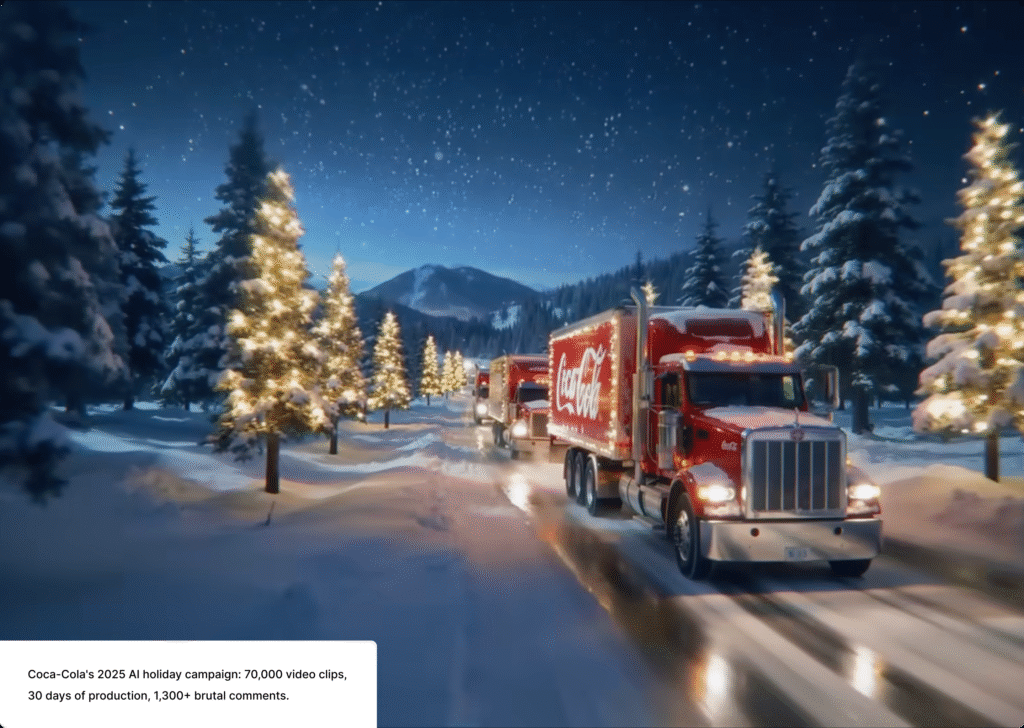
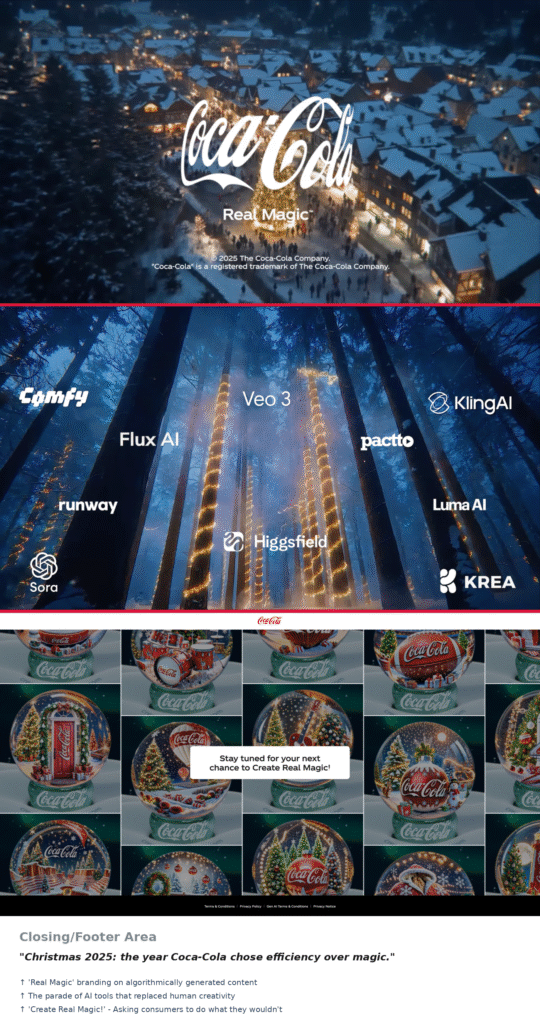
Coca-Cola spent a year and a fortune perfecting AI technology. Then they used it to make animated animals stare blankly at illuminated trucks whilst 1.3 billion people online asked: “Did anyone actually watch this before releasing it?” The answer, apparently, was no.
The world’s most recognisable fizzy drink produced 70,000 AI-generated video clips in 30 days to deliver what amounts to the digital equivalent of a greeting card written by an algorithm that learned Christmas from Reddit. Critics called it soulless. The YouTube comment section called it genocide. And marketing teams everywhere watched a brand with 140 years of creative heritage choose efficiency over actually giving a damn.
Here’s the thing: this isn’t about AI being bad. It’s about a company with unlimited resources and institutional muscle memory deciding that the fastest route to the market was more important than the route that might make people feel something.
That’s not innovation. That’s bankruptcy—the creative kind.
If you work in marketing, own a brand, or depend on getting people’s attention, this is your case study in what happens when you confuse speed for strategy, efficiency for empathy, and algorithms for artistry. Read this, learn from it, and please—please—don’t be the next brand that mistakes a technical achievement for a creative one.
Don’t confuse speed for strategy, efficiency for empathy, and algorithms for artistry.
The Launch That Misses the Moment
Coca-Cola’s AI-powered holiday push isn’t just a creative misfire—it’s a calendar car crash. The ads were released on 3 November, 52 days before Christmas. That’s not anticipation. That’s premature detonation.marketing-interactive
Big brands have been escalating their festive launches for years, hoping to snare Christmas shoppers before they get distracted by Black Friday flash sales and year-end shopping fatigue.
But effective timing isn’t just about getting out the gate faster—it’s about knowing when consumers are in the right mood for your message.absolute+1
Go too soon, and you’re forgotten by the time the actual holidays roll around. Go too late, and you’re lost in the noise. The trick is knowing when anticipation turns into irritation—which is usually the moment audiences realise they’ve been bombarded with the same old clichés for weeks.
This year, Coca-Cola used AI mostly for velocity. Their production cycle was smashed down to 30 days instead of a year—a technical feat, if not a creative one. But in speeding up, they didn’t pause to ask: Does this make what we’re saying any better? The answer is no.theverge
Why Now: If you’re a marketer reckoning with AI and speed, this is the lesson: Don’t just use a tool because it gets you somewhere quicker. Ask if ‘quicker’ helps the brand, the story, or the audience. For a deeper look at how AI tools intersect with creative strategy, read my analysis of AI-generated content and whether it’s stolen creativity from digital marketing.
The Refrigerator in December: Cold Drinks, Warm Hearts
Let’s clear up this myth: “Nobody drinks Coke in winter.” In North India, rum and Coke is practically a seasonal staple. Walk into a wedding or a party in Delhi this December and you’ll find more Cuba Libre than hot toddy.
Soft drinks still shift by the millions in winter, spiked or not, because the ritual is about celebration, camaraderie, and indulgence—not just thirst.economictimes+1
Globally, winter doesn’t mean no cold drinks. The US now gets 75% of its Starbucks sales from cold beverages year-round. Australia, South Africa, and New Zealand celebrate Christmas in the heat—barbecues, beach coolers, “sandmen” built with Coke bottles stuck in for noses.linkedin+4
Coca-Cola’s new ads, filled with snowy landscapes and a parade of illuminated red trucks, could have aired anywhere above the equator. Not one scene anchors itself to how people actually live or celebrate. Where are the Indian weddings, beach picnics down under, or granny mixing rum and coke at midnight?
Lesson for Now: Find the audience’s truth, then film it. Don’t build your festive story out of stock winter footage just because a machine can stitch together pretty pixels.
Sledgehammer Nostalgia: When “Tradition” Falls Flat
You know what ruins Christmas advertising faster than novelty socks? Marketing that sells Christmas as if it were universal. In most of the world, Christmas is a local tradition, celebrated with a distinct blend of nostalgia and context.
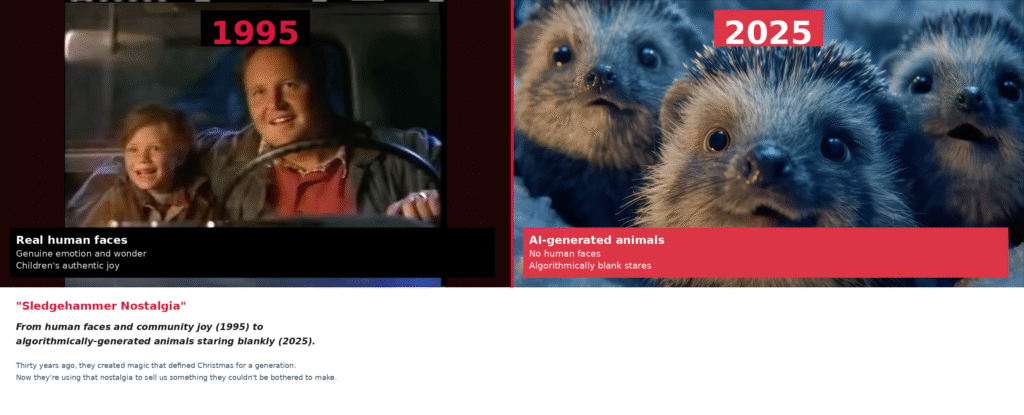
Coca-Cola, for decades, owned Christmas—the fat Santa, the magical trucks, the “holidays are coming” refrain. But that iconic spot worked because it found human faces to pair with its trucks. It didn’t just repeat a time-honoured visual; it told a story of anticipation, community, and joy. The new, AI-driven work packs none of this: just animated animals and whizzy snow effects. The magic’s gone, replaced by what critics called “soulless,” “bland,” and totally “uninspiring”.newsbytesapp+2
Australia’s “Summer Wonderland” from Air New Zealand, meanwhile, lampoons wintry clichés and leans proudly into beach Christmas—a campaign that feels true and gets shared for its charm. John Lewis wins in the UK by centring deeply personal emotional stories, turning those moments into must-see events every year.ninaharmon+1
Nostalgia marketing isn’t about rehashing past glories. It’s about finding what still connects, then making it vivid and real. Much like how Red Label Tea’s monsoon campaign tapped into seasonal cultural moments with authentic storytelling, brands need to ground their nostalgia in lived experience.
AI at the Wheel, No Driver in Sight
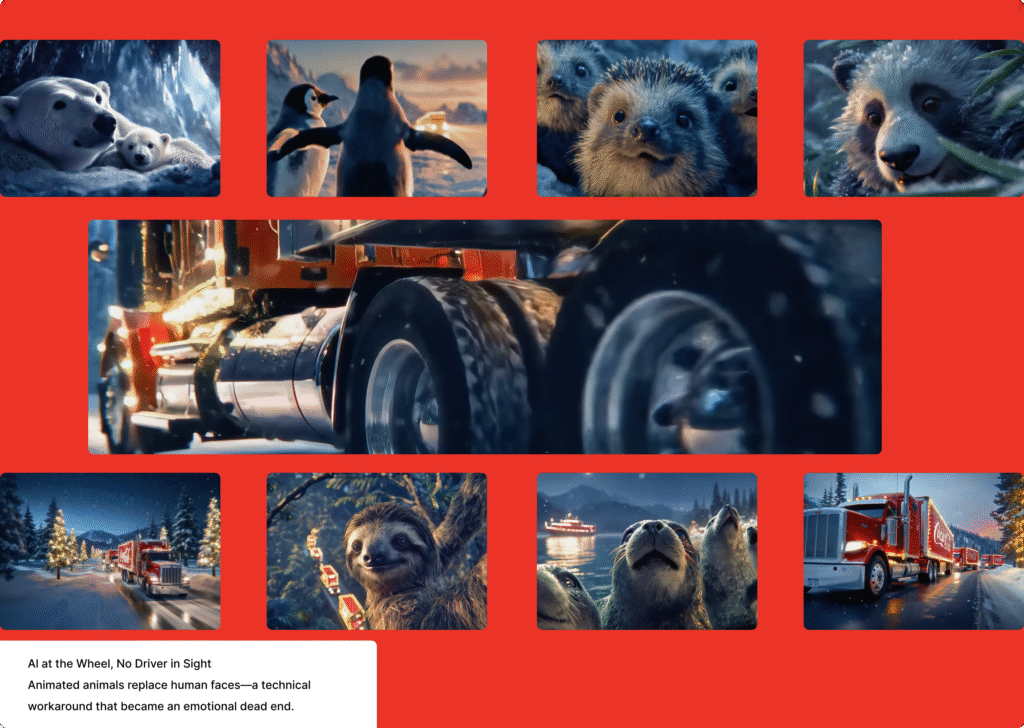
Here’s what marketers care about right now: AI is fast, but is it good? Coca-Cola’s campaign (built by Secret Level and Silverside AI) is a technical leap. They fixed the trucks’ wheels, swapped out awkward AI humans for animals, and ironed out last year’s many visual glitches. From a tech standpoint, it’s a win.news.yahoo+1
But the soul is missing. Emotional advertising wins not because it’s efficient, but because it feels human—building joy, warmth, and even sadness that viewers want to remember. The rush into AI because it’s “innovative” can only get you so far.unruly+1
This year’s Coca-Cola launch saw positive public sentiment collapse, with negative conversation tripling after the ad dropped. People are now talking about the ‘blood of out-of-work artists’ more than the joy of Christmas. That’s a brand problem, not a technical one.nbcnews+2
Bold takeaway: If AI is the tool, then people must be the purpose. Use the machine to amplify what resonates—don’t let it run over the craft, the voices, or the stories.
For contrast, consider how Swiggy’s people-powered marketing approach prioritised human connection over algorithmic efficiency.
When the Audience Roasts You: The YouTube Comments Laugh Riot
Want to know how badly this campaign landed? Head to the YouTube comments section—it’s a masterclass in public brand autopsy.usatoday
The brutal highlights:
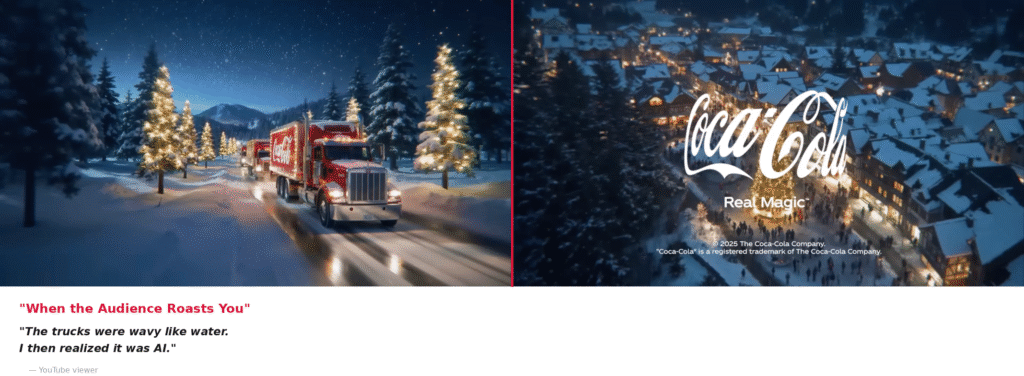
“A year of AI development later and it still looks terrible,” wrote one viewer. Another observed: “The trucks were wavy like water. I then realised it was AI. They failed big time”.independent+1
But the technical critiques were mild compared to the existential ones. “Nothing like celebrating the spirit of Christmas with the most soulless ad possible,” commented one viewer. Hollywood writer Alex Hirsch’s viral takedown—”Coca-Cola is ‘red’ because it’s made from the blood of out-of-work artists”—garnered over 631,000 views and became the campaign’s defining narrative.instagram+2
The comments revealed something more damaging than disappointment: betrayal. Coca-Cola essentially invented modern Christmas advertising with their Haddon Sundblom Santa paintings and the 1995 “Holidays Are Coming” spot. For them to replace that human-crafted magic with algorithmic efficiency felt like sacrilege.
Coca-Cola essentially invented modern Christmas advertising. For them to replace that human-crafted magic with algorithmic efficiency felt like sacrilege
“This is how creativity dies,” one commenter wrote. Another asked: “You know the kind of ad that you remember? This isn’t one of those”.bandt
Even Coca-Cola knew this was coming. The ad was shared only on YouTube—not on their other social platforms—suggesting the brand anticipated the backlash and chose to contain it. That’s not confidence. That’s damage control disguised as a media strategy.usatoday
With over 1,300 predominantly negative comments, the laugh riot wasn’t mockery—it was the sound of an audience watching a beloved brand publicly embarrass itself while insisting everything’s fine.reddit+1
It’s Not Christmas for Everyone—And That Matters
Marketers talk endlessly about “global reach,” but the real trick is regional specificity. In India, December means weddings as much as Christmas; in Australia, it’s full-on summer.
The best campaigns aren’t the ones with the broadest reach, but the deepest fit.
Coca-Cola—with one of the largest creative budgets on earth—chose to deliver a lowest-common-denominator campaign, then scaled it to 140 countries. The technology could have let them make local versions at speed, but what’s the use if all the versions look the same? Christmas in the UK could have shown families gathering around a fire; in Delhi, winter parties and rum and Coke; in Sydney, sunburnt kids building ‘sandmen’ at Bondi Beach.ndtvprofit
Instead, Coca-Cola’s AI gave us snow, trucks, and animals staring into middle distance. It’s “global” only in the sense of being “everywhere and nowhere.”
This stands in stark contrast to campaigns like Maybelline’s Mumbai mirage, which at least attempted local specificity (even if executed through CGI artifice).
How To Get Festive Marketing Right: Make It Useful, Not Just Timely
1. Start With Why—Not When
Don’t obsess over being first. Launch when people actually care. Use behind-the-scenes teasers to build anticipation, but hold the main event until people are ready to pay attention.robusmarketing+1
2. Anchor to Real Lives
Are your audience celebrating with barbecues, cocktails, or bonfires? Film that. Don’t manufacture universal magic; show the rituals that are real in each market. Parle-G’s emotional storytelling about unsung relationships offers a model for grounded, culturally-specific messaging.
3. Make Nostalgia About People, Not Packaging
Find and film emotional stories with real faces. Even if your product is the star, the supporting cast should be lived experience, not AI-generated filler. See how Asian Paints disrupted India’s paint wars with heritage storytelling that felt human.stptrans+1
4. Let AI Be Infrastructure. Keep Humans Centre Stage.
Use AI for scale and speed—regional versions, rapid testing, social media assets. But for your main campaign, let humans develop the narrative, the arc, and the heart.ndash+1
5. Own the Calendar, Don’t Be Owned By It
If tradition means winter in some markets, summer in others, reflect that in your work. You don’t need a universal approach: you need specific, vivid campaigns that look, sound, and feel local.goldstandarddiagnostics+2
What Would Real Innovation Look Like?
Imagine a Coca-Cola campaign that leans hard into the weirdness and joy of actual holiday consumption:
- In North India: Winter weddings, bonfires, rum and Coke toasts at midnight.
- Sydney Harbour: Family beach parties, sandmen built with Coke bottles, ice-cold cans in Esky coolers.
- UK high streets: Firesides, shopping queues, the classic anticipation of Christmas Day.
- Global social: Stories about how people find and share “Christmas spirit” in their own way, with Coke as the celebratory treat—not the forced accompaniment.
Each region’s narrative could be built in weeks, not months, using AI to produce, adapt, and localise. But the vision, the detail, the emotional draw—those have to come from the team, not the tech. KitKat’s latest musical campaign shows what happens when brands prioritise concept over connection—a lesson Coca-Cola would do well to heed.
Don’t Blame the Machine. Blame the Complacency.
Marketers right now face a crossroads: AI can make more ads, more quickly, for less money.
But consumers can sniff out empty optimisation faster than ever. What they want—especially during holidays—is tradition, emotion, warmth, and a sense that the creators actually care.
Coca-Cola’s 2025 campaign looks like a rush job because it is. The red trucks are still iconic, but they’re now digital ghosts of what was once magical. The acceleration isn’t progress: it’s avoidance.
Marketing in 2025 shouldn’t mean giving up on connection—just because a new technology lets you run faster. It should mean doing the work to genuinely connect, especially when the stakes are high. As I explored in my critique of Nothing Phone’s anti-ad Diwali campaign, sometimes the boldest marketing move is acknowledging what you’re not trying to be.
If you’re in the business of making people care, act local and slow, get specific, build with real faces, and use AI only for what it’s actually good for. Otherwise, come January, you’ll find your big bet on speed didn’t move the needle—except in all the wrong directions.
The comments section doesn’t lie. The audience isn’t fooled.
And Christmas 2025 will come and go—but this AI-generated campaign will be remembered only as the moment Coca-Cola chose efficiency over magic. That’s not a holiday memory. That’s a cautionary tale.
Evidence & Links
Sources for claims and statistics are cited below—click through for the research that backs them up.
- Coca-Cola’s 2025 AI-driven holiday ad draws mixed reactions
- NBC News: Coca-Cola controversy as AI-made ad displaces artists
- Hindustan Times: ‘Holidays are Coming’ falls flat
- USA Today: Coca-Cola’s AI holiday commercial sparks backlash
- The Independent: After its 2024 Christmas disaster, Coca-Cola tries again
- Reddit ArtistHate: Coca-Cola faces backlash for replacing humans with AI
- B&T: Coke leans further into AI with “soulless” Christmas spot
Hyperlinks are for research reference and suggested reading; sources are provided for verification of facts and case studies used in this article.
- https://www.marketing-interactive.com/coca-cola-s-2025-ai-driven-holiday-ad-draws-mixed-reactions
- https://absolute.digital/insights/when-to-start-christmas-marketing-campaigns/
- https://www.linkedin.com/pulse/when-best-time-launch-your-christmas-marketing-campaign-wb8vf
- https://www.theverge.com/news/812559/coca-cola-ai-holiday-christmas-commercial-2025
- https://economictimes.com/industry/cons-products/food/rising-consumption-of-hot-beverages-oil-liquor-etc-to-beat-the-cold-spells-big-boost-for-business/articleshow/45609861.cms
- https://economictimes.com/this-winter-season-try-different-rums/articleshow/10620956.cms
- https://www.linkedin.com/posts/shiprapriyamvada_consumerinsights-markettrends-beverageindustry-activity-7324107909846499328-LFdr
- https://commonwealthjoe.com/blogs/blog/snow-or-shine-the-unstoppable-rise-of-year-round-cold-brew
- https://www.goldstandarddiagnostics.com/x-masau
- https://www.changesinlongitude.com/christmas-in-new-zealand-australia/
- https://drprem.com/travel/be-a-part-of-the-unique-summer-christmas-celebrations-in-australia-this-year/
- https://www.newsbytesapp.com/news/science/coca-cola-ai-christmas-ad-sparks-backlash-over-weird-visuals/story
- https://www.hindustantimes.com/trending/us/cocacolas-holidays-are-coming-ai-ad-for-christmas-fails-to-impress-the-internet-a-sloppy-eyesore-101762203184025.html
- https://ninaharmon.com/marketing-journal-blog/air-new-zealand-holiday-marketing
- https://stptrans.com/best-local-christmas-marketing-campaigns/
- https://uk.news.yahoo.com/coca-cola-trying-another-ai-133000858.html
- https://www.hollywoodreporter.com/business/digital/coke-new-ai-holiday-ad-video-1236416491/
- https://unruly.co/blog/article/2019/11/13/christmas-ads-twice-as-likely-to-make-you-cry-smile-and-feel-nostalgic/
- https://www.rockerbox.com/blog/the-power-of-emotional-advertising-why-it-works-and-how-to-do-it-right
- https://www.nbcnews.com/tech/innovation/coca-cola-causes-controversy-ai-made-ad-rcna180665
- https://www.usatoday.com/story/tech/2024/11/21/coca-cola-ai-holiday-commercial-backlash/76477569007/
- https://www.independent.co.uk/life-style/coca-cola-christmas-ai-holiday-ad-santa-claus-truck-b2857982.html
- https://www.reddit.com/r/ArtistHate/comments/1gs6zk3/cocacola_faces_huge_backlash_for_replacing_humans/
- https://www.instagram.com/campaignsoftheworld/reel/DDJW-SNS_cy/
- https://www.bandt.com.au/coke-leans-further-into-ai-with-soulless-christmas-spot/
- https://www.ndtvprofit.com/business/coca-cola-revamps-holidays-are-coming-ads-with-ai-driven-makeover-faces-backlash-from-artistes
- https://robusmarketing.com/how-early-should-i-start-planning-my-festive-marketing-campaigns/
- https://reteno.com/blog/how-to-build-a-perfect-christmas-marketing-campaign-11-tips-great-examples
- https://www.5wpr.com/new/the-art-of-emotional-storytelling-in-pr-building-lasting-brand-connections/
- https://www.ndash.com/blog/innovation-vs-integrity-the-impact-of-ai-on-brand-authenticity-and-consumer-trust
- https://www.news18.com/lifestyle/discover-australias-summer-holiday-magic-christmas-markets-beaches-and-fireworks-9116592.html