
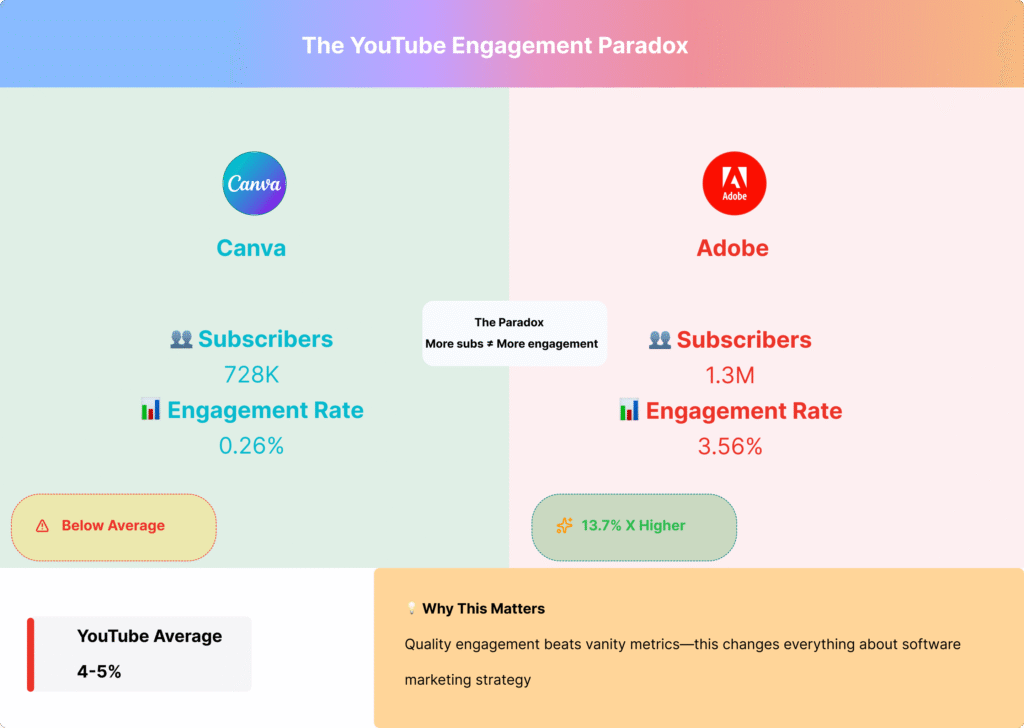
Canva’s YouTube numbers certainly stand out. The channel has over 728,000 subscribers and uploads 8.5 videos each week. Countless tutorials fill the channel, with a total of 656 million views. On the surface, it looks like a masterclass in digital content—consistent, easy to access, and set up for discovery.
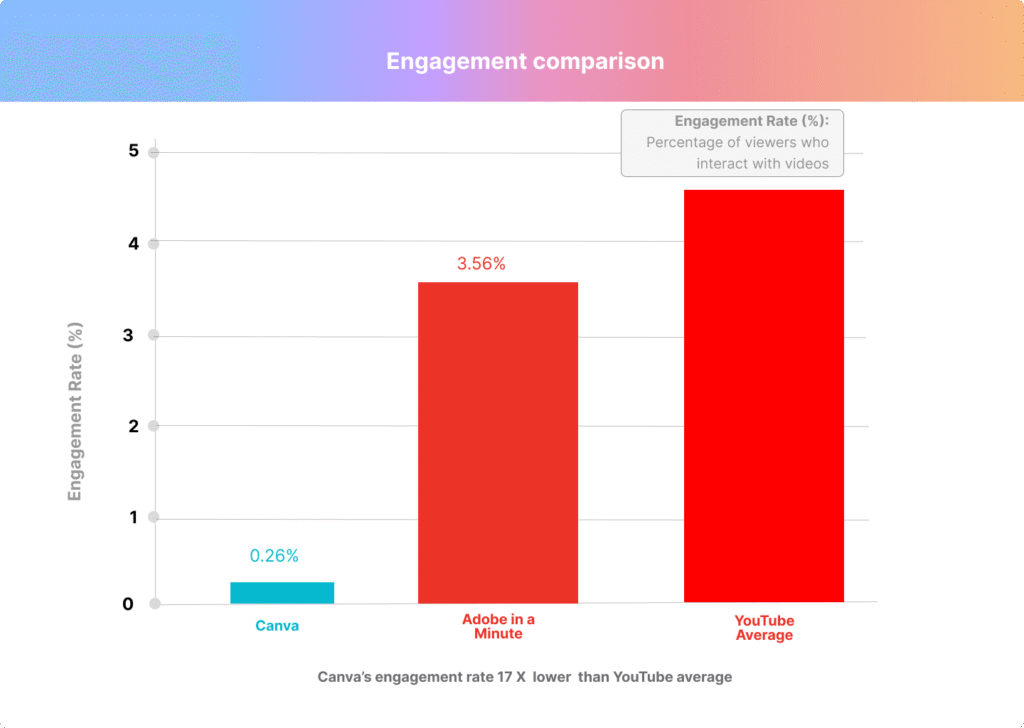
However, the engagement rate tells a different story: just 0.26%. That’s not what you would expect from those stats. In fact, it’s a warning disguised as success. Most channels on YouTube average about 4-5% engagement. When people watch Canva’s videos, they aren’t interacting. Few viewers comment, share, or even hit the like button.
What does this mean for marketers? Despite marketing “design for everyone,” Canva has built a channel people often ignore. Meanwhile, Adobe—with all its messiness—is quietly doing something right.
Both companies are fighting for the fast-growing creator economy. Today, millions of people earn income through TikTok, YouTube Shorts, Instagram Reels, or livestreams. This is the new battlefield. Whoever learns how to win here will change software marketing for everyone.
The Canva Trap: More Content Isn’t Always Better
On paper, Canva’s strategy sounds smart. Teach design in under five minutes. Keep viewers returning with fresh templates. Rely on a smooth sales funnel from free plan to paid subscription. And yes, upload content constantly. These steps should build loyalty, right?
At first, this has worked. People watch a tutorial, try Canva free, hit the tool’s limits (like watermarks), and upgrade to Canva Pro for £4.50 a month. The content makes it easy for someone to get started. Yet there’s a catch—one most marketers won’t say out loud.
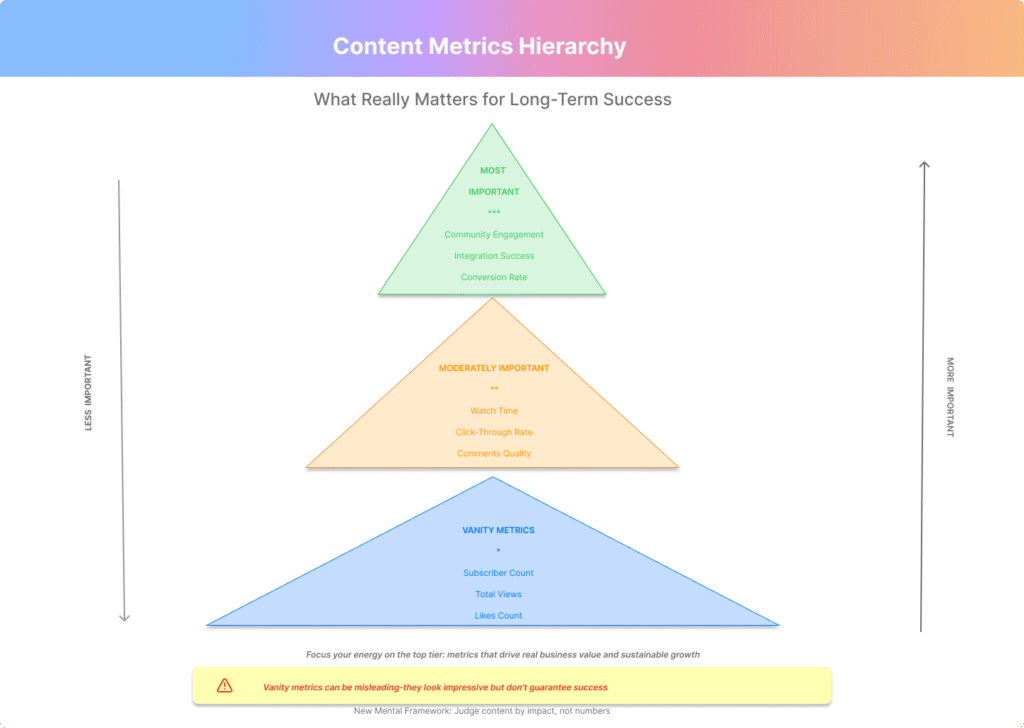
Uploading more videos doesn’t guarantee stronger engagement. That 0.26% rate matters far more than subscriber count.
Many viewers don’t feel part of the Canva community. Instead, most videos get watched in silence. A two-minute tutorial on “birthday poster design” rarely sparks a conversation or deeper commitment.
What do creators really want? They aren’t just looking for quick tips or shortcuts. Many want to know why a design works and see honest stories about creators using the tools. They want community, not just features. Most importantly, they’re looking for a path to become professionals—not just template users.
Making design simple is important, but if you simplify everything, some people stop caring.
Adobe’s Messy Approach Has a Hidden Advantage
At first glance, Adobe looks disorganised. It runs several YouTube channels and hasn’t updated all of them consistently. Adobe in a Minute—famous for fast-hit tips—hasn’t posted in weeks. To an outsider, it can seem confusing.
Despite these issues, Adobe in a Minute achieves a 3.56% engagement rate. That’s over thirteen times higher than Canva’s. Why?
Unlike Canva, Adobe’s short tutorials are aimed at committed creators. Each video shows a real shortcut, not just a basic template. People who click “play” are already hooked on their tools. This approach respects viewers’ skills.
Adobe’s best move, though, goes beyond content. In October 2025, Adobe teamed up with YouTube to put Premiere Pro inside YouTube’s Shorts creation tool. This is a big deal.
Rather than schooling people on YouTube, they’re building tools directly where creators actually work.
That’s the difference between brands that understand workflow integration and those that treat marketing as entertainment. See Figma’s Schema campaign for an example.
The Creator Economy Wants More Than Simplicity
Now, the landscape for creators is changing quickly. People aren’t just seeking easier design tech; they’re hunting for career-making opportunities. Many hobbyists want quick design tips. The pros need speedier workflows, pricing that grows with their success, and a sense of community around their work.
Canva gained traction by helping beginners start out. That’s worth celebrating. However, many active creators ask for more than basic tools.
For instance, someone designing fifty Instagram stories a week needs powerful features. Some creators, like YouTube thumbnail specialists and agency founders, often outgrow Canva before they feel emotionally invested in it.
Adobe is now adapting better. Its latest partnership with YouTube means their tools show up right when creators need them—not buried in a tutorial. That makes all the difference.
What Actually Works in Software Marketing Today
Let’s be clear: by 2025, YouTube’s role in software marketing has transformed.
No more uploading plain tutorials and hoping for conversions. The winning strategy is to place your tools where creators build, nurture real communities, and remember that creation happens live—not just during a lesson.
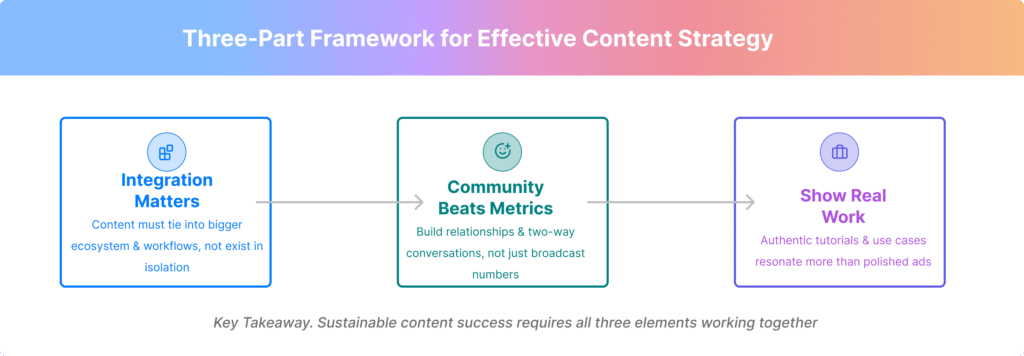
The strongest brands focus on:
- Integration: Adobe’s Shorts workflow, Figma’s design thinking
- Community: Channels led by real creators, not just templates
- Real work: Content that helps creators boost their own revenue, not just do a hobby
Canva’s lesson: uploading more shallow content turns design into passive consumption.
When viewers consume and leave, you’re renting attention, not building loyalty.
Why Passive Learning Fails
What does a 0.26% engagement rate really say? It says creators are done with endless tutorials. They’ve watched hundreds of hours of instruction. What they need is something new—community, workflow integration, and tools for serious work.
Canva can fix this. Imagine uploading fewer videos focused on real creators’ businesses, successes, and challenges. They could run forums, host contests, and develop professional spaces for users. As engagement rises, conversions will likely increase. That’s what it takes to build advocates, not just viewers.
Adobe’s challenge is different. It needs to unite its channels, clarify its audience, and choose between serving professionals or the masses. Right now, the mixed focus means nobody’s truly satisfied.
What Marketers Need to Know Now
There are two clear strategies in modern software marketing:
- Canva’s approach: High volume, fast conversions, and broad reach. Make tools simple and everywhere.
- Adobe’s shift: Integrated into workflows, deeply rooted in community, priced for value rather than volume.
What’s next could reshape software marketing. Canva’s power users will soon ask: “Can I scale my business with this? Does it serve professionals?” Some will stay, but others will move on. Adobe’s users must wonder: “Is it worth the price? Can I work faster than before? Do the pros around me recommend it?” Adobe might win deeper engagement but currently loses price-sensitive creators.
The lesson for marketers: never let reach distract you from authentic engagement.
The strongest communities are built from conversation and real work, not just subscriber counts.
If your strategy still relies on outdated metrics, you could lose the battle for creators to platforms that adapt faster. Recent trends across the industry reinforce this lesson.
In the creator economy, winning isn’t about having the most videos. It’s about making creators feel professional, connected, and essential. So far, neither Canva nor Adobe has quite solved this challenge.
Sources
- YouTube Creator Academy: Engagement Benchmarks
- VidIQ Studio: Canva Analytics
- TubeBuddy: Adobe in a Minute Analytics
- Adobe MAX 2025 Partnership Announcement
- Figma’s Schema Campaign Analysis
- YouTube Platform Changes
- AI YouTube Wars: SaaS Channel Comparison
- The Browser Wars: Market Competition Patterns