
When humour overshadows information, even brilliant creative execution can miss the mark
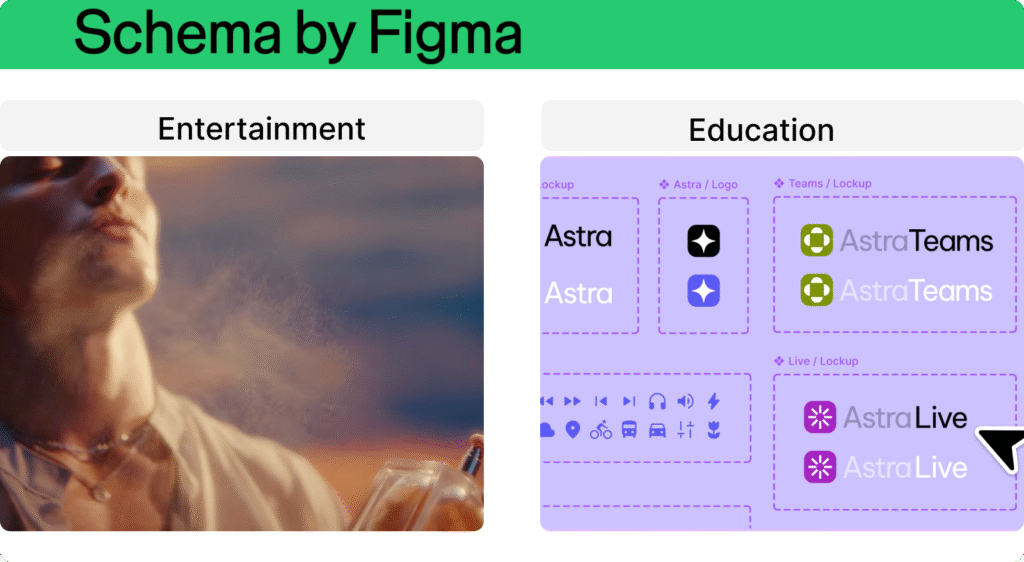
The marketing world collectively applauded when Figma released their perfume ad spoof during Schema 2025. The production values were flawless, the cultural references sharp, and the social media buzz immediate. But beneath the sophisticated cinematography and Albert Camus references lies a troubling trend that’s quietly undermining B2B marketing effectiveness: the prioritisation of entertainment over education.
Figma’s three-video Schema campaign offers a masterclass in this phenomenon. They produced a 63-second product demo, a 83-second luxury parody, and a 63-minute keynote—each serving different audiences and objectives. Yet analysing their performance against current B2B video marketing data reveals a fundamental misalignment between what marketers think audiences want and what actually drives business results.
The Numbers Don’t Lie: Information Beats Entertainment
The statistics surrounding B2B video marketing in 2025 tell a clear story.
87% of B2B marketers now use video^1^, but more importantly, 93% report positive ROI from video marketing^1^ when it’s done correctly.
The key phrase here is “when it’s done correctly.”
Product demo videos specifically drive remarkable results: landing pages with demo videos can increase conversion rates by up to 86%^2^, and 83% of consumers say they’ve been convinced to buy a product or service after watching a brand’s video^2^. Yet the most effective demos share common characteristics that Figma’s campaign largely ignores.
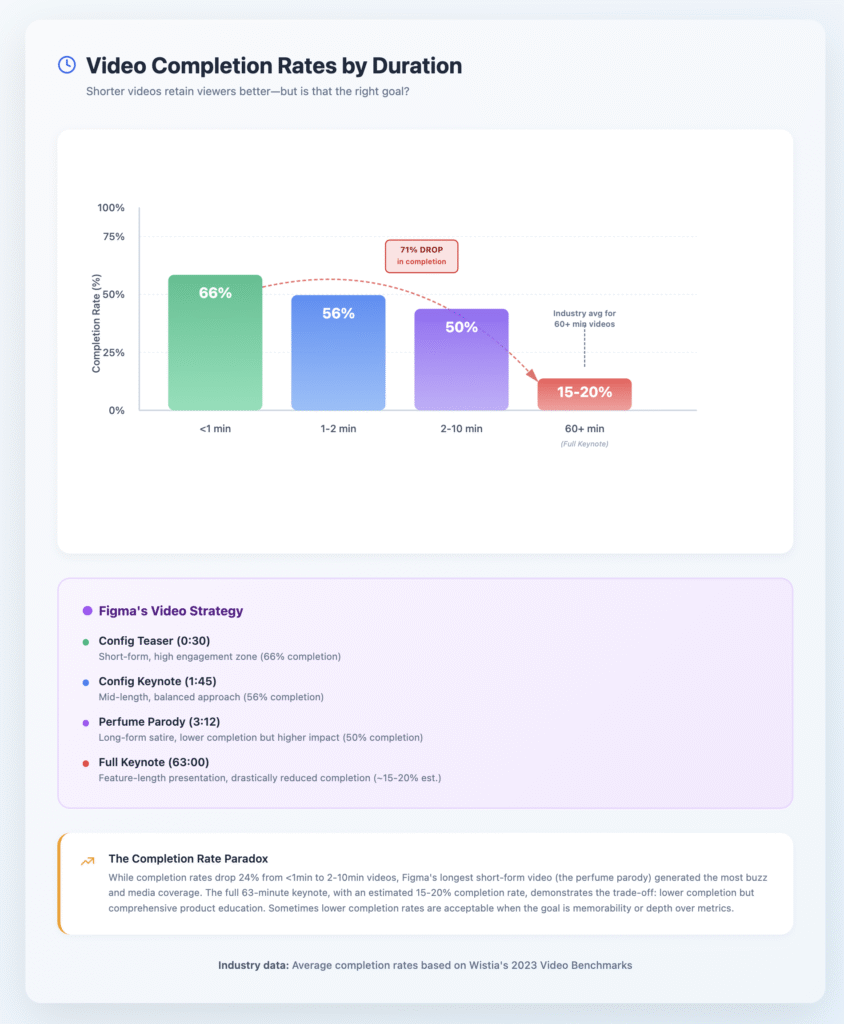
The sweet spot for B2B video engagement is brutally specific: 66% of users watch videos under one minute to completion, dropping to 56% for 1-2 minute videos and just 50% for 2-10 minute videos^3^. This data suggests Figma’s 83-second perfume parody is already pushing attention span limits before delivering any product value.
What Actually Drives B2B Video Success
Research consistently shows that problem-solution focused demos convert 37% better than feature tours in the software industry^4^. The most effective B2B videos follow a predictable pattern: hook (problem identification), context (pain point amplification), solution (product demonstration), and action (clear next step).
Figma’s Make Kits demo attempts this structure but stumbles on execution. At 65 seconds, it shows functionality without establishing the underlying problem of design-to-code friction. The perfume parody, meanwhile, inverts this entirely—spending 83 seconds on entertainment while communicating virtually no product information.
The contrast becomes stark when examining what B2B buyers actually prefer. When asked how they’d like to learn about a product or service, 44% choose short videos over ebooks (16%), infographics (15%), or text articles (13%)^5^.
However, the operative word is “learn”—buyers want educational content delivered entertainingly, not entertainment masquerading as education.
Compare this to Anthropic’s minimalist approach to launching Claude Sonnet 4.5, which prioritised technical demonstrations and enterprise validation over entertainment value—a strategy that resonated with their B2B audience’s need for substantive information.
The Rise of “Edutainment” and Its Limits
The marketing buzzword “edutainment”—blending education and entertainment—has gained significant traction in 2025. Edutainment content increases engagement, improves information retention, and encourages sharing^6^ when executed properly. The key phrase, again, is “when executed properly.”
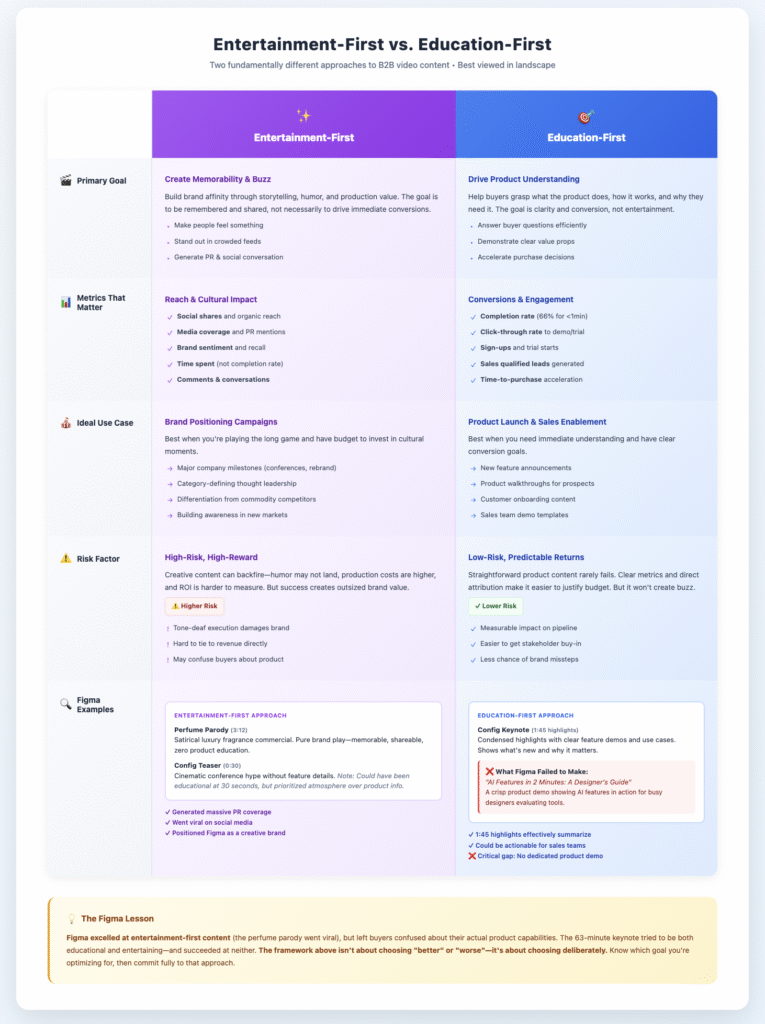
Effective edutainment maintains information as the primary goal with entertainment as the delivery mechanism. Figma’s perfume parody reverses this hierarchy, prioritising cleverness over clarity. While the parody demonstrates impressive brand confidence and cultural literacy, it fails the fundamental B2B video test: can a viewer explain what they learned after watching?
Can a viewer explain what they learned after watching? That’s the fundamental B2B video test.
This isn’t to dismiss humour in B2B marketing entirely. Research shows that 70% of B2B buyers believe humour in advertising is effective^7^, finding it attention-grabbing and persuasive. But effective B2B humour integrates organically with product benefits rather than existing parallel to them.
OpenAI’s marketing videos for ChatGPT demonstrate this balance effectively—injecting personality into product demonstrations without sacrificing clarity about functionality and use cases.
The Design Systems Market Context
Understanding why this matters requires examining Figma’s market position. The global design systems software market was valued at approximately $4.5 billion in 2023 and is expected to reach $23.8 billion by 2033, growing at 18.5% CAGR^8^. This explosive growth is driven by increasing demand for design-development collaboration tools, exactly the problem Extended Collections and Make Kits address.
In a rapidly expanding market with significant enterprise investment, clear product communication becomes critical for market share capture. Figma’s competitors aren’t standing still—companies like Adobe, Sketch, and emerging players are aggressively pursuing the same design systems buyers. In this context, a perfume parody that generates social buzz but fails to communicate competitive advantages represents a missed strategic opportunity.
The Attention Economy Trap
The root issue extends beyond Figma to a broader B2B marketing trend: the conflation of attention capture with business result generation. Social media metrics—shares, comments, engagement rates—don’t directly correlate with B2B conversion metrics like trial sign-ups, demo requests, or sales qualified leads.
Figma’s perfume ad will undoubtedly generate impressive social engagement metrics. It’s shareable, quotable, and demonstrates sophisticated creative thinking. But for a design systems manager evaluating Extended Collections against competitors, the video provides no decision-making information.
The entertainment value becomes a barrier rather than a bridge to product understanding.
This represents what behavioral economists call the “interesting distractor” effect—when compelling tangential information interferes with primary decision-making processes. In B2B contexts, where purchase decisions involve multiple stakeholders and extended evaluation periods, distractors can actively harm conversion by muddying value propositions.
Compelling tangential information can actively harm conversion by muddying value propositions.
The September 2025 smartphone marketing melee demonstrated this same trap—brands prioritizing spectacle and surface-level luxury signifiers over substantive product improvements, ultimately training audiences to scroll past rather than engage deeply.
The Humour Calculation: Risk Versus Reward
B2B humour requires more sophisticated risk-reward analysis than consumer marketing. Parody works best when it’s obvious, when the original format is beloved, and when it fits established brand heritage^9^. Figma’s perfume parody succeeds on criteria one and three but stumbles on two—luxury fragrance advertising isn’t universally beloved by design systems managers.
More fundamentally, the parody targets general design community entertainment rather than specific buyer education. This audience mismatch means the video optimises for viral share-ability over conversion effectiveness. In a market growing at 18.5% annually, this represents opportunity cost—budget and attention spent on share-ability rather than competitive differentiation.
Kajaria’s Gresbond campaign offers an instructive parallel—humor that resonated culturally but raised questions about whether entertainment value translated to actual brand preference and purchase consideration.
Alternative Approaches That Honor Both Entertainment and Information
The challenge isn’t eliminating humor from B2B marketing but integrating it more strategically. Consider how Figma could have approached their perfume parody concept differently:
Maintain the luxury advertising spoof but integrate product demonstrations organically. As the model interacts with the “perfume bottle,” brief UI sequences could show Extended Collections functionality. The philosophical voiceover could explain features metaphorically: “Inheritance without replication” (showing component inheritance), “Consistency across realms” (demonstrating multi-brand management).
This approach provides entertainment value while delivering concrete product information. Viewers get both the cultural reference satisfaction and practical understanding of feature benefits.
Alternatively, position entertainment content within a broader educational sequence. Release the product explainer first, followed by the parody as a “reward” for engaged viewers. This sequencing honors information priority while acknowledging that educated audiences can better appreciate sophisticated humor.
Apple’s iPhone 17 Pro campaign demonstrated effective sequencing—technical specifications grounded in clear copy before moving to aspirational messaging, ensuring audiences understood capabilities before being sold on lifestyle promises.
What This Means for B2B Marketers
Figma’s Schema campaign represents broader tensions in contemporary B2B marketing. The pressure to create “buzzworthy” content often conflicts with the need to generate qualified pipeline.
Social media metrics can obscure business impact metrics, leading marketing teams to optimise for the wrong outcomes.
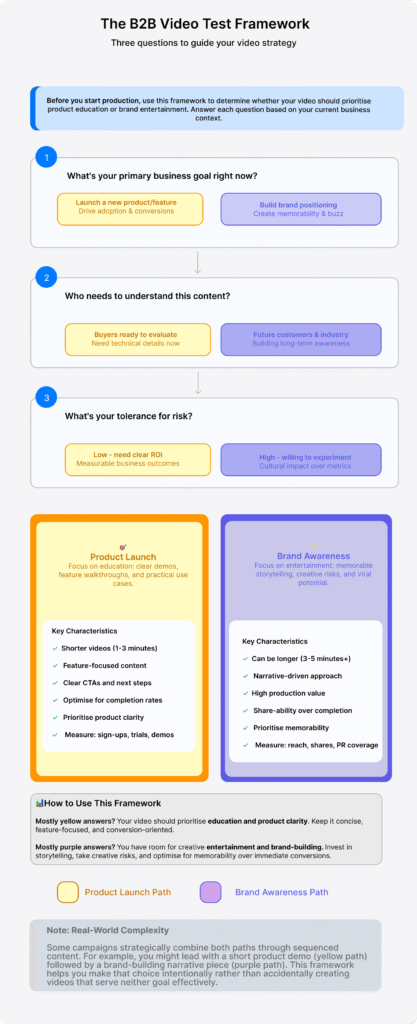
The solution isn’t abandoning creative thinking but applying it more strategically. Before green-lighting entertaining content, B2B marketers should ask:
- Does this content help qualified prospects make better purchase decisions?
- Can viewers explain our key differentiators after consuming this content?
- Does the entertainment enhance or distract from our core value proposition?
If entertaining content can’t pass these tests, it belongs in brand awareness campaigns rather than product launch sequences.
Swiggy’s Durga Puja dog feeding campaign illustrated this tension perfectly—purpose-driven marketing that prioritized optics over contextual awareness, demonstrating how even well-intentioned campaigns can miss the mark when entertainment and timing overshadow strategic thinking.
The Broader Implications for B2B Video Strategy
As video consumption continues growing—video content is expected to account for 82% of all consumer internet traffic in 2025^10^—B2B marketers face increasing pressure to create compelling content. But “compelling” shouldn’t automatically mean “entertaining.”
The most successful B2B video strategies in 2025 are embracing what researchers call “authentic storytelling”—genuine narratives that create emotional connections while maintaining information integrity^11^. This approach recognizes that B2B buyers are humans seeking emotional engagement, but within the context of rational business decisions.
Figma’s Make Kits demo actually demonstrates this balance effectively. The screencast format provides concrete functionality demonstration while the casual presentation style humanizes the technical content. At 65 seconds, it respects viewer attention spans while delivering substantive information. This video will likely drive more qualified trials than the perfume parody despite generating fewer social shares.
Swiggy Wiggy 3.0’s people-powered approach shows how brands can create emotionally resonant content that still centers on authentic value delivery—transforming delivery partners into campaign stars while maintaining focus on service quality and community connection.
A Call for Marketing Maturity
The design systems software market is experiencing unprecedented growth driven by genuine enterprise needs for design-development collaboration. Companies investing in these tools are making strategic decisions affecting entire product development workflows. They deserve marketing that respects the seriousness of these decisions while acknowledging the humans making them.
Figma’s perfume parody demonstrates impressive creative capabilities but represents strategic misalignment.
In a market projected to grow from $4.5 billion to $23.8 billion by 2033, clear product communication and competitive differentiation matter more than viral marketing moments.
The future of B2B video marketing lies not in choosing between entertainment and education but in mastering their integration.
Samsung India’s digital campaigns showed how platform specificity and contextual storytelling can create engaging content that still prioritizes product understanding and user problem-solving.
The most successful campaigns will honor audience intelligence, respect their time, and provide both emotional engagement and practical value. That’s a balance worth perfecting—no parody required.
Sources:
- Amra & Elma – B2B Video Marketing Statistics 2025
- Gumlet – Can Product Videos Boost Conversions?
- Wix – Video Marketing Statistics
- Vidico – 15 Best Software Demo Video Examples
- ContentBeta – Video Marketing Statistics
- Footprint Digital – Edutainment in Digital Marketing
- ScienceDirect – To Humor or Not Humor Buyers?
- Data Horizon Research – Design Systems Software Market
- Advertising Association – Comedy in Advertising
- Firework – 7 Video Marketing Trends That Will Define 2025
- TeraLeap – B2B Video Marketing Trends for 2025