
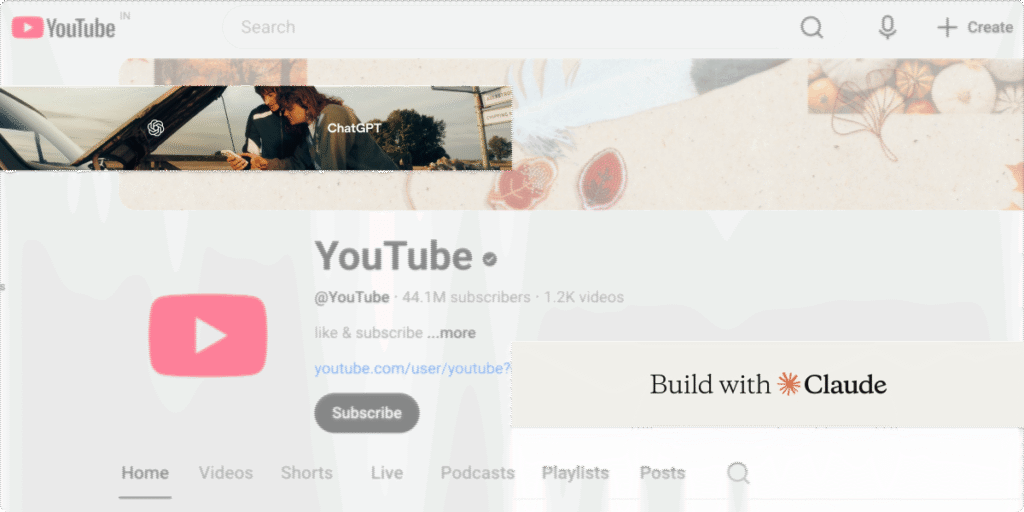
OpenAI and Anthropic represent AI’s two dominant marketing philosophies. One targets mass user engagement; the other prioritises credibility among enterprise partners.
However, their YouTube channels aren’t a leaderboard. Instead, they reflect fundamentally different business models—and the numbers only make sense once you understand what each company is optimising for.
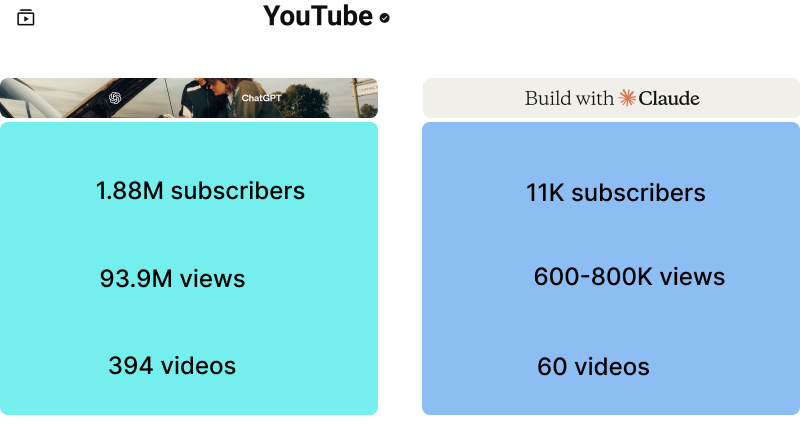
OpenAI commands 1.88 million YouTube subscribers and 93.9 million total views across 394 videos. Meanwhile, Anthropic has roughly 11,000 subscribers. This isn’t a rounding error or a sign of failure. Rather, it’s strategy made visible. Moreover, it matters profoundly to anyone trying to understand how AI companies actually build market power.
Two Business Models, Two Success Metrics
Here’s what most commentators miss: OpenAI and Anthropic aren’t fighting the same war. In fact, they’re not even measuring success by the same rubric.
OpenAI is optimising for consumer reach and adoption velocity. Their business model depends on mass awareness. Eight hundred million weekly ChatGPT users. API adoption from developers worldwide. YouTube’s algorithm rewards volume and engagement—the exact metrics that signal consumer momentum. Therefore, 1.88 million subscribers signals real market penetration and brand familiarity.
Anthropic is optimising for enterprise credibility and customer depth. When 90% of your revenue comes from business customers paying premium prices for AI safety and reliability, subscriber counts become noise. Instead, their success metrics are 300,000 enterprise deployments, 42% market share in coding AI, and trust from Fortune 500 firms dealing with regulated data. Consequently, YouTube subscribers don’t register on that dashboard.
This distinction is crucial: measuring Anthropic’s YouTube presence against OpenAI’s is like judging a B2B SaaS company’s effectiveness by its Instagram follower count. It’s technically comparable, but strategically meaningless.
The Content Strategies: Expansion vs Cultivation
OpenAI’s approach: rapid release cadence
OpenAI treats YouTube as a growth engine. Specifically, they deploy high-frequency content: DevDay keynotes, product announcements, developer tutorials, behind-the-scenes footage, podcast series. In essence, it’s volume marketing. Multiple videos per week, each designed to capture attention, generate clicks, and feed the algorithm’s appetite for engagement.
Their Sora 2 launch exemplifies this strategy: generate buzz, iterate publicly, respond to controversies as they surface. Launch fast, apologise later, maintain momentum. Ultimately, the goal is to own narrative space, drive adoption, and establish OpenAI as the default “AI company” in public discourse.
Anthropic’s approach: purposeful selectivity
In contrast, Anthropic uses YouTube like a research institution uses academic conferences—as venues for reaching specific audiences with detailed content. Lower frequency, higher specificity. Educational courses, technical deep-dives, conference recordings, research presentations. Therefore, content designed for engineers making decisions and enterprises evaluating AI vendors, not for viral discovery.
When Anthropic finally launched their first major advertising campaign—”Keep Thinking”—they bypassed YouTube entirely. Instead: Netflix, Hulu, premium print media (The New York Times, Wall Street Journal). As a result, they’re buying credibility and targeting specific audiences, not chasing algorithmic reach.
The difference is structural. OpenAI optimises for impressions; Anthropic optimises for conversions.
Accordingly, one approach favours YouTube; the other doesn’t.
The Brand Positioning: Momentum vs Deliberation
The marketing messages reflect these different strategies.
OpenAI’s narrative: speed, accessibility, possibility
OpenAI positions itself as the scrappy innovator democratising advanced AI for everyone. Furthermore, the messaging centres on capability, velocity, and expansiveness.
“AI for all. AI now. AI without gatekeepers.”
Notably, they’re comfortable with public beta testing, rapid iteration, and being first-to-market—even if it means moving faster than some would deem safe.
This works strategically: mass audiences reward decisiveness. Consumer product adoption runs on momentum and perceived possibility. Therefore, the more OpenAI launches, the more inevitable AI feels.
Anthropic’s narrative: thoughtfulness, safety, reliability
By contrast, Anthropic positions itself as the responsible alternative.
Their recent “Keep Thinking” campaign explicitly frames Claude as “AI to amplify thinking, not replace it”.
Subsequently, the messaging prioritises caution, transparency, and human agency. This directly challenges competitors who promise to eliminate human effort entirely.
Consider the visual language: OpenAI’s content features polished product demos and high-energy event footage. Meanwhile, Anthropic’s ads show real researchers, developers, and professionals working with AI rather than being replaced by it. One promises acceleration. The other promises augmentation.
Both narratives are defensible and well-executed. Neither is inherently superior. Rather, they simply serve different buyer psychologies.
The Sora Controversy: When Scale Creates Exposure
OpenAI’s recent stumble reveals a structural vulnerability baked into consumer-first strategies: when you court mass audiences, you inherit mass problems.
When you court mass audiences, you inherit mass problems. Every breakthrough capability becomes a potential liability.
Sora 2, OpenAI’s AI video generator, launched as a TikTok-style social app and immediately sparked backlash. Specifically, users created “disrespectful depictions” of Dr. Martin Luther King Jr., forcing OpenAI to intervene. Additionally, Hollywood studios—Disney, Warner Bros, Universal—are now suing over copyright infringement. As a result, the app’s rating collapsed to 2.9 stars on Apple’s App Store.
This is the price of rapid scaling: every breakthrough capability becomes a potential liability. More users means more edge cases, more malice, more unintended consequences. Therefore, the algorithm rewards viral moments, but virality cuts both ways.
Anthropic’s structural insulation from this risk
Anthropic’s enterprise focus shields them from equivalent blowback—but not from risk. In fact, their customers (Fortune 500 companies in regulated industries) actually prefer measured, predictable innovation to breakthrough disruption. A Claude error affecting a Fortune 500 customer’s legal department is a live crisis, not a press cycle.
Yet Anthropic faces different vulnerabilities: slower product iteration potentially cedes “thought leadership” to more aggressive rivals. Moreover, their reliance on a handful of major enterprise contracts creates concentration risk. Limited public-facing transparency about model training data and decision-making leaves room for external critics. Furthermore, if enterprise demand flattens, their entire revenue model becomes precarious.
Both models carry genuine risk. However, the risks are simply asymmetrical.
The Enterprise Approach: Proof, Not Popularity
Here’s what’s remarkable about Anthropic: they’ve proven you can build a successful AI company while barely existing on YouTube.
Their website generates 60,000+ monthly organic visits through customer success stories and research content. Additionally, their LinkedIn strategy targets B2B decision-makers with strategic partnerships. They host physical events (pop-ups, academic conferences) and maintain thought leadership through published research. Consequently, they’ve secured 300,000 enterprise customers and meaningful market share in coding AI—without a single viral YouTube video.
This isn’t a workaround or a limitation. Instead, it’s a different playbook. It proves that YouTube dominance isn’t a requirement for building a dominant AI company, just as it proves that consumer reach isn’t the only path to scale.
Competing Playbooks: Consumer and Enterprise

The AI YouTube wars reveal a bigger truth about marketing in 2025/2026: there’s no universal playbook anymore.
In fact, the tactics that drive OpenAI’s growth would undermine Anthropic’s positioning, and vice versa.
This matters beyond AI. Moreover, every industry is fracturing into consumer-first and enterprise-first business models, each requiring fundamentally different strategies—a lesson evident in everything from smartphone launch timing to tech brand positioning.
- The consumer playbook: High-volume content, algorithm optimisation, viral moments, rapid iteration, public beta testing, influencer partnerships, social-first distribution. Success metrics: reach, engagement, user growth. Ultimately, the goal is to move so fast that adoption becomes inevitable.
- The enterprise playbook: Thought leadership, customer stories, industry events, compliance documentation, relationship-driven sales, earned media. Success metrics: contract value, customer retention, industry influence. In this case, the goal is to move so deliberately that trust becomes unavoidable.
Mixing these approaches doesn’t create the best of both worlds. Rather, it creates strategic confusion—messages that confuse, campaigns that contradict, audiences that disengage.
The Deeper Question: When AI Becomes Your Brand
There’s a more profound issue emerging from these YouTube wars: when AI becomes central to your brand identity, marketing and governance cease to be separate functions.
OpenAI’s Sora controversy wasn’t just a PR problem—it was a product-governance problem that became a brand problem. Specifically, when your marketing channels showcase AI capabilities, every AI failure becomes a marketing failure. Similarly, every technical limitation becomes a brand compromise.
Anthropic understands this, which is why their “Keep Thinking” campaign emphasises human oversight and responsible deployment. Therefore, they’re not just marketing an AI product—they’re marketing an AI philosophy. Constitutional AI. Human-in-the-loop decision-making. Transparent uncertainty.
As more companies embed AI into core offerings—from Google’s Performance Advisor to NVIDIA’s enterprise solutions—the boundary between product strategy and brand strategy dissolves. Consequently, your AI governance policies become your brand promise. Your safety protocols become your competitive differentiation.
This is why both companies’ approaches carry credibility: they’re both betting that their governance models will ultimately define market victory. OpenAI bets on capability as trust-builder. Anthropic bets on caution as trust-builder. Different bets. Both defensible.
Winners and Losers: Not Who You Think
By traditional metrics, OpenAI is winning. More subscribers, more views, more brand familiarity.
By business metrics, both are winning—because they’re optimising for different outcomes. OpenAI’s YouTube dominance supports their consumer expansion strategy. Meanwhile, Anthropic’s enterprise focus explains their minimal YouTube investment and validates it.
By sustainable brand building? Too early to say. OpenAI’s high-risk, high-reward approach could cement their position as the inevitable AI leader—or create reputation damage that opens doors for “safer” alternatives. Similarly, Anthropic’s measured approach could build unshakeable enterprise trust—or lose public-narrative control to flashier competitors.
The real winners are marketers learning from both approaches. OpenAI shows how to build mass consumer excitement around emerging technology. Conversely, Anthropic shows how to build enterprise trust around the same technology.
The real losers? Any company trying to do both simultaneously without acknowledging they require completely different strategies—like brands caught in September’s smartphone wars, launching products without clear positioning, speaking to everyone and converting no one.
What Comes Next: The Divergence Deepens
The AI YouTube wars are opening act. As AI capabilities expand and competition intensifies, expect both strategies to double down.
- OpenAI will likely expand consumer dominance. More social features. More consumer applications. More accessible price points. More viral moments—and likely more controversies. Furthermore, their announced social network plans suggest serious commitment to owning consumer AI touchpoints. Ultimately, they’re betting that mass adoption and network effects will protect them from policy backlash and ethical critiques.
- Anthropic will likely deepen enterprise positioning. Their $8 billion Amazon partnership gives them runway to invest in customer success, research credibility, and regulatory influence without chasing quarterly YouTube growth. Therefore, they’re betting that enterprise stickiness and policy relationships will protect them from being outpaced by faster innovators.
Both bets can pay off. Both can fail. However, the outcome depends on which force proves more durable: consumer momentum or enterprise permanence.
The Lesson for Marketers
In an AI-driven future, marketing strategy isn’t just about reaching audiences. Instead, it’s about defining what kind of company you want to be. Moreover, once you’ve made that choice, marketing’s job is to stay faithful to it—even when alternative playbooks look flashier.
OpenAI’s YouTube strategy works because they’re genuinely committed to consumer adoption. Similarly, Anthropic’s minimal presence works because they’re genuinely committed to enterprise credibility. Neither company is half-hearted about their choice. Furthermore, that authenticity—the alignment between strategy, messaging, governance, and metric selection—is what actually drives credibility.
Marketers who understand this distinction stop asking “Should we be like OpenAI or Anthropic?” and start asking “What is our actual business model, and what marketing strategy authentically serves it?”
The companies that answer that question first, commit to it fully, and resist the temptation to copy a competitor’s playbook—those are the ones who’ll survive the next wave of AI consolidation.
Because once you choose your path—consumer or enterprise, momentum or deliberation, reach or depth—you can’t walk both roads at once.
Sources:
¹ OpenAI YouTube Channel Stats, VidIQ
² Anthropic’s YouTube channel has only 11,000 subscribers, Reddit
³ Anthropic to triple international workforce, CNBC
⁴ AI Fluency: Framework & Foundations Course, YouTube
⁵ Anthropic launches first brand campaign for Claude, Axios
⁶ OpenAI Blocks Sora Videos Of Martin Luther King, Forbes
⁷ Disney, Warner Bros., and other studios say no to Sora, Times of India
⁸ How Anthropic Drives 60K+ in Organic Traffic, Foundation Inc
⁹ Inside Anthropic’s Influencer Marketing Program, Favikon