
OpenAI’s ChatGPT Atlas landed on Tuesday.
For us marketers still chasing keywords and building backlinks, this marks the end of an era. Not tomorrow. Not next quarter. NOW.
Here’s what Atlas represents: the final blow to the myth that we can control discovery. For two decades, we marketers lived a comfortable lie. We believed that mastering Google’s rules, building domain authority, and creating “SEO-friendly” content meant it’d reliably appear when customers searched.
That game is ending. The new one?
Your brand now competes for selection by an AI agent. Moreover, that agent may never send users to your website at all.
This isn’t guesswork. Furthermore, it’s already happening.
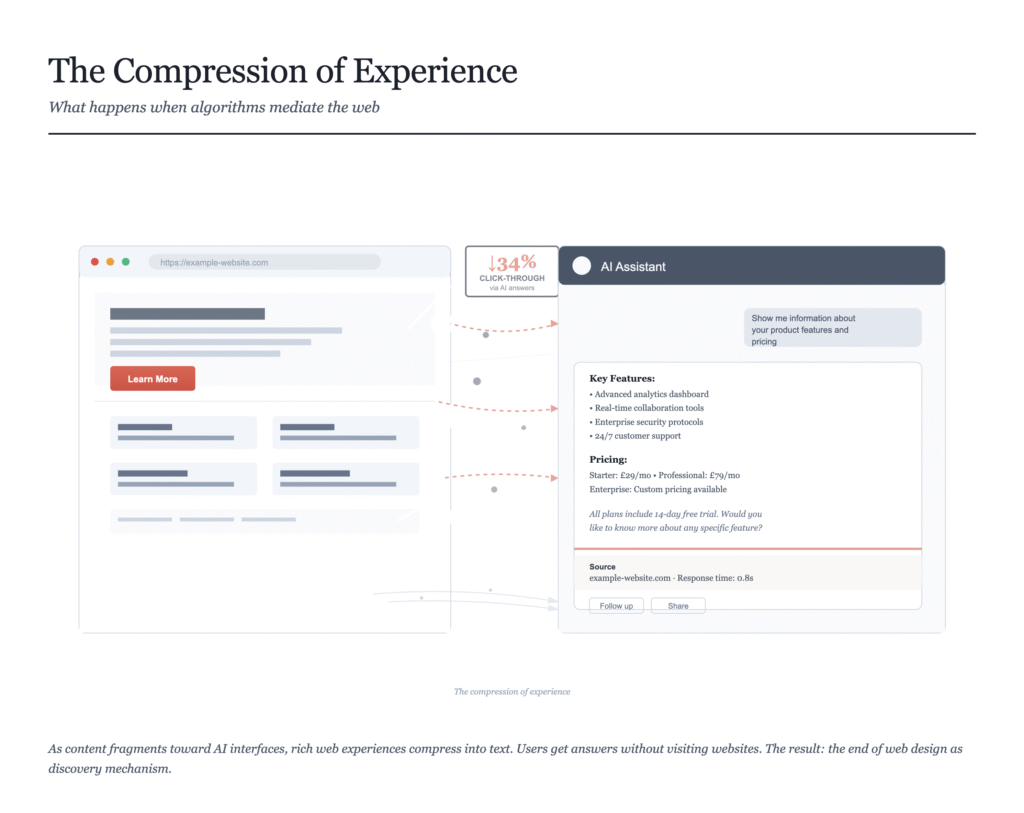
Google’s AI Overviews have reduced click-through rates to top-ranked sites by more than 34%.
Additionally, Ahrefs data shows the same pattern across AI-improved search: impressions rise, but clicks fall.
Impressions rise, but clicks fall. Users get their answers without ever leaving the AI interface.
Users get their answers without ever leaving the AI interface. Meanwhile, Atlas joins Perplexity’s Comet, Opera’s Neon, Microsoft’s Copilot Mode in Edge, and Google’s own Gemini integration into Chrome. Together, they’re driving the mass compression of web traffic.
The uncomfortable truth?
Most marketing strategies are built for a web that no longer exists.
Much like the smartphone industry’s September marketing chaos, brands are scrambling to make noise without substance.
What Atlas Actually Does (And Why It Matters)
Atlas isn’t just ChatGPT in a browser window. Rather, it’s a deliberate design choice that makes AI help unavoidable. There’s no traditional address bar. Instead, every web interaction flows through ChatGPT’s interface.
You don’t type URLs. Rather, you describe what you want, and the AI decides where (or whether) to take you.
The Agent Mode Revolution
The “agent mode” goes much further. During demos, Atlas successfully ordered groceries via Instacart, researched documents across multiple sites, and completed tasks. Crucially, users never touched a single webpage. The system keeps “browser memories”—context saved across sessions. This theoretically allows it to predict needs and filter options ahead of time.
For us marketers, this setup has brutal effects.
Our carefully crafted landing page? The AI might sum it up in two sentences and move on. Our conversion funnel? Compressed into a single agent-driven transaction. Your brand story? Reduced to data that an algorithm deems worth showing.
The Premium Problem
Here’s the kicker: Atlas currently limits its most powerful features—agent mode—to paying subscribers only.
Consequently, OpenAI is building a premium tier where the wealthiest, most valuable consumers never see your website at all.
The Competitive Battlefield: Who’s Actually Fighting This War
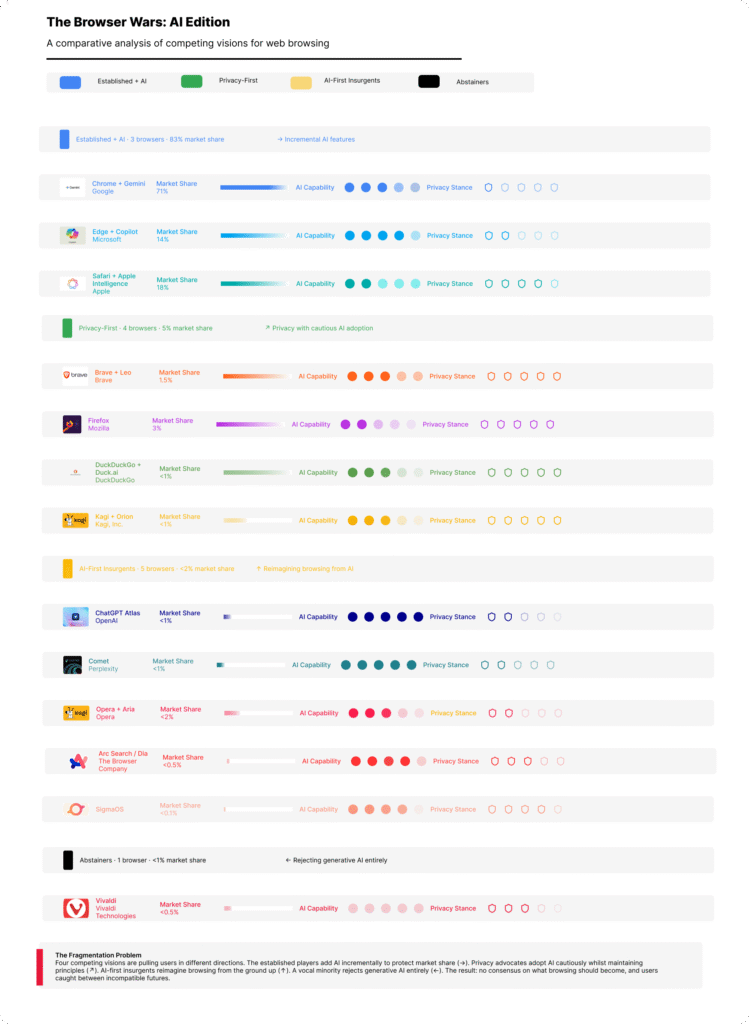
Atlas isn’t alone. In fact, it’s entering a crowded field where every major browser maker and several upstarts are racing to embed AI into browsing. Here’s the landscape as of October 2025:
The Established Players Adding AI
Chrome with Gemini dominates with 71.77% global market share. Google’s integration of Gemini into Chrome brings tab-aware help, multi-tab summaries, and tight ecosystem links. For marketers, this matters most: billions of users get AI browsing without switching browsers. Google’s AI features in Chrome reach more people instantly than any upstart can dream of.
Microsoft Edge with Copilot uses similar advantages. The sidebar integration, page summaries, and business controls make it compelling for company users. Moreover, Microsoft’s Copilot features benefit from Office 365 links—a moat Atlas can’t cross.
Safari with Apple Intelligence takes a different path. Available on iOS 18, iPadOS 18, and macOS Sequoia, Apple’s on-device AI provides page highlights and summaries whilst keeping strict privacy controls. However, device support is limited, and Apple’s walled garden remains firmly walled.
The Privacy-First Contenders
Brave with Leo offers an interesting middle ground. Brave’s AI assistant Leo provides on-page chat, summaries, and translation whilst keeping a privacy-forward stance. The local-plus-cloud mix appeals to users who want AI help without full surveillance. For marketers, this represents a smaller but highly engaged audience.
Firefox’s AI features focus on on-device processing. Mozilla’s approach includes alt-text generation, translation, and the iOS “shake to summarise” feature—all designed to respect privacy. However, Firefox’s declining market share limits its effect on marketing strategies.
DuckDuckGo Browser with Duck.ai Chat makes AI interactions fully anonymous. DuckDuckGo’s private AI chat isn’t used for training, and searches remain private. This matters for privacy-conscious segments but represents a fraction of overall traffic.
The AI-First Insurgents
Perplexity’s Comet launched free for everyone as of October 2025. Built on Chromium, Comet focuses on deep research, planning tasks, and integrated AI search. It’s Atlas’s most direct competitor—similar vision, similar execution, but from a search-first company rather than a chat AI company.
Opera with Aria weaves AI throughout the browsing experience. Opera’s Aria assistant handles real-time answers, tab commands, and image generation using multiple LLMs. Opera’s smaller user base limits its impact, but the features point to where mainstream browsers may head.
Arc Search and Dia from The Browser Company take yet another approach. Arc Search’s “Browse for Me” feature and voice commands (“Call Arc”) represent the most radical reimagining of browsing UX. However, Arc’s mobile-first strategy and the emerging Dia browser remain niche plays.
The Deliberate Abstainers
Notably, Vivaldi has explicitly rejected generative AI features. Instead, they focus on customisation, built-in tools (email, notes), and Proton VPN integration. This positioning serves a small but loyal audience that values control over automation.
What This Fragmentation Means for Us the Marketers
Here’s the uncomfortable truth: we now need visibility strategies for at least five different AI browsing models. Each uses different ranking signals. Each cites sources differently. Each has different plans to make money.
Chrome’s Gemini pulls from Google’s knowledge graph. In contrast, Perplexity’s Comet prioritises its own search index. Meanwhile, Atlas relies on ChatGPT’s training data and real-time web access. Similarly, Brave’s Leo uses a mix of models. Lastly, Opera’s Aria taps multiple LLMs.
Optimising for one may hurt performance in another. Unlike the Google dominance of 2015-2024, where one SEO strategy could capture most search traffic, the AI browser era demands multi-platform thinking from day one.
The Numbers Don’t Lie: Traffic Is Disappearing
Let’s drop the euphemisms.
AI browsers aren’t “changing the discovery landscape.” Instead, they’re destroying the traffic model that funds most digital marketing.
According to Gartner, traditional search queries will drop 25% by 2026. That’s not a guess. Rather, it’s a conservative estimate based on current trends.
Meanwhile, Google’s search market share fell below 90% for the first time in a decade this July. At the same time, ChatGPT’s share of search queries jumped from 1% to 5% in just four months in 2024.
How Zero-Click Browsing Works
The process is simple: AI browsers deliver zero-click experiences. Users ask questions, receive summarised answers with citations, and never visit the source.
Bain research shows that 80% of consumers now rely on zero-click results in at least 40% of their searches. As a result, organic web traffic has fallen by 15% to 25%.
Real-World Casualties
For publishers and brands that depend on search traffic, the economics are devastating. The education company Chegg sued Google this year after AI-generated summaries destroyed its site visits and revenue. Similarly, Wikimedia published data showing massive growth in automated content requests—bots scraping to train AI models—without corresponding credit or traffic.
This isn’t temporary. It’s structural. McKinsey’s analysis of the “new front door to the internet” makes clear that consumers are using AI-based search for product discovery, feature comparison, and recommendations. When they do, traditional SEO tactics become increasingly useless.
Why India Faces Bigger Challenges
India’s digital marketing system is particularly vulnerable. Chrome commands 87% market share in India—higher than the global average. This means Google’s Gemini integration into Chrome reaches more users here, faster. When the platform that dominates your market fundamentally changes how discovery works, you don’t get to opt out.
The Attention Bottleneck
The attention economy dynamics make this worse. With 403 quintillion bytes of data created daily and 90% of all existing data generated in just the last two years, Indian marketers face an impossible bottleneck.
Attention cannot be made or expanded. Consequently, every interaction that AI handles represents attention you’ll never capture directly.
Language and Context Challenges
For brands targeting India’s growing digital middle class—users who increasingly default to conversational search rather than keyword queries—the shift to AI browsers speeds up the death of Western-imported SEO playbooks. English-language content optimised for traditional search patterns performs poorly when AI agents prioritise natural language understanding over keyword matching.
What “AI Optimisation” Actually Means
The consultant class has responded predictably. They’ve rebranded SEO as “AEO” (Answer Engine Optimisation) or “GEO” (Generative Engine Optimisation). Then, they sold the same tired advice with new acronyms.
Much like how AI-generated content has reshaped creative work, marketers now face the challenge of optimising for machines that read differently than humans.
Here’s what actually works, based on early data from brands navigating this shift:
Structure for Extraction, Not Persuasion
AI agents parse content to extract facts, not to be convinced by your brand story.
This means leading with direct answers. It means using structured Q&A formats. Most importantly, it means implementing schema markup that makes your content machine-readable.
Canva exemplifies this approach. By building a library of how-to content marked up with consistent author credit and schema, they’ve ensured that tools like Gemini and Perplexity surface Canva prominently in design-related queries.
Authority Signals Trump Keywords
AI browsers validate information across multiple sources before citing it. Therefore, external citations, industry recognition, depth of topic coverage, and author credibility matter more than keyword density or backlink volume. Superficial or duplicate content rarely survives algorithmic scrutiny.
Compress Your Value Proposition
When AI agents summarise your brand, you’ll be represented by two sentences, not a hero section and three scroll-triggered animations.
The entire value proposition must be extractable from metadata, opening paragraphs, and structured data.
If an LLM can’t parse your competitive edge in under 100 words, you don’t have one.
This principle echoes what we’ve seen in Apple’s iPhone 17 Pro marketing missteps—when clarity is sacrificed for clever, the message gets lost.
Diversify Beyond Text Content
AI systems increasingly pull from videos, podcasts, and infographics. For instance, Google’s Gemini in Chrome can interpret content across multiple tabs and formats. If your content strategy is text-only, you’re invisible to an expanding portion of AI-mediated discovery.
Accept Lower Traffic, Higher Intent
The brands that survive this transition will see fewer visitors but higher conversion rates.
AI agents pre-filter, meaning the traffic that reaches you is already qualified.
Therefore, metrics like “share of AI voice” (frequency of inclusion in AI answers) and “query relevance” (types of questions where your brand appears) matter more than pageviews.
The Questions We Marketers Must Face
Most of us are avoiding the real strategic implications of AI browsers. This is because those implications require admitting that legacy infrastructure—CMSs, analytics platforms, attribution models—is built for a web that’s disappearing.
Here are the questions you should be asking instead:
Revenue Model Reality Check
If 80% of our traffic comes from organic search, and AI browsers reduce that by 25% over the next 18 months, what’s our backup revenue model? Not our aspirational answer. Our actual, budgeted plan.
Attribution in an AI World
How do we measure brand impact when users never visit the website?
Traditional analytics track sessions, pageviews, and conversions. But if an AI agent recommends your product and the user purchases through the agent’s interface, where does that appear in our funnel? How do we attribute it? How do you optimise it?
Multi-Platform Strategy
What’s our strategy for visibility in an ecosystem where Google, OpenAI, Perplexity, and Microsoft all operate competing AI browsers with different ranking signals? Optimising for one platform may hurt our performance in others. Unlike the Google monopoly of the past decade, the AI browser landscape is fragmented and rapidly evolving.
The Pay-to-Play Future
Are we prepared to pay to be an AI agent’s preferred provider? Because that’s where this is heading. OpenAI’s business model depends on making Atlas profitable, and advertising within AI-mediated experiences is the obvious path. Perplexity and Opera have already signalled similar intentions.
The “organic” discovery of the Google era may be replaced by pay-to-play agent placement.
Brand Building vs. Performance Marketing
If AI agents compress the customer journey from awareness to purchase into a single interaction, what’s the role of brand building? Traditional marketing assumes multiple touchpoints to nurture consideration. But if agents deliver shortlists of two to three options based on user context, how do we build preference before that critical moment?
These aren’t theoretical questions. Every one of these dynamics is already visible in early AI browser behaviour.
The Opportunity (If You’re Willing to Start Over)
Here’s where I’m supposed to offer reassurance. To tell you that with the right adjustments, everything will be fine. But that would be dishonest.
The truth is that most brands will handle this transition badly. They’ll add “AI optimisation” to existing strategies, hire consultants to audit their structured data, and watch traffic decline whilst convincing themselves it’s temporary.
Designing for Machines First
Winning brands will do something different. They’ll accept that their website is no longer the primary customer touchpoint and rebuild accordingly.
This means designing for AI agents as primary users.
Your site structure, content organisation, and data layer should serve machines first, humans second. That’s not a typo.
If an AI agent can’t navigate, parse, and act on your content, it doesn’t matter how beautiful your design is.
APIs as Customer Infrastructure
Treating APIs as customer-facing infrastructure becomes essential. In an agentic web, agents interact with your systems programmatically, not through visual interfaces. Shopify and Salesforce Commerce Cloud already support automated, API-driven shopping flows. If your commerce stack doesn’t, you’re not ready.
Modular Content Systems
Building modular content systems where every component is independently extractable and recombinable becomes critical. AI agents don’t consume your content linearly. They pull snippets, facts, and data points to construct responses. Your CMS structure must support this, or you’ll be invisible.
Accepting Attribution Chaos
Accepting attribution ambiguity is unavoidable.
You will not know where half your conversions originate. You will not be able to measure campaigns with the precision you’re used to.
The brands that thrive will shift to outcome-based measurement—revenue, customer lifetime value, brand lift—rather than obsessing over which touchpoint gets credit.
Living with AI Mediation
Finally, getting comfortable with the fact that your brand will be mediated is essential.
An AI will speak for you. It will summarise your value proposition in its own words, compare you to competitors, and make recommendations you didn’t approve. You cannot control this.
What you can control is the raw material the AI works with.
For a deeper look at how AI is reshaping brand communication, see my analysis of Anthropic’s Claude marketing strategy.
Who Actually Wins This War?
Despite the hype, Atlas faces structural disadvantages that suggest it will remain a niche tool rather than a mass-market disruptor.
Chrome’s dominance isn’t just about features—it’s about distribution, compatibility, and inertia.
Why Incumbents Keep Winning
Chrome reaches billions instantly. Edge leverages Windows integration. Safari benefits from iOS defaults. These aren’t advantages Atlas can replicate, regardless of how good its AI capabilities become.
Brave with Leo found a niche serving privacy-conscious users. Arc carved out productivity enthusiasts. Opera attracts interface experimenters. These prove that specialisation works—but none threatens Chrome’s dominance.
Fragmentation, Not Consolidation
What’s more likely is ecosystem fragmentation. Traditional browsers will successfully integrate AI capabilities—Google’s Gemini in Chrome, Microsoft’s Copilot in Edge—whilst capturing the majority of users who value familiarity over revolutionary interfaces.
Meanwhile, AI-first browsers like Atlas, Comet, Dia, and Opera’s Aria-powered variants will carve out smaller but lucrative segments: power users, early adopters, and professionals willing to rewire their workflows for productivity gains.
For marketers, this fragmentation is worse than consolidation. Instead of optimising for one dominant platform, you’ll need visibility strategies for multiple ecosystems with different ranking signals, citation practices, and business models.
Your Action Plan for This Quarter
If you’re a CMO, head of growth, or founder responsible for customer acquisition, here’s what to do now:
Audit and Model Impact
First, audit your traffic sources and model the impact of a 25% decline in organic search over 18 months. Run the P&L. Identify which channels can absorb that loss and which parts of your business become unprofitable. This is CFO-level planning, not a marketing exercise.
Track AI Discovery Separately
Next, instrument AI discovery as a distinct channel in your analytics. Tag and segment traffic from ChatGPT, Gemini, Perplexity, Copilot, and other AI referrers so you can track volume, engagement, and conversion separately from traditional search. You cannot optimise what you don’t measure.
Conduct Structured Data Audit
Then, conduct a structured data audit. Do your pages use schema markup? Are your products, services, pricing, and key differentiators marked up in a way that AI agents can extract? If not, this is your first technical priority.
Test LLM Parsability
Additionally, test your content against LLM parsability. Run your core pages through ChatGPT, Perplexity, and Gemini with queries like “Summarise this page’s main value proposition” or “Compare this company to its competitors.” If the AI gets it wrong—or can’t answer—your content isn’t structured correctly.
Expand Content Formats
Furthermore, diversify content formats. Commission video explainers, podcast interviews, and infographic summaries of your key resources. AI agents increasingly pull from multimedia sources, and text-only strategies leave money on the table.
Build First-Party Data Infrastructure
Moreover, build or acquire first-party data infrastructure. As AI agents mediate discovery, third-party attribution and cookie-based tracking become even less reliable. Brands that own direct customer relationships and behavioural data will navigate this transition successfully. Those dependent on referral traffic will not.
Prepare for AI Advertising
Finally, prepare for a shift in media spend from search to direct AI placement. When OpenAI, Perplexity, and others roll out advertising products for AI-mediated discovery, early adopters will secure better placements and pricing. This won’t be cheap, but it will be necessary.
The Uncomfortable Truth
The browser wars of the 1990s were about which company controlled the interface to the web.
This time, the war is about whether humans control the interface at all.
AI browsers like Atlas, Comet, and Gemini-enhanced Chrome aren’t just new products. Rather, they’re a renegotiation of the relationship between users, brands, and information. One where an algorithmic middleman decides what you see, how you see it, and whether you act.
For marketers, this means the end of the illusion that you can reliably “reach” customers through owned media, earned media, or even paid media as we’ve understood them. Reach is now granted or withheld by systems you don’t control, using signals you can only partially influence.
The Survival Test
Some brands will adapt. Most won’t. The difference won’t be who hires the best AI consultants or implements structured data fastest. Instead, it will be who has the institutional courage to admit that the rules have changed—and the capital reserves to survive the transition whilst others are still pretending the old playbook works.
Because here’s the final uncomfortable truth: the brands that thrive in the age of AI browsers won’t be the ones that optimise best for algorithms. They’ll be the ones that build products and experiences so genuinely superior that customers demand them by name—even when an AI suggests three cheaper alternatives.
Everything else is just noise.
This article examines the launch of OpenAI’s ChatGPT Atlas browser and the broader shift towards AI-mediated web discovery. For more on navigating AI disruption in marketing, explore Brand Anthem in the Age of Algorithms: Swiggy’s Marketing Strategy and How AI-Generated Content Is Reshaping Digital Marketing.
References
All external sources cited in this article:
- OpenAI – Introducing ChatGPT Atlas
- New York Times – OpenAI Unveils Web Browser Built for Artificial Intelligence
- Microsoft – Introducing Copilot Mode in Edge
- Opera – Opera Ships the Opera Neon AI Agentic Browser
- Brave – Leo AI Features
- Wired – Google Injects Gemini Into Chrome
- Google – New AI Features for Chrome
- Microsoft – Copilot in Edge
- Apple Support – Apple Intelligence in Safari
- Mozilla – Firefox AI Browser Features
- DuckDuckGo – Private AI Chat
- The Verge – Perplexity Comet Available to Everyone
- Opera – Aria AI Features
- Arc Browser – Arc Search
- gHacks – Vivaldi Says No to AI Features
- TechCrunch – The Browser Company Launches Dia
- Fortune – AI Browser Wars Heat Up
- Columbia Journalism Review – Browser Wars: The Rise of AI
- Digiday – The Next Browser Wars Are Here
- Ezbot – What SEO Looks Like After Google
- Bain – Zero-Click Search Redefines Marketing
- McKinsey – New Front Door to the Internet
- Affinique Marketing – SEO in the Age of AI Browsers
- M16 Marketing – The Rise of AI Browsers
- Vajra Global – How Agentic Browsers Will Transform Discovery
- Martech – What AI Browsers Mean for Marketing
- StatCounter – Browser Market Share
- Magecomp – Browser Statistics