
November 2025

Split-screen image showing UFC crowd spectacle on the left contrasting with IBM watsonx UFC Insights Engine database filter interface on the right, illustrating AI marketing hype versus reality

“AI-Powered” Hype or Useful Tech? What Marketers Must Learn from UFC, IBM, and the Database Hype Cycle

IBM’s UFC “Insights Engine” is pure marketing theatre: slick graphics, exultant broadcasters, and the word “AI” slathered everywhere. But strip away the hype and you’re looking at retrieval-augmented generation paired with text-to-SQL—a database search interface dressed in generative AI clothing. This isn’t breakthrough innovation; it’s rebranding infrastructure. The real problem: 95% of enterprise AI pilots fail to deliver business impact, yet marketers keep falling for the same hype cycle. As regulators tighten enforcement against AI washing and CFOs demand measurable ROI, brands must stop buying into vendor theatre and start demanding transparency. Marketers who act boldly, measure fiercely, and champion honest communication will write the playbook for 2025. The rest will fade into undifferentiated noise.
“AI-Powered” Hype or Useful Tech? What Marketers Must Learn from UFC, IBM, and the Database Hype Cycle Read More »

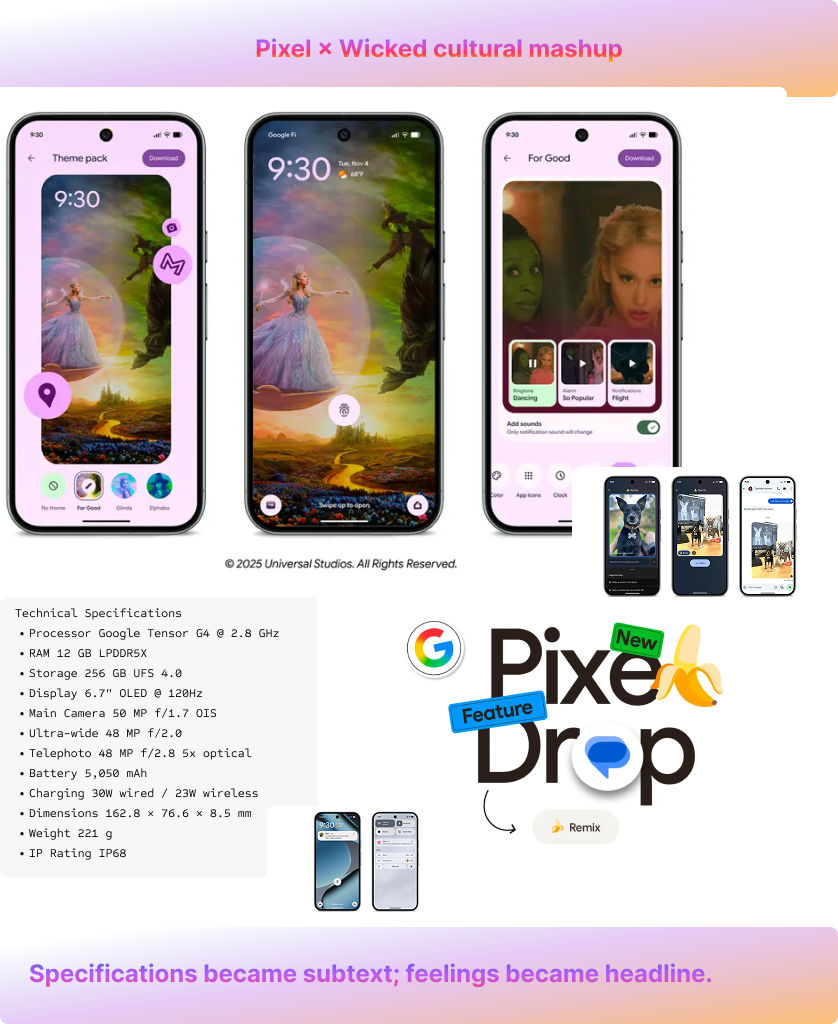
Editorial visual showcasing Google Pixel and Wicked mashup: themed phones with cultural, creative, and AI features, playful banana ‘Remix’ icon, technical specifications, and headline 'Specifications became subtext; feelings became headline

When Your Phone Gets Wicked: What Google’s $350 Million Cultural Bet Reveals About Marketing’s Identity Crisis

Google’s November 2025 Pixel Drop isn’t just another tech launch – it’s a $350 million culture play riding on Wicked, viral AI features and short‑form video. This piece breaks down what the campaign gets right, where it quietly contradicts itself, and what that means for marketers drowning in AI hype.

When Your Phone Gets Wicked: What Google’s $350 Million Cultural Bet Reveals About Marketing’s Identity Crisis Read More »

Why Figma’s India Launch Film Says Everything About What Tech Announcements Get Wrong in 2025

Figma opened its Bengaluru office with a 90-second video full of energy and chaos—dripping taps, meowing cats, demands for sliders and glow mode. It’s entertaining. Yet it’s also a lesson in how companies bury their story under product features when the moment demands more. Here’s what makes this puzzling: seven days before the launch, Figma released the perfect positioning video. Real Indian creators from Meesho, Swiggy, Fynd, and Times Internet explained why India matters, how design sets companies apart, and why India is a creative hub. Then they announced the actual office opening with a product demo. No named creators. No business context. No strategic positioning. This matters because Figma went public in July 2025 at a $22 billion valuation. Half their revenue comes from international markets. Getting the India narrative right isn’t optional—it’s critical for investor confidence. The November 5 video proves they know how to position. They just chose not to when it mattered most.

Why Figma’s India Launch Film Says Everything About What Tech Announcements Get Wrong in 2025 Read More »

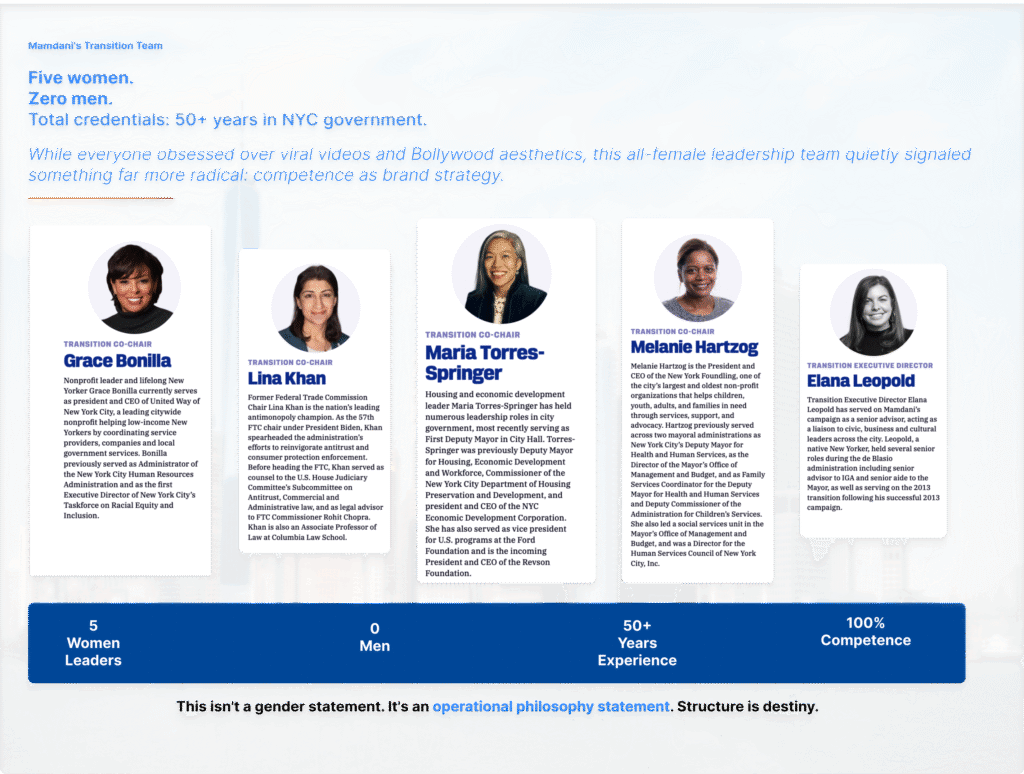
Zohran Mamdani's all-female transition team comprises five women with 50+ years combined NYC government experience and zero men: Grace Bonilla (nonprofit leader, United Way NYC), Lina Khan (former FTC chair and antimonopoly champion), Maria Torres-Springer (housing and economic development leader, First Deputy Mayor), Melanie Hartzog (president and CEO of New York Foundling), and Elana Leopold (transition executive director). Infographic includes text: "While everyone obsessed over viral videos and Bollywood aesthetics, this all-female leadership team quietly signalled something far more radical: competence as brand strategy" and concluding statement "This isn't a gender statement. It's an operational philosophy statement. Structure is destiny."

The All-Women Transition Team Nobody’s Talking About: Why Zohran Mamdani’s Real Victory Isn’t About Vibes

Zohran Mamdani won New York’s mayoral race with viral TikToks and Bollywood aesthetics. But what nobody noticed: his all-female transition team signalled something far more important—structural authenticity matters more than viral content.

The All-Women Transition Team Nobody’s Talking About: Why Zohran Mamdani’s Real Victory Isn’t About Vibes Read More »

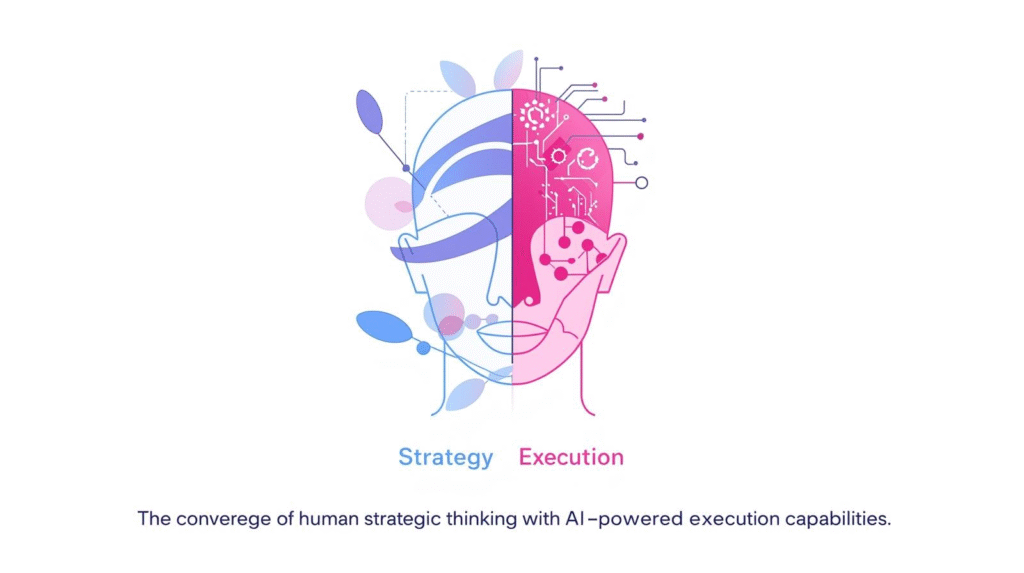
Minimalist line art of a human face split in half, with the left side in blue labelled "Strategy" and decorated with organic shapes, and the right side in pink labelled "Execution" with circuit and technology icons, visually representing the convergence of human creativity and AI-powered automation.

Pomelli and the Great Marketing Reckoning: Why I’m Rethinking Everything I Know About My Career

After sixteen years leading marketing teams, I watched AI tools like Pomelli reshape the landscape—speeding execution, shifting what matters, and revealing that real value now comes from strategy, not routine tasks. I use AI daily, not just for output, but as a creative catalyst and editor’s partner. But as automation encroaches, I’ve had to rethink my role, focusing on judgment, originality, and how to direct machines—not compete with them.

Pomelli and the Great Marketing Reckoning: Why I’m Rethinking Everything I Know About My Career Read More »

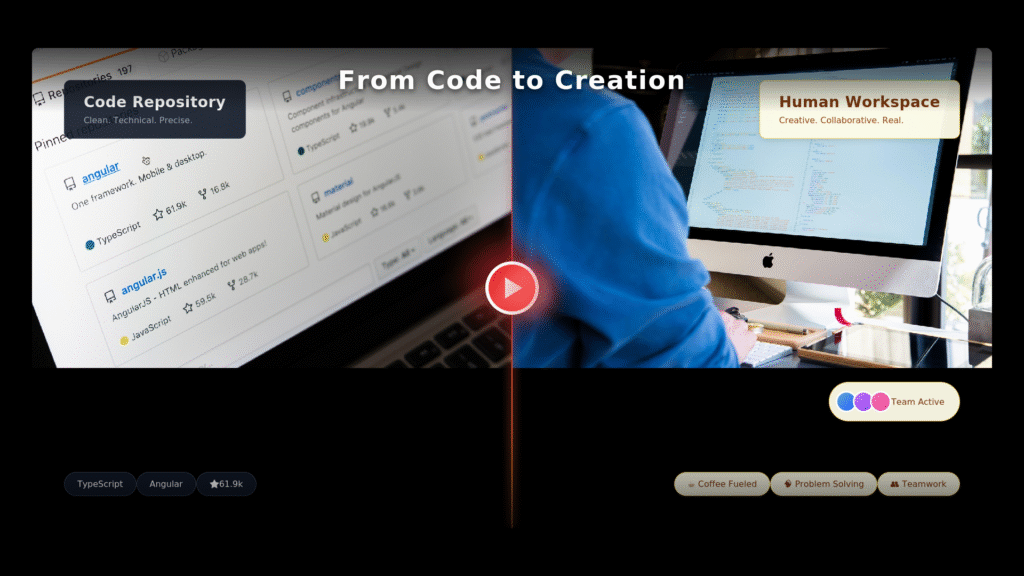
Split-screen image: left side shows GitHub code repository interface with languages like TypeScript and Angular; right side shows warm developer workspace at Mac computer with coffee and notebooks. A red play button divides the two halves, representing the bridge between technical and human elements of developer education

GitHub’s YouTube Problem: Why B2D Marketing Needs a Human Revolution

GitHub Copilot has over 15 million users—a fourfold increase in just one year. Yet their YouTube channel, with 530,000 subscribers and 2,400 videos, feels curiously detached from this revolution. This disconnect reveals a broader crisis in developer marketing: the profound tension between treating technical audiences as users versus humans.

GitHub’s YouTube Problem: Why B2D Marketing Needs a Human Revolution Read More »

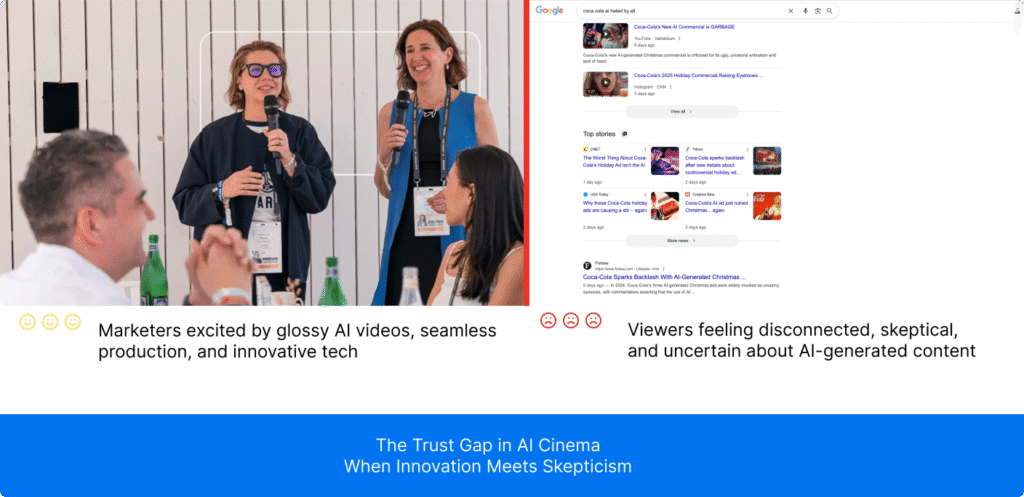
AI-generated Coca-Cola holiday campaign showing illuminated red delivery truck driving through snowy mountain landscape with lit Christmas trees. Caption states: 70,000 video clips, 30 days of production, 1,300+ brutal comments.

Why Coca-Cola’s 2025 Holiday AI Ads Reveal What’s Broken in Big-Brand Marketing

Coca-Cola spent a year perfecting AI technology, then used it to make animated animals stare blankly at illuminated trucks. With 1.3 billion people online asking “Did anyone actually watch this?”, the answer was apparently no. This case study reveals what happens when brands confuse efficiency with empathy, and why the fastest route to market isn’t always the one that makes people feel something.

Why Coca-Cola’s 2025 Holiday AI Ads Reveal What’s Broken in Big-Brand Marketing Read More »

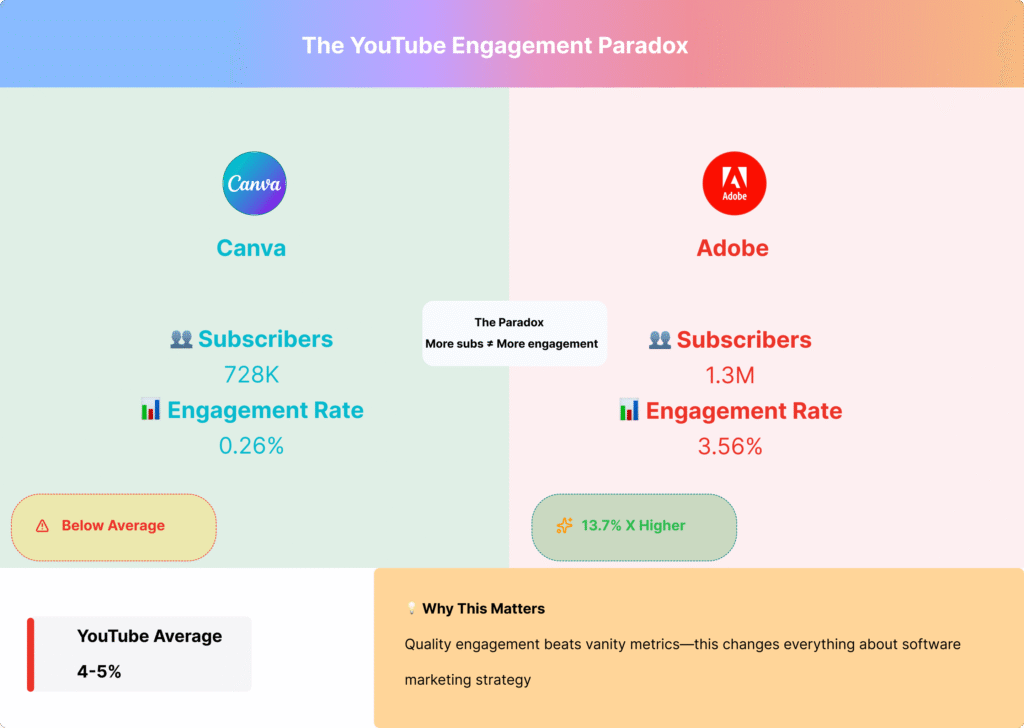
nfographic comparing Canva and Adobe YouTube channels. Canva: 728K subscribers, 0.26% engagement rate (below average). Adobe: 1.3M subscribers, 3.56% engagement rate (13.7x higher). Shows central paradox: more subscribers does not equal more engagement. Includes YouTube average benchmark and key message that quality engagement trumps vanity metrics.

Why Canva’s Engagement Crisis Reveals the Real Problem With Marketing to Creators

The numbers look impressive. Canva’s YouTube channel has 728,000 subscribers and uploads 8.5 videos every week. But then you see the engagement rate: 0.26%. That’s not just low—it’s a crisis hiding behind a success story. Meanwhile, Adobe is quietly embedding Premiere Pro into YouTube Shorts, showing that integration beats education. Here’s why this battle for the creator economy matters to every marketer.

Why Canva’s Engagement Crisis Reveals the Real Problem With Marketing to Creators Read More »

Scroll to Top