November 2025

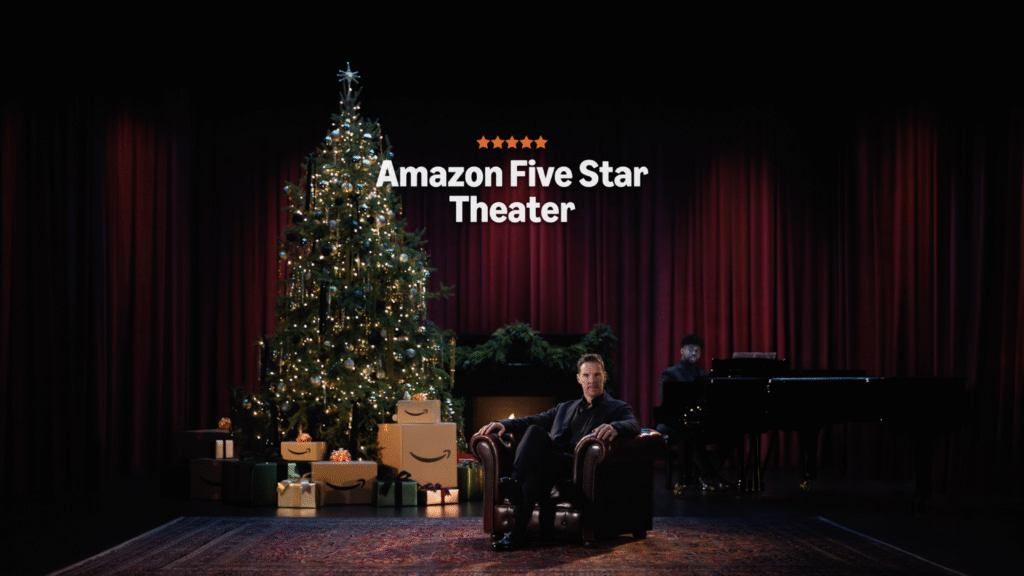
Benedict Cumberbatch sitting in a leather armchair on a theatrical stage with a Christmas tree and pianist, representing Amazon's Five Star Theater campaign. Title: Amazon Five Star Theater Campaign Visual

The Genius of Amazon’s “Five Star Theater”: Why Brands Are Finally Ditching the Glossy Act

Amazon’s “Five Star Theater” campaign represents a seismic shift in modern advertising. Rather than selling aspirations, the brand performs real customer reviews with theatrical intensity—transforming messy authenticity into marketing gold. This campaign works because audiences are exhausted by polished corporate messaging. They want to be seen, not sold to. The data backs this up: 90% of Gen Z prioritizes authenticity, 88% of consumers trust peer reviews over brand claims, and funny ads deliver 6x more brand lift than traditional spots. Amazon didn’t invent new content; it simply elevated what already existed—unfiltered testimonials from the reviews section—into strategic art. The result? A campaign that mocks influencer fakery, celebrates internet culture, and critiques advertising excess simultaneously. This signals the end of aspiration-based marketing and the beginning of recognition-based authenticity. The brands winning in 2025 aren’t trying harder. They’re trying differently.

The Genius of Amazon’s “Five Star Theater”: Why Brands Are Finally Ditching the Glossy Act Read More »

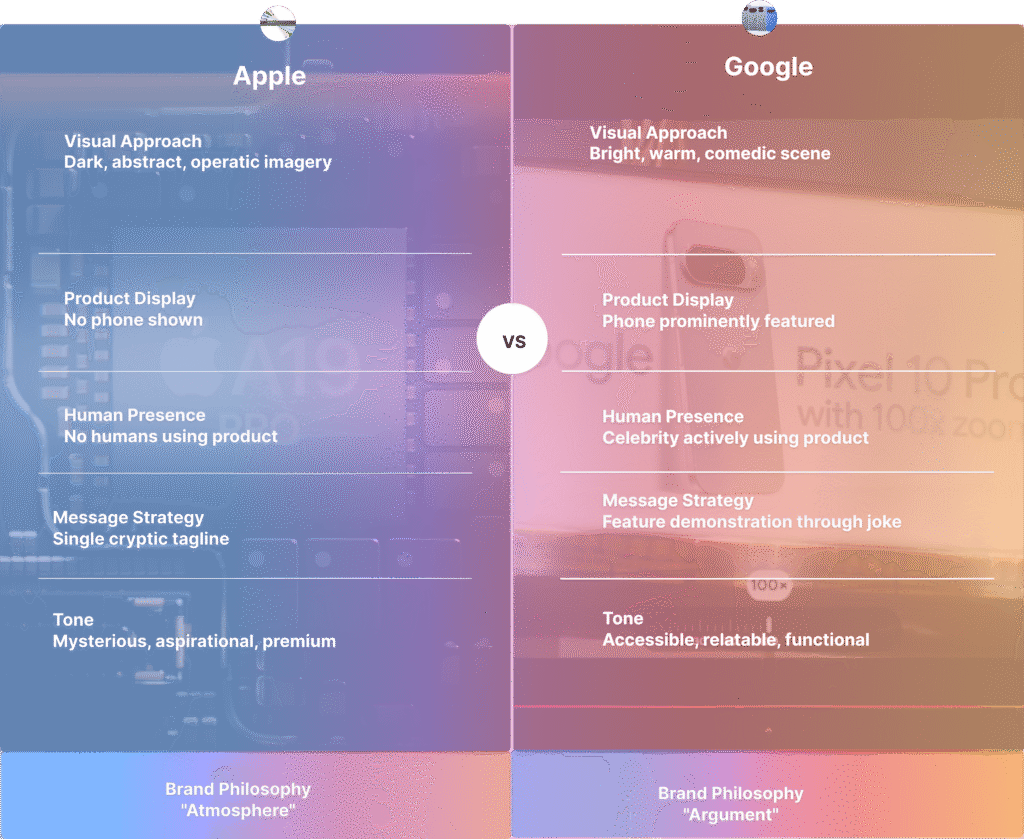
Split-screen comparison of Apple and Google advertising approaches: Apple side shows dark, abstract imagery with no phone and text reading 'Atmosphere'; Google side shows bright, comedic scene with phone featured and text reading 'Argument'

Apple Doesn’t Know You Exist. Google Wants You to Know It Knows.

Two smartphone ads dropped on the same day. Apple’s 65-second spot for the iPhone 17 Pro features men in dinner jackets performing surreal feats to an operatic crescendo, never once showing the phone in use. Google’s “It’s Pixel, Actually” reunites Thomas Brodie-Sangster and Martine McCutcheon from Love Actually to demonstrate the Pixel 10 Pro’s 100x zoom. These aren’t merely advertisements—they’re philosophical declarations answering a question every marketer confronts: Should you acknowledge your competitors, or pretend they don’t exist? The surprising truth? Both strategies are working. Apple advertises from overwhelming market power. Google advertises from rapid growth against a dominant incumbent. This article breaks down why opposite approaches both succeed, and what your brand should do about it.

Apple Doesn’t Know You Exist. Google Wants You to Know It Knows. Read More »

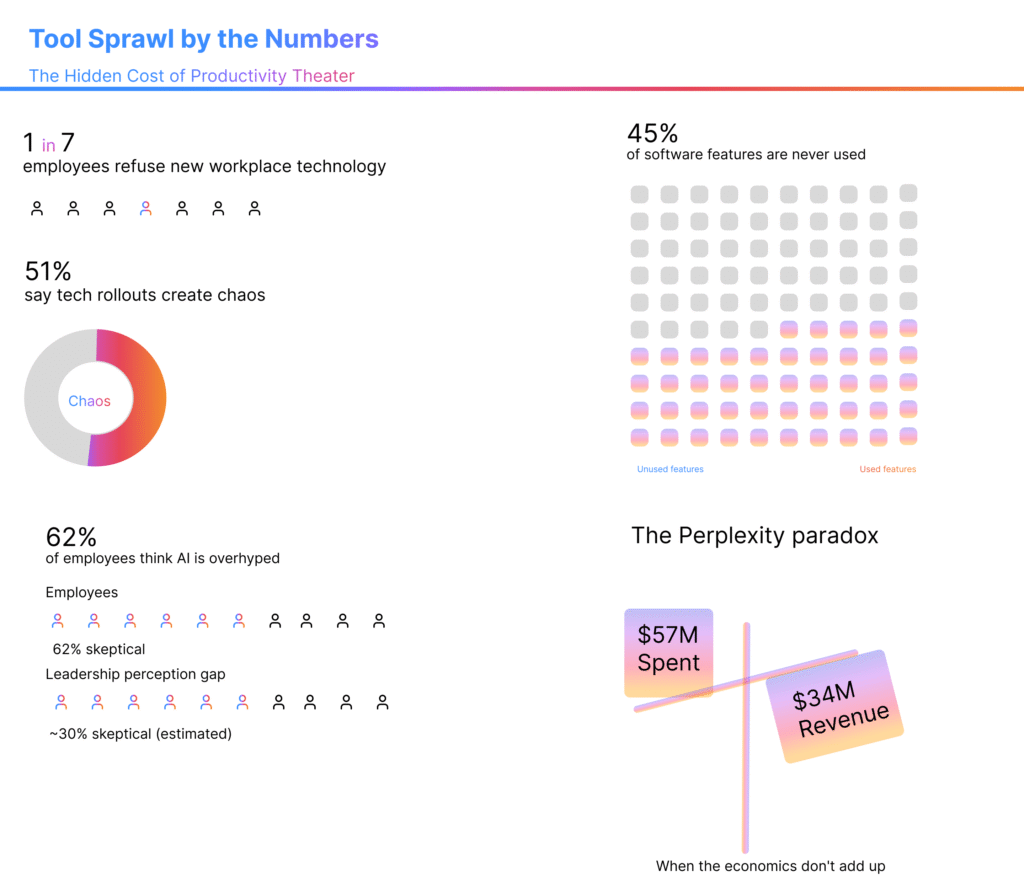
Infographic titled Tool Sprawl by the Numbers showing five key statistics: 1 in 7 employees refuse new workplace technology, 51% say tech rollouts create chaos, 45% of software features are never used, 62% of employees think AI is overhyped, and a tilted balance scale showing Perplexity spent 57 million dollars against 34 million in revenue

The Tool Sprawl Delusion: Why Your New Productivity App Is Making Everyone Less Productive

Perplexity AI’s new slides, sheets, and docs feature promises integrated productivity—but in a workplace already drowning in tool sprawl, is this innovation or just more noise? A critical analysis of feature bloat, the productivity paradox, and why more tools don’t equal more output.

The Tool Sprawl Delusion: Why Your New Productivity App Is Making Everyone Less Productive Read More »

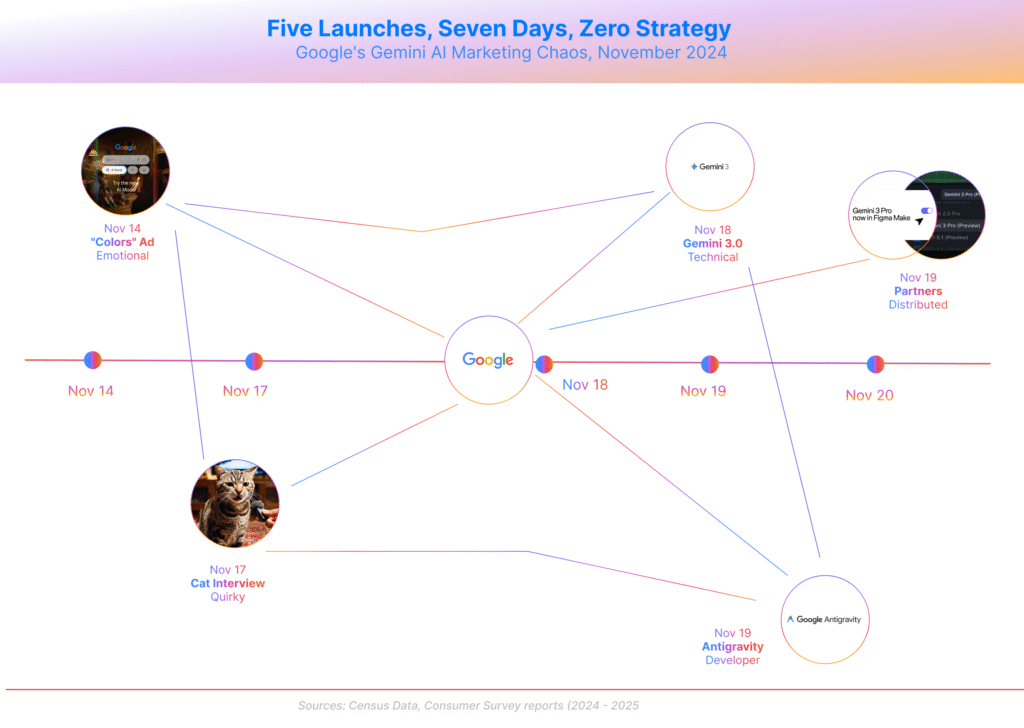
Timeline infographic showing Google's Gemini AI marketing chaos from November 14-20, 2025, with Google logo at center and five radiating connections to scattered launches: Nov 14 What Colors Feel Like emotional accessibility campaign, Nov 17 Honest Cat Interview quirky meme video, Nov 18 Gemini 3.0 technical enterprise announcement, Nov 19 Antigravity developer IDE platform, and Nov 19-20 distributed partner integrations from Figma and GitHub, demonstrating five different value propositions targeting five separate audiences in seven days with zero coherent positioning strategy

Google’s Launch Frenzy Reached Peak Absurdity: Five Products, One Week, Zero Strategy (And Why It Might Actually Work)

Between November 14-20, 2025, Google launched three contradictory AI Mode campaigns while partners like Figma independently announced Gemini integrations—creating five different value propositions targeting five separate audiences in seven days. First came an emotional tearjerker about accessibility. Then quirky cat memes. Then enterprise technical jargon. Meanwhile, Antigravity launched as a complete AI-native IDE, and partners announced integrations on their own schedules with their own messaging. This isn’t creative diversity—it’s distributed positioning chaos where Google doesn’t even control the narrative. Yet here’s the uncomfortable truth: when you own Chrome, Search, Android, and Workspace, this messy strategy might actually work. Distribution can beat positioning when you already own the defaults. But there’s a limit: encounter doesn’t equal trust for professional work. Google’s betting that defaults matter more than excellence. History suggests that works until it suddenly doesn’t.

Google’s Launch Frenzy Reached Peak Absurdity: Five Products, One Week, Zero Strategy (And Why It Might Actually Work) Read More »

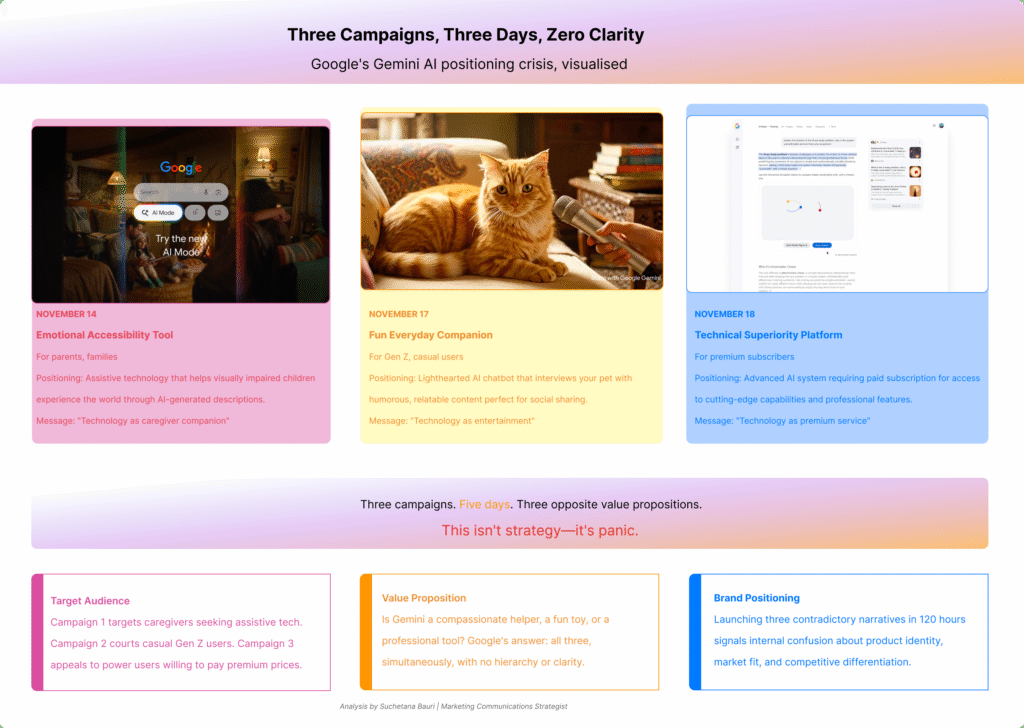
Infographic showing Google's three contradictory AI Mode campaigns launched Nov 14-18, 2025: What Colors Feel Like (emotional accessibility tool for parents), Honest Cat Interview (lighthearted chatbot for social sharing), and Gemini 3 Launch (advanced AI system for premium subscribers). Bottom text reads "Three campaigns. Five days. Three opposite value propositions. This isn't strategy—it's panic."

When Google Runs Two Opposite Campaigns at Once, It’s Not Creativity—It’s Panic

Google India launched three completely opposite AI Mode campaigns in five days. First came “What Colors Feel Like?”—an emotional tearjerker about explaining colours to a blind child. Three days later, “Honest Cat Interview” dropped—quirky meme humor about a snarky cat. Twenty-four hours after that, Google announced Gemini 3 with technical jargon targeting premium subscribers. Same product. Same market. Three fundamentally incompatible value propositions. This isn’t creative variety—it’s strategic paralysis at scale. When a company as sophisticated as Google can’t commit to a single positioning, it reveals what every marketer needs to understand: nobody knows how to position AI products yet. The lesson? Testing is good. Testing instead of deciding is catastrophic. Successful brands pick one job their product does brilliantly, one audience it serves best, and one tonality that fits both. Then they commit. Clarity beats resources. Every time.

When Google Runs Two Opposite Campaigns at Once, It’s Not Creativity—It’s Panic Read More »

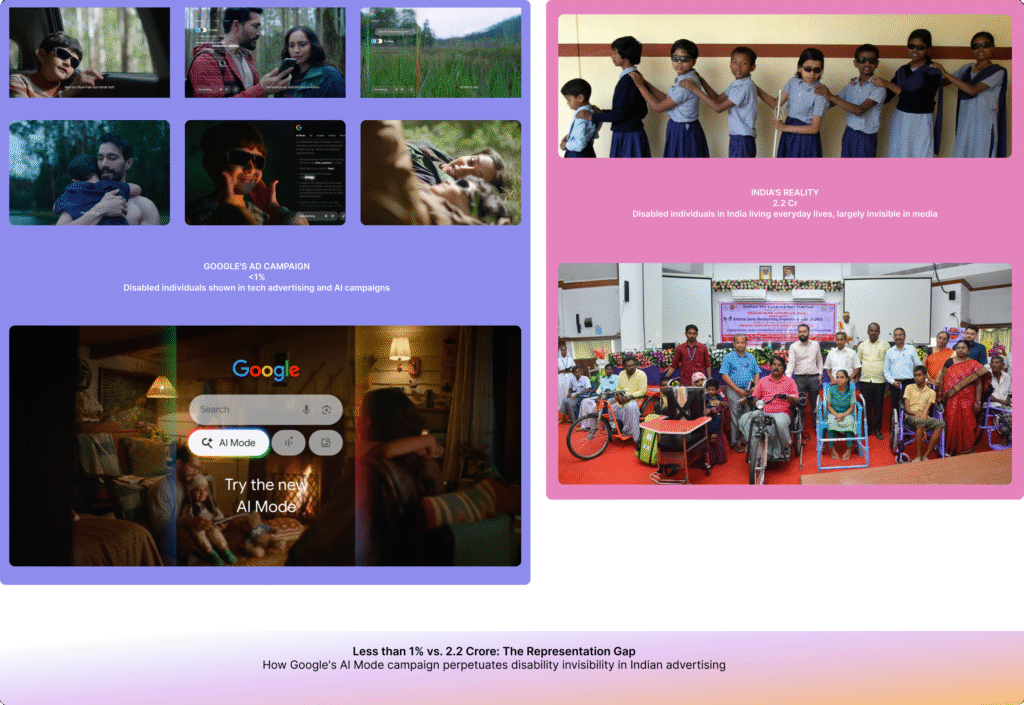
Split-panel comparison showing Google's AI Mode campaign on left (purple background with ad stills) versus everyday disabled Indians on right (pink background with school children, community event participants with mobility aids). Text reads: "Less than 1% vs. 2.2 Crore—The Representation Gap: How Google's AI Mode campaign perpetuates disability invisibility in Indian advertising

Marketers, Stop Hiding Behind Inspiration: Why Google’s “What Colors Feel Like?” Is a Wake-Up Call for Authentic Disability Inclusion in India

Google’s “What Colors Feel Like?” ad showcases stunning craft and emotional storytelling—but it’s also a masterclass in what’s broken about disability representation in Indian advertising. With less than 1% of Indian ads featuring disabled people despite 2.2-8 crore disabled Indians controlling ₹3-4 lakh crore in spending power, brands are bleeding market share through neglect, not malice. This isn’t about charity—it’s about business. As 86% of Indians now prioritise DEI in brand choices, the conversation has shifted from “should we include disabled voices?” to “can we afford not to?” Google’s AI Mode campaign, while technically brilliant, positions the blind child as inspiration rather than agent—falling into the “inspiration porn” trap that disability advocates have long critiqued. For Indian marketers, the wake-up call is clear: authentic inclusion requires disabled talent behind the camera, not just in front of it.

Marketers, Stop Hiding Behind Inspiration: Why Google’s “What Colors Feel Like?” Is a Wake-Up Call for Authentic Disability Inclusion in India Read More »

Scroll to Top